
Monthly Archives: August 2014

On Earthquakes and Apostles

Isola Tiberina.2The earthquake in Napa registered over 6 around 3:20 this morning. I woke and felt the house sway back and forth as though it were tossing in a stormy sea. I wondered if this was it, the time of reckoning, the end of it all. Would the walls collapse? Would the gas water heater explode? The epicenter – Napa – turned out to be a ways away from our town, but close enough that we felt the quake’s strength in our East Bay community. But the quake was a reminder of our human fragility and a reminder of time running out.

We checked for damage and found none apparent, so we trundled off to church to pray for those hurt, to pray for our raging world, to become one with one another and God in the Eucharist, and later to celebrate a parishioner’s birthday (ninety-nine!) with a festive lunch. As I knelt in the oak pew, I recalled today was the Feast of Saint Bartholomew, one of the twelve apostles, thought to be the same as Nathaniel, brought to Christ by the Apostle Phillip. I saw suddenly in my mind his beautiful church in Rome.
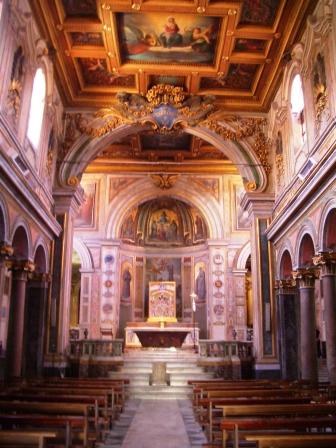
SAN BARTOLOMEO, ROMEIn the middle of the Tiber on an island the shape of a ship stands the ancient church of San Bartolomeo, Saint Bartholomew. I have long loved this church, for its setting amid the rushing waters and leafy banks as well as for its graceful vaults running up side aisles, its colorful apse. But when I enter and pause at the foot of the central aisle to gaze up towards the high altar, I invariably smile.

Altars in Christian churches have been sanctified by the bones of the martyrs since the earliest days when women cleaned the saints’ bodies and buried them outside the walls of Rome. It had long been the custom for pagan Rome to visit their dead and remember them on their anniversaries with outdoor suppers over their graves. The custom continued with the Christian martyrs, a custom that evolved naturally into something more than a memorial meal. For the holy bones seemed to work miracles. So when Christianity became legal, it was natural to build churches over these graves, to celebrate with holy suppers of thanksgiving, Eucharists, and when these sacred relics were threatened by eastern invasions they were brought inside the city walls for safety.

Thus throughout the Christian world altars are sanctified by the relics of the martyrs, relics placed beneath in what is sometimes called a confessio or witness to truth. Saint Bartholomew, Apostle, lies under the altar of San Bartolomeo in Rome on the Tiber Island, in a large boat-shaped reliquary that bears the altar table above it. There is something earthy about this dark sarcophagus in this bright and lofty church, so I often experience a frisson of joy, seeing this union of Heaven and earth, which of course, is the action of the Holy Eucharist in each Mass that will be celebrated on that altar.

Little is known of Saint Bartholomew whom Christ describes as “without guile,” meaning ingenuous, honest. Bartholomew had asked whether anything good could come from Nazareth. He soon had his answer; he recognizes Christ for who he is; he is present at the Ascension. It is said that he preached in India and Armenia, where he was martyred, flayed and crucified upside down. His relics found their way from Armenia to Rome and were placed under the altar of St. Adalberto, now to be called San Bartolomeo.

When we visit San Bartolomeo in Rome we usually come from the Aventine Hill, descending along the stone path from the gardens of Santa Sabina, following the river walk under the plane trees, the waters rushing below. Soon the island comes into view, and we cross an old stone bridge, the Ponte Fabricio, to the Isola Tiberina. In ancient Rome a temple of healing stood here; a hospital remains today. We enter the marbled and gilded Romanesque-Baroque church and, after pausing at the foot of the central aisle to view the the tomb holding the high altar, we visit the side chapels.

In 2000 Pope Jean Paul II dedicated these altars to the martyrs of the 20th and 21st centuries. Each chapel recalls regions and regimes where Christians died for their witness to truth, to Christ: Asia, Oceana, the Near East, Latin America, Africa, Communism, Nazism, Spain and Mexico. The Community of San Egidio, a lay fraternity of men and women who pray for peace and care for the poor in Rome, look after these memorials.

In many ways this church embodies the resurrected church of today, one reborn again and again in the blood of these modern martyrs, one intensely full of the Holy Spirit, of suffering. And as I worshiped in my own parish church in the Bay Area this morning, I thought of this Apostle without Guile, this Apostle of Truth, Saint Bartholomew, who was not afraid to witness to God becoming Man and living among us, dying for us, rising for us, with us. Such a witness, seen in the Basilica of San Bartolomeo on an island awash by the tumbling waters of Rome, is encouraging. We too are awash in such dangerous tides that threaten to flood our parish naves. We too sail in an ark of faith and we too pray for the courage to witness.

pilgrimage_book_coverI set a scene on this island in my first novel, Pilgrimage, and a more dramatic scene on the Ponte Fabricio in my recently released novel, The Magdalene Mystery. Both novels are about truth and healing, about navigating dangerous waters in arks of faThe Magdalene Mysteryith, about allowing the past to inform our present through the lives of saints and martyrs.

Thank you, San Bartolomeo, for being without guile.

http://www.sanbartolomeo.org; http://www.sanegidio.org 

Chateau de la Puisaye, France

Chateau de la Puisaye.compLast week, on the occasion of my niece’s wedding nearby, we stayed at Chateau de la Puisaye, a Napoleon III house set in a large park a mile outside of Verneuil-sur-Avre on the southern Normandy border. Diana and Bruno Costes (she British, he French) have turned the chateau into a country “bed-and-breakfast,” offering five traditionally furnished bedrooms in the main house, a guest cottage, and a studio over the old stables. Our son and his family (children aged nine and eleven) joined us.

One of our rooms on the second floor (Europeans say the first floor), looked out the back onto green grass, a box hedge, and a large kitchen garden, hence called the Chambre du Potager. Decorated in antiques, the light and airy room had a closed fireplace and three tall windows, high ceilings, and a large bath. White wainscoted panels were papered in pink and green floral with complimentary borders and matching draperies. The room is charming, recalling Jane Austen, with polished hardwood floors and oriental carpets. Two more bedrooms faced the front drive and park with tall windows as well, nicely appointed, and two more on the third floor.

Always intrigued by history and the mystery of time, I wondered who had lived here over the centuries. Diana said an elderly lady was the last owner. She mentioned that a tunnel, perhaps no longer evident, once hid Resistance fighters in World War II. Our articulate hostess was certain the house held many secrets and hidden passages, nooks and crannies yet to be discovered. The house had seen so much, both joy and sorrow, I thought, love and hate, birth and death. Foreign armies encamped, reigning terror upon the countryside.

For we were, after all, in Normandy, unhappy witness to centuries of war. Northwest, the landing beaches of World War II stretch alongside the English Channel,  where so many young soldiers were gunned down by the enemy on overlooking cliffs. Today they rest beneath rows of white crosses in a field of green, and I often thought of these young men and the world they protected with their lives, our world. How deceiving peacetime could be, especially in our lovely chateau surrounded by leafy park and night silence and sun and shadow, in rooms of genteel comfort and civilized conversation. How deceiving it all was, not wanting to believe we lived in a rare moment of peace that bridged the times of war. How long would it be before fighting revisited this lovely pastureland of chateaus and sheep and medieval stone?

Of course this area of southern Normandy has seen other wars over the centuries, for Normandy was British for many years, a coveted prize with its ports and pastures. Fortified villages surrounded by deep moats saw much bloodshed in the Hundred Years War that pitted English against French and raged intermittently from 1337 to 1453. Verneuil-sur-Avre was formed from three such villages, with streets that trace the old walls, each community clustering around its church and market.

Much to the delight of my grandchildren, chateau sheep grazed in a distant field, and the children were invited to help herd them to another pasture. Two elderly ponies, a horse, and a donkey grazed in another paddock. Three dogs meandered in and out of the chateau, nuzzling the children and other friendly hands, and two cats could be spotted if one watched carefully. There was a heated swimming pool, put in this last year, anchored at one end by a picturesque stone gatehouse.

The gravel drive curved up to the white façade of the chateau as if curtsying, and mature plane trees shaded broad lawns and white wrought-iron chairs and tables and wooden lounges. We had unseasonable rain and cool temps this last week, but in better weather guests could sip cocktails on the lawn before dinner. I for one enjoyed the drawing rooms.

The entry led to stairs spiraling up to the bedrooms. Guests met in the paneled drawing room to the right of the entry for an aperitif before dinner.  (My grandson played a little Beethoven on the grand piano.) Velvet upholstered chairs and a settee grouped around a working fireplace probably ablaze in winter. The adjoining library housed walls of books with another working fireplace.

In the dining room to the left of the entry, Diana served hot breakfasts with fresh breads and jams, and even dinner (with notice), featuring local foods and French country wines. She was most gracious in preparing several dinners for us over the week we stayed, all delicious.

I particularly appreciated (naturally) the many books that greeted us, and I left my own novels to add to the chateau’s collection. There were hundreds of books in English and French and other languages, out-of-print books, bestsellers, classics, history, crime, romance, art, cooking, landscape. Books were stacked on tables and mantels and overflowed from shelves. They lined the rooms with history, their own history and those stories living inside the leaves, reflecting centuries of writers and readers, but also reflecting a more sophisticated syntax and thought pattern.

I came across a young-adult story with black-and-white illustrations on shiny pages. The printing style reminded me of books I once borrowed and devoured from our local Orinda library when I was young. The title page stated the book was a war printing, using circumscribed ink and paper, for it was dated 1944, London. It appeared to be about a girl’s school with a simple and direct and sweet style. I thought how different today’s young adult novels are, with their dark and often violent themes, their sexually charged language, their despairing and anguished tones. What have we sowed in the hearts and minds of our children and what kind of a culture will we – and they – reap one day? Perhaps we already are reaping what we have sowed.

Tucked among old books on the landing upstairs I found an Anglican Book of Common Prayer with no publication date, but with a Christmas 1915 inscription from the owner’s grandfather. By Christmas 1915, Britain was in the First World War. London bombing commenced in May of that year. The leather-bound prayer book, its tissue pages well thumbed, was no more than two by three inches, and it contained not only Anglican prayers and liturgies, but hymns as well. It looked to be the old 1662 Prayer Book, similar to our 1928 BCP in America, with rites going back to the seventh century monastic offices and the medieval liturgies of Old Sarum.

Diana’s warmth charmed us, encouraging conversation. She treated us like family. As my nine-year-old granddaughter nodded off to sleep under white embroidered linen, she said with a happy smile and a sweet sigh, “Diana is so nice, I just want to move in and help her in the kitchen.” “I know,” I said, “me too,” and I gently turned out the light and kissed her on the forehead.

The skies are broad in this rolling countryside, and while the rain limited our explorations, the changing skies created dramatic canvases of blues and whites and grays. We walked out to the paddocks and followed the gravel paths and drove the lanes through fields of corn waiting for harvest.

Staying at Chateau de la Puisaye was far more than memorable and far more than restful. It was stepping into history and for a short time living there as though we shared the space with hundreds of ancestors. The two hundred years these rooms witnessed seem to have been more ordered times, in spite of candlelight and bedpans and cold rooms heated by fires in hearths. It was a time when social graces tamed our bestial natures and manners orchestrated our gatherings. Conversation linked minds and hearts, and shared meals wove generations together. Civility, that old art of living with one another, was valued over self-esteem, thoughtfulness over thoughtlessness, patience over impulse. Being dependent upon one another for day-to-day needs required selfless sacrifice. It required love.

One cannot turn back the clock, but it is good to be reminded of what we have lost, so that we might plant similar seeds before the the lost is forgotten completely. We flock to these quiet old houses seeking something we cannot name; we mourn a time of gentle, gentile, gentlemen and gentlewomen. Today transfixed by gadgets and toys and bright screens with buttons, we have nearly forgotten how to think, how to reflect (or even dream), how to link generations with words around a table.

Chateau de la Puisaye reminded me how to live gently. The old house said, do not forget. Thank you, Diana and Bruno Costes, for pulling this past into our present and with such grace.

http://www.chateaudelapuisaye.com/

A French Country Wedding

domaine_evis_idx2

We witnessed my niece’s wedding this weekend in the French countryside. 

The wedding was held outdoors at Domain des Evis, a fifteenth-century fortified farmhouse set in the rural landscape of the Perche region, not far from Verneuil-sur-Avre on the Normandy border. The few days before, unseasonable torrential rains poured upon the land, nearly flooding the narrow roads, but a Saturday sun worked its way mightily through dark billowing clouds.

We took our places on benches under the suddenly bright sun and watched the bridesmaids step up the aisle, followed by the bride, arm in arm between her father and her brother. It was a curious blend of old and new, and the secular ceremony, while never mentioning God, spoke of love and commitment and how-we-met. Poems were read and vows exchanged, hearts were touched, and eyes were moist with tears. The wedding reflected the beliefs of the bride and groom, as it surely should, for they are poised on the edge of a dying culture in a France tragically beautiful in its diminished faith.

Later, during the dinner, since they had asked me to speak as my niece’s godmother, I mentioned God who, while not invited to the wedding, was ever-present, loving them anyway:

As godmother I made my own vows for my niece at her baptism, and as her godmother I said a few extra prayers each evening, asking God to bless her. The prayers clearly worked, for she has found her prince charming who is now added to my list of intercessions each evening. And now two families have been united…

Weddings are rites of passage. The philosopher Roger Scruton notes that “rites of passage are the vows that bind generation to generation across the chasm of our appetites.” In this rite of passage we call marriage, family and friends of many generations witness the vows of love between a man and a woman. The vows are made in a public ceremony, before a community that gives assent and approval by their presence. When the bride walks up the aisle, alongside a member or members of her family, the journey through the gathered witnesses reflects her journey from one family into another, as well as the creation of a new family. This is the “giving away” of the bride and as archaic as it may sound in today’s world, it represents a giving over to the groom certain responsibilities, that of loving, protecting, and sheltering the future mother of his children.

The wedding ceremony in our Anglican Book of Common Prayer states that matrimony is a holy estate. Indeed, it is considered one of the seven sacraments, for it is sacred. Matrimony produces life, and all of life is holy, sacred. With marriage comes the blessing of children, and those children will step through their own rites of passage…

I thank my niece and her new husband for sharing this sacred day with us. Love and cherish one another, comfort one another, honor one another. Have and hold one another, for better or worse, richer or poorer, in sickness and health. Be true to one another…

It is curious, I now reflect, that as the Judeo-Christian roots of Western Civilization shrivel, folks cling to these shadowy memories of faith. They hold on to the symbols and ceremonies that speak truth even though they don’t believe in the author of those truths, he who designed our marvel-ous natures, he who created us to love. For without belief in the source of love, the symbols and ceremonies will wither and disappear. How many generations will it take for nihilism to eclipse Christianity? And how many generations will it take for the religions of death to fill the void left behind?

We are entering a new Dark Age, for we take for granted the inheritance bequeathed by Judaism and Christianity, the values that birthed our culture of freedom. It is this heritage of liberty protected by law, rights birthed by responsibility, marriage and family ordained by sacraments, governance authorized by democracy, that has defined the Western world and has given hope to peoples living in poverty and tyranny. It is this Judeo-Christian culture of the West, planted and watered for millennia, that is envied the world over by refugees, regardless of their own beliefs. Immigrants flood our borders for they understand what and who we are. We all know the Western world is not perfect, for it is shaped by humans, but it is our best and brightest hope for the future and for peace.

So on Saturday we heard good words in this elegant and sweetly beautiful marriage ceremony beneath stone towers and alongside dry moats of medieval stone. We saw love blossom, taking root in the garden of marriage whether the lovers believed in the sacrament or not. Their love was watered by the words and the vows and the faux-rituals. One day they will hopefully bear children so that another generation will water the roots of our culture, if they can remember this day and others like it. Perhaps, in the future, they shall recognize the God who loves them so, reflected in the leaves.

I’m glad I was able to attend the wedding of my sister’s daughter, who I held in my arms the first week of her life. I’m glad I was present to see our two families intertwined, one French and one American. My prayer list is longer, and I rejoice in this binding of generations.

With a Song

035“Once we came before God’s presence with a song; now we come before his absence with a sigh.” So writes Anglican philosopher Roger Scruton in his beautifully written memoir, Gentle Regrets. The first reference is, of course, to Psalm 100, O be joyful in the Lord, all ye lands: serve the Lord with gladness, and come before his presence with a song… Dr. Scruton’s second reference, that to sighing, is to the sadness that seems to permeate our culture of unbelief, the most prosperous and “advanced” culture in recorded history.

Psalm 100, also called the Jubilate Deo, is part of our Office of Morning Prayer, in the Book of Common Prayer prayed by Anglicans worldwide for centuries. I wondered, what happens to a person’s attitude toward life if he or she repeats this prayer psalm every morning upon rising? Is there a change in the way he sees the world, or even a gradual restructuring of the soul?

I’ve been thinking about this the last few days, having dipped deeply into Dr. Scruton’s words of wisdom. He rightly values the Prayer Book with its Elizabethan English, so suitable to worship God. We sing the words of these prayers, sometimes in melodies, sometimes in chants, sometimes in our hearts and minds, following the rhythm of the phrases like a dance.

I first crossed the threshold of an Anglican Church (then Episcopalian) in 1966, at the age of 19: St. Matthew’s, Burlingame, California. Raised Presbyterian, turned collegiate agnostic, I was unfamiliar with the ritual, the set prayers, the kneeling, the making of the Sign of the Cross, the processions, the candles, the incense. Yet I felt as though I had entered Heaven. I was sure I had; I was totally smitten. I sat in the back pew and drank in the liturgy like a traveler in the desert. I was thirsty and didn’t know how parched I really was until then, didn’t fully understand what I deeply longed for, but here it was, all around me, the sights, the sounds, the smells of Heaven.  It was as though I was being held in the palm of a loving God, one who had created me in great joy and was so glad I had come home.

I wasn’t instructed and Confirmed until the following year, but in the meantime I entered, knelt, imitated the others. Since many of the prayers were the same each week, and there were Prayer Books in all the pews, I learned the words quickly and was soon part of the miracle happening around me. I learned how to dance with the Church, a universal dance stretching back two thousand years and celebrated all over the world. Since then, I have come to understand the meaning behind the rituals and the prayers, the Scriptures that ordained the words, the actions, the steps in this dance of worship. I came to understand what happened in what was called the great Sacrifice of the Mass, when the wine became blood and the bread became body in the Real Presence of Christ. I understood how the Liturgy of the Word led to this pivotal moment of bell-ringing and happy holiness – the Collects, the Scriptures, the Creed, the Confession and Absolution, the Sermon. And since then, I have traveled deeper and deeper into the mystery of worship and into the heart of God.

So it was with great joy that I discovered this Anglican philosopher who is also in love with the Book of Common Prayer, who “gets it,” as is said today. And he is right when he profoundly observes that our culture, having trouble finding God, has become sad, “morose.” Many no longer sing to the Lord a joyful song with gladness for they have lost him in a kind of slippery sophistry. Instead, they look to one another, and to themselves, to create gods from their own kind, longing for but not finding true worship. The resulting attitude is one of un-thankfulness, of grievance and complaint, of never having enough, of striving, of racing, of consuming, all in hopes of finding. The old adage, “Count your blessings,” is just that, an old adage and rarely practiced. Today curses are counted rather than blessings.

And so it was that this morning when I entered our parish church I was especially thankful for the words of our Prayer Book, the poetry of the prayers and psalms and liturgy, and most of all for the belief that backs and binds it. I addressed some “proofs” for the historicity of the Resurrection in my recent novel, The Magdalene Mystery, arguments of the mind if not the heart. And in the end, if one can argue the Resurrection, the rest falls into place, at least for me. But here, this morning, in my parish church and recently in the words of my new philosopher mentor, I find argument for the heart and soul. Human beings long to sing to God because we know deep down he exists, that he loves us, and that he has provided a path on earth to Heaven, to one day, see him face to face, no longer through a glass darkly. We long to experience what we suspect is waiting for us, true joy.

And as we sang with the children in Sunday School “All Things Bright and Beautiful,” prayed an “Our Father” together, and led them up the central aisle to kneel at the altar rail for their blessing during the Mass, I knew we had taught them well this day. They had experienced the bright and the beautiful, to be sure, when they entered that hushed space, as they padded up the red carpet toward the tabernacle set amid the flaming candles, as the robed clerics drifted by. “God the Father, God the Son, and God the Holy Spirit be upon you, Natalie, this day and always” the priest said, touching her head lightly with blessing. We each made the Sign of the Cross, and with folded hands we processed out, back to the Sunday School, where we made more animals from paper plates.

It is good for us to pray, to develop an attitude of thankfulness for what we have been given, beginning with life itself, another day on this earth. I recommend an “Our Father” followed by the “Jubilate Deo” each morning, even if it’s in the rush of the early hours, driving to work, waiting for the bus, readying the children for school. Say it regularly and your life will be filled with joy, the jubilate of God, and far less sighing. I know mine has.