
Monthly Archives: December 2015

A Light in Time

Advent St. JIt is a season of renewal, a time when we review the old year and make resolutions for the new one. We judge our time, our spending of time, our use or abuse of the year 2015. Each year is a gift. It is a unique segment of our lives, a year we cannot retrieve and a year that will never be repeated. We are given only one chance with our lives, only one chance with the time given.

And so we look back and consider what habits to discard and what to keep, what to repent and what to repeat, what to affirm and what to deny. Sometimes confusion reigns even in hindsight, and the better path not obvious even from this vista point, perched as we are on the cliff at the end of the year, getting ready to jump into 2016, a new segment of time granted to us, this new year. 

“She had the time of her life.” We say this to emphasize a moment of great exuberance and joy, a peak time amidst the other valleys. But all time is of our lives. All time is holy.

As I look back on my year, I do indeed see confusion and chaos. A good friend and mentor left our earthly time and entered eternity, leaving us behind. Another friend is getting ready to leave, in hospice care. Her bags are nearly packed and she is peacefully waiting the chariot.

In the past year there have been many risings to occasions and putting best feet forward and keeping stiff upper lips. There have been duties and responsibilities not always heartfelt, actions ordered by God’s law of love. There have been dark times in shadowy valleys where answers could not be seen, where the fork in the road had no signpost, or the sign had been lost, thrown into the bushes.

And yet looking back at 2015 I also see clarity and order. My good friend and mentor in Heaven left me many gifts that live on bridging our separation, gifts of wisdom and love, ways to see and believe, the necessity of humility and its fruit, repentance. My friend waiting for her journey to Heaven continues to gift me in her last days, but I can see clearly now that her friendship itself was given to me to make sense of my own time.

The risings to occasions, the duties and responsibilities not eagerly engaged, rewove my own heart to be of stronger stuff, not so easily thwarted by dismay and danger, informing my soul again with God’s law of love. The dark times through the journey of 2015 led me to the altar of my local church, pushing me to my knees in penitence and prayer, and when I re-entered the world I found myself on the top of a mountain of light with a clear view of the surrounding countryside.

We do indeed live behind the veil of eternity. Some of us glimpse the brilliant color and catch the fragrance and sensory delight on the other side. Some of us hear the music, the choirs of angels and the songs of the saints. Some of us don’t know how to lift the curtain or even believe that it can be lifted or that it is there at all, thinking this world is all there is.

And so as I stepped through the dark days of Advent, those short wintry days, I watched and I prayed and I worshiped God in his Church, calling for Christ’s coming, singing with his people. Slowly, a light shined in the darkness, revealing my place in the world, my place in my moment of time. I observed the rituals and rites of Christmas with their sacramental signs, knowing they would lead me to the light to see again.

I garlanded the evergreen in our bowed window and strung twinkling lights through the branches. Ornaments from the years of my life were resurrected from tissue nests in boxes, where they had lived since last Christmas. The figurines and balls and tassels hanging from bits of wire released memories from the prison of my mind, giving them air, and a stained-glass gathering of family and children and loved ones crowded happily with one another in my heart.

In the days before Christmas – after the parish pageant on Advent IV – I set up our large crèche figures on the hearth and dangled a golden star from the mantel. Fresh white candles found holders in all the rooms so that I would not forget the great light coming soon to the world to banish the dark, the darkness of winter, the darkness of my soul.

So the confusion of life, after all, I learned once again, can be cleared. There is a way to lighten the darkness, as described by St. John whose feast we celebrate today:

“In the beginning was the Word, and the Word was with God, and the Word was God… All things were made by him; and without him was not any thing made that was made. In him was life; and the life was the light of men. And the light shineth in darkness; and the darkness comprehended it not… That was the true Light, which lighteth every man that cometh into the world. He was in the world, and the world was made by him, and the world knew him not. He came unto his own, and his own received him not. But as many as received him, to them gave he power to become the sons of God, even to them that believe on his name: which were born, not of blood, nor of the will of the flesh, nor of the will of man, but of God. And the Word was made flesh, and dwelt among us, (and we beheld his glory, the glory as of the only begotten of the Father,) full of grace and truth.”

John 1+, Gospel reading for Christmas Day

And in one of John’s letters to an early church:

“This then is the message which we have heard of him, and declare unto you, that God is light, and in him is no darkness at all. If we say that we have fellowship with him, and walk in darkness, we lie, and do not the truth: but if we walk in the light, as he is in the light, we have fellowship one with another, and the blood of Jesus Christ his Son cleanseth us from all sin. If we say that we have no sin, we deceive ourselves, and the truth is not in us. If we confess our sins, he is faithful and just to forgive us our sins, and to cleanse us from all unrighteousness. If we say that we have not sinned, we make him a liar, and his word is not in us.”             I John 1+

And so, as my good friend in Heaven taught me, one must walk in the light – that is, penitently – in order to see in the darkness. He also gave me the gift of the Church, the Body of Christ, that leads me to the light. For only by entering the doors of Christ’s Body can we experience clarity amidst confusion. Only by walking up the aisle to kneel at the altar can we know the love of God and his forgiveness. Only by observing our time, each day, hour, minute, within the seasons of the life of the Church, can we find our way forward into the New Year that awaits each of us.

I look back upon 2015 and see a map of love through time. I want to follow that path that journeys with Love incarnate. I look forward to 2016, every minute, every hour, every step of the way, lit by the light and love of Christmas, Emmanuel, God with us.
A Living Creche

The Nativity of Our LordIt was cold and windy when we arrived at church this morning for our Living Crèche Christmas Pageant. The Bay Area has had a little rain this weekend, and for this gift from the heavens we are grateful. Still, it was cold, bitingly cold, at least for us softies in California. 
I had placed extra gold garlands in a Sees shopping bag along with an angel costume made from a white sheet I found last night in a linen closet. My notes from last year’s Christmas Pageant warned me we had run out of costumes, so I made my own this year, freeing up the choir cottas for the littler angels. This morning, in the dark before dawn, I grabbed some pins for Mary’s headscarf and a pair of scissors and whatever safety pins that caught my eye in a drawer. 

I was all set.

Each year I look forward to wearing my wings, and I suppose this might be evidence of early senility at the age of sixty-eight, but I like to think I am flourishing a child-like spirit, an attitude, as I recall, our Lord Jesus commanded us to cultivate. So I am. 

My husband and I crossed the parking lot with our bags and found refuge in the warm church, where I soon greeted our young Mary, a sweet precocious nine-year-old. We found the Sunday School rooms and laid out the costumes and went to work costuming children and adults as they came in from the cold. 

Our “Living Crèche Christmas Pageant” is a multi-generational effort (lucky for me). Children watch and learn from working with adults, hopefully, as we support one another. The children know that they too are part of this Great Story of Christmas in the creation of a living crèche. We all sense this is far more than play-acting. In some solemn, holy, joyful way, we are creating, through lessons, carols, and tableau, not a performance but a prayer, a parish family prayer. This is no small thing. 

The Great Story of Christmas – the Incarnation, God becoming man, taking on human flesh to redeem us – is a cosmic prayer. But even more than a prayer, it is a prayer-dialog. It is part of a conversation begun with Adam and Eve, one that is never-ending. And that moment in Bethlehem when Christ was born, when God the Son became one of us, was an intimate crucial moment for us all, a turning point in human history. In that moment Almighty God kissed us. He held us in his embrace. 

The Great Story of Christmas is God’s love song to humanity. And since his coming among us over two thousand years ago, Christians have responded, have sent heavenward their own love songs to God, through art, music, pageantry, and liturgy. The conversation is never-ending, for these responsorial prayers will be sung in turn between Heaven and Earth until the end of time. 

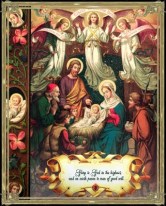
One of the beauties of the Living Crèche is that the tableau – this still-life living scene – is created in layers as the congregation sings and the lessons are read (usually Luke 2 and part of Matthew). In our parish we begin with Adam and Eve and their Fall from grace. They remain “on stage” (in this case the chancel, above the steps) as the rest of the story is added: the Annunciation (the Virgin Mary and the Angel Gabriel), the Incarnation (the Virgin Mary, St. Joseph, Baby Jesus). Soon shepherds of Earth and angels of Heaven step solemnly up the aisle to honor this newborn king. When all have taken their places, after Scripture and carols, the tableau is complete and we have told with our lives the Great Story of Christmas. 

I thought of this as I put on my wings this morning in the Sunday School room. Another angel helped me and straightened my garland halo. Our heavenly host was ready to fly to the manger, set before the high altar in the sanctuary. We gathered in the narthex to await our moment of entry through the double doors, our stepping up the red-carpeted aisle to help create our living crèche. 

Our ages spanned eighteen months to sixty-eight. Some of the young adults in our cast had been part of the Living Crèche when they were toddlers, and now they brought their own children to create memories, to hearten hearts, so that they could share this experience with their children, to enliven lives with the love of God come among us, Emmanuel. 

We processed up the aisle and told the story with our living bodies. We became the sculpted art of God’s great love. We recessed out, having taken part in God’s love song by singing our own song in response to him. We knew as we left the warm church and re-entered the cold world we carried his love inside us. We could hear the melody, feel the beat of God’s heart within our own. 

And this is the gift of Christmas, Emmanuel, God with us, God in us.

A Still Small Voice

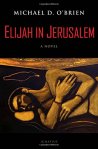
Elijah in JerusalemI’ve been rereading for review Michael O’Brien’s Elijah in Jerusalem released in August by Ignatius Press. The story has seamlessly woven into my Advent readings from Isaiah and Revelation which focus on similar themes about the End-Times. The tribulations are great, the plagues horrific, death rides the world. In the midst of these apocalyptic themes, we see the Prophet Elijah, returning as one of two last witnesses to warn the Anti-Christ. He is humble. He can hear the still small voice of God.
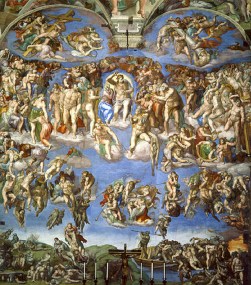
Today we recall the End-Times and Christ’s Second Coming as we prepare for the celebration of his First Coming at Christmas. In both preparations, we must face judgment. We must clean out our hearts to be worthy to receive him at Christmas and to kneel before him at the Judgment. In both senses, these Advent scrubbings are made easier when we consider Christ is not only judge but loving redeemer, the Way, Truth, and Light. We are moved by love not fear, by the desire to be more like him, more in him, more a part of him.

It is this dependency, this trust, this smallness that is at the heart of confession and absolution. It is in the not-knowing that we find rest, not in the knowing. 

I often wondered about the Tree of the Knowledge of Good and Evil. Why were Adam and Eve punished for desiring knowledge of Good and Evil? To be sure, they were disobedient which is reason enough to be sent out of Eden. But why that particular tree? Don’t we want that kind of discernment? 

Our Father Elijah in O’Brien’s novel wrestles with an aspect of this problem. He wants clear instructions. He wants to know. His heart is eager to do God’s will, he fasts, prays, goes without sleep. But there are times when God is silent. Our Father Elijah cannot hear the still small voice that the Prophet Elijah of Scripture had heard on the mountain and Elijah himself had heard earlier. Our Father Elijah becomes despondent. Why has the Spirit left him? What is he to do next? Did he misread his earlier instructions? Wasn’t he supposed to leave Ephesus and journey to Jerusalem to confront a man who many thought the messiah and others thought the Anti-Christ? Weren’t he and Enoch, his companion, to be the two witnesses mentioned in Scripture? Was he having grandiose ideas of their true mission? 

The doubts assail him. He doesn’t know what to do. He finally realizes that his demand for answers, his need for control, is in itself the obstacle. His need to know – to eat of that fruit – is preventing him from hearing God’s voice. Only in his humility, his trust, can he hear God’s voice and truly know, so that he can take the next step, do God’s will. 

Father Elijah is a Carmelite monk, an order founded on Mount Carmel, the traditional home of the Prophet Elijah. The Prophet Elijah of the Old Testament retreated to a mountain to pray:

And, behold, the Lord passed by, and a great and strong wind rent the mountains, and brake in pieces the rocks before the lord; but the Lord was not in the wind: and after the wind n earthquake; but the Lord was not in the earthquake: And after the earthquake a fire; but the Lord was not in the fire: and after the fire a still small voice.  (I Kings 19:11,12)

Our Father Elijah must learn to hear this still small voice as his namesake had done. He must seek a humility that opens his ears to hear. Being gifted with a keen intellect, the challenge is great to accept this cloud of unknowing, one embraced by Christian mystics going back to St. Augustine of Hippo. 

Unknowing. A difficult desire. I love the old hymn’s refrain: “Trust and obey, for there’s no other way, to be happy in Jesus, but to trust and obey.” I have often thought that the best cure for stress, anxiety, and depression is simply to trust in God. We still must plan, work, learn, organize, and arrange our lives. But at the end of the day, when we have done our perceived duty (the conscience of love), meeting the demands of family, faith, friends, vocation, we can release from prison any anxiety that remains.

We pray the Psalms and read the lessons for Morning and Evening Prayer. We pray an Our Father and a Glory Be. We invoke Our Lady with “Hail Mary, blessed art thou…”, we pray for others by name and intention, and for ourselves that we not lose the humility that will open our ears to God’s voice.  “Be still and know that I am God” (Psalm 46:10). We quiet our hearts and minds. We listen to the words of the Creed on our lips, the Te Deum, the Jubilate Deo, the Venite. We then take our rest in the heart of God, in the palm of his hand. All anxiety flees, banished by humility.

On this Third Sunday in Advent, Gaudete Sunday (Gow-day-tay Sunday), meaning Rejoice Sunday, we sing an introit of joy: 

Gaudete in Domino semper: iterum dico, gaudete… Rejoice in the Lord always; again I say, rejoice. Philippians 4:4–6; Psalm 85 (84):1 

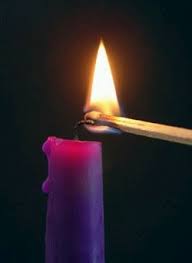
We light the rose candle amidst the purple penitential candles nesting in their Advent greens, and we consider Heaven, having faced Death and Judgment on Advent One and Two. We await Christ’s advent at Christmas, his advent in our hearts and bodies in the Eucharist, and his Second Coming in Judgment. The way to Heaven is narrow we are told, rather like the eye of a needle. We need to be small enough and humble enough to cling to Christ as he rises us up, to enter Heaven with him. 

 And so the Church cradles us through the year, teaching us how to grow toward Heaven, with its seasons of penitence and joy. We are of the world and not of the world, living fully within creation yet knowing we are destined for something even greater and more glorious: Heaven.

And so we do indeed rejoice.

Death, Judgment, Heaven, and Hell

476px-LastjudgementReflecting on these traditional Advent themes, I searched the Internet to learn more about them. I discovered that many Protestants and Catholics seem to avoid death, judgment, heaven, hell. They prefer the more feel-good themes: hope, peace, joy, love, or waiting themes such as expectation, fulfillment, prophecy, etc.

I finally found Father Longenecker’s blog at Patheos.com. Father Longenecker is an Evangelical turned Anglican priest turned Roman Catholic priest. Like many converts, he understands the temptation to dilute Christianity. Others who have made a similar journey and have taken a stand in the American public square include Father Richard John Neuhaus (Lutheran to Roman Catholicism) and Dr. Scott W. Hahn (Presbyterian to Roman Catholicism).

Father Longenecker reminds us of Holy Scripture and the purpose of Advent:

“Advent is… a time to face facts. Christ is on his way, but it may not be the happy party everyone would like to imagine. He is the Good Shepherd, but he is also the Righteous Judge… It does matter what religion you belong to. ‘No one comes to the Father but by me’ says the Righteous Judge… Universalism is false. Some people will not be saved. ‘Broad is the path that leads to destruction. Narrow is the way that leads to life and few there be that find it.’ So we had better snap to it says the prophet preaching to himself. I want to set out on that quest to follow the map, fight the pirates and find the buried treasure–which is eternal life.”

These are hard words for many of us to accept.

Some communities speak of living in a “bubble” of unreality, having cushioned the hard edges of life. Today, in 2015, Americans live in such a bubble of unreality, the nation having been at peace for over forty years. The last military draft ended in 1973. While we bemoan sending our sons and daughters to Iraq and Afghanistan and Syria, putting them in harms way, they go there by choice, not by conscription. We live in a bubble.

The two Paris attacks and the recent San Bernardino attack have brought death home to us. But death has always been with us, even inside the bubble, we just refuse to see it. War, terrorism, threats to peace whether domestic or abroad, force us to face death.

This, of course, is one of the fruits of Advent, rightly referred to as a “Little Lent.” We are reminded of the terror of our own mortality, that our days are numbered, our bodies decaying with each minute.

Christians believe our future is something to take seriously. Not only do we die, but we are given the chance to live again. Not only are we given the chance to live, but the chance to live forever in the glory of Heaven. It sounds good, but the catch is that Day of Judgment. Holy Scripture makes this clear in a way that cannot be sugarcoated as metaphorical. Again and again, we are told we will be asked to explain our lives, give an accounting. We will be judged. And the only person who can redeem that judgment call, be our advocate, is Christ Jesus.

As for me, I’d like to know where I stand in these eschatological indictments. I’d like to prepare if possible, as I would for a crucial exam.

And so on the first two Sundays of Advent (today is the Second) I’m glad that we are reminded of Death and Judgment. We take stock, we examine our hearts and our lives, we confess, and we repent. We are no longer afraid of facing death, knowing we have a friend in Jesus, an advocate in our last days, or The Last Days, whichever come first.

This is good news. This is incredibly, credibly good news, that we, like Christ, with Christ, will overcome death. But how does this happen?

It happens with the advent of Christmas. It happens with the coming of Our Lord, to live and die and rise again. As fully human and fully divine he takes us with him, bears us up. We become one with him to break the bonds of Hell, to rise to life eternal. His flesh and blood are the only way to the Father, to truth, and to life. Jesus Christ comes to us at Christmas as a baby in Bethlehem, incarnate, in the flesh, and he comes to us daily on the many altars of the world in the bread and the wine of the Eucharist.

This is good news. The attacks in Paris and San Bernardino remind us today of death and darkness, something Advent reminds us of every year. But Advent gives us the antidote to darkness and death, the living God-made-man, the Incarnation of Divine Love. Advent gives us the good news of Christmas.

As traditional Anglicans, we pray the Collect in our Book of Common Prayer not only on the First Sunday in Advent but each day until Christmas Day:

“ALMIGHTY God, give us grace that we may cast away the works of darkness, and put upon us the armour of light, now in the time of this mortal life, in which thy Son Jesus Christ came to visit us in great humility; that in the last day, when he shall come again in his glorious majesty to judge both the quick and the dead, we may rise to the life immortal, through him who liveth and reigneth with thee and the Holy Ghost, now and ever. Amen”

Good news indeed.

Heaven and Hell are the themes of Advent 3 and 4. Just in case we weren’t paying attention to the first two Sundays, we are offered the choice with a different emphasis. Do we want to live in eternity with Love or eternity with Unlove? With God or without him? It is a choice I can make today, this very minute, for Heaven and Hell begin in real time on this real earth. We make the choice continually, and with each choice between selfishness and selflessness we choose our direction and our destination, Heaven or Hell. Like a body of law, our choices build upon past choices, so the warnings in Advent are vitally real in present time, vitally present in real time. It is easier to set a straight course now than later. It is wrenchingly difficult to turn around and go a different way later, to re-pent.

So Advent reminds us how to travel to Heaven. It gives us a roadmap, so  that we may cast away the works of darkness and put on the armor of light.