
Monthly Archives: October 2017

Fighting Fires

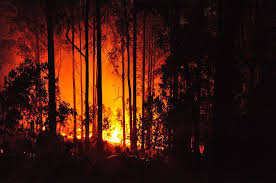
FireThe fierce firestorms that have devoured our beautiful North Bay counties and blanketed the Bay Area with smoke remind us of our helplessness in the face of the natural world.

Since man first discovered fire by rubbing stones together, he has tried to tame the wildebeest called nature. We are a part of nature, yet somehow apart. We think, reason, argue, debate. We create and we protect others with our creations. We are masters of nature, if not the universe, or so we believe, at least until hurricanes, floods, earthquakes, and fire remind us of our helplessness, and our huge hubris.

Why did this happen? we ask. Indeed, the fires in the North Bay feasted on forest, protected open space. Unlike the East Bay, where a few oaks survive the parched grassy hills, the North Bay has many trees, protected, as though saved to feed the next firestorm. Because we loved the natural world – its beauty, its tranquility, even its so-called spirituality – we safeguarded it from humans, but could not safeguard nature from nature.

We are reminded that the world is a wilderness, tamed in places by human civilization, by communities of people banded together to safeguard one another from the wilds. But if we let down our guard, we are no longer safe. We are not as powerful as we think.

So we seek meaning in the face of natural disasters, asking, Why?  Is this the end of the world?

All week I was reminded of the prophet Elijah and the “still small voice” of God. Elijah had retreated to a cave for safety:

“And, behold, the Lord passed by, and a great and strong wind rent the mountains, and brake in pieces the rocks before the Lord; but the Lord was not in the wind: and after the wind an earthquake; but the Lord was not in the earthquake: And after the earthquake a fire; but the Lord was not in the fire: and after the fire a still small voice… And, behold, there came a voice unto him, and said, What doest thou here, Elijah?” (I Kings 19:11-13, KJV)

We are still, small creatures with a few tools, some shelter, and smartphones. Yet we do listen to God’s voice of love.

For it is love that makes us different from this violent natural world surrounding us. And it is freedom, the freedom to choose love, that breathes into us that divine spark. The voice of God is not in the redwoods or the vineyards, so beautiful at harvest. The voice of God is in his words to us, his words to us in Scripture, Sacrament, and prayer. We hear the voice of God when we see how small we are, and from this place of humility, confession, and repentance, we learn to love one another better.

While there is no God in the firestorm or in the hurricanes or in the floods, we hear his voice and see his love in the many who care for one another in these times of crisis. They knock on doors. They carry the elderly to safety. They feed, clothe, and shelter.

They fight these fires that rage according to nature’s rules, not ours. As they quench the torched earth with water, they show they are different from nature. Creatures spurred by love, they hear the still, small voice within.

We bury our dead. We rebuild. We make a wider firebreak around our homes. We restore civilization and civility. Do we remember what we have learned? If we do, if we have learned a lesson, we turn to God, to his still, small voice in Scripture, Sacrament, and prayer. We follow his law of love – the Ten Commandments – and know he will drench the wildfires in our hearts. Only then can his own fire be lit within, his own controlled burning of love. Two of the disciples knew this divine fire as they walked to Emmaus with Christ. “Did not your heart burn within you?” they later asked one another.

We tame our own fires, until we burn with the love of God. God’s fire gives life; it doesn’t consume. God’s fire clears the air of smoke and debris. We can see and we can breathe deeply. We no longer feel quite so helpless in the wilderness of this world.
Touching the Untouchable

Michelangelo CreationBerkeley was quiet as we drove through its leafy streets to St. Joseph’s Collegiate Chapel on the corner of Durant and Bowditch, one block from campus. Once more, we would join others to pray for peace and freedom in Berkeley.

We parked, and I carried red roses from my garden to freshen the vase beneath St. Vladimir’s icon of Our Lady. I replaced the candles and lit a few, saying a prayer of thanksgiving for the week. I opened the front door and set out a foam-board sign announcing the Mass. I replaced a small notice, missing, announcing, “Singers Wanted.”

Our organist warmed up, the altar candles were lit, and the pews filled. A procession entered as we sang from our hymnals, incense swirling, tapers tall and flaming, crucifix carried by a young acolyte. The Mass began, weaving song and sacrament and prayer through the vaulted dome, through our hearts and minds, settling in. My own heart was grateful for the last few weeks. My friend, who had lay dying, had entered Paradise, carried by Jesus; I witnessed two bishops consecrated in Tulsa, Oklahoma, in a setting of beauty and promise and pageantry; our little chapel had survived the Free Speech Week, peaceful speakers stonewalled, freedom denied by cowardice.

So much had happened in three weeks. It seemed that if we blink, our lives pass by and we are gone. We must not blink, but watch and wait and pray each minute of each day, eyes wide open to truth, our hearts bravely seeking. We guard our time, so that our time is not stolen by the darkness of the night. We offer this time to God, so that it is sanctified by the light of the day. Some say “be present” and it is good advice, that in all of our hurrying and worrying we forget who we are, that we are holy children of God. We are loved by the Infinite One, touched by the Eternal.

My thoughts wove through the dance of the liturgy, and when our preacher spoke of the healing miracles of Christ, how he brought the dead to life, gave sight to the blind, healed the lepers, all with his touch, I saw how the Christian’s time is also touched by God. The Christian’s time, those days on this good earth, is reborn in the present moment, weaving past and future, creating a fine cloth. We look to our past to repent. We offer our leprous hearts to Christ, in confession and Eucharist. Only then can we freely look to our future.

Arms outstretched, our preacher explained how Christ lay his hands on the ravaged flesh of the lepers. He touched the untouchables. We, too, he said, are untouchables, for our hearts are cancerous and in need of healing. Yet, here, in this chapel, before this altar, Christ touches our hearts and makes them whole. The Lord of Life breathes life into us and resets our heartbeats.

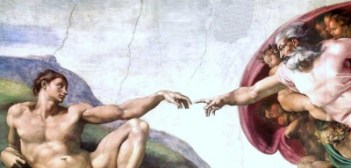
Michelangelo’s famous painting of Creation that covers the ceiling of the Sistine Chapel in Rome shows the finger of God reaching to touch Adam to give him life. Whether this is myth, allegory, or literally true is of no matter. It explains the truth of our beginnings, our holy beginnings, the sacred nature of our humanity. We are touched in the womb, enlivened, quickened. We are touched in Holy Baptism and Holy Communion, with water and with wine, with the bread of Heaven in the Mass.

My friend who lay dying three weeks ago has been touched and reborn to new life in Paradise. Each one of us awaits that touching, in the meantime biding this time of redeeming. For in this mean-time, this middle time between birth and death, between the womb and the grave, we touch the precious, present time given to us. We hold it in our palms. We finger its seconds. We listen. We pray. We pay attention to God’s voice in Scripture and Sacrament, his voice spoken by others in the Body of Christ who are also touched and listening. And we go to church to be touched by Christ, to be cleansed, to no longer be untouchable.

In Tulsa, four bishops “laid their hands” upon the heads of the two priests. The priests had risen from a prostrate position on the carpet before the altar, where they formed crosses, their fingers touching one another, gravity pushing their bodies into the carpet that touched them. We sang a litany, invoking the Holy Ghost to touch these men, to fill them with discernment, humility, and holiness. The Holy Ghost came, and through the fingers of the bishops, through this laying on of hands, the Spirit pulsed through the centuries, from Jerusalem to Tulsa on this twenty-first day of September, touching them. Holy oils touched their heads through the hands, rings encircled their fingers, and pectoral crosses pushed against their hearts. They were touched by God.

And our chapel, during this week of Free Speech in which there was little speech and freedom, and a great cost to the community, was untouched by trouble, touched and protected by the love of God, and by the stalwart presence of police.

This morning, in church, St. Paul touched me as I listened to the Epistle for today, with these beautiful words, written in a letter to the Church in Ephesus (today in Turkey):           

I bow my knees unto the Father of our Lord Jesus Christ… that he would grant you, according to the riches of his glory, to be strengthened with might by his Spirit in the inner man; that Christ may dwell in your hearts by faith; that ye, being rooted and grounded in love, may be able to comprehend with all saints what is the breadth, and length, and depth, and height; and to know the love of Christ, which passeth knowledge, that ye might be filled with all the fulness of God. (Ephesians 3:14+)

Rooted and grounded in love, strengthened by the Spirit, touched so tenderly with such power and beauty and truth, knowing the breadth, length, depth, height, love of Christ beyond knowing, filled with the fullness of God. These are no small things. These things tell us who we are and who we are meant to be. These are indeed, wondrous touchings, the hands of God touching our hearts and making them whole.

Someone touched the little sign asking for singers in our chapel porch. What did they do with it? Will they touch the one we put up today? Will these bits of paper and print float down Durant to Telegraph, or perhaps over to Bancroft and Sproul Plaza? Will someone else wonder? Will they touch the scrap from our chapel? Will this touch their heart and soul?

Today, after the service ended, we locked the chapel doors securely. I knew as I switched off the lights, the Sanctus Lamp burning steadfast, that this morning, like every Sunday morning, our songs and prayers and incense and processions had spilled out onto Durant Avenue to the passersby. We, having been touched, touched Berkeley with peace and freedom, with the unsurpassed fullness of the love of God.