
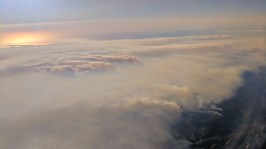
A pall of white smoke has covered Northern California. While we haven’t evacuated, we packed “go” bags in case, remembering our elderly cat Laddie, his travel cage, his insulin shots.
Living amidst nature is a beautiful experience but does have drawbacks, and grass fires are some of them, as well as annual armies of aunts (the insects), field mice, turkeys, and the occasional wild pig who takes delight in digging up the lawn. I believe, as we age, we come to realize that the natural world is winning against our meager, ineffective attempts at control, yet we do battle as best we can to own the space we have been given.
And now fires and smoke and the expectation of earthquake season.
 I walk through the house, surveying our possessions, accumulations from 70-80 years on this Earth, considering what is important to save and what is not. I sense a parallel with my wandering through time, accumulating ideas and opinions and thoughts, sins and virtues, hates and loves, blessings and bedevilments. One day I will walk on my final journey, hopefully holding our Lord Jesus’ hand and arriving at the pearly gates of fame, carrying these spiritual possessions on the back of my soul. St. Peter will advise what to save and what to leave behind, what to confess, what to celebrate. Or perhaps Our Lord will, or perhaps an angel, like Angel Michael in my recent novel, Angel Mountain, who guides the hermit Abram on his journey through the Woods of the Cross (plot spoiler alert).
My bishop of blessed memory often said he finally understood the phrase, “The good die young.” How can that be right, I wondered. He meant, I have come to see, is that they are released from this life’s suffering earlier than the rest of us. They’ve earned early release. They enter Eternity and into the beloved’s Presence, hear the glorious music and laughter, bathed in His love. They enter bliss, blissfully.
 The Chinese flu, which some say is overly hyped for political purposes while others cringe in fear of contagion, has added menace to this already dangerous wildfire season in Northern California. We are under house arrest either by force of the state or by force of society’s judgment upon us should we go out and meet together, see one another’s faces, return their smiles, their hugs, their touch. We stay connected through keyboards and Clouds that somehow carry our messages to loved ones and friends. We wait and we wonder. When will these troubles pass? What will be their cost to each of us, to America?
The Presidential election in November is on our minds as well, as one political party concluded their virtual gathering last week, having nominated their runners in this earthly race. The second political party will begin their Cloud gatherings tomorrow. There was and will be much hand-ringing and accusations, much anger and angst. There is also hope that Americans will cast thoughtful votes, that they will listen and learn before choosing.
The gregarious conventions of the past which became increasingly scripted and violent may be no more. Instead they will be replaced with faces in squares and speeches intoned to an invisible audience through the Cloud into our living rooms, appearing on screens we can remotely turn on and off with a small handheld wand or a tap of the finger or even a few words to Siri, the Cloud servant of all. Conventions will squeeze into phones and tablets and live there forever.
I for one will vote for the peacemakers, the deal-makers, the protectors of life, the defenders of our exceptional country, those who do the job I would like them to do. This is no time for careless complaints. The stakes are serious.
 America was always a miracle in the making. Can she continue to make miracles? The odds are not with us, for who believes in miracles? Yet we pray without ceasing that the miracle of America continue to shine a light in the darkness of the world, that the impossible continue to be possible, for the poorest of the poor, for hopeful immigrants, for every race and gender, for the unborn, for every identity.
Today, as Christians are denied the right to pray together as Our Lord commanded, “When two or three are gathered…,” we still hope and pray and repent our many sins. We repent, so that we may be forgiven. We are forgiven so that we may find the Way to Heaven, to arrive at those pearly gates, to enter the glory that awaits us in the Kingdom. So my husband and I tuned in to virtual services, attending three Masses this morning, overlapping in time. We gave awards: Best Chanting, Fr. Weber, St. Ann Chapel, Stanford. Best Sermon, Canon Dart, Christ Church, AZ. Best Hymns, St. Joseph’s, Berkeley.
 As we stood to sing #600, “Ye holy angels bright who sit at God’s right hand…” I smiled. My husband’s marvelous tenor filled the room, and I squeaked along as best I could, making up for talent with enthusiasm. We could hear a few voices in the chapel, living deep inside my laptop, and the organ played by the talented Eugene was magnificent.
A challenging time. Riots and burnings in our cities. Fires and smoke in the hills. A political landscape of triumphant truths and shamefaced lies further dividing us, as if house arrest and natural disasters weren’t enough.
 And yet… we overcome these tribulations. We follow the star that leads to the manger in Bethlehem. In this dark time, we follow the light we know—the light of love shone upon us by our Creator, upon all creation. We follow the light to where it leads, and along the way hope to reflect that light, carry that lantern for others to see and follow too. We are not really alone and there is no reason to be lonely, or despairing, not with all we have been given as Christians, not with the overwhelming and saving grace of Christ in His amazing abundance.
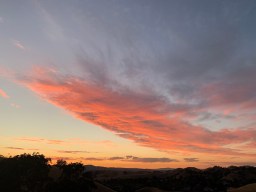 A triple-digit heat wave rolled over our golden hills a few days ago. To open a window or door is to enter an oven.
 My recently released novel, Angel Mountain, speaks of these things, this second coming of Christ and some of these choices that are set before us. Is the world ending? Is the return of the King soon? Our preacher (one of them) said that Jesus Christ will make all things new, that He will reconcile Heaven and Earth, that He will create a new Earth. Come, Lord Jesus, come.
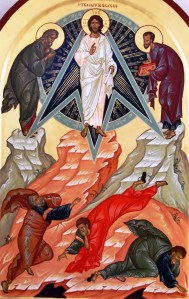 “AND it came to pass about an eight days after these sayings, he took Peter and John and James, and went up into a mountain to pray. And as he prayed, the fashion of his countenance was altered, and his raiment was white and glistering. And, behold, there talked with him two men, which were Moses and Elias: who appeared in glory, and spake of his decease which he should accomplish at Jerusalem. But Peter and they that were with him were heavy with sleep: and when they were awake, they saw his glory, and the two men that stood with him. And it came to pass, as they departed from him, Peter said unto Jesus, Master, it is good for us to be here: and let us make three tabernacles; one for thee, and one for Moses, and one for Elias: not knowing what he said. While he thus spake, there came a cloud, and overshadowed them: and they feared as they entered into the cloud. And there came a voice out of the cloud, saying, This is my beloved Son: hear him. And when the voice was past, Jesus was found alone. And they kept it close, and told no man in those days any of those things which they had seen.”
 My recently released novel, Angel Mountain, is about transfiguration. There are icons in a bright cave that glow with uncreated light. There is the face of a believer transfigured by the joy of faith when he speaks of Christ. There are singers glistering with the melody of hymns and psalms. For all of us are invited into transfiguration. We need only say yes, Lord, transfigure me: let me hear your voice.
 My bishop of blessed memory often said that to love is to suffer. And yet to love is to experience transfiguration inside the suffering, to know joy. It is a curious conundrum, a contradiction, like many in this world of spirit and matter, in this world of Heaven and Earth we do not fully understand. In this world of God the Father, God the Son, and God the Holy Spirit.
 Aside from the riots and burnings, the assault on private and public property, the rise in unemployment, bankruptcies, and closures, the students denied education, the poor becoming poorer, sports with no live fans, performing arts with no live audience, the churches with empty pews, the fear engendered by a strange virus, aside from these minor disruptions to daily life (“Other than that, Mrs. Lincoln, how did you enjoy the theater?”), Americans seem to have downshifted into a simpler mode of existence, which may not be a bad thing altogether.
 Having obliged a number of obligations, particularly in regards to my recently released novel, Angel Mountain, I now have a little time. When this occurs—usually on vacation or other “rest” periods—I assign a bit to memorize, either from the 1928 Anglican Book of Common Prayer or Scripture (usually KJV, more poetic). One can never have too many prayers or verses tucked away in one’s little memory bank. And my memory bank is often depleted and bereft… for I don’t pay attention often enough to this simple challenge. So, it being an election year, and a year of clear attacks on our freedoms, recalling the Marxist playbook, I revisited a prayer in the Service of Morning Prayer, “A Collect for Peace.” I have tried this one before and always struggled for some reason, confusing the phrases in a most frustrating manner. So I am giving it another go and taped the words to the back of my phone (naturally, attached to my palm).
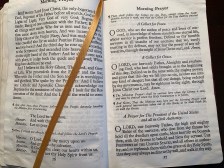 “Defend us thy humble servants in all assaults of our enemies”
 But the question of open/closed doors continues to fascinate me. The church is supposed to be making disciples of all nations. Here we were, suddenly in a place in time where folks in all nations were looking for our open digital doors. I know from the Facebook page we have for our UC Berkeley chapel, St. Joseph’s, we have visitors from all over the world. They especially like the short videos of singing and processions, but the altar and the vertical space and the sense of holiness in our chapel seems to draw many to us, folks we have never met, but longed for something we could offer.
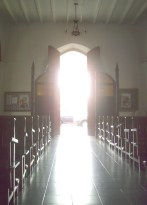 So I am thankful for this remarkable opportunity given to churches to preach the Gospel to all nations from simple screens and keyboards and video cameras, preferably in a physical chancel before a physical altar. I hope more churches do this, and if they have an invitation-only service, that they consider doing a live-streaming as well.
 Christine Sunderland
 Christine Sunderland