
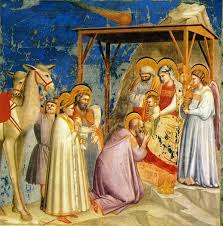
Merry Christmas!
We have entered the Twelve Days of Christmas, the time spanning the birth of Christ to the arrival of the Magi, the Epiphany of Our Lord on January 6.
I have found that the Christmas festivals of the last three days are often obscured by the rush and bustle of the season. Even adults who no longer believe in the birth of the Son of God yearn to recreate the days when they believed as children. They yearn to yearn for God, to experience mystery and miracle. The secular world, having lost faith, keep the rituals of gift giving, caroling, and the tale of the extraordinary bearded man from the North Pole on a sleigh pulled by reindeer. They keep the recipes and the dinners and the festive gatherings. They want to believe but do not want the moral demands of such belief. They want to be children again and see the world as fabulous.
This season was dampened by the pandemic, hushing it to a hum. My husband and I and our two Christmas kittens celebrated a quiet Christmas (well, they are kittens, so not that quiet). We connected with family by phone and screen rather than in a physical gathering. I wondered in some awe that the events in Bethlehem two thousand years ago could feed us so miraculously and mysteriously and joyously today in a quieter time. We have been forced to step back, breathe, and see differently.
The pandemic lockdowns, at least here in California, meant more virtual church, more contemplation, more singing alone or with one’s immediate sheltered family, and to those living inside the screen, more words read, more glory stories told, and most of all, a sudden quietude that filled the rooms of our home.
At the end of the day, and perhaps all time, we are reminded to remember God. We are called to pay attention to Christmas, Christ-Mass, the celebration of the child born in Bethlehem, He who brought salvation to mankind, and Himself in every Eucharist.
 And so, on Thursday evening my husband and I gathered in front of our screens to take part in a virtual Christmas Eve Mass, celebrated at our beloved chapel a block from UC Berkeley. We said the words, sang the songs, and prayed the prayers.
Silent night, holy night / All is calm, all is bright / Round yon virgin mother and child. / Holy infant so tender and mild. / Sleep in heavenly peace. (#33, Joseph Mohr, 1818)
On Friday we gathered before our screens to hear the Holy Liturgy for Christmas Day, sung at our chapel at Stanford.
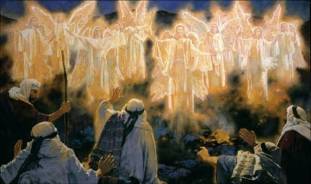
Hark, the herald angels sing / Glory to the new-born King! / Peace on earth and mercy mild, / God and sinners reconciled! / Joyful, all ye nations, rise, / Join the triumph of the skies; / With the angelic host proclaim / Christ is born in Bethlehem! (#27, Charles Wesley, 1739)
Mary and Joseph sheltered in a hillside cave. Obedient to God, she gave birth to the Savior of the World. We, obedient to God, shelter in our homes, give birth to belief in this Savior of the World. We welcome Him into our hearts, our sheltered hearts. We give him room. In the quietude of this season, we listen to the melody processing through the centuries, into our time, our day and hour and minute, and in these notes of grace we face our Redeemer. We are unmasked by Love; our souls are bare; we prepare for life eternal.
 On Saturday, the Feast of St. Stephen, we honor the true cost of discipleship. We read the words in Acts 7, how Deacon Stephen saw the face of God as he was stoned to death, our first Christian martyr. St. Paul, then Saul, watches, as his own transformation begins, for he would soon meet Christ on the road to Damascus and be changed forever.
And today, Sunday, we celebrated the glorious Feast of St. John, Apostle and Evangelist. John saw and wrote that in the beginning of all creation was the Word, and the Word was God. He was the Light in the darkness witnessed by John to be the true Light, and all who believe on his Name would become sons of God. The first verses of John’s gospel are read on Christmas Day (John 1:1-14) and describe who Christ Jesus is: He is the Word who created the world, who was born into that world but unknown by that world. But to those who did know him he empowered them to become sons of God. And the word was made flesh, and dwelt among us, and we beheld his glory, the glory as of the only begotten of the Father), full of grace and truth.
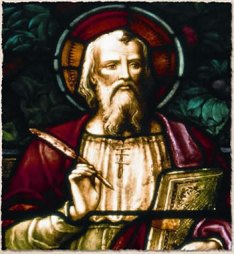 These three days tell the magnificent story of the intersection of time with Eternity. We tell of our Savior’s birth, tell of Stephen the first martyr, and tell of John who teaches what this means for us.
Tomorrow, the fourth day of the twelve days of Christmastide that lead to the Feast of the Epiphany on January 6, we descend into the violent Roman world of the first century. We mourn and recall the slaughter of the Holy Innocents, the murders carried out by Herod to protect his crown.
We recall these historic events because we have witnesses who testified to their truth. Our Bishop Morse of blessed memory often said that Christians are a people of reality. We face the truth of what happened, then and now, both the glory and the tragedy, both life and death. For like Stephen we will be called to suffer for our faith. And like the killing of the firstborn boys under age two by Herod, we will be attacked for our faith. This is the reality of salvation, the reality of Christmas.
 We Christians will never stop telling the story of our redemption in Time to live in Eternity, salvation on Earth to live in Heaven. We will never be silenced, even sheltered as we are, for God so loved the world that he gave his only begotten son, that whosoever believeth in Him should not perish, but have everlasting life. (John 3:16)
Deo Gratias.
 We put aside, or perhaps assuaged, our grief over the loss of our tabby, Laddie, who climbed into Heaven three months ago, and adopted two kittens from a local shelter. At only 14 weeks, they seem incredibly tiny, and we have been introducing them slowly to the house and of course to us, graduating from small spaces to ever bigger spaces.
  We pray for grace to cast away the works of darkness and put upon us the armor of light, now in the time of this mortal life in which the Son of God, Jesus Christ, visited us in great humility.
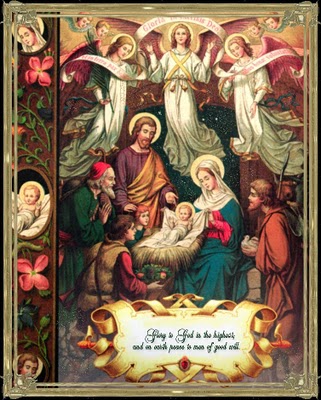 The Incarnate Word lying in a stable amidst the the farm animals, the angels singing glory and praise, the star in the heavens showing the way, a powerful portent of eternity, the Holy Family teaching us how to be a whole family, the traditions that further incarnate this immense event in history – all these things are given us. The creche, the evergreen tree strewn with lights, the gifts and cards and greetings given, the songs of peace and joy and delight – all the past Christmases are reborn to live in this coming Christmas. We keep the holy tales alive and they in turn enliven us, feeding us with humanity’s greatest desire throughout the centuries, to become whole, holy, filled with the love and light of God. The past is sacred for it forms our present and our future. To deny our history is to deny life itself, to deny meaning, to deny that what and who we are has eternal consequences.
 In my recently released novel, Angel Mountain, my characters face judgment in the course of the story, and how they deal with it reveals more about them. Indeed, America today faces judgment; our culture faces judgment; our universities face judgment.
 A second sermon considered the wonderful Collect prayer for this morning:
 Ah, angels! They are all around us. I have a number of gilded icons portraying archangels which comfort me in this time of sheltering and pandemic. They guard and guide and protect. They are messengers and warriors. Scripture says we will be their judges one day (!).
 There are two strong currents blowing over our land. One is light and one is dark. One tells us to honor judgment, to confess, repent, and be forgiven, to enter the Kingdom of Heaven, clad in the white robes of the Lamb. The other tells us to kill the judges, to deny, to hate, to fall into the lake of brimstone and fire, the Kingdom of Hell, clad in nothingness, to devour and be devoured.
 Christine Sunderland
 Christine Sunderland