
 The season of Advent has often been called Little Lent, for it is a penitential season, a time to examine our hearts and minds to see if we are ready to receive the Savior of the World among us.
Over the years I have used this time to memorize or re-memorize the Collect for today, an opening prayer that is repeated throughout Advent. And so as I listened to the prayer prayed before the altar this morning, collecting us together, the familiar words sang to me:
“Almighty God, give us grace that we may cast away the works of darkness and put upon us the armor of light, now in the time of this mortal life, in which thy Son Jesus Christ came to visit us in great humility, that in the last day, when he shall come again in his glorious majesty to judge both the quick and the dead, we may rise to life immortal…” BCP 90
If I do nothing else this Advent, I shall endeavor to repeat this prayer daily, to forge the words into my heart and mind, my memory a golden home for these words, food for my soul.
 For today we begin to think about judgment, law, and love. Paul writes to the church in Rome in the Epistle (Romans 13:8+) about how the law leads to love. “We owe no man any thing, but to love one another: for he that loveth another hath fulfilled the law.” But there is more; it is not that simple. He goes on to list the commandments, for the commandments are the law of love, commandments against adultery, killing, stealing, lying, and coveting, all which harm others. How do we measure up against this standard given to Moses on Mt. Sinai, burned into tablets of stone?
And so we have our instructions for Advent: to examine, confess, and repent; to clean out our hearts.
Paul writes one of his most beautiful exhortations to his church in Rome, making his words appealing and encouraging, even beautiful:
“Now it is high time to awake out of sleep: for now is our salvation nearer than when we believed. The night is far spent, the day is at hand: let us therefore cast off the works of darkness, and let us put on the armour of light. Let us walk honestly, as in the day; not in rioting and drunkenness, not in chambering and wantonness, not in strife and envying. But put ye on the Lord Jesus Christ, and make not provision for the flesh, to fulfil the lusts thereof.”
It startled me anew, “put ye on the Lord Jesus Christ.” Christ becomes a garment worn over our souls. It is a garment of light and love, and also law. Christ himself is our armour of light. We wear him.
We don the holy, the sacred, the eternal. And by wearing Christ, a holy light of discernment, we see our way in the darkness of this world. He hallows us, covering our body and soul, protecting us from harm, from the dark.
I will admit, confess, that chambering and wantonness, rioting and drunkenness, are not my usual temptations. But I see them all around me, in our towns, in our schools, in our elections, in our lack of law and order, in the everyday shootings and lootings and chaos nearby. But strife and envying are always hovering, tempting, for it is easy to desire to be someone else, or covet what they have, to be ungrateful for blessings given, for life itself. So I admit to these sins that encourage the darkness and dispel the light, making it more difficult to “walk honestly.”
Tradition appoints four themes, the “last four things,” to be addressed on the four Sundays in Advent: Death, Judgment, Heaven, and Hell, themes of darkness and light. For we all shall die and we all shall face judgment and our final destination. Considering these last things leads us to our means of salvation, Christ himself, born in Bethlehem. Considering these events, we cast our hope on this Child in the manger, the One who will carry us into eternity.
 For if we don Jesus Christ, if we cover our souls with his armor of law and love, we need not fear the encroaching dark. We can see the morning light through the trees, as we follow the path through the forest, through the woods of the Cross, and to the river that runs by the throne of God.
In Angel Mountain I was glad to describe some of these events in our own end-times, our own lives on this earth. I was glad to echo the words of Paul and the words of the Prayer Book’s Collect for the First Sunday in Advent. I was glad to glimpse the glowing dawn of his glorious majesty when He judges us, when we rise to the life immortal.
Come, Lord Jesus, come.
 Today is called “Stir Up” Sunday because of the prayer at the beginning of the liturgy, which “collects” us together as one body in Christ, hence called the Collect for the Day:
 And so as I examined the dusty, faded, spines of these many volumes published over the last fifty+ years, I recalled that such basements full of books might indeed be banned one day. Would libraries be burned down? It was thought a remarkable and fortunate turn of fortune that the great Alexandrian library in North Africa was spared the looting and pillaging of the vandals in the raids of the fifth century. Libraries – of word, print, or mind – exist to share ideas and times, plottings and plannings between people and cultures and ages. Libraries attempt to ensure that we do not make the same mistake as our ancestors did, that we learn from history and not repeat the failures.
 So another idea for a theme in my novel emerged. Deep within the caves of Angel Mountain is the last, lost library. Far down, below ground, and farther down than that… where hidden wellsprings bubble and moisture seeps and drips through sandstone… are the last books of Man, his lost words, forgotten and abandoned and left in the dark during the terrible terror, the silencing of speech, writings, communications. It is a time when we no longer sing the song of humanity to one another, to the next generation. We no longer tell stories to children about life, death, and love. One character recalls church bells, though, and sings the tones as she goes to sleep. Another recalls poetry. Another recalls a mother’s lullaby. But these are deep interior memories, silenced by the great levelling, the equalizing of humanity into a gray stream of sameness.
 Another character recalls that at one time they heard news of other places and events. The news came through screens and phones, generally propelled by those in power in Washington using carefully scripted words. But now, with the silence mandate, which criminalized writing and most other communication as racist and therefore hate speech, and therefore a sign of domestic terrorism, news was broadcast once a month by a town crier, who read a carefully scripted and word-barren paper he unrolled in the village square. Some wondered if he was human, and perhaps he wasn’t, for he sounded like a digital recording from a bygone age. Others listened, but learned little about human affairs in other places.

 A cold breeze pierced the air making way for the sun to light up our green hills in the East Bay, welcome after more light rain this week. For without light, colors fade into grays.
 And just so, the unborn have been given a voice, a tiny voice, barely a whisper, but still light has been shone once again upon the genocide of the unborn. When I reach the pearly gates, what will I confess to St. Peter, or indeed Our Lord himself, about my silent role, my collusion, in this fifty-year genocide? Granted I have voted against this horror. I have supported those who marched against it. I have written and spoken. Will that be enough? It is a huge pandemic of life, of our nation, of the world, each day, each hour; a giant condemnation of America; a Holocaust, but of far greater numbers and time span.
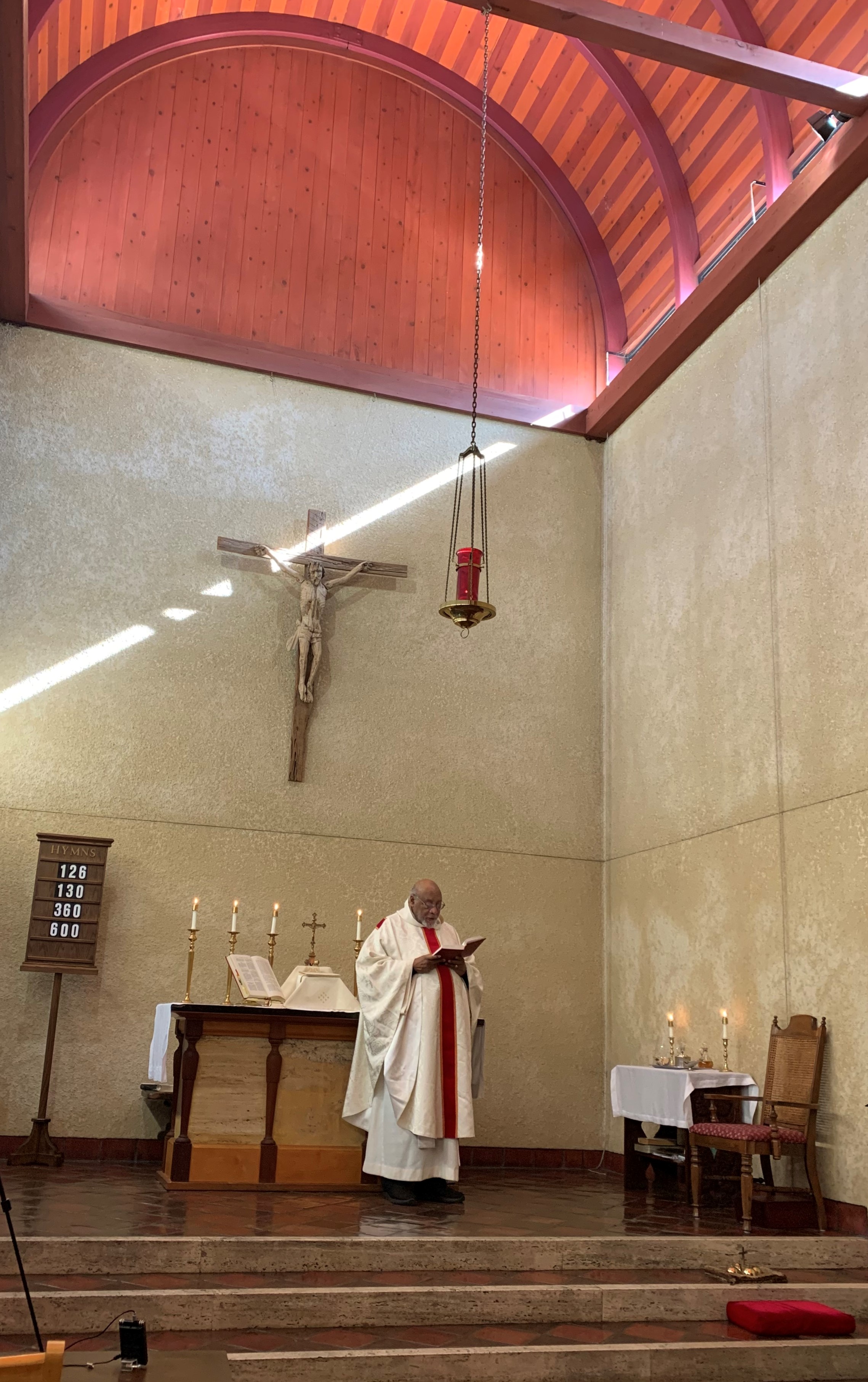 I thought about this and about the light of the saints, their shining a light upon us all, their examples of selflessness and sacrifice, their witness to seeing reality as it truly is – I thought about these things as I worshiped in St. Joseph’s Chapel this morning, and I gave thanks for the testimony of the majestic organ notes that danced into the dome above the white-linen covered altar, above the candles burning bright, above the white tented tabernacle, and above the crucifix itself.
 Christine Sunderland
 Christine Sunderland