
 I always look forward to Trinity Sunday, since we usually sing the majestic, awe-inspiring “Holy, Holy, Holy,” one of my favorite hymns, but I didn’t expect (although should have) “St. Patrick’s Breastplate,” another hymn to the Holy Trinity, a powerful hymn, robust, and commanding. To have these two hymns, accompanied by the magnificent melodic and thundering organ playing six feet behind us! I thought we might soar into the heavens: our little chapel burst with song.
 I wrote of “Holy, Holy, Holy” in my latest novel, Angel Mountain (Wipf and Stock, 2020). Toward the end of the story (plot spoiler!) Abram the hermit finds himself in Heaven, and the great vision of St. John on the Island of Patmos is described, the vision that became the Book of Revelation (some call it the Apocalypse) in Holy Scriptures. In his vision, John describes the angels and saints worshiping before the throne of God.
The hymn is a testament to the triune God – God the Father, God the Son, and God the Holy Spirit, the belief that God is One in Three Persons, the Holy Trinity. Reflected in Scripture, this dogma was written into the Nicene Creed with carefully carved phrasing, at the Council of Nicaea (325 AD), an effort to clarify Christian belief.
The words to the hymn are more recent than the Council and the Creed, written in 1827 by Reginald Heber, an Anglican priest. He captures, using phrasing from Revelation, the glory and beauty of worship before the throne of God, and for a brief time this morning in a small chapel in Berkeley, we sang with the angels:
“Holy, Holy, Holy! Lord God Almighty! Early in the morning our song shall rise to Thee;
Holy, Holy, Holy! merciful and mighty! God in three Persons, blessed Trinity!
Holy, Holy, Holy! All the saints adore Thee, Casting down their golden crowns around the glassy sea; Cherubim and seraphim falling down before Thee, Which wert, and art, and evermore shalt be!
Holy, Holy, Holy! Lord God Almighty! All thy works shall praise thy Name, in earth, and sky, and sea;
Holy, Holy, Holy! merciful and mighty, God in three Persons, blessed Trinity.”
 So of course our Epistle for today was Revelation 4:1+, reflected in the hymn and the creed (BCP 186). And the Gospel, too, considers what it means to believe the Creed. In this scene with Christ Jesus and the Pharisee Nicodemus, their conversation explores being born again of the Spirit (John 3:1+, BCP 187). For Christ says, “Except a man be born again, he cannot see the kingdom of God… except a man be born of water and of the Spirit, he cannot enter into the kingdom of God.” Christ has come to Earth and a new world has been born among men. We are invited to enter, to come and see, to glimpse Heaven from Earth.
Our Eucharistic liturgy also reflects the words of Revelation, when the priest prays before the consecration of bread and wine, “Therefore with Angels and Archangels, and with all the company of heaven, we laud and magnify thy glorious Name; evermore praising thee, and saying (the people join in), “HOLY, HOLY, HOLY, Lord God of hosts, Heaven and earth are full of thy glory: Glory be to thee, O Lord Most High. Amen.” (BCP 77)
Holy Scripture is woven throughout the liturgy, and these sacred words are sung in the hymns chosen for the day. There is a satisfying sense of having partaken deeply of Beauty, embraced by Love, Truth, and Goodness.
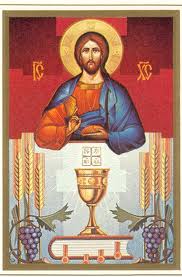 In this sense we are born again in every Eucharist, every song, and every prayer. “For in him we live, and move, and have our being… For we are also his offspring.” (Acts 17:28). For the space of an hour of worship, we live inside this golden reflection of Heaven, fed by God the Father, God the Son, and God the Holy Spirit.
One would think that hymns to come would seem less, or even redundant, but no, we sang an ancient hymn attributed to St. Patrick (372-466 AD), a hymn of dedication (268). For we lived within God; we were given graces and joys. Now, in return, we dedicated ourselves to Him with the words, “I bind unto myself today the strong Name of the Trinity, by invocation of the same, the Three in One, and One in Three.” The hymn describes the great moments of our salvation in the life of Christ – His baptism, His death, His resurrection, our judgment and eternal life. Toward the end of the hymn, it shifts in tone to one of the greatest prayers, pleas, of any Christian, as the words and phrases march to the sounds of salvation:
“Christ be with me, Christ within me, Christ behind me, Christ before me, Christ beside me, Christ to win me, Christ to comfort and restore me, Christ beneath me, Christ above me, Christ in quiet, Christ in danger, Christ in hearts of all that love me, Christ in mouth of friend and stranger.”
It was a holy, holy, holy morning, full of Christ, filled by Christ.
 Christine Sunderland
 Christine Sunderland