
 This week we observe Ash Wednesday, the day when Christians are reminded of their mortality with an ashen cross drawn on their foreheads, as they hear the words, “Remember o man, that dust thou art and to dust thou shalt return.”
It is a sobering moment that makes our lives more precious. To face one’s death is to celebrate life more intensely. We live in a materialistic world denying the life of the spirit, the creeds of Christianity, the hope of Eternity. And so this world often cannot face death, for the implications are too painful. Death is denied, ignored, erased. Modern man lives a lie, that he will not die, or that it does not matter.
Of course it matters. And today’s Epistle tells us why we should care about life and death. St. Paul writes what might be his most exquisitely beautiful passage in his letter to the church in Corinth, explaining that the answer to all of our questions lies in love, the love of God our Creator who gives us life: “Though I speak with the tongues of men and of angels, and have not charity, I am become as sounding brass, or a tinkling cymbal…” (I Corinthians 13:1+, BCP 122) And once we see the key is to love God, we then can look around us and see that we must love our neighbor. He writes in this passage as well that we are like children in our mortal lives, but when we die and return to God we are grown up, fully realized: “For now we see through a glass, darkly; but then face to face: now I know in part; but then shall I know even as also I am known…”
 And so we shall become perfect in our new lives, on the new Earth, in the New Jerusalem. What must we do in the Earth-time meantime? We must learn to love, for loving others as God loves us teaches us how to grow into what we are meant to be. It can be no other way. Love is the creative force that lives within us and opens the gates of Heaven when our time comes.
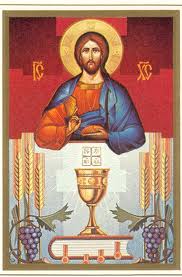
For it is the love of God that feeds us. It is his Word that nourishes us, for his love is expressed through his Word, not only in Scripture and Sacrament, but Christ himself in Eucharist and prayer.
So in Lent we clean our house within, exposing the dark shadows to the light, and finding places to feed the love of God. We confess our failures to love God and our neighbor. We confess our failures to be the person God created us to be. We confess we have strayed like lost sheep. We know we need help. We know we cannot do this on our own. Perfection is only realized with the love of God lighting our souls.
The Church helps us by carefully and lovingly setting out a seasonal calendar, ordaining a time for self-examination, a time to consider repentance and a return to the path we are meant to be on. And thus we have Lent, a time to do just that. We can strengthen our minds and hearts with a Lenten discipline so that we will turn away from the bad and embrace the good. We can learn, mark, and inwardly digest the virtues so that we can sweep away the vices. We can in this time, face sin in our lives and banish the dark so that we can see the light.
 God’s love for us means we have meaning in our lives today and everyday that we open our hearts to him. Every day we close our hearts we invite despair, for the absence of God in us kills hope. In this same passage we are told by Paul that faith, hope, and charity abide, but the greatest is charity. And yet we must have faith to hope to love.
It is a holy time, a time of penitence and repentance and rebirth. Christ offers himself for us, to us. We need only take his hand and learn to love as he loves us.
In this way we will step toward Eternity, minute by minute, hour by hour, day by day until we enter the glory of Paradise.
 Christine Sunderland
 Christine Sunderland