Monthly Archives: February 2025

February Journal, Sexagesima Sunday, the Octave of the Feast of St. Joseph of Arimathea

It’s a curious thing to submit a manuscript to a publisher, rather like sending your child out into the real world. My desk is mourning the characters and the mischief they get into, the hearts they break, the loves they discover, the lessons they learn, the past they confess. Stories grow with the telling and I’ve learned to use a period occasionally, a save button, or a send button. Takes courage to stop.

I fuss over the words like a mother fussing over packing, taking out, adding, then realizing it was better before the fussing. The storyline becomes convoluted and loses its natural rhythm, weaving in circles and landing in all the wrong places.

So I’ve learned to tell myself to stop fussing and send the book through the air to an office (a phone?) where strangers will examine and pass judgment. Then it’s on to another publisher, another submission.

I tell myself the times are changing, and our culture is finally admitting it needs serious literature that may not follow a formula, may not check all the boxes, may not virtue signal, but falls into the category of… could it be… art?

After all, companies are now disbanding DEI and ESG and other letters that live together in a strange manner. They are no longer terrified there will be protests/riots outside their offices or stores. Fear continues in blue states (here in California to be sure) but many national producers, be they be books or groceries or clothing, are not as concerned as they were before the election of President Trump, our common sense hero (CSH).

Nevertheless, I understand products need to sell, and literary novels generally do not, but fall into the loss category, the top of the pyramid, the fewer the better for the bottom line. The broad base of the pyramid is largely formula fiction, or nonfiction written by famous folks with platforms, which has its place among readers and will sell, given promotion by other stars with large fan clubs. This broad base does indeed support the more eccentric and literary endeavors at the top.

At the same time, there has been a great deal of wailing and gnashing of teeth over the cultural decline of America and what happened and can we change course? Is it too late?



So I offer my little novels celebrating the Judeo-Christian tradition and its moral demands to create a civil civilization, to live together peacefully. Heroes and heroines desire virtue and work to achieve some semblance of such. Responsibility and hard work and honesty are lauded: ideals I grew up with in the fifties, fictional accounts that examine the human condition, the nature of love and suffering and sacrifice. 

I do believe I have a calling to write; what happens to the resulting novels (my talkative children out there in the world) is up to others. I’m a good soldier or try to be, and seek the will of God, hoping/praying I hear the right answer. I think I hear his voice, feel his angels nudge me one way or another. One day I will find out for sure when I enter the gates of the New Jerusalem.

In the meantime, that is, in Earth time, Father Seraphim of Nazareth House Apostolate read a recent draft and gave me an endorsement:

“Thank you, thank you. This book cannot be read apart from wonderment and awe couched in the liminality of Love. You have told the truth that has brought forth freedom out of the quarrel and quandary of this present age. You told the truth, you have told the truth… In The Music of the Mountain there are no stop gaps, only the ongoing flow of Love that leads us and holds us into a Reality beyond, in our midst. Again and again, thank you.”

Fr. Seraphim, Elder Nazareth House Apostolate, Taylorsville, Kentucky

And two professional editors have had a go with the book, tweaking and suggesting, and I have taken (most) of their advice to heart. A fourth reader/writer is still out there… and we shall see what he thinks.

So God holds me in his palm. Can’t get better than that, as we enter Lent and travel to Jerusalem with Our Lord. Saint Joseph of Arimathea, the Apostle to England, planted his staff in Glastonbury and set in motion Western Civilization. Today we do the same, planting our staffs to save our world, one word at a time, one story at a time.

Deo gratias.
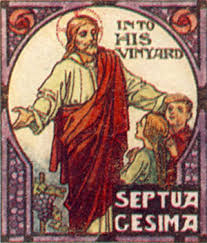
February Journal, Septuagesima Sunday

Today is the beginning of Pre-Lent, three Sundays that prepare us for Lent, which of course, prepares us for Easter and Resurrection Day.

In the wisdom of the Church we are ushered in slowly, as if we could not enter suddenly, jumping from one major feast day to another. And I have found that this slower pace allows us to live and breathe the season, to let the seriousness of the moment in our own time penetrate our souls, planting seeds we do not notice. The seasons of the Church Year thus live within us so that we can live them out together as Christians.

One could call it God’s marketing plan, soaking the faithful with profound truths too deep to absorb in one rain, then watering the seeds planted with care and prayer to blossom on that great festival. 

And so we allow Our Lord to garden within us, and part of that gardening is weeding, rooting out the weeds – the tares (last week’s lesson) – so that the good seeds will grow and flourish.

Today we learn that the tares are our sins, those times when we have not loved enough, as my bishop of blessed memory used to say. The Church gives us a list, however, which is most helpful for those of us who tend to wander from the path. We learn of virtues and vices; the Ten Commandments; the Summary of the Law. We have lists to check off as we examine the state of our souls. We are sorry and we repent, promising or at least trying to love more, enough, to exercise virtue and repel vice.

Pre-Lent thus prepares our souls to prepare our bodies during Lent. We consider in these weeks how to run the race, as St. Paul writes in his letter to the Corinthians, our Epistle today. We want that incorruptible crown by disciplining our bodies with our minds, taming our flesh with our spirits so that we may control what we do (or what we do not do) not only to ourselves but to others. And in the end, we learn to love.

Christians are like athletes in this sense. We repent in Pre-Lent so that we can fast and abstain in Lent, not for the purpose of losing weight or toning our physique, but to exercise our minds/spirits/souls to command our bodies, our flesh, our appetites.

I believe it was the Anglican writer Evelyn Underhill who said that the greatest fast or discipline is to face the full will of God in your life, and we can see how the taming of the soul in Pre-Lent and the subjection of the body in Lent would leave us in a better position to face that full will of God, to even know or recognize his will. I keep this in mind as fasting becomes more difficult in the senior years, as the body is frail and constantly under subjection.

But it is good to remember these things, and the seasons remind us of Heaven and who we are meant to be. Human beings need reminding, and rituals do this. Sunday rituals are the more obvious, attending Church regularly, keeping the Sabbath holy. Seasonal rituals sneak up on us, and yet arrive on time, given we have been faithful with the daily and weekly ones. 

God is building us. Making us. Recreating us. Clothing us with his garments of glory so that we will be ready for the wedding feast in Heaven. In the meantime, on this little planet Earth, we glimpse those glories, if we keep the law, repent breaking it, tame our passions, learn to love enough.

We call this growing in grace and it is a delightful mystery. If we have been blessed to begin this growing up-ward early in our time we experience more and more grace, glimpse greater and greater glory right here and now. If we begin this growing late in life, as the workers in today’s Gospel parable did, we are still welcomed into the Kingdom of Heaven.

But isn’t it better to begin at once, now, if not yesterday? Isn’t it better to experience Christ daily, hourly, with each breath? Bathe me in your love, your glory, O Lord. We need only ask.

So we are reminded today to confess our faults. The big one is pride, for it is the root of all evil (not money) and begets the others. We are a proud people for we reflect our Creator, made in his image. We are royalty and demand obeisance. We are reminded today to put such pride away, to realize we are nothing without God, can do nothing without him. We are sorry, for pride has metastasized and has produced other evils separating us from God.

And so we take those baby steps toward our Maker. With each confession, with each repenting and turning away from the dark toward the light we grow in grace, in fullness, becoming who we are meant to be, fully human, fully children of God.

And we might love enough to enter the gates of the New Jerusalem and the Kingdom of Heaven. 

  • The Seven Deadly Sins: Pride, Covetousness, Envy, Anger, Sloth, Gluttony, Lust
  • The Theological Virtues: Faith, Hope, Charity (Love)
  • The Cardinal Virtues: Justice, Prudence, Temperance, Fortitude

February Journal, Fifth Sunday after Epiphany

It has been said, and I believe it to be true, that sports reflect human passions, both good and bad, and in a sense the playing field hosts the drama of life acted out as if on a stage. Two teams play today on this Super Bowl Sunday. They will work together in tandem to defeat the other, to tackle the other, to make that point. They are as fleet of foot as dancers, playing out their rehearsed moves to best the other.
Competition. There was a time when I thought competing wasn’t fair, since one side loses, and with the wokesters of the last few years we saw what happens when everyone gets a prize and no one wins by merit. (It is curious that sports still exist, and even more curious that all-male teams exist.) And so we hail football, where talent can still claim the day.

Watching the opening ceremonies just now in New Orleans, I realized how powerful the game has become, a national anthem in itself. Patriotic anthems were sung, and flags flown, and the drama of the players running out from the dark tunnel and into the bright stadium pulled us together as one nation. We grieved together too, as we remembered the fourteen recently slain. We play together. We compete together. We celebrate our nation together. And we mourn together.

In some ways the entire game is framed with ceremonial pageantry, rituals in which we act out our human yearning for order and grace and brotherhood. These men have trained their bodies and their minds to perform this dance. They disciplined their flesh to achieve what you and I cannot, and they disciplined their spirits to honor one another by honoring the rules of the game. We see mankind at its best.

Competition is a great motivator. It discourages sloth, appeases anger, celebrates something greater than what was before. To be the best, to achieve that one step that to the crowd in the bleachers seems impossible, is to celebrate humanity, body and soul.

We can see that here, on this field, and even when they pile upon one another like grade schoolers on the playground, we know they will soon stand back and follow the rules. As a mother and grandmother of boys, I wince, hoping no one is hurt, and yet I realize sometimes the stakes must be real, and we the watchers are pulled in as well.

And so the game mirrors our nation’s teams of citizens as they battle with ballots or in halls of Congress. It mirrors our nation’s military, our national team ready to fight other nations, to protect Americans, to keep us safe. For there will always be combat in this world, whether for power, or land, or food, or survival. It is “survival of the fittest” we are told by evolutionary theory. That is the human condition.

Into this world of charge and tackle enters the Prince of Peace. He does not do battle (although there were some tables overturned in the temple as I recall) but tells us to forgive seventy times seven. He says we don’t need to worry about tomorrow. He says to love one another.

This revolutionary messiah did not bring revolution, as we know, and yet the seeds of order and brotherly love were planted in the rich soil of Judaism, already honoring a code of civility. And thus in that first century came a new way of living together. The Way, as it was first called, would flower in Western Europe and the Mediterranean basin, scribbled by monks and taught on Sundays in sermons. This Way became Christianity, the child of Judaism, and built a culture of freedom and civility, protecting the weakest among us, women and children, honoring God and obeying civil authority. Parliaments grew and became true “talking institutions”, and these forms became congresses made up of elected citizens. Structures of civility forged democracies of thought and action and law and order.

America, like its mother, England, has beaten the odds of survival in our warring world. It is indeed an exceptional country, a city on a hill, a shining light. America says, “See, we did it. We did the impossible. We formed ways of living together, and while we fight one another, we honor the code. Our justice isn’t perfect. We are human. But we try and we do not lose sight of the ball as it travels down the field. We hold our flag high and honor our code of Mosaic mores and Christ’s commands. When we break those rules we expect punishment, for our country is one nation, all judged the same by our blind Lady Justice.

The players are now in a huddle, a bit like Congress, I suppose. They plan the next move. Now they are lined up ready for action. And after the action, we see the replay in slow motion, a ballet on grass. The ball is in the air after much scuffling and grabbing and halting and trying, again reminding me of the playground and perhaps Congress or our local school board.

And it is a playground after all. All of life is a playground not unlike this football game. We play our positions, keeping the goal in mind, following the rules. We hope the referee doesn’t whistle and judge us. It is our national sport and it provides catharsis as we see our own human condition civilized by order and design, a dance of body and soul.

This morning we heard about the wheat and the tares. Christ says he will burn the tares and collect the wheat. In the Epistle we are told to love and forgive one another. Just like football.

February Journal, The Presentation of Christ in the Temple, Fourth Sunday after Epiphany

This year the Feast of the Presentation of Christ lands on a Sunday, today, February 2, Epiphany 4, shining light on the act of the giving, of the presenting, of the offering of Christ to the world, indeed, to you and me (Luke 22+).
Mary and Joseph are fulfilling Jewish law, presenting their son to God. But what touches me about this story is Simeon and Anna, two prophets who have waited for the Messiah, fasting and praying, having been promised they would see the child before they died. When Mary and Joseph arrive with Jesus, Simeon knows immediately that his promise has been fulfilled.

Simeon’s response glorifies God and is a part of our Anglican Evening Prayer, so it is well known and often prayed by the faithful each evening. It is called the Song of Simeon and the Nunc Dimmitis, Latin for the first words of the canticle. Simeon knows this is the promised one and raises him up in his arms, praising God:

Nunc dimittis. St. Luke ii. 29, BCP 28
LORD, now lettest thou thy servant depart in peace, according to thy word.
For mine eyes have seen thy salvation,
Which thou hast prepared before the face of all people;
To be a light to lighten the Gentiles, and to be the glory of thy people Israel.

And just so, in this scene, we see another epiphany, or perhaps many, as the Holy Child is recognized by the Jewish world and presented to the gentile world as a light to lighten their way. God offers his son to us, presents Him to each one of us, a great and holy gift.

We also learn that Anna “gave thanks likewise unto the Lord, and spake of him to all them that looked for redemption in Jerusalem.”

The presentation of Christ to the world is thus effected through the rituals of the time, uniting us with the Judaic history back to Moses, connecting us with this offering in the temple, bringing that past into our present, to become part of the Christian year on February 2.

This presenting, this ultimate epiphany of Jesus Christ, the Messiah, dramatizes this glorious, momentous, event for all the world. The world has been prepared with the choosing of the People of God, the People of Israel, and their journey through time to this moment. And then the impossible becomes possible, God enters our world as a baby in a stable. The stars change course. Shepherds hear angels. Kings travel on camels to lay gifts at his feet. The world will never be the same.

And yet the presentation is also the offering of Our Lord to each one of us. Do we accept the gift of Love incarnate? Or are we ashamed to confess the faith of Christ crucified?

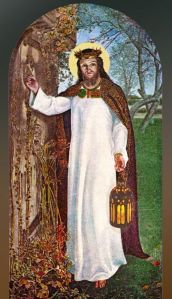
Light of the World, by Holman Hunt

I believe this offering never ends, at least in our lifetimes. He will knock again and again at the doors of our hearts. Some will not hear the knock. Some will hear it late and miss out on early glory. Some will open their hearts to the Lord of Hosts on the first knock, the first presentation.

And will those who invite him in celebrate his presence, sing him songs, love him as he loves us?

For when this happens, another amazing presentation happens. We turn about, and we make our own presentation of the Lord to others. We point to the child born in the stable, this salvation for all people, this light to lighten our way through this life and into the next. We raise him high as Simeon did, praising his mercy and grace.

Luke writes that “the child grew, and waxed strong in spirit, filled with wisdom: and the grace of God was upon him.” When we accept this Savior of the world as our savior, we too will wax strong, be given wisdom and grace. We too will sing songs of thanksgiving and praise. We too will look for every chance to present him to others, to knock on the doors of their hearts.

Deo gratias.