
My novel, The Music of the Mountain, has received another endorsement, this one from the admirable writer in England, Francis Etheredge, bioethicist and theologian:
“In what is very nearly a dystopian novel, Christine Sunderland takes a much closer look at a person who encounters baptism. In this, the second of her books about a semi-mysterious mountain, she takes up the previous theme of hope amidst destructive trends in society. There are four people at the heart of the book. And, by contrast with an illegitimate, authoritarian, withering of justified dissent, these four are very much at the beating heart of both preserving and advancing a renewal from above.
So, the outer circumstances of the novel are as impenetrably destructive, as the inner group are personally engaged in the intimate struggle to love in the truth. At one point, while we know how each of the four have been affected by the cultural crisis in which they live, there is a pointed encounter between those living the inner life and those seeking to puncture it as abruptly, aggressively, and intimidatingly, as they are unjustified in doing so.
The book is about two men and two women, almost entailing the possibility of a double love story which, in a certain way, is unexpectedly but beautifully concluded. The elderly man, a widowed Anglo-Catholic priest assists, like an emergency doctor, at the late but timely coming to Christ of an almost atheist, but probably agnostic professor of ethics who is wholly taken up into Christ. While the young man and woman, clearly taking a two stepped kiss to courtship, are equally traced through their first meeting to marriage and a family, albeit the latter is viewed from on High.
Just as the dialogue between those who love is intimately unfolding, just so there is an equally, painful incapacity to even talk, in those who execute the mandate to burn good books. Christine Sunderland’s novel expresses, in the likely reader’s tears, the very contrast between being open to the mystery of life and being hardened by the dictates of an impenitent hatred of what is good, true and beautiful.”
Endorsed by Francis Etheredge, Catholic married layman, father of 11, 3 of whom he hopes are in heaven, whose latest book is Transgenderism: A Question of Identity: https://enroutebooksandmedia.com/transgenderism/.
Reading and writing and speech itself are gifts given by our God of love, part of the miracle of being human and made in His image. They are graces, mysterious and real, that express who we are and who we are meant to be. They sculpt and carve greater truths through metaphor, symbol, story, and character. And, at the end of the day, they tell us what love is by showing us love, dramatizing love, making love real.
Just so, today’s Epistle is the stunning ode to love that St. Paul writes to the Church in Corinth (I Corinthians 13+): “Though I speak with the tongues of men and of angels, and have not charity, I am become as sounding brass, or a tinkling cymbal…” This poetic chapter describes the nature of love (charity), what it is and what it isn’t, with words that paint images to help us see: “For now we see through a glass, darkly; but then face to face: now I know in part; but then shall I know even as also I am known…”
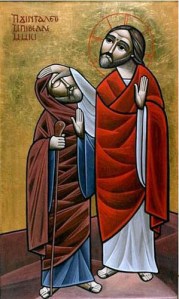 Sight is again repeated in the Gospel story of Christ healing a blind man. For that is what we are, blind, feeling our way through life, reaching for God, for Eternity, for Love. We know this intuitively but we must act upon it, sculpt our own souls with Christ himself.
And so we clean out our hearts, confess our sins, receive absolution, and step into Lent to rise on Easter Day. In this way we become part of the music, part of the hymn of love, speaking the words and singing the notes that pull us heavenward. In this way we learn to love as we are meant to love, and we become part of the mystery as we enter the miracle and see Him face to face. We are no longer blind, but can see.
 Christine Sunderland
 Christine Sunderland