
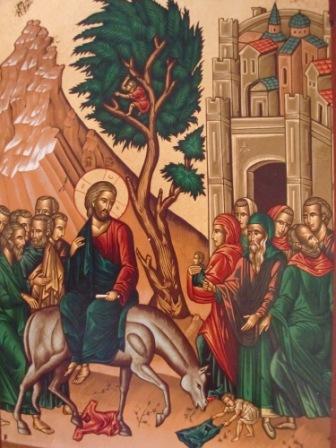
Passiontide is observed the two weeks before Easter, Resurrection Sunday, when the Son of God conquered death to give us life eternal. Lent leads into Passiontide, and we have prepared ourselves with ashes and discipline to face the fullness of Christ’s love for each one of us. To face the fire of this love is no small thing, and so we step carefully through this penitential season, reading and learning the words of love that need to be written on our hearts.
For Passiontide is about freedom, the freedom to love, the freedom to express that love, the freedom to accept that love, the love of our Creator. My bishop of blessed memory often said that “passion” in this sense is the union of love and suffering, meaning the Way of the Cross to death and resurrection. We choose to travel that Way (or not) in our own time on Earth, the days and months and years given to us in which we learn how to love. For love means sacrifice of self to make room for the beloved. A curious conundrum, this love and sacrifice, and each Lent as winter folds into spring we see and hear and know a bit more of that suffering love through our Lenten sacrifices and offerings, through our sacraments and songs.
We are on a journey of love and suffering, a schooling for Heaven. The lessons are life and death to us, literally, so we must pay attention. We learn each time we fall, each time we fail to love enough. We look up from that fallen place, and reach for His outstretched hand. We confess we have not loved enough and He raises us from the dead.
The lessons in this school of love – our own lifetimes – are taught throughout the Church Year. The Church has organized these marvelous works of God, these marvelous words of God, indeed, the Word of God Himself, in seasons throughout our 365 days so that we can walk this path with and within the Church, alongside Christ, re-membering and re-enacting the great moments of salvation history – Christmas, Epiphany, Lent, Easter, Trinity. They are “tides” or seasons and repeat just as the year repeats, so we walk with those gone before and those alongside and those to come. We are schooled in this story, this passion, engrafting words and deeds on our hearts.
I have found memorizing prayers and scripture to be a good discipline as well as sustenance for the soul. This Lent I am working on the prayer For Our Country found in the Episcopal Book of Common Prayer:
For Our Country.
ALMIGHTY God, who hast given us this good land for our heritage; We humbly beseech thee that we may
always prove ourselves a people mindful of thy favour and glad to do thy will. Bless our land with honourable industry,
sound learning, and pure manners. Save us from violence, discord, and confusion; from pride and arrogancy, and from
every evil way. Defend our liberties, and fashion into one united people the multitudes brought hither out of many
kindreds and tongues. Endue with the spirit of wisdom those to whom in thy Name we entrust the authority of
government, that there may be justice and peace at home, and that, through obedience to thy law, we may show forth
thy praise among the nations of the earth. In the time of prosperity, fill our hearts with thankfulness, and in the day
of trouble, suffer not our trust in thee to fail; all which we ask through Jesus Christ our Lord. Amen. (BCP 36)
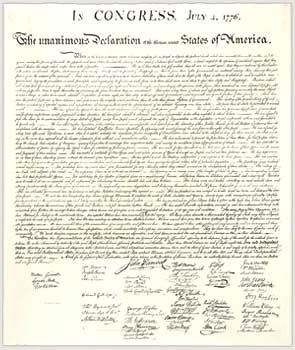
It seems an appropriate prayer for this anniversary year of the Declaration of Independence, particularly the “honourable industry, sound learning, and pure manners” and the union of “the multitudes brought hither out of many kindreds and tongues.” America is indeed the great experiment, and it is true that the Founders of our nation assumed certain truths to be self-evident, given to them by God, for they were largely Christians – Protestants from a Judeo-Christian world.
The prayer was written not by Archbishop Cranmer, who wrote many of the British prayers and put together our marvelous Book of Common Prayer in the 17th century, but in 1882 by Rev. George Lyman Locke (1835-1919), Rector of St. Michael’s Episcopal Church in Bristol, Rhode Island. For it is an American prayer, not British. It was added after his death (but I’m sure he looked on from above) in the 1928 edition.
America is a nation founded on free will, freedom of choice, which is founded upon self-evident truths and moral obligations, laws ordained by God. And so we pray at this time that “through obedience to thy law, we may show forth thy praise among the nations of the earth.” And we write these laws on our hearts as we follow Our Lord to Jerusalem, walk with Him the Way of His Cross, and learn what love truly is.
 Christine Sunderland
 Christine Sunderland