Author Archives: Christine Sunderland

January Journal, First Sunday after Epiphany

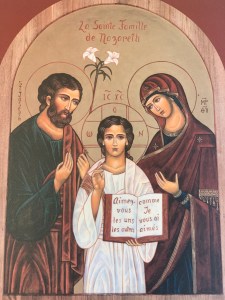
Holy Family of Nazareth, Denise Gosselin Gravel, Iconographer

This year, Epiphanytide, swinging on the date of Easter, a moveable feast, runs a full five weeks. The longest it can be is six weeks, so we are close to hearing all of the lessons appointed for this season of light. Today, the first Sunday after January 6, Epiphany, the Gospel lesson reveals another revealing of the Christ Child, who he is and why it matters.

The story is told by Saint Luke, thought to have been particularly close to Mary, and thus this writer also gives us the main narrative of Christ’s birth. It touches me, as a mother, for we forever worry about our children. My son is fifty-two, and when I learned there were raging fires in Los Angeles on the day his plane was due to arrive from Bangkok (Wednesday) I doubled, no tripled, my worrying. The plane arrived safely and one day I will find out what he saw in those skies, but for now I am grateful he made his connection home to Denver, albeit in the middle of the night. It is moments like these that make me grateful for cell phones, messaging, and even FaceBook. How did we ever manage without instant communication?

But returning to the story in today’s Gospel, about the boy Jesus in the Temple. We are told he is twelve years old and goes missing, at least his parents cannot find him. When they do, they fuss over him asking what was he thinking going off like that. (Sounds familiar.) And of course he replies that he was about his “Father’s business.”

An epiphany. A light shines on Jesus and who he really is.

The story produced other epiphanies in my little brain. He was born a baby, a human baby, and would have grown as we all grow, learning from our environment. He must have absorbed the lessons of the local synagogue, the readings, the conversations, as he grew up, for he needed to know these things, the history and rituals of his people, their prophets, their challenges. And so he is drawn to the temple in Jerusalem when they visit for the Passover feast. Luke writes that they had gone there every year (!) as was the custom. And yet we only have this one account of Jesus questioning the rabbis.

Given the choices all writers make, I have often thought the Gospel accounts were carefully curated. When there is a feeding of five thousand, this is only one account of many feedings we do not hear about. The healings too are probably too numerous to list, both of soul and of body. How many did Christ the Lord raise from the dead?

And just so, Mary and Joseph most likely were challenged with the boy Jesus and his remarkable parentage and his ways of learning, led by his Heavenly Father, guided by the Holy Spirit. This was their twelfth Jerusalem Passover, but Jesus is now of an age – a precocious age as mothers know – when his mental and physical growth take new turns. We call it adolescence. They called it becoming a man.

Today we ponder our time on Earth, Jesus’s time on Earth, and the accounts we are given, so carefully and prayerfully written “for our learning.” We are told in the Collect for Advent II to “inwardly digest” the Word, Holy Scripture. For indeed, these accounts, historical accounts, are food for our souls. Scripture tells us what is important in life, what is good and what is bad. Scripture, and those who interpret these Holy Words for us, gives meaning to our time, meaning to our individual lives. These words set us on the right path, shining a light in the dark forest of our days.

I for one am glad and grateful, for with every lesson, new epiphanies reveal more glory here and now and then in Heaven and eternity. What we don’t know, what we don’t understand, doesn’t matter. What matters is in the pages of this book called the Holy Bible. What matters is what we do about these matters in our own lives.

Are we part of a church community, one that welcomes us on board to sail the seas of our time? For community is one of the pillars found in Holy Scripture – community that teaches us, feeds us, leads us through the rough waters. It is the church family that gives us the songs to sing, the prayers to pray, the eucharists to strengthen our hearts and souls.
The answers to life’s questions are here for the taking. We need only trust and obey as the old hymn goes. Looking for happiness? Trust and obey, for there’s no other way, to be happy in Jesus, but to trust and obey.

One of my grandchildren said she couldn’t find a church she liked. I suppose she thought there was a perfect one, just for her, as if she were at a buffet table, trying each dish. Alas, I told her, every church community is fallen, for it is made up of fallen men and women just like you and me. Find one close by and attend regularly. Be slow to judge and quick to forgive.

For without being a member of the community we call the Bride of Christ, the Church, we will die a slow death from spiritual starvation. We need to be fed, and this is where Christ is, feeding his sheep, caring for you and me. Don’t go it alone, or even imagine it is possible. Hermits are few and far between.

If you want to experience epiphanies of heart and soul, walk through those doors, take a seat, and sing with all your might. Pray prayers of repentance, prayers of petition, and prayers of thanksgiving. Listen and learn from the lessons read and the sermons preached. And do these glorious things with others, your new brothers and sisters, mothers and fathers, grandmothers and grandfathers. One day you will be in their shoes, and you will be given parish children, grandchildren, in your church family. One day you will open the doors for those outside who want to come inside, in from the cold, the damp, and the dark of our world.

One day you will see them from Heaven and you will hear the words, “Well done, thou good and faithful servant. Welcome home.” You will turn and see the Master, the one who questioned the rabbis in the temple and set our worlds in motion. And you will know the ultimate epiphany, Christ himself.

January Journal, Second Sunday after Christmas

My novel in progress, The Music of the Mountain, is set in the month of January 2023. It is a dark and stormy month, a time of short days and long nights. And yet January is a month of epiphanies, of new beginnings, of seeing what we didn’t see before. An epiphany is a sudden thought, a conclusion, an answer. January unveils these day by day, week by week.

But most of all, being the first month of the new year, time itself commands attention. What have we done or left undone in the past year? What do we regret? What would we do differently if we had the year to do over again? We make resolutions to be better.

It is unfashionable to admit fault, to judge oneself, to admit we are not all we should be. We are told that judgment is judged to be unkind, and above all, we must be kind to ourselves, looking for excuses, reasons why we didn’t love enough, circumstances that would send the judge and jury home for good.

Falling short of the mark hurts.

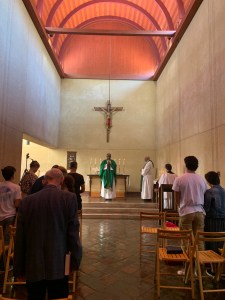
And so during Mass this morning I was glad to be reminded of my failings in the General Confession and the Absolution following. It is a crucial, cross-bearing reality, that we are human beings subject to moral law who will face God’s judgment one day, like it or not. I for one need reminding in this world of no fault, grievance, and victimhood.

And so we acknowledged and bewailed our manifold sins and wickedness we have committed by thought, word, and deed, provoking God’s wrath and indignation. We repent and are sorry. The burden is intolerable… we call on God for forgiveness.

It is good to be reminded of reality. It is good to repent on a regular basis after holding oneself up to the bright light of Heaven. In this way, we choose the best path to take in the new year. In this way we see ourselves as we are, not as we imagine, and allow God to carve away the darkness and bathe us in his light.

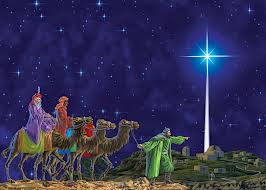
Today is the twelfth day of Christmas; tomorrow is the Feast of the Epiphany of the Lord. Epiphany, of course, is when the Magi or Wise Men arrive in Bethlehem, bringing gifts to the Christ Child. Epiphany, then, is the good news sung to the rest of the world, not just the shepherds and the holy family. We are included in this epiphany of light; we travel to the creche and kneel and worship too. We bring our gifts – ourselves. We too have followed the star in the heavens, wondering where it will lead. Could something so grand and cosmic as a star in the night sky shine upon the meager manger in Bethlehem? And yet angels appeared to the shepherds, the great choir singing to the lowly herders.

Christmas tells how the little becomes large, how flesh houses spirit. God becomes tiny and humble; kings follow a star and kneel before him.

To find answers to the human condition, the whys and the wherefores, look to the manger bed and see who kneels before the Christ Child. If kings and shepherds kneel, we can too. If they see, we can see too.

January is the month of the Holy Name of Jesus, so that we give the baby in the manger a holy glory by intoning his name, breathing the name, calling his name.

January is the month of life granted through this Holy Child, but it is also the month of death decreed with the slaughter of our own innocents through abortion. For half a century this month proclaims our grief, prays our petitions as we walk for life all across this nation.

The star is bright in the night sky as we embark on this year in time. We divide our time into months and days and hours, stepping through the squares on our calendars, trying to pay attention to each precious, passing minute. It is too much for our ashen earthiness, and so we take an hour on a Sunday to bundle the time into meaningful notes, and sing a melody of penitence, absolution, eucharistic feeding, and by the end of the hour we see epiphanies meant only for you and me.

We go to church for an hour each Sunday and kneel alongside the people of God, the bride of Christ. For in that humility, epiphanies are born, and we see again. We see the path laid out for us, at least for the next day and week, as we step into the woods of time, marking another year.

December Journal, First Sunday after Christmas

We are in the middle of Christmastide, those twelve glorious days of Christmas ending on Epiphany, January 6.

I have celebrated seventy-eight Christmases on this good earth. If I don’t remember each one, they remember me. 

With each year I have added another layer, another garment, to my Christmas past to create my Christmas present, which becomes indeed a yearly present presented to my heart, mind, and soul. The past does this to the present if we pay attention, or even if we don’t, for today’s Christmas is partly the memories of earlier ones and perhaps even the anticipation of ones to come.

Thus rituals and traditions color our world. We sing the same songs and add new ones. We decorate our homes as if a king were arriving, for indeed he is, and did arrive on Christmas Day. We turn earlier saints into messengers, and invite Saint Nicholas to gift us, arrive on the roof and come down through the chimney to place delicacies in our giant stockings hung with care in hopes he will be there. 

We build anticipation in the weeks before, trying to be good, greeting one another with holiday cheer, wearing holiday colors and hats and tees, singing about a reindeer named Rudolph with a red nose who was humble and then great, or so the story goes.

We prepared for Christmas by thinking of others, teaching our hearts to expand to include another in our thoughts and plans. We bake for them, give them gifts that are wrapped in bright paper with shiny and curly ribbon, so that the joy becomes even more special for it has been hidden, as Jesus is hidden in history and mankind’s retelling.

In these rituals we tell the story of God becoming Man and walking among us. The story is too fantastic to tell. It is too amazing to fathom. So we tell it in our preparations, in our humble human attempts to shine the light on the glory of God and the laughter of his love.

Like Our Lord, Saint Nicholas comes down from stary skies and gives us wonderful gifts. The gifts do not compare to the gift of Christ and Eternity, the gift of God and incarnation, the gift of life over death, joy over sorrow. They do not compare, but they remain our meager attempt to reveal Christmas, the birth of the Son of God, the Messiah, the long awaited one here to set us free from our own captivity of self.

And so we try to be like Saint Nicholas and give gifts and reflect Our Lord Jesus who gave himself to us.

And we try to be like the angels and sing to him in his manger. We sing of the miracle and mystery of that unlikely birth, we harken to the herald angels singing glory to the newborn king, we sing of a silent and holy night when away in the manger there was no crib for his bed, we tell of the little town of Bethlehem and what happened on that midnight clear when the glorious song of old was heard as angels touched their harps of gold, for Christ is born of Mary, and while mortals sleep, the stars proclaim the birth and peace to men on earth.

Indeed, the Prince of Peace, the Lord of Love of You and Me, was born that night over two thousand years ago, and today we sing carols layered upon earlier carols, as humankind tries to express the inexpressible with words and melody.

We teach our children the songs, so that they will teach their children. To help them remember, we dress them to play parts in a stable in Bethlehem. We clothe them with the story of the Christ Child. They act out the greatest story ever told, and each year they add to their own library of Christmas rituals and traditions.

And so I have been graced with seventy-eight years of Christmases. The time is rich and glorious and I wear a tapestried robe of many colors and notes and words. I live out what I have been given, a humble life of gilded mystery and miracle, for each day brings its own gifts of healing, seeing, hearing, being. Every minute is birthed by Christ. We breathe Christmas all year, birthing this Bethlehem child who births us.

We follow the star of Christmas and find ourselves at the cross of Easter. In this journey in time, we learn to love as God loves us, wrapping our hearts with the bright ribbons of Christ, to give ourselves to one another.

December Journal, Fourth Sunday in Advent

There is the silent hush of valley fog enshrouding our house today. The mute world waits, hoping for a sign. A sign of what? A sign of life, life everlasting, before and to come. A sign that we are more than flesh, more than animals on the hunt to survive.
I have long found it interesting that the Jewish world before Christ knew who humankind was and is, knew their identity and mission expressed in rituals and rules. They knew they were made in the image of God, their Creator. Just so, they treasured life, children, families. When they erred, their God called them back to Him and set them on the path to life.

The Greco-Roman world also knew that humankind was not mere flesh, but owned a spirit, a soul.

And so Jesus, the Son of God incarnate, was born into the Roman world, a Jew in the messianic lineage of David. The time was ripe for the two cultures to merge, for the Roman world gave the life-changing message of Christ the forum to broadcast the good news, the gospel. It is in the Roman Mediterranean basin that the first Christian churches would be planted, secretly in homes, then building upon the graves of the martyrs, celebrating eucharists over holy bones.

When Jesus was born in Bethlehem of Judea He synthesized these worlds, baptizing Rome with Jerusalem, and opening Heaven to all mankind. 

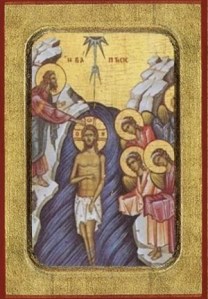
Today’s gospel tells of John the Baptist who prepares the way for Christ’s birth, life, death, and life. The great followings that John attracted would shift to Jesus of Nazareth, as our preacher pointed out today. The Baptist prepared the way. And what did he say that prepared the world for the Savior? What could he possibly say that would be enough? Repent, he said, make his way straight. And with baptism, each follower said yes, I will change and I will make the crooked straight in my life.

And so the way was prepared in the hearts of many.

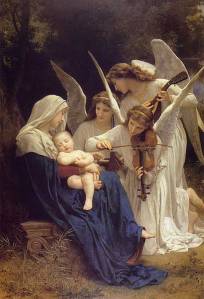
William-Adolphe Bouguereau (1825-1905), Song of Angels (1881)

Just so Advent prepares each one of us to receive the Lord of Lords, to kneel with the shepherds and bring gifts with the kings, to fly with the angels into the starry night of Christmas, Christ’s Mass.

Christmas, full of giving and singing and sharing for a brief time, gives us a taste of glory, the glory of the angels, the glory of life itself, the glory in a newborn baby.

Christmas says you needn’t be great or rich or powerful. In fact, it is better if you are lowly, poor, and powerless. Christmas says look at the baby and sing to him. Thank him. Love him. Invite him into your heart.

As Christina Rosetti wrote in her lovely Christmas sonnet, “What can I give him? I give him my heart.”

May we all experience the glory of the love of God this week, this sacred and holy time, when Christ Jesus came among us, bringing us life here and now, and forever in Eternity.

Come Lord Jesus, come.

December Journal, Third Sunday in Advent

Today is Gaudete Sunday, or Rose Sunday, and Heaven Sunday too. The Third Sunday in Advent is rich with meaning as we prepare for Christmas and the Incarnation of God, come to us to live with us and in us. Such miracle and mystery often astounds me.

The name “Gaudete” meaning “Rejoice” refers to the introit for the day (translated from the Latin):

“Rejoice in the Lord always; again I say, rejoice. Let your forbearance be known to all, for the Lord is near at hand; have no anxiety about anything, but in all things, by prayer and supplication, with thanksgiving, let your requests be known to God.” (Wikipedia)
Indeed, the Lord is near at hand, to be born in Bethlehem soon and reborn in us daily, hourly, with each breath. We need only ask. It is a reminder to be at peace, reconciled to God, with His birth among us, in us. We request what we need and give thanks for the life we have been given. We need not be anxious, but are called to rejoice in the Lord always. It is a good reminder to do so in our worldly world.

We place roses on the altar (no flowers during Advent except for today) and vestments are rose-colored. We consider the “last things” once again, but in the lighter light of Heaven. Having considered Death and Judgment so far, today we hope in Christ to defend us when we die, when we face our examination, or court appearance as it were, that we see what we have done or not done, repent, be absolved and step through the gates of Heaven into the New Jerusalem. It is a good reminder to practice our repentance here on Earth.

The fog drifted into our valley this morning and settled around the hills, obscuring the lower hamlets and allowing the peaks to emerge into light. I watched it swirl and change and move on, as other mists born by the breeze came in, changing shape with each second, opening and closing the planet to the sun.

We too are obscured by the swirling mists of not seeing or not knowing or not being sure of what we believe or who we are. And yet we have a path given to us, a way of parting that fog, if we so desire. We have reasonable arguments for certainty handed to us by the church and a heritage of believers, witnesses who testify to what they have seen and what they know to be true. We need only say “yes” we want to believe, we want to step further into the world of faith, hope, love, and joy. It sounds too good to be true, but it’s true.
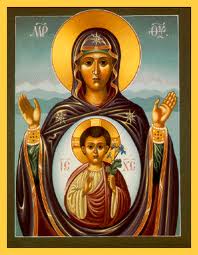
And so we look to Mary who said those words, her “fiat”, her “yes”, her “be it unto me…”, to allow her body to be the home of Christ Jesus. We travel with her through Advent, to learn how to say yes as she did, to step into this miracle given to each one of us, Christmas. We walk alongside her, and she with us, for she is our mother.

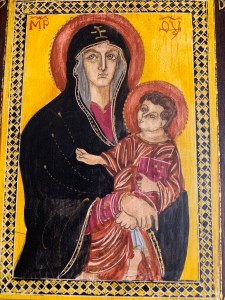
There is a wonderful icon of Mary and the Holy Child Jesus hanging in the great basilica of Mary Major, Santa Maria Maggiore, in Rome. It is said to be painted by St. Luke. Tradition and first century carbon dating testify to the probability that it was. Under the main altar lies the wooden creche. 

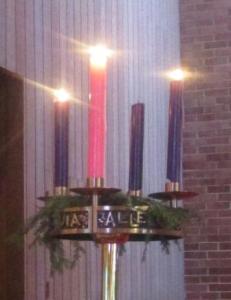
We light our three candles today, including the rose candle, and we recall our ultimate destination, Heaven. As we do, we experience a moment of Heaven on Earth. The candles flame, testifying to the Lord of Lords to come, to be born on Earth and reborn in our hearts.

Yes, come Lord Jesus, come.

December Journal, Second Sunday in Advent

The opening prayer that collected our small flock together on this brilliantly clear morning in a chapel in Berkeley was the “Collect for the Second Sunday in Advent”:

“Blessed Lord, who hast caused all Holy Scriptures to be written for our learning; Grant that we may in such wise hear them, read, mark, learn, and inwardly digest them, that by patience and comfort of thy holy Word, we may embrace, and ever hold fast, the blessed hope of everlasting life, which thou hast given us in our Saviour Jesus Christ. Amen.”   —Anglican Book of Common Prayer, 1928, 92

These opening prayers, written by Archbishop Thomas Cranmer (1489-1556), introduce the Epistle and Gospel lessons for each Sunday of the Church Year. Written at an exceptional time for the English language, the Elizabethan period, we treasure these vivid and lucid expressions, the heart of the appointed – assigned – readings, part introduction, part summary.

Words. Today was all about words. Words in Scripture. Words in prayers. The Word – Christ – the expression of God in human form.

We are to hear, read, mark, learn, and inwardly digest Holy Scripture. These words feed us, both soul and body. For words recreate us, sculpt us. Our beliefs form us; our word-expressions reach out to others, connecting, loving. We make sense of the world around us in words, and if the world doesn’t make sense, we don’t make sense. The body informs the soul. The soul informs the body.

Who are we? What are we? Christ answers these questions, giving each one of us a vision of our own selves as we are meant to be, as His creatures, His children. And with this self-portrait, painted with words, His Word, we are able to live our lives to the fullest, to His glory.

Without these words to mark, learn, and digest daily, weekly, monthly, stepping through the feast of festivals and seasons of each year, we become chaotic creatures empty of meaning and sanity.

Advent’s daily prayer begins with “Almighty God, give us grace that we may cast away the works of darkness, and put upon us the armour of light…”. To memorize this prayer is to digest it, to send our words to God, expressing our need for re-forming, re-creating. And even as we pray the words, we become clothed in a protective garment, an armour of light, lighting the darkness.
Advent. Sculpting who, what, why, and where we are in time and place is no small thing. Advent prepares us for the next great things – the redemption of the world, the apocalypse. For today’s Gospel is Luke 21: 25+ where Christ describes the signs that herald His second coming, when “the kingdom of God is nigh at hand.”

Today is also the theme of Judgment.  We shall be judged. The world shall be judged. But Christ takes our part if we desire Him; we are forgiven if we repent. And so we return to words – words to instruct our conscience, learning right and wrong, law and love. Holy Scripture becomes the textbook that teaches us where we have gone wrong, returning us to who we are and are meant to be. We need merely pray our words to Our Lord to be changed, to be redeemed, to be saved.

And so we prepare for the first coming of Christ in a stable cave in Bethlehem. We hear, read, mark, learn, and inwardly digest the Word of God, Christ himself, come to live with each of us, within us, feeding us, walking alongside, revealing who we are in this miraculous mystery we call the world, Heaven and Earth, now and forever.

December Journal, First Sunday in Advent

The nights have been clear and cold here in the Bay Area. We can see the stars and I reach to touch them, they seem so close. Advent is the time of stars in the heavens. Advent is when we follow the star to Christmas. We reach and we follow the star.
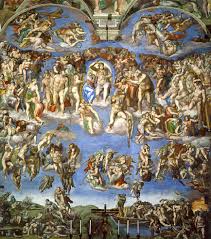
There’s a good deal about light and dark in today’s assigned lessons as we leave behind thanksgiving and open the door to Advent. Light and dark, life and death, judgment. We are told the four last things are to be considered in these Advent Sundays: Death, Judgment, Heaven, Hell. Indeed, these are the four last things we will face when we die, and it appears they are also the four last things to consider when we are alive, if we want to live life to the full.

And so in today’s Epistle, Paul writes to the Roman church (13:8). He speaks of the night being far spent and the day at hand. He tells us to cast away the works of darkness and put on the armor of light, walking honestly as in the day. He even tells us to “put on the Lord Jesus Christ” which I would assume means wear Him like a garment, a protection against the dark and the judgment.

These are big things, subjects we would rather avoid. Especially judgment. We define deviancy down and further down, so that we can deny judging anyone and thus not be judged ourselves. And yet we know deep within there is a moral law all mankind senses, reckoning that a standard has been set, a standard we don’t meet. And with law there is judgment.
What happens when we die? Where do we go? Will we be held accountable for our life on Earth? Christian theology answers these questions in ways that make sense and that have proved true. For in the last twenty years+ witnesses to Heaven have returned to give testimony to what happened to them there. A great deal of literature has been collected, depositions, great clouds of credible witnesses.

And so we face the light and the truth of who we are, in Advent. Today we face death, that it will happen to each one of us some day… today, tomorrow, in fifty years. We are told to live each day as if it were our last, to savor each moment, for these minutes will not return.

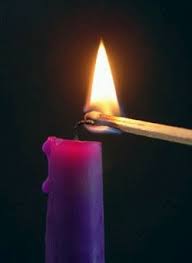
We light our first Advent candle in our Advent wreathe. It is only one small flame in the dark, but it will light the others, each week, until we see the light of Bethlehem, the light of the world, the light of Christ.
Our preacher said that yes, we are in the Endtimes. For Catholic teaching says that the Endtimes – the Apocalypse – began with the birth of Jesus. Each of us has a role to play, a job to do, a vocation assigned to live out fully. Each one is a precious bead in the great rosary of the universe, in the miracle of time itself. Each one of us is necessary to complete the picture of man’s salvation. What is your vocation, job, role? What is mine?

Yesterday was the 150th anniversary of Winston Churchill’s birth. He led the West into the light of freedom, away from the dark of tyranny. He was a great leader for he sensed his destiny was to act at certain times. He was unpopular often, as many leaders are, for he listened to what he thought was right and wasn’t swayed by opinion. They say he wasn’t a religious man, but I say he listened to his head and heart and the angels that hovered about him. He knew the road to take to win freedom back. He worked long hours and slept little. He was brave. Steady. True. Industrious. “Never, never, never give up,” he said. “The price of greatness is responsibility.” And some humor alongside: “History will be kind to me for I intend to write it.” “You have enemies? Good. That means you’ve stood up for something.”

Reminds me of a certain political figure who recently won the White House. And it is interesting that President Trump had an American mother and a British father; Prime Minister Churchill had an American father and a British mother. Both leaders were (are) brash and committed and decisive… and fearless.

It is good we practiced gratitude for our blessings this past week. Gratitude humbles us. Gratitude says, we owe something to someone else. Indeed. We owe much to those giants that have preserved the West, and fought for our freedoms through war and peace. We owe much to our local church, filled with good souls who try to love us. We owe much to our own families who try to put up with us. We owe much to Our Lord who gave us life itself and continues to breathe life into each day we live.

We open the door to Advent, to the advent of Christ among us, that we may be worthy of His gift of life. We light our little candle and watch it flame and flicker, knowing that we are growing green with each day of penitence and prayer, until we complete the circle of pungent pine and shine our little lights on the Light of the World.

We begin at the beginning, the first day of the Church Year. In this new year we open the gates of Jerusalem – and our hearts – to the Messiah as our Gospel reading describes. Today the story begins, and each one of us will play a vital part in the greatest drama of all, life overcoming death, eternally, minute by minute.

We follow the star and see where it leads.

Singing the Song of Thanksgiving

The Cross on Mt. Diablo, courtesy of Bob Marx

I’m pleased to announce that ACFW, American Christian Fiction Writers, has published my post, “Singing the Song of Thanksgiving,” how Christian writers sing songs of thanksgiving with words, breathing life into dust and ash, singing life into our dying world, lighting the dark with the cross. 

Singing the Song of Freedom, a Birthday Melody

I’m pleased to announce that American Christian Fiction Writers (ACFW) has published my birthday post, Singing the Song of Freedom, about how Christian novelists sing the song of freedom to the world with our words, lighting the dark with beauty, truth, and goodness. Thank you, ACFW!

May Journal, Trinity Sunday, Memorial Weekend

Today we celebrate the Holy Trinity, the three persons in one God, God the Father, God the Son, and God the Holy Spirit, beginning the long green Trinity season of growth.

The weekend merges with Memorial Day, fittingly, for memory is a gift of God, a cherished record of who we are and who we are to become. We honor our history and those who fought and died for our nation, a history erased, no longer passed on to our children.

We must not forget. We must not lose our memory of the past, whether it be personal, national, or those truths acted out in history, the salvation of mankind. For the past informs the present, directing the future toward the truth.

Tomorrow, Memorial Day, we celebrate those men and women who have given their lives for our freedom, fighting in wars on other shores, in other waters.

We must not forget. The cost of freedom is dear and it is far better to pay that price peacefully through common laws, agreed upon by a common people, and enforced by their representatives.

We must not forget. The imperative of truth seeking and truth telling in our fragile democracy is the foundation of our fragile freedom. There is not your truth and my truth and their truth. There is only the truth, and it is our challenge to seek it honestly as best we can.

My father, a chaplain on board the Phoenix in the South Pacific in World War II, was a man of truth. Fresh out of Dallas seminary, he joined his ship in June of 1944 at the age of 28. He prayed and he preached and he pastored his young charges, as kamikazes dove into the sea around them. He returned to America even more dedicated than when he enlisted.

He continued his passionate ministry, pastoring in Fresno, Palo Alto, Berkeley, Lafayette, and San Mateo. Through the years, he sought the truth so that he could bear witness to the truth.

The Father, the Son, and the Spirit formed and forged him to become true to the ideals of equality, human dignity, and compassion – truly Christian ideals.

We too must not back down in a world of lies. We must follow the path Our Lord lays out for us, embracing every opportunity to heal our broken world.

For we are broken, with hearts both good and evil. But the Father reaches out to us with the Son, and the Son fills us with the Spirit. A trio of loves lives with each believer, a holy nesting birthing a holy voice that sings the song of the Holy Trinity to the world.

And so we sing the words and the melodies of life itself, of freedom itself.

We learn as baby Christians that God gives us free will to choose to love Him or not. For love can only live within freedom of choice. Freedom comes from God, our precious gift from the Trinity of persons, the Trinity of love.

And so we sing of America the beautiful, of the stars and the stripes that unfurl in skies both clear and cloudy. We sing of our history, so that we will never forget the immense and astonishing gift of living in a free country. We sing of our heroes who died to protect this gift, and we sing of their courage as they fought to protect our shores, our families, our children.

It is true that the truth will set us free. Free of the bondage of evil. Free to welcome the freedom of love. Free from the unlove pulling us into a quicksand of death.

For the truth is the Holy Trinity, the reality of God’s great love for mankind, each one of us. The truth is the Ten Commandments, God the Father’s prescription for living in an unloving world. The truth is the Summary of this Law of Love, to love God with all our heart, soul, and mind, and our neighbor as ourself.

So on this Memorial Weekend we pause to praise the God of all memorials, the Lord of all lives, the Father of all freedoms. We remember with our sacred memory those who have gone before us, those who gave themselves for you and me. We tell our children these sacred stories, so that they will tell their children, so that the people of this great nation will never forget our brave soldiers.

For they gave their lives for us, just as God the Son gave himself for us, in the abundance of mercy from the Spirit and the Father. Just as the Son gives eternal life to all believers and living waters in this life on earth.

We remember and we give thanks for all those who seek the truth about man and God, for those who act upon that truth, that freedom be prized and protected, and for those who honor these men and women who gave their lives for us all.

I can hear Our Lord’s words at Heaven’s gates. “Well done, thou good and faithful servant. Welcome to paradise. You have not been forgotten.”