
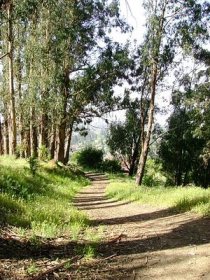
 We are in the long, green, growing season of the Church Year, a season that is seasoned with Paul’s letters to the first Christian churches, and the miracles and teachings of Christ. We heard today in Paul’s Epistle that the wages of sin is death, that as servants of sin we were free from righteousness and without fruit; we were paid with death. But as servants of God, our fruit is holiness and everlasting life through Jesus Christ (Romans 6:19+). In the Gospel (Mark 8:1+) we hear of Christ’s miracle when he fed the four thousand, those traveling to hear him preach from the hillside, turning seven loaves and a few fishes into many, a witness to his divinity and a precursor to the institution of the Holy Eucharist on the night before he was crucified.
It is a time of learning and listening, this green season of Trinitytide.
And so I reflected on the last two weeks and the graced chance to attend daily noon Mass at St. Joseph’s during their seminary residential session. Each morning I decided whether I would go that day, for I have many home commitments that require my presence. But the Real Presence waited for me on the simple altar in our chapel, urging me with that still small voice, nudging me to be present at all ten of the weekday Eucharists.
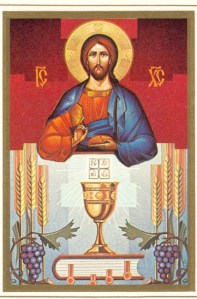 The daily feeding enriched me beyond measure, in a way that I find miraculous and precious. Each day I asked, “What will you show me today?” “What part of my soul needs healing?” so that the effort seemed to work out – the scheduling, the lack of planning, the spontaneity. Ten great gifts for me at the altar. Ten meals for my soul. Ten fruits harvested. Ten seeds planted to flower with faithful watering.
A friend of mine, the vicar of our chapel, showed me a website a number of years ago. There were boys singing in a cathedral a lyrical song I wasn’t familiar with, since it wasn’t in our hymnal. They sang “Great Is Thy Faithfulness.” Their voices soared in the space, and they sang as though they too soared, flying into the domes and beyond into Heaven. I never forgot that, those voices and those words so plaintive and grateful, and I looked up the song later and learned it. It has become one of my favorites, and from time to time we sing it from printed sheets in our chapel.
For it is faithfulness that teaches us about righteousness and the Kingdom of Heaven. It is daily prayer, daily song, daily ritual morning and evening that brings us into God’s presence. Most of the time, the routine is just that, routine, but I have found that as I memorize the words they come from someplace deep inside my heart, and my conversation with the Father, the Son, and the Holy Spirit becomes more real, feeding me, so that I am better able to recognize sin and to know righteousness. The daily conversation gives me the sight that is needed to see, the nutrients needed to flower.
 Faithfulness can be boring, to be sure, and even with this slight annoyance we learn discipline and fortitude. A bit at a time, a still small voice at a time, so that compiled in years upon years (my threescore and fifteen as I write this) the whisper becomes a chorus of angels. Along the way are many dry times, and faithfulness bridges these deserts in the heart. Faithfulness says, go to Mass even if you don’t feel like it.
Faithfulness means getting off the couch and stepping out the door and traveling to Sunday Mass, often at a cost to our immediate comfort. Perhaps it is the cost, the discipline, that feeds more faithfulness, for in time it becomes easier and easier to keep the feast and observe the fast of comfort.
Faithfulness means recognizing and responding to the gifts others have given you – an invitation to teach Sunday School, a chance to sing in the choir, a sign-up for the local mission and its food drive or soup kitchen. We open our hearts and minds to these sudden moments, evaluating if they are sent by God to help s grow green and fruitful and righteous. An elderly friend of mine at the age of 82 faithfully tidies the pews, putting books back, each Sunday. She will be rewarded.
Faithfulness multiplies just as those loaves and fishes multiplied on the hillside. Christ as our creator is not challenged by creating more out of his own creation. And so he multiplies the loaves and the fishes. Just so, he multiplies the graces and blessings in our lives as we open our hearts to his will. Our faithful attendance, seemingly a little thing, begets others to be faithful as well, and then they beget others’, so that many sheep hear the Shepherd’s call, and many seeds are sown in the desert.
Today my heart is full because I took those little baby steps each day to go to the noon Mass. I shall remember these two weeks for a long time, and I shall magnify their presence in my soul with each Sunday eucharist, all the while looking forward to our Seminary Summer Session 2023.
 For great is thy faithfulness, O God my father. Call me to be faithful too.
There is no shadow of turning with Thee.
Thou changest not, Thy compassions, they fail not
As Thou hast been, Thou forever will be.
Great is Thy faithfulness!
Morning by morning new mercies I see.
All I have needed Thy hand hath provided:
Great is Thy faithfulness, Lord, unto me!
Sun, moon and stars in their courses above,
Join with all nature in manifold witness
To Thy great faithfulness, mercy and love.
Great is Thy faithfulness!
Morning by morning new mercies I see.
All I have needed Thy hand hath provided:
Great is Thy faithfulness, Lord, unto me!
Thine own dear presence to cheer and to guide,
Strength for today and bright hope for tomorrow,
Blessings all mine with 10, 000 beside.
Great is Thy faithfulness!
Morning by morning new mercies I see.
All I have needed Thy hand hath provided.
Great is Thy faithfulness!
Great is Thy faithfulness, Lord, unto me!
 This last week I’ve been attending the St. Joseph of Arimathea Seminary (SJATC) residential summer session weekday noon Masses, in Berkeley, at our
  The sun slants in through clerestory windows high above and there are moments when the crucifix is lightened as the sun travels through the skies. The tiled floor gleams and shimmers, reflecting the movement around the altar and the kneeling of the worshipers. Abp. Robert Morse (1923-2015) of blessed memory oversaw the building of this chapel on the corner of Bowditch and Durant in the 1970’s and was wise, considering all the turmoil then, and now today, not to have street level windows. Those church windows that were street-level in those days were often destroyed by rioters, and the parishes forced to rebuild.
 On the weekend between the two weeks, today, the clergy and seminarians are assigned various churches in the Bay Area to assist in the Holy Liturgy. When our Bp. Ashman is here he often confirms at St. Peter’s Parish, Oakland, our sister parish in the East Bay. And so I attended St. Peter’s today, and witnessed the glorious descent of the Holy Spirit upon the confirmand, the joyous hymns, the majestic processions, all a part of reaching for the Eternal on Earth, reaching for the resurrection of Christ and thus, of our own bodies and souls.
 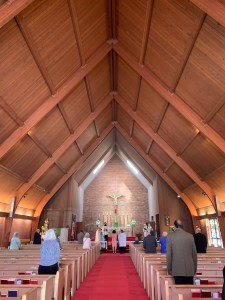 In our parishes of traditional Anglicans (Anglican Province of Christ the King) we face the altar, and we honor Our Lord with music that transcends time, going back to St. Ambrose of the fourth century. Our hymnal is a poetic treasury of history, a history of the love of God expressed in song.
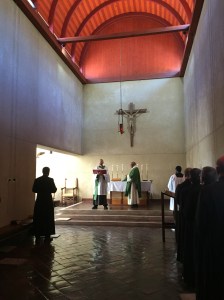 Our university chapel near UC Berkeley,
 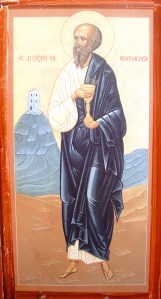 We have a history with the chapel going back to 1974 when the first shovel entered the ground to build this unique church. 1976 is the date of the consecration to St. Joseph of Arimathea, the Apostle to England. Scripture tells us he is the rich man who gave his tomb for the body of Christ. He helped bury him. Legend tells us that he received the Holy Grail from Christ, the cup of the Last Supper before his death. As a tin merchant he traveled to the southern coast of France, worked his way up to the Channel and into the marshy coast of England. He planted his staff where he chose to evangelize, Glastonbury, and the staff flowered. There are other marvel-ous tales about St. Joseph, and today you can see the outline of a cathedral in the tall grasses.
 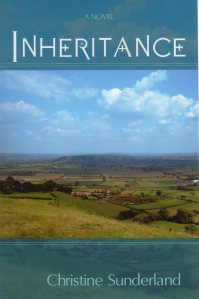 You can climb up to Glastonbury Tor and see the surrounding countryside. I wrote about Glastonbury and St. Joseph in my third novel of a pilgrimage trilogy, Inheritance (OakTara 2009). We have visited many times and been entranced with the sacredness of the place even today. The book cover is the view from the Tor.
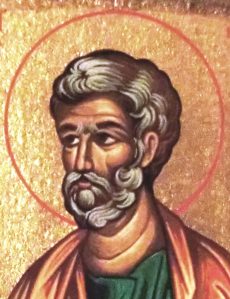 And so it was with a deep sigh of thankfulness that I listened this morning to our priest speak of St. Peter and how Our Lord formed him into a true and strong and faithful apostle, one that would bear the Great Commission (Go into all the lands…). We know it took some forming, this fisherman who was told to catch a different kind of fish. We know the stories of Peter, and there are many in Scripture, how Christ tested his faith and his stamina, again and again, until he was forged in the fire of God’s love. He had a big heart, and this heart became sanctified with this forging. Our seminary seeks to do the same, forging priests who can bear their times, teach to their times, sanctify their times, the age to which they are called. The chapel welcomes others as well, parishioners, worshipers of all ages, some students for a short time come to us, some local residents attend, yearning to touch the holy.
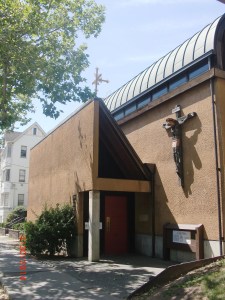 Welcome, St. Joseph of Arimathea Anglican Seminary! Welcome to St. Joseph’s Collegiate Chapel.
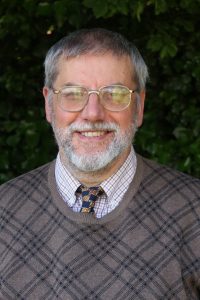 Francis Etheredge, Catholic husband, father of 11, 3 of whom are in heaven, is author of 13 books on

 George Leef is Director of Editorial Content at the

 I am pleased to announce that the
  My review of
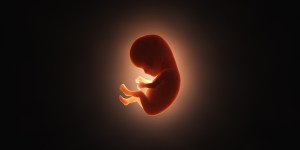 Trinity is the long green growing season, the season of life. Our parish altars are draped in green, and our clergy are vested in green, changed only for saints and martyrs and other special feast days. It is fitting, although way beyond due, that the lives of a generation of unborn babies have been saved, will enter our world of oxygen, breathe their first breaths, cry their first cries, and begin their greening, their growing outside the womb. Earlier, they grew inside, fed not by oxygen but by their mother’s life. And now, they are allowed to breathe the air of our world, to live. Already, in just two days, thousands of lives have been saved.
 This was a great course reversal for our nation and for the world we influence. This has been a victory for all humanity. And it must be added that this recent Supreme Court ruling did not stop abortion entirely, but bravely allowed we, the people, to decide, state by state, with our vote. For nearly fifty years we have lived with the monstrosity of the Roe v. Wade decision that said there was a right to abortion. It has been a great shame and stain upon our nation, and the violence condoned and even celebrated over these years has only encouraged more violence. For if the least of our people, the most innocent, are not protected, no one is protected.
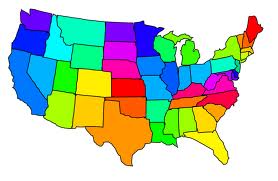 Other countries seem perplexed by our drama of choice, the extremes we seem act out. But we are many states united in federation. When law is legislated by the courts, especially the federal (national) courts, it bypasses the voter. We as Americans demand a say in these vital issues. We demand that we decide when life begins, when the killing is allowed, and why. Nine justices should not be deciding such things. And so the Supreme Court on Friday said, yes, you may vote on these issues from now on. They moved the decision to the states.
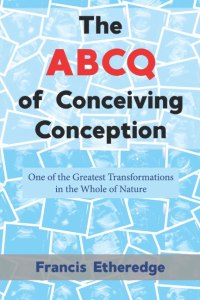
 Those who believe in God generally believe in the soul or spirit, and it is at this moment that God “ensouls” this new life, so that the mother, the father, and God have all come together to create this unique, mysterious, miraculous creature we call a human being. For excellent explanations as to how this happens, described so that we laymen can understand, see the work of Francis Etheredge, especially his recently released ABCQ of Conceiving Conception (En Route, 2022), reviewed in these pages.
 And so I have been singing a Te Deum on and off all weekend, the thanksgiving prayer that St. Ambrose and St. Augustine sang when Augustine emerged from the baptismal pool in the cathedral of Milan. I saw the pool in the crypt many years ago, uncovered by excavations.
 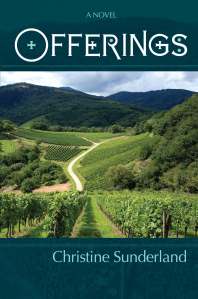 Offerings (A Novel) by Christine Sunderland, Waterford, VA 20197: OakTara Publications, 2009, 249 pages and additional notes.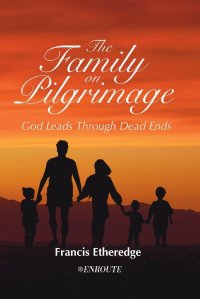
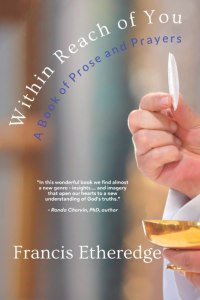 Francis Etheredge, Catholic husband, father of 11, 3 of whom are in heaven, author of 13 books on Amazon, particularly, The Family on Pilgrimage: God Leads Through Dead Ends:
 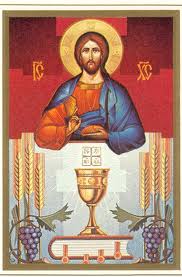 We are in the octave of Corpus Christi, the celebration of the Real Presence of Christ in the Holy Eucharist. The celebration falls on the Thursday after Trinity Sunday, marking the end of the seasons of Eastertide, Ascensiontide, and Whitsuntide, a span of rebirth that now continues in the Holy Eucharist. In my fifth novel, The Magdalene Mystery , I included a Corpus Christi procession, the traditional Rome solemnity, processing from the Lateran Basilica to the Basilica of Mary Maggiore. It is a kind of pilgrimage (and part of the ancient pilgrim’s route), praying with one’s feet, the Host in a monstrance on an altar within a canopy, carried reverently in the procession. It is a somber but happy celebration of the Presence of Christ among us and within us, an ongoing feeding in this life that continues the work of rebirth and re-creation and salvation begun in Baptism.
 In The Magdalene Mystery, to be re-issued this year by En Route Books and Media, I attempted to create a work that embodied our faith. The characters seek answers in Rome’s churches, through clues in the Apostles Creed, and slowly, praying with their hearts and minds, and yes, their feet, they discover the truth about what happened two thousand years ago on a hill outside Jerusalem and in a cave-tomb three days later. They learn what we can know of history and what we have good reason to believe.
 Christine Sunderland
 Christine Sunderland