
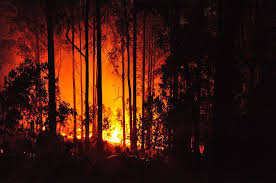
 The fierce firestorms that have devoured our beautiful North Bay counties and blanketed the Bay Area with smoke remind us of our helplessness in the face of the natural world.
Since man first discovered fire by rubbing stones together, he has tried to tame the wildebeest called nature. We are a part of nature, yet somehow apart. We think, reason, argue, debate. We create and we protect others with our creations. We are masters of nature, if not the universe, or so we believe, at least until hurricanes, floods, earthquakes, and fire remind us of our helplessness, and our huge hubris.
Why did this happen? we ask. Indeed, the fires in the North Bay feasted on forest, protected open space. Unlike the East Bay, where a few oaks survive the parched grassy hills, the North Bay has many trees, protected, as though saved to feed the next firestorm. Because we loved the natural world – its beauty, its tranquility, even its so-called spirituality – we safeguarded it from humans, but could not safeguard nature from nature.
We are reminded that the world is a wilderness, tamed in places by human civilization, by communities of people banded together to safeguard one another from the wilds. But if we let down our guard, we are no longer safe. We are not as powerful as we think.
So we seek meaning in the face of natural disasters, asking, Why? Is this the end of the world?
All week I was reminded of the prophet Elijah and the “still small voice” of God. Elijah had retreated to a cave for safety:
“And, behold, the Lord passed by, and a great and strong wind rent the mountains, and brake in pieces the rocks before the Lord; but the Lord was not in the wind: and after the wind an earthquake; but the Lord was not in the earthquake: And after the earthquake a fire; but the Lord was not in the fire: and after the fire a still small voice… And, behold, there came a voice unto him, and said, What doest thou here, Elijah?” (I Kings 19:11-13, KJV)
We are still, small creatures with a few tools, some shelter, and smartphones. Yet we do listen to God’s voice of love.
For it is love that makes us different from this violent natural world surrounding us. And it is freedom, the freedom to choose love, that breathes into us that divine spark. The voice of God is not in the redwoods or the vineyards, so beautiful at harvest. The voice of God is in his words to us, his words to us in Scripture, Sacrament, and prayer. We hear the voice of God when we see how small we are, and from this place of humility, confession, and repentance, we learn to love one another better.
While there is no God in the firestorm or in the hurricanes or in the floods, we hear his voice and see his love in the many who care for one another in these times of crisis. They knock on doors. They carry the elderly to safety. They feed, clothe, and shelter.
They fight these fires that rage according to nature’s rules, not ours. As they quench the torched earth with water, they show they are different from nature. Creatures spurred by love, they hear the still, small voice within.
We bury our dead. We rebuild. We make a wider firebreak around our homes. We restore civilization and civility. Do we remember what we have learned? If we do, if we have learned a lesson, we turn to God, to his still, small voice in Scripture, Sacrament, and prayer. We follow his law of love – the Ten Commandments – and know he will drench the wildfires in our hearts. Only then can his own fire be lit within, his own controlled burning of love. Two of the disciples knew this divine fire as they walked to Emmaus with Christ. “Did not your heart burn within you?” they later asked one another.
We tame our own fires, until we burn with the love of God. God’s fire gives life; it doesn’t consume. God’s fire clears the air of smoke and debris. We can see and we can breathe deeply. We no longer feel quite so helpless in the wilderness of this world.
 Berkeley was quiet as we drove through its leafy streets to St. Joseph’s Collegiate Chapel on the corner of Durant and Bowditch, one block from campus. Once more, we would join others to pray for peace and freedom in Berkeley.
 There comes a time in one’s life, a time in one’s week, a time in one’s time bracketed by calendars and clocks and digital devices, when the cares of the world seem to weigh heavily, crowding upon one another, demanding attention. The cares of the world – those cares we read in print and view in video – those public cares – layer on top of our own personal cares, until we cry that there is no room for more.
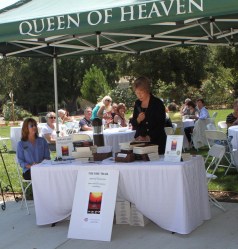 It was a warm sunny Saturday at
  The booming sound of men voicing liturgical responses, creeds, and confessions has lingered in my memory over the weekend. For St. Joseph’s Collegiate Chapel was fulsome with the sound of unison chants and prayers these last two weeks in our Seminary Summer Session.
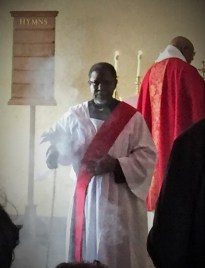 Again and again, I prayed for these postulants and discerners. For the students were largely seekers, searching for God’s will in their lives. As bells rang and the Host was lifted high, I prayed for these men who were discerning their future. Did God call them to be priests? Deacons? Laymen? I knew that the discipline of the residential program would test them as they fitted their lives and bodies into the schedule and demands of living in community. I knew that the discipline of their studies would challenge their minds and memory. And in this process of trial, they would hear God’s voice.
 I recently turned seventy and the best birthday present ever was to see my son and worship side by
  As the world grows more dangerous, church-going becomes more welcome, a true respite and refuge. Worshiping as one chooses is one of the great gifts given to Americans on the wondrous Fourth of July. And each year, as that holiday approaches, I give thanks for the freedom of worship.
 A blistering heat wave finally broke last night in the Bay Area. The fog rolled in from the vast Pacific Ocean, through the Golden Gate, blanketing the towns along the bay with mercy.
 The sky touches the sea here in Hana, Maui, holding it close as the waters move over the face of the earth. It is warm on this Ascension Sunday, the day we celebrate Christ’s bodily ascension from earth to Heaven, but a cool breeze is spirited ashore. We sit on a wooden deck that wraps our cottage, immersed in sky and sea as though joining them. The blue waters crash and spew against green bluffs and black lava, like sudden memories urging our minds to not forget Memorial Day, and to not forget Christ’s ascension.
 St. Mary’s Catholic Church in Hana was festive this morning as though ascending with Christ. All was light and bright, for the Bishop of Honolulu was visiting to confirm eight children. Arched windows in the white walls leading to the vaulted chancel caught breezes from the sea far below, and the gentle air breathed over God’s people. The acolytes and clergy processed in, lighting the path to the altar with crucifix and candles and Holy Scripture, carried by solemn servers absorbed by the rites of holiness.
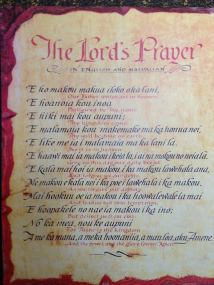 As we witnessed their Confirmations we confirmed our own, ascending with them into Love, into God, this morning in the village church of Hana, Maui. We joined in the singing and praying and thanksgiving. We ascended into the song of love, the song of yes, the song of Scripture and sacrament. In this white church with its polished pews, young and old from all backgrounds joined hands and sang “E ko makou makua iloko okalani…,” “Our Father, who art in Heaven…”
 Christine Sunderland
 Christine Sunderland