 The ordering of chaos has long been a goal of mankind, and long been my own goal, to be sure.
The world often seems chaotic, and yet we see order and meaning in its folds, its wrinkles, the weave of life itself. Those who cannot produce order and meaning in their lives often descend into madness, allowing the chaos to reign.
The order and design of the world – and the universe – is one of the themes of my novel-in-progress, The Music of the Mountain. For music is orderly, if it is to be music and not noise, a judgment that is often subjective, given the cacophony of modern music. Nevertheless, perfect ratios create harmony, and melody pulls the notes into patterns discernable to the human ear.
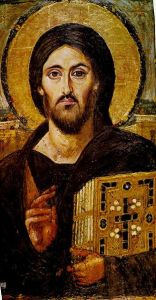 When Christianity, rooted in Judaism, influenced art, music was musical. Notes painted pictures and meaningful moments. They told stories of heartbreak and heroism, of lives lived in beauty, truth, and goodness. Some of this continues today, in spite of the disorder of atheism and agnosticism, but it remains rooted in Christ and his salvific actions for mankind, a divine order ordained in Eden and destroyed by the Fall of Man, a divine order redeemed and made whole should mankind choose life over death, hope over despair, love over hate, truth over lies.
My bishop of blessed memory often said that Christians are a people of reality. We face truth as best we can straight on, without blinders, so that we do not become blind by our own misguided perceptions and opinions. We look to our truth book, the Bible, to discern reality today, to understand the patterns that underlie and inform all of life. From the historical accounts in Holy Scripture we can discern how we fit into those patterns, how each of us is given unique gifts to live out the art of our own life. We look to the Church to formulate doctrine from these great events recorded in Scriptures, giving these truths shape and meaning that effects our own lives.
When we do this, when we become what and who we are made to be, the canvas of our life makes sense, with its broad strokes and its fine lines. We become a book to be read by those we encounter in our time, just as those we encounter become books for us to read with delight. Each of us is a musical score, a symphony, a harmonic singing of the spheres that joins other notes to form grand choruses.
God is our conductor. There are sections of the orchestra and each one of us is placed from birth where we are meant to be, where our song will be sung, and our glorias will harmonize with the others.
 Each one of us is a work of art reflecting and portraying our God of love and his marvelous marvels in time and eternity, living out our divine diversity in all of its beauty and goodness and truth.
Chaos is the result of the Fall of Man, and we live in a world of chaos. And yet, when we search for the truth and see the truth of the human condition we are invited to carve something beautiful out of the chaos, just at God did in the beginning, when he created something out of nothing, filled the void with light and meaning.
There was a time in my life when I rejected belief in the God of Christianity. I was an agnostic, I suppose, and a materialist, that is, all that is real is the material world of matter. C. S. Lewis pulled me out of that suicidal worldview. He pointed to the resurrection of Christ and the logic of belief.
And once you believe that the resurrection most likely happened… there are certain conclusions you cannot escape. Who was/is he? If he was/is who he said he was/is – the God of life and love conquering death – what instructions did he give us? What laws, stories, ways of living did he prescribe?
And so the journey of faith began in my heart, age twenty, fifty-six years ago.
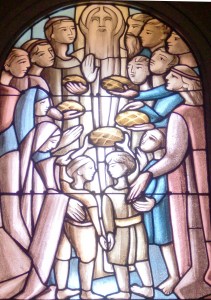 I have learned that the journey cannot be made alone, but must be with others, as prescribed by Christ, that it is a path of continual repentance, absolution, and renewal, that the deeper you go into the love of God in his Church, the deeper you go into beauty and goodness, that the joy of communion with others and with Christ himself in the Eucharist, the greatest of all prayers, is contagious, spreading from one Christian to another, so that when you hear the Psalmist sing, make a joyful noise unto the Lord, you know what he is singing about and you can sing along.
(I have also learned that long sentences reflect the warp and weave of our life in Christ and so I indulge in them often. Indeed, we are long sentences, words birthing phrases with each passing moment, with each turn on the path to Heaven.)
And so today on the Sunday after Thanksgiving, I give thanks for the blessings of America, and for the blessings of the Church, the Body of Christ. I give thanks for not being alone on my journey and knowing Christ is beside me, beside us, within me, within us, as we sing our songs, making those joyful noises we call music. We are not alone.
And today is also what has come to be known as “Stir up Sunday” because of the opening prayer in our Elizabethan prayerbook:
“Stir up, we beseech thee, O Lord, the wills of thy faithful people; that they, plenteously bringing forth the fruit of good works, may by thee be plenteously rewarded; through Jesus Christ our Lord. Amen.” (BCP 225)
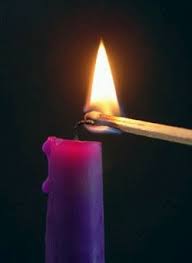 We are stirred up for we enter the season of Advent soon, a season that ushers in Christmas and that miraculous season of giving, of music, of harmony, of love. We are stirred up to prepare for Our Lord’s birth and all that that means for each one of us, when this magnificent God of love took our flesh, became incarnate. Such incarnation incarnates each one of us with Christ himself, his spirit, his love.
And so it goes – the mystery and miracle of words and music and you and me. We follow the star to where it leads, to meaning and purpose and rebirth.
The chaos of the void is no longer a threat, for we have been redeemed by Love.

 It is an unusual year when Christmas Eve falls on the Fourth Sunday in Advent. What is one to do? St. Joseph’s Chapel in Berkeley combined the services, beginning with penitential Advent with purple vestments and segueing into Christmas Eve, Feast of the Nativity, with white vestments. Within these two services, we sang carols with gusto. We ended up with 2 Epistles and 2 Gospels and one Mass. It was all quite remarkable, and allowed our small congregation – a university chapel during winter break – to celebrate appropriately. And it was a visual feast, even changing out the wreathe candles burning brightly alongside our creche. We essentially sanctified the chapel, adorning it in real time with our liturgies, voices, and prayers. We sculpted a work of art, of living art, which is what we were celebrating, the birth of the greatest of all living creations, God’s son incarnate, coming among us, to love us and to save us from ourselves, sin, and death, and to declare victory over all to bring us with Him to Heaven, to life immortal in glorious majesty.
 Our preacher made an important point, that we must practice humility to enjoy life in glorious majesty, just as Our Lord did, coming as he did into such a setting, homeless, fraught with enemies, and yet bearing our burdens, our own Lamb of God taking away the sins of the world.
As the pageantry danced around us, I thought how we were in a new dark age, or darkening one at least, one mirroring Medieval times and earlier. For not only has Christianity been marginalized and threatened, but the general populace is slowly becoming illiterate. Reading and writing has been replaced by images and screens. Sure we can load our phones with books, but that is a temporary measure I sense. Videos are so entertaining, why look at a Kindle page?
Our preacher made an important point, that we must practice humility to enjoy life in glorious majesty, just as Our Lord did, coming as he did into such a setting, homeless, fraught with enemies, and yet bearing our burdens, our own Lamb of God taking away the sins of the world.
As the pageantry danced around us, I thought how we were in a new dark age, or darkening one at least, one mirroring Medieval times and earlier. For not only has Christianity been marginalized and threatened, but the general populace is slowly becoming illiterate. Reading and writing has been replaced by images and screens. Sure we can load our phones with books, but that is a temporary measure I sense. Videos are so entertaining, why look at a Kindle page?
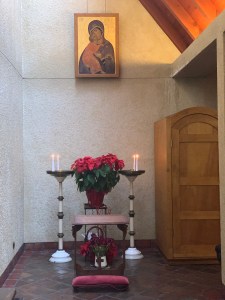 And so how was Christianity taught in the Medieval world? The world of an illiterate populace? Through images – stained glass and sculpture – and through song – hymns and ballads. Memory capacity must have been greater than ours today with no touch screens. And so in our Anglican rite we continue those practices, mostly from habit and love of beauty. We memorize Scripture and Creeds and responses in the Mass. We memorize and recite the General Confession, cleaning out our hearts and minds before becoming one with Our Lord in the Eucharist. We sing hymns, from books with stanzas printed on pages and notes that tell us when to go up and when to go down, how long to hold a note, and even suggestions at the top of the page, like “with spirit” for “The First Noel,” or “with marked rhythm” for “Good Christian Men Rejoice,” or “steadily, in moderate time” for “Silent Night.” But we don’t need those instructions, for the songs are so familiar, thank Heaven, that we live the songs as we sing them, and the Chapel delights in being painted by our voices.
The Medieval world and on for many centuries was an illiterate one. Clergy were trained in Latin, but the populace was illiterate. And not knowing Latin, the liturgies were in themselves in a foreign tongue. Bit through the years, with repetition of the oral traditions and with familiar music and with stained glass stories marching up and down the outer walls, the people became educated in terms of their immortal souls and how to love one another.
Of course mankind never gets it right, with the falling back and moving forward and the darkness devouring the light, until the day comes once again and the light allows us to see once again.
And so how was Christianity taught in the Medieval world? The world of an illiterate populace? Through images – stained glass and sculpture – and through song – hymns and ballads. Memory capacity must have been greater than ours today with no touch screens. And so in our Anglican rite we continue those practices, mostly from habit and love of beauty. We memorize Scripture and Creeds and responses in the Mass. We memorize and recite the General Confession, cleaning out our hearts and minds before becoming one with Our Lord in the Eucharist. We sing hymns, from books with stanzas printed on pages and notes that tell us when to go up and when to go down, how long to hold a note, and even suggestions at the top of the page, like “with spirit” for “The First Noel,” or “with marked rhythm” for “Good Christian Men Rejoice,” or “steadily, in moderate time” for “Silent Night.” But we don’t need those instructions, for the songs are so familiar, thank Heaven, that we live the songs as we sing them, and the Chapel delights in being painted by our voices.
The Medieval world and on for many centuries was an illiterate one. Clergy were trained in Latin, but the populace was illiterate. And not knowing Latin, the liturgies were in themselves in a foreign tongue. Bit through the years, with repetition of the oral traditions and with familiar music and with stained glass stories marching up and down the outer walls, the people became educated in terms of their immortal souls and how to love one another.
Of course mankind never gets it right, with the falling back and moving forward and the darkness devouring the light, until the day comes once again and the light allows us to see once again.
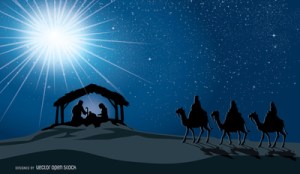
 So embrace Christmas, the greatest story ever told, and sing the song that angels sang to the shepherds, that the wise men heard from the star in the night sky. Give thanks for the symbols and the signs that we must continue to teach, so that when the last blog post is shut down for lack of readers, we will be able to hear God singing to us.
He calls us tonight, this holy night, to come and see him in Bethlehem, the place of bread, where he enters our world in our flesh, so that we can come and see him in church and in the hearts of others who love him.
It is a silent night, a holy night, for all is calm and all is bright. Advent is over for the advent of Christ is here, the coming of the Lord of Lords to save us from the dark.
Merry Christmas to all!
So embrace Christmas, the greatest story ever told, and sing the song that angels sang to the shepherds, that the wise men heard from the star in the night sky. Give thanks for the symbols and the signs that we must continue to teach, so that when the last blog post is shut down for lack of readers, we will be able to hear God singing to us.
He calls us tonight, this holy night, to come and see him in Bethlehem, the place of bread, where he enters our world in our flesh, so that we can come and see him in church and in the hearts of others who love him.
It is a silent night, a holy night, for all is calm and all is bright. Advent is over for the advent of Christ is here, the coming of the Lord of Lords to save us from the dark.
Merry Christmas to all!  It has not always been obvious to me that Christmas trees were more Christian than pagan. They are a Germanic tradition, popularized by Queen Victoria (from one of the German states) in nineteenth-century England. To be sure, the lights festooned through the branches (originally real candles) create a magical sense of another world, one we long for but cannot see. But I wanted more of the Good News of Christmas, so I often placed a creche at the base or nearby, thinking surely this is the true meaning of Christmas.
 So in a sense the tree, once decorated (don’t forget the lights), reaches for Heaven, the star on top pulling us higher. We gaze into the branches of our pasts, hoping to understand who we are today and who we will become on our journey into tomorrow. We play carols as we look into the depths of the fir and think about the true meaning of Christmas, the Incarnation of the Son of God come among us.
 We are told by theologians that the tree reappears on Golgotha, that hill outside Jerusalem, many years later. It is on the wood of a tree that Christ Jesus cancels the Fall, raising us up with him in his resurrection. And so on Good Friday we meditate upon the wood of the cross, thinking of Eden and the wood of that other tree with its forbidden fruit. Mary becomes the new Eve, crushing the serpent at her feet.
 And as I hear the words sung by a choir of faithful, It came upon a midnight clear, that glorious song of old…, or perhaps Silent night, holy night…, I will know I have one foot in Heaven already. Perhaps it is the first rung of a wooden ladder that Jacob saw in his dream.
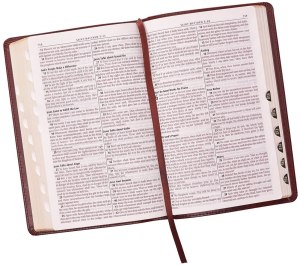 “BLESSED Lord, who hast caused all holy Scriptures to be written for our learning; Grant that we may in such wise hear them, read, mark, learn, and inwardly digest them, that by patience and comfort of thy holy Word, we may embrace, and ever hold fast, the blessed hope of everlasting life, which thou hast given us in our Saviour Jesus Christ. Amen.” (Collect for the Second Sunday in Advent, BCP 1928, p. 92)
 Words have always fascinated me, ever since I learned to read. I recall by the age of ten I was reading Dickens along with Nancy Drew, and devouring library books brought home weekly, piled high (we were limited to ten at a time). I recall the delight I felt in anticipation of all those words and what those words would bring me, where they would take me.
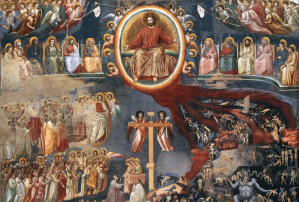 Our Lord goes on to describe his Second Coming in a cloud with power and glory. He is warning us of the advent of the last days and to watch and wait and pay attention to the signs all around us, to be ready.
 And he will teach us to love, to love one another, should we turn to him to read, mark, learn, and inwardly digest his words of life.
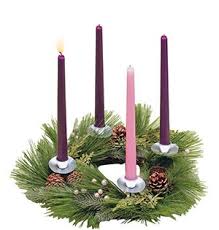 Every Advent I re-memorize the prayer – the Collect – prayed daily in the prayer offices of the Church, including the four Sundays in Advent:
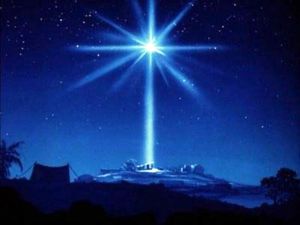 We live in a dark world, and in Advent we pray to see light, to see the star that will lead us to Bethlehem. That star is there for all to see who are not blind. It is bright with the love of God and the love of mankind. It is our beacon of hope in a world of despair.
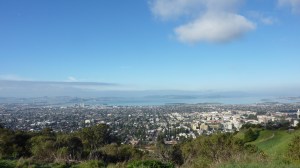 It’s turned cold here in the Bay Area, with some rain during the week. We live on the edge of turning seasons, a turning of the natural world and a turning of the spiritual world. We rotate with time, as it pulls us ever forward, having spent the past, now spending the present, and soon to spend the future.
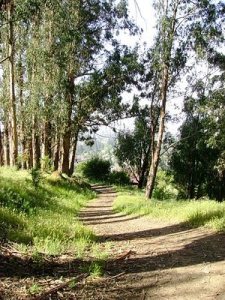 For time disappears behind us as if we are traveling on a path through the woods, speeding on a highway that parts the trees, and we glance back furtively to see what we have left behind.
 We open our hearts to our Creator and invite him in. Come into my heart, dearest Lord Jesus. Come in and live there, plant seeds of life, turn my decay into glory.
 We give thanks. We give thanks for those who sailed from distant shores in search of peace, fleeing persecution or poverty or penury. We give thanks for those who offered their time and talent to make this country better, to make this country safer, to make this country the way that the God of Abraham desires it to be. The list is a long one and growing longer – all the men and women over four hundred years who gave themselves to freedom, by responding responsibly to the call to be all that you can be.
 We give thanks for the children and the fathers and mothers who raise them to be in awe of their birth and what the talents given to them in this remarkable country. We see our sons and daughters grow in love and wisdom, feeding on our lessons of life, of lives lived in the past, of deeds done through the years, of the need to plant seeds in fertile soil to reap a good harvest.
 We tell the stories of The Little Red Hen, of Chicken Little, of The Boy Who Cried Wolf so that our children learn to value industriousness, truth about skies falling (or not), and sounding false alarms. We heard these stories, and many many more, and we pass them on to our children.
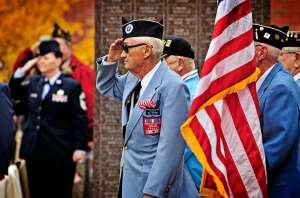 Yesterday was Veterans Day, a national celebration in which we salute those men and women who have defended our country to keep the peace. In many ways, the Armed Services are our national border, for they protect us from harm, protect our homes, our communities, our nation. They salute the flag with their lives, and thus embody freedom. They risk all so that we may be free.
 My last novel, Angel Mountain, is set in the days between Veterans Day and Thanksgiving, 2018. Those days in California were days of fires and earthquakes, shooters and riots, but we had not yet experienced lockdowns and deadly viruses. Even so, the times called for reflection on the big questions, including, is the world coming to an end? Since then, with the compounding horrors at home and abroad, we continue to ask this, along with life’s meaning, death’s meaning, and so we look to Christ and his coming among us.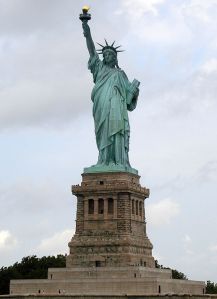
 And most of all, we honor those who risk their lives to protect ours, so that we can continue to salute the dignity of all persons, each one made in the image of God, the God of Abraham, Isaac, and Jacob, the God who loves us so, the God who died and rose again, the God that sets us free.
 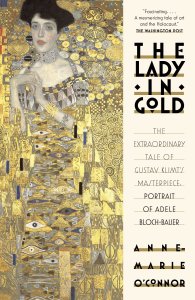 I have been revisiting the backstory of one of my characters in Music of the Mountain, recalling a Holocaust escape from Vienna in August of 1938, based on the true story of Maria Altmann, niece of Adele Bloch-Bauer, whose tale is told in The Lady in Gold by Anne-Marie O’Connor. Some readers may recall the movie with Helen Mirren portraying the recovery of paintings stolen by the Nazis when they annexed Austria in the spring of 1938.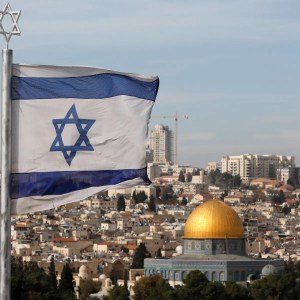
 We in America can also appreciate these cautionary tales of being blind to the reality around us. The terrible attacks of October 7 will not be forgotten and may open our eyes, although it is a horrible price to pay to see the truth. Many of the policies of the Left are no longer “Liberal” but racist regarding minority classes, but most ironically, racist regarding Jews, who have been some of the Left’s largest contributors. We shall see how re-alignments form in the next few years.
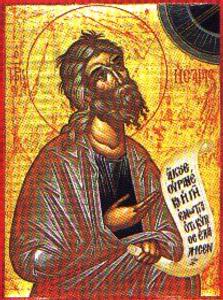 How true. World War II recalls this truth, including the horrendous and controversial bombing of Japan. September 11, 2001 recalls this truth, including our own war on terrorists abroad and the domestic tracking of our citizens. Today’s vulnerability recalls this truth, as open borders invite terrorists into America, our communities, our homes. There are people that mean us harm. Wake up from woke, America.
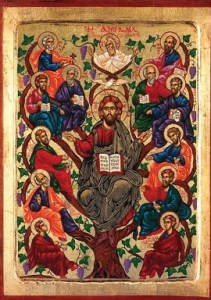 And then there is today, the Feast of Christ the King, a celebration of the victory of life over death, light over darkness. We celebrate the Lamb of God who becomes Christ the King on his throne in glory. We celebrate this victory that outshines all defeats, all darkness. We look to Him to quell the demons of fear that maim and butcher the innocent. We look to Him to pull us from the precipice and bring us home on His shoulders, to cure our blindness and heal our deafness and give voice to the humble and meek. Only Christ the King can redeem our world of death and darkness.
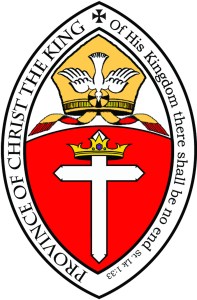 Today, our Anglican Province of Christ the King celebrates their patronal festival. In this world, we hold on to our King, grateful to have preserved the Episcopate, the line of bishops going back to St. John the Evangelist in the first century, the apostle of love. Some of us were in Denver on January 28, 1978 (our good Dean Napier carried the Christ the King banner) and witnessed the consecration of Robert Sherwood Morse to preserve this episcopacy through the centuries. From there our band of truth-tellers welcomed others, so that matters of faith and practice could continue unbroken. These matters were credal ones, issues of belief in key doctrines, or truths, but the one that cannot be denied is the Resurrection of Our Lord, for all else depends on this. Once you believe in the resurrection (and there is plenty of evidence to believe), you have to ask, what does this mean to me, that the Son of God came to earth to love me so? You have to ask, how will I live my life now that I have come to see so clearly? The Resurrection changes everything.
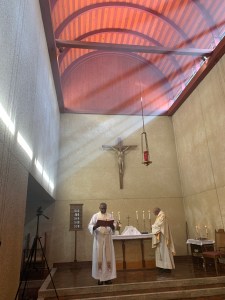 And so in our little chapel in Berkeley, I gave thanks for the love and light of Christ the King, and when the Gospel was sung by our good priest, sunlight shafted through the high windows, enshrining the chancel. It was a vision of love, of knowing, of seeing the truth of Christ, that goodness conquers evil, love conquers hate, and the victory is ours in the precious name of Our Lord Jesus.
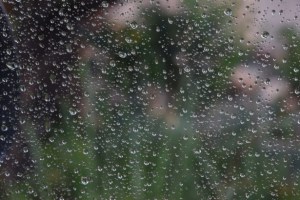 It’s raining!
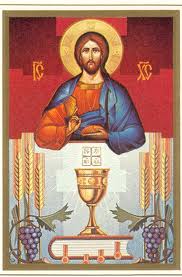 Our preacher is not interpreting these answers on his own, thankfully. He has over two thousand years of Church teaching, Church debate, Church conclusions. He has his own life-time on earth so far, his learning from others in this time, his humility in terms of that learning. But the good news is that there are answers to our many questions. There are answers to who we are, what we are, where we are, where we are going, why and how. And we too, pray for humility as we listen to others and join in their song of God, join in their dance of beauty, as bread and wine welcome the Real Presence of Christ.
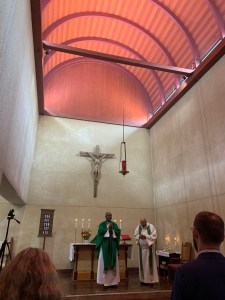 And so, like so much of Holy Scripture, we learn it is about our hearts, our deepest desires, how we decide to live our lives. It is about what we do when we are invited. And as we choose to attend the feast on a Sunday morning in a chapel in Berkeley, we take part as we should – singing, confessing, praying, opening our hearts to mystery and miracle at the Eucharistic table.
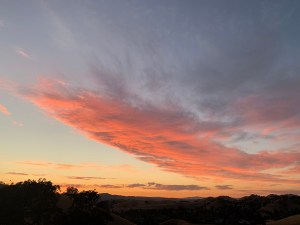 And we turn to our neighbor and see them in a new way. We see our family members in new ways. With each turning and seeing, doors are opened in our souls, doors we didn’t even know were there.
 Christine Sunderland
 Christine Sunderland