
 Victor Davis Hanson recently wisely observed that working on his farm balanced mental work with physical work to leave him more whole, or words to that effect. There is truth to this, that all mind or all body makes for a lopsided individual. We have been created with both, and perhaps it is also true that one influences the other, even corrects or directs the other, in some miraculous complementarity.
As I type these words, I am combining, to a degree, both faculties, the physical fingers placing my thoughts onto the keyboard and onto the screen and then, with the tap of a tab, with the touch of “Publish,” my intellectual fingerings fly into a cloud, our word for something some of us can’t visualize, involving wave lengths or something that abbreviates to WIFI or Internet.
And so as I worked in the back yard the last few days, I thought of VDH’s words and appreciated the ache of my back, the movement of the hose as I unwound and rewound the coils, allowing the water through the long yellow snake of plastic. I really must get one of those trolleys, I thought, realizing the hose had become a workout on its own. But it was good to be outside (in the shade), good to breathe the air deeply, good to clean things up a bit, good to see such direct result of my labor.
I felt grounded by the ground, by the dirt, by the soil, by the plant in the pot drinking up the water from the hose. My thoughts reminded me of Francis Etheredge, probably the most brilliant and under-appreciated Catholic poet of the century, and his garden in back and how he created a book of poems and essays from his relationship to the earth and his relationship to God the creator through the earth. An Unlikely Gardener is soon to be released, and I was honored to write the Foreword, my son Tom contributing an endorsement.
My thoughts then drifted to Tom’s love of the earth and landscaping. He too is grounded, balanced by his work, sculpting God’s garden as he once called it. The vast intricacies of life can be seen in the outdoors, whether sculpted or not, tamed or wild. We are a part of creation, and our bodies respond to the world into which we are born. In some sense we are wild creatures, or part of us remains wild, and we yearn for the conversation we have when we step outside. It is a conversation with an old friend, nature, sunlight, clouds, rain, and a conversation with the creator of all this splendor.

Perhaps it was St. Francis of Assisi (feast day last Wednesday) who tapped my shoulder this week, pointing out the birds of the air, the scuttling jack rabbit, the formal-stepping quail that cross the patio from one side to the other as if it were a great dry route across a desert, from greenery to greenery. Curious things, quail. They can fly but choose not to most of the time; instead they prance prettily in order, scuttling to keep up, groups of ten to twelve, sometimes babies, sometimes older teens ready to leave and start their own family. And so it goes. Life.
What prompted my wild excursion into the backyard? It was the pigeons who had nested on the roof, actually building nests in the chimney, covering the roof tiles with splashes of white. We worried what kind of takeover this was, and while I love to watch them fly, soaring in formation (truly an amazing wonder), we decided to take the matter in hand and hire experts to see what was what on the roof. By the end of the day, they had removed the pigeons and all calling cards, previous homes (alas), and set up some deterrents that have worked so far. I’m glad to say they still soar in our skies, lighting lightly on my patio, for a drink from the planter basin, but not for long.
There was still a necessary cleanup of the patio, and this called me into the sunlight from the shade of my house, pulled me out of my meditative reading and writing, and into the dance with the natural world.
 We are curious creatures, you and I, made in the image of God Almighty. Little mortals, made immortal in his image. We sense this from a deep place within, the heart or the soul or the mind. We sense we are made for something else, and our yearning for happiness and beauty and goodness and justice is planted in this place within. Our yearning for something that is fleeting in this earthly world gives us the hints and guesses that grounds T.S. Eliot in his magnificent Four Quartets.
I don’t live on a farm as VDH does, but he’s profoundly correct. We are body and soul, and we are grounded from our flights of fancy by the real world all around us. It is a real world of matter that matters and lives and dies, crumbles to nothing, having bloomed just for us. We have little power to control the climate and its changes, but we can protect ourselves from its sharper elements, its heat and its cold, as we pretend to be groundskeepers here on planet Earth. For as I cleaned up in the backyard, and as I do the same inside keeping a house clean, I know it is a recurring endeavor, that what I have done this week will be undone next week, and certainly will need redoing again and again in the course of a year, a lifetime.
 It is a dance with life, I suppose. And I’m glad to be dancing, listening and learning the tune the stars sing, to one day follow the song through the galaxies to the heavenly city of Jerusalem, to dance with our Lord of love, our creator and redeemer.
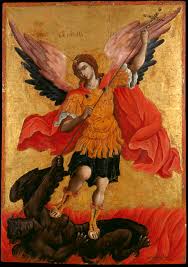 Friday was the Feast of St. Michael and All Angels. I find angels to be special gifts we are given. They are messengers, guardians, and protectors. It is easy to forget that they are all around us. I firmly believe that I have my own guardian angel that prompts me, protects me, and encourages me.
 And so in this rich passage, we see the beginnings and the endings, so that we understand our gift of salvation in the endings, either of our earthly life or the end-times of Earth. Either way, we are welcomed by Christ into his Kingdom. We are welcomed to the great feast, the supper of the Lamb, the Heavenly table. We are invited to be a guest, to make merry with many others who have said yes to Christ, yes to his invitation.
 For Christ gave humanity entrance to the Garden of Eden and we have chosen to remain in the jungle of death. We have chosen to look the other way, passing by the wounded man on the side of the road, wanting only to be left alone. We must speak the truth, that men are men and women are women, that parents have the right to raise their children and determine their education, that abortion can only be an option when the life (not just the health) of the mother is at stake. We must call genocide by its name, and all holocausts by their deeds. We must defend the defenseless, execute our laws, respect justice meted out equally. We must respect all persons, unite and not divide, for everyone is made in the image of God.
 I’ve been thinking about home, having just discovered a beautiful book series called The Theology of Home by Carrie Gress and Noelle Mering. What is home? Home on earth is where our family is or was, where we feel (felt) safe and loved. Home is where we are seen as the individual we see in ourselves, our strengths and weaknesses, our habits and ways of living and speaking. Home is not a house as the real estate folks insist. Home is a gathering of a family who loves us unconditionally (ideally).
  I recently saw “Fahrenheit 451” (the remake, 2018) in which home and family are enemies of the state. Several images have stayed with me, ways of speaking truth to a dying culture, warning us that we are on a path away from our heritage of freedom, a crooked path we need to make straight, one taking us away from our nation’s home, the founding principles and documents (creeds, essentially) that form our cultural home of freedom.
 It appears we must be dependent upon individual goodwill, an honor system. Manners, customs, traditions that birth goodwill must be nurtured and taught to the next generation. Rules of behavior are learned from a young age in the school of the family, for we learn by living together in close proximity. We learn to love one another, not necessarily like one another, a difficult thing to do, from our parents, and our grandparents. We learn that love means sacrifice and possible suffering, for love is a gift given to the beloved, the gift of oneself, one’s time, one’s care. It is the gift of coming home.
 Today we see a conscious effort to divide the family and families of faith found born in churches. These institutions nurture personal choice, personal responsibility, and personal civility with a litany of vices and virtues. The list is clear and forms a path to civility and freedom of speech:
 And so, in my novel, The Music of the Mountain, I explore some of these challenges in our world today, as I have done in The Fire Trail (2016) and Angel Mountain (2020). Our world is close to the book burning described by Ray Bradbury. We have allowed the shunning and firing of those who say the wrong words. We look away, as they did in Hitler’s Germany in the 1930’s. Our nation is moving closer and closer to silencing by force.
 One of the delights of being a Christian is that I am never bored. Or at least I cannot recall the last time I was bored, and given my memory and age, it may be true that I’m not to be trusted.
 Animals too. No two alike. Plants. No two alike. How can such infinite variety be comprehended? That is one of the arguments recent scientists have made for the existence of God.
  I’m pleased to say I have finally found a few hours to return to my manuscript, the first draft of my eighth novel. I have found that as I age, I move more slowly with more aches and more pains and greater care not to trip and fall. And as this natural progression occurs, one that pulls me toward my final, eternal, and glorious destination, I am also caretaker for two others, my mother (103) and my husband (88, but I didn’t tell you). So oddly, there is less and less time for… playing around with words.
 But those tests will be much later, after readers have read drafts and editors have weighed in. And at the end of the day, I won’t be woke enough to appeal to today’s publishers. But I’m happy to slip under the radar, in exchange for telling the truth as I see it, nothing but the truth, so help me God.
 Looking back to this morning, the experience of singing and saying and listening and learning together with others, where many voices become one voice, and many prayers become one prayer, I see a sculpted hour that is indeed its own work of art. It was an hour of our time, mine and other faithful, that became a creation of love, a song or symphony of praise, an offering of men and women to their Creator. And in return, Christ gave us himself. Pretty good exchange.
 And it is curious, that our liturgy developed when an illiterate people took part, many centuries ago. You don’t have to be able to read in order to hear and say and sing and see. If you go regularly you learn by heart, engrafted on your heart. It may be that this is the liturgy of the future, as we turn the clocks back to an illiterate time, a time of graphic novels, pictures, apps, and screens.
 I’ve been thinking about time and the language we use to describe this remarkable, mystical, and mortal aspect of our existence. We see time as something tangible that we are given and that we spend. We have a limited amount, clearly, for how we spend it matters. We say time was lost, time disappeared, time passed. We hold an account of time, rather like a bank deposit, like coins paid out or hoarded.
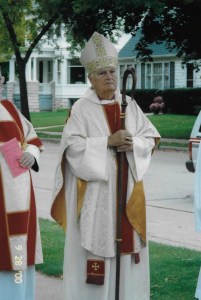 We have many ways of marking time – calendars, seasons, festivals, birthdays, anniversaries, pilgrimages. I went on a pilgrimage once, a curious experience of procession, prayer, intercession, reflection, and time marked by my footsteps along the main street of a town, along with others, walking and singing toward a shrine of an Anglican saint in Fond-du-lac, Wisconsin, Bishop Charles Grafton.
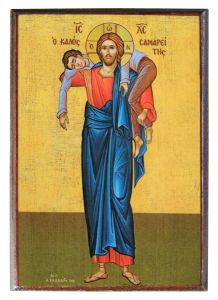 I considered these things this morning in my time with other faithful (this time logging in from home) and listened to the Gospel about the Good Samaritan. Christ tells this parable in answer to the question, “If I must love my neighbor as myself, who, exactly is my neighbor?” We all know the parable – the man accosted by thieves and left by the side of the road, those travelers who pass by him, and the one man, a hated Samaritan, who stops to help him, bind his wounds, and take him to an inn to care for him. Clearly, Our Lord tells us, we must love and care for all.
  And so the clock ticks through our days, hours, and minutes. How are we spending our days, hours, minutes? Could our time be better spent? Are we burying our talents, spending our time fruitlessly? These are valuable, blessed questions to ask, to reflect upon, and find answers in the Inn of Christ, his Church. And this is how we spend our time on a Sunday, being lifted in the arms of Our Lord and carried upon his shoulders, to be healed.
 hat being said, the silencing of speech today is a dark trend that silences freedom. The silencing of elections and election challenges invites distrust in government. The silencing of instruction in Civics and American History in high school and college allows false histories to grow like cancer among our people, and is a death knell for democracy. The silencing of the rule of law is perhaps the most egregious, for political opponents are tried in show trials and imprisoned at the whim of the powerful.
 And so as we sang together, many voices becoming one, in our chapel this morning, I thought of the mystic chords of memory, how we sing those harmonies that form a family from folks of varying backgrounds, varying ages, varying talents. We sang a particularly poignant hymn, #299, 1940 Hymnal, written by Percy Dearmer in 1933, a priest who has penned many. I did not recall these words (with my failing memory), but the hymn gives thanks for all those who have given us so much, all those we must not forget in these troubled times:
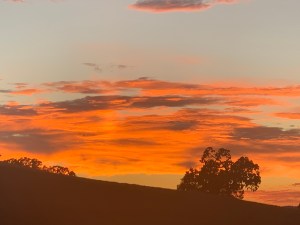 It is only mid-August, and yet hints of autumn have teased us this last week, here in the Bay Area. Temperatures have dropped a bit, school has started, and the rituals and rhythms of summer’s end are dancing through our days.
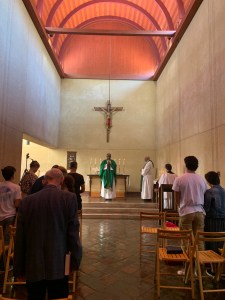 And so this morning, we (my husband, myself, and the Holy Spirit within us) headed for St. Joseph’s Chapel in Berkeley, a precious space of prayer, a special gathering of God’s children, for an hour of penitence and repentance and salvation. It was a sacred time, set apart from the bustle of the world, a family time of sharing the Eucharistic feast, Our Lord himself. We prayed the Decalogue (the Ten Commandments), beseeching God to incline our hearts to keep these laws and even to write these laws on our hearts. It is a good reminder, a simple reminder, of what is required of the faithful, and we as infirm irresolute human beings need reminders. For surely we desire to incline our hearts toward obedience, for then we will be happy. We need these laws written on our hearts too, so that we do not forget, so that we leave this hour of sacred space in our mortal time, stronger, with a more informed conscience.
 The irony is that only by looking out of ourselves can we become ourselves. Only by looking up to the Heavens and forgetting for a moment our immediate desires, can we know our place on Earth. Only by seeing each person as precious, a divine creation, can we know that we too are precious and a divine creation.
  We pray for those lost in the fires on Maui and those survivors who must rebuild their lives.
 I first realized the truth of this shaky truce between man and nature when we first visited the Big Island of Hawaii, where black volcanic lava from Kilauea covers much of the west side of the island. It looks like a moonscape. I wondered as we drove from the airport up the coast to our hotel, why we had come, and why anyone would want to come here, a place so barren and bleak. Yet, farther up the coast the lava rock had turned to lava gravel with greenery trying to sprout. Farther still, our hotel had carved out an oasis amidst this flat volcanic world, a water-fueled landscape of palms and hibiscus and white imported sand that met the blue sea, a pleasure to our urban eyes. Other resorts worked the same miracle by piping water in, landscaping with greenery, and creating beauty in a black lava desert.
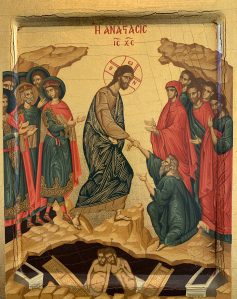 Things are not always as they seem. Life and death are close cousins, even siblings. It is good to remember this, that we will not live forever on this earth, but can choose Eternity in Heaven. For Our Lord has given us hope in his resurrection, his conquering death, his command of the natural world. It is his life that lives within us (for those who believe and desire him) and it is his death that has given us life everlasting. He is the alpha and the omega, the only one who can and does free us from ourselves, from our own blindness. He is the one to whom we sing on a Sunday morning in a Berkeley chapel and in our evening prayers as the light dims and dusk falls. He is the one who lives in the prophets and their prophecies, about whom poets and playwrights write, and about whom the bards sing their ballads.
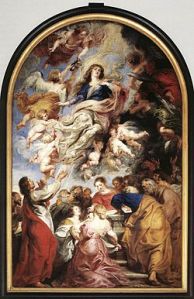 And so, on this Sunday in Trinitytide that falls between the Transfiguration of Our Lord and the Assumption of Mary we witness to the astounding news that God loves us. For he has shown us many things and will show us many more. He loves us. He is with us. Emmanuel. One day, we too will be transfigured, death turned to life, and we will rise to Heaven to be with our family and friends once again. One day, we will escape the fires and the storms and the twisting of truth about who we are and are meant to be.
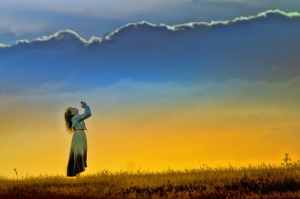 I have become fascinated with the accounts of “Near-Death Experiences,” when a person dies and returns to life, having witnessed something resembling a route to Heaven, or Paradise itself. I have been reading a curated summary of findings over the last few decades in
 The interest has led me to a website,
  Through it all, and I am continuing the study (plot alert in terms of this blog…), I had a question I wanted answered. I finally found the answer(s). The question was, what about sin in Heaven? If we have free will, and we are told we must be free in order to love God and our fellows, then do we have it in Heaven? And if we do, what keeps us from sinning again? What protects us from other sinners? The problem of freedom and love was a nagging one. I found a good answer on an online site called
 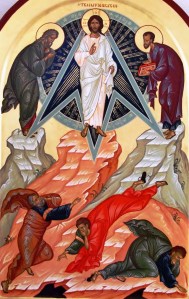 For we will be transformed and transfigured, just as Christ was on Mount Tabor with Elijah and Moses in today’s Gospel (Luke 9:28+, BCP 248) with the light and love of God. We will enter that “cloud,” be filled with Christ’s love, and be carried to a better world that awaits us. In the meantime on Earth, we experience a taste of that transfiguration when we worship together, when we sing and praise God. For in time we are transformed, sanctified, made ready for our final journey outside of time.
 Christine Sunderland
 Christine Sunderland