
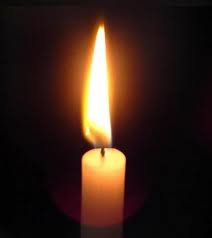
 This year the Feast of the Presentation of Christ lands on a Sunday, today, February 2, Epiphany 4, shining light on the act of the giving, of the presenting, of the offering of Christ to the world, indeed, to you and me (Luke 22+).
Mary and Joseph are fulfilling Jewish law, presenting their son to God. But what touches me about this story is Simeon and Anna, two prophets who have waited for the Messiah, fasting and praying, having been promised they would see the child before they died. When Mary and Joseph arrive with Jesus, Simeon knows immediately that his promise has been fulfilled.
Simeon’s response glorifies God and is a part of our Anglican Evening Prayer, so it is well known and often prayed by the faithful each evening. It is called the Song of Simeon and the Nunc Dimmitis, Latin for the first words of the canticle. Simeon knows this is the promised one and raises him up in his arms, praising God:
Nunc dimittis. St. Luke ii. 29, BCP 28
LORD, now lettest thou thy servant depart in peace, according to thy word.
For mine eyes have seen thy salvation,
Which thou hast prepared before the face of all people;
To be a light to lighten the Gentiles, and to be the glory of thy people Israel.
And just so, in this scene, we see another epiphany, or perhaps many, as the Holy Child is recognized by the Jewish world and presented to the gentile world as a light to lighten their way. God offers his son to us, presents Him to each one of us, a great and holy gift.
We also learn that Anna “gave thanks likewise unto the Lord, and spake of him to all them that looked for redemption in Jerusalem.”
The presentation of Christ to the world is thus effected through the rituals of the time, uniting us with the Judaic history back to Moses, connecting us with this offering in the temple, bringing that past into our present, to become part of the Christian year on February 2.
This presenting, this ultimate epiphany of Jesus Christ, the Messiah, dramatizes this glorious, momentous, event for all the world. The world has been prepared with the choosing of the People of God, the People of Israel, and their journey through time to this moment. And then the impossible becomes possible, God enters our world as a baby in a stable. The stars change course. Shepherds hear angels. Kings travel on camels to lay gifts at his feet. The world will never be the same.
And yet the presentation is also the offering of Our Lord to each one of us. Do we accept the gift of Love incarnate? Or are we ashamed to confess the faith of Christ crucified?
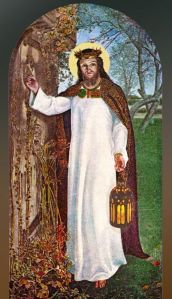
Light of the World, by Holman Hunt
I believe this offering never ends, at least in our lifetimes. He will knock again and again at the doors of our hearts. Some will not hear the knock. Some will hear it late and miss out on early glory. Some will open their hearts to the Lord of Hosts on the first knock, the first presentation.
And will those who invite him in celebrate his presence, sing him songs, love him as he loves us?
For when this happens, another amazing presentation happens. We turn about, and we make our own presentation of the Lord to others. We point to the child born in the stable, this salvation for all people, this light to lighten our way through this life and into the next. We raise him high as Simeon did, praising his mercy and grace.
Luke writes that “the child grew, and waxed strong in spirit, filled with wisdom: and the grace of God was upon him.” When we accept this Savior of the world as our savior, we too will wax strong, be given wisdom and grace. We too will sing songs of thanksgiving and praise. We too will look for every chance to present him to others, to knock on the doors of their hearts.
Deo gratias.
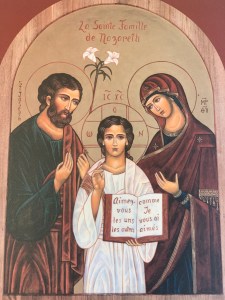
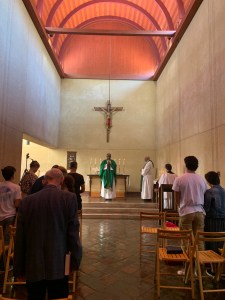 Are we part of a church community, one that welcomes us on board to sail the seas of our time? For community is one of the pillars found in Holy Scripture – community that teaches us, feeds us, leads us through the rough waters. It is the church family that gives us the songs to sing, the prayers to pray, the eucharists to strengthen our hearts and souls.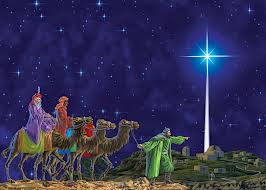
 We are in the middle of Christmastide, those twelve glorious days of Christmas ending on Epiphany, January 6.
  And we try to be like the angels and sing to him in his manger. We sing of the miracle and mystery of that unlikely birth, we harken to the herald angels singing glory to the newborn king, we sing of a silent and holy night when away in the manger there was no crib for his bed, we tell of the little town of Bethlehem and what happened on that midnight clear when the glorious song of old was heard as angels touched their harps of gold, for Christ is born of Mary, and while mortals sleep, the stars proclaim the birth and peace to men on earth.
 We teach our children the songs, so that they will teach their children. To help them remember, we dress them to play parts in a stable in Bethlehem. We clothe them with the story of the Christ Child. They act out the greatest story ever told, and each year they add to their own library of Christmas rituals and traditions.
 Today is Gaudete Sunday, or Rose Sunday, and Heaven Sunday too. The Third Sunday in Advent is rich with meaning as we prepare for Christmas and the Incarnation of God, come to us to live with us and in us. Such miracle and mystery often astounds me.
 “Rejoice in the Lord always; again I say, rejoice. Let your forbearance be known to all, for the Lord is near at hand; have no anxiety about anything, but in all things, by prayer and supplication, with thanksgiving, let your requests be known to God.” (Wikipedia)
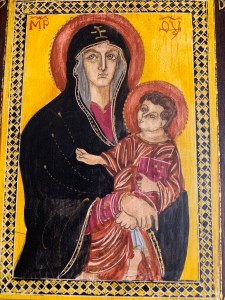 orld of faith, hope, love, and joy. It sounds too good to be true, but it’s true.
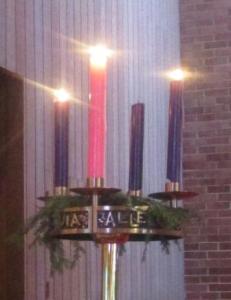 We light our three candles today, including the rose candle, and we recall our ultimate destination, Heaven. As we do, we experience a moment of Heaven on Earth. The candles flame, testifying to the Lord of Lords to come, to be born on Earth and reborn in our hearts.
 The nights have been clear and cold here in the Bay Area. We can see the stars and I reach to touch them, they seem so close. Advent is the time of stars in the heavens. Advent is when we follow the star to Christmas. We reach and we follow the star.
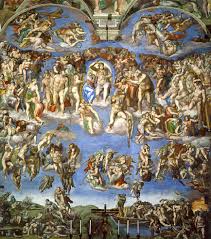 These are big things, subjects we would rather avoid. Especially judgment. We define deviancy down and further down, so that we can deny judging anyone and thus not be judged ourselves. And yet we know deep within there is a moral law all mankind senses, reckoning that a standard has been set, a standard we don’t meet. And with law there is judgment.
 We light our first Advent candle in our Advent wreathe. It is only one small flame in the dark, but it will light the others, each week, until we see the light of Bethlehem, the light of the world, the light of Christ.
 It is good we practiced gratitude for our blessings this past week. Gratitude humbles us. Gratitude says, we owe something to someone else. Indeed. We owe much to those giants that have preserved the West, and fought for our freedoms through war and peace. We owe much to our local church, filled with good souls who try to love us. We owe much to our own families who try to put up with us. We owe much to Our Lord who gave us life itself and continues to breathe life into each day we live.
 We begin at the beginning, the first day of the Church Year. In this new year we open the gates of Jerusalem – and our hearts – to the Messiah as our Gospel reading describes. Today the story begins, and each one of us will play a vital part in the greatest drama of all, life overcoming death, eternally, minute by minute.
 It is a season of renewal, a time when we review the old year and make resolutions for the new one. We judge our time, our spending of time, our use or abuse of the year 2015. Each year is a gift. It is a unique segment of our lives, a year we cannot retrieve and a year that will never be repeated. We are given only one chance with our lives, only one chance with the time given.
 Since signing a contract with eLectio Publishing earlier this week for the publication of my novel, The Fire Trail, to be released May 10, I have been rereading the manuscript, polishing, fine-tuning. Words and phrases are deleted and replaced, sentences are shaved and reshaped, paragraphs and pages and chapters judged as honestly as possible.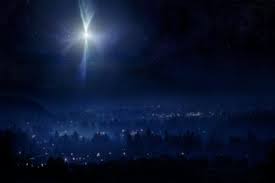

 Christine Sunderland
 Christine Sunderland