
Tag Archives: Jesus

June Journal, First Sunday after Trinity

There are times when truth hits forcefully (gob-smacks? or perhaps God-smacks?), as though you always knew it but had buried it and now it appeared like a long lost coin or memory or friend. God’s truth is like that. The Trinity is like that. Love is like that.

Our Bishop Morse of blessed memory often said that the Trinity – the remarkable union of God the Father, God the Son, and God the Holy Spirit – is the love between the three persons of God. It was a confusing idea for me until recently when I thought about our parish churches.

For it is the Trinity that lives in our churches (or should). God the Holy Spirit welcomes folks into his home. Through an usher, He opens the door, greets us warmly, hands us a bulletin, and leads us to our pew. He will inspire us, fill us with his spirit, as we pray and sing together. God the Father presides as Host of the banquet, insuring order and peace through ceremony and ritual. God the Son awaits on the altar – that banquet table – in the species of bread and wine.

It is this Love that we enter as we step into a church. And as we settle in, we are aware of great beauty – the beauty of an organ playing a Bach preludethe beauty of flaming candles on a linen-draped altar, the beauty of cleanliness suffused with old incense, the beauty of symmetry, the space pointing and leading to the Lord of Lords and away from the self of self, you and I. We know, dwelling in this house for an hour, the beauty of holiness. We know love. We know the Holy Trinity.

The beauty of holiness. What is that? Amazingly, such beauty is by design and not difficult to create with the help of imagining first impressions as the stranger becomes our sister or brother. It is Worship 101, my compilation fron fifty-seven years of Anglican Eucharists in many parishes with many Families of God, my dear brothers and sisters:

  1. The porch and front doors must invite, be in good shape, with clear and attractive signage nearby. In this way the church family introduces who they are and what they offer, good information for the visitor.
  2. The entry or narthex also welcomes, is clean and orderly, and provides information and direction.
  3. Greeters and ushers welcome the visitor personally, creating a human bond with strangers entering a sacred space. The usher is the visitor’s first contact and must be Christlike in caring and concern as folks find refuge from the secular without, entering the sacred within. The bulletin he offers contains the service with hymns and prayers as well as welcoming words, inviting all to stay for coffee.
  4. The interior’s first impression: what we hear, what we see. The organ plays preludes to settle the mind in beauty, to prepare a quiet mind to worship; the sanctuary is alight with candles lit on the altar, a Sanctus lamp burns before the tabernacle; the hushed holiness is tangible.
  5. The space is clean and tidy – brochures, hymnals, and prayerbooks neatly placed in the pews, readily available.
  6. The Family of God is on time: the church is open and all is ready at least 15 minutes before the scheduled liturgy so we may prepare our hearts and minds for worship and to receive visitors. The service begins promptly unless there is an exception for good reason. The visitor’s time is precious. The church must respect that. He will judge this family of God in many ways, some clear, some not. He may not bother to return. Most do not. We are marketing the Family of God and we must think of first impressions.
  7. The Family of God sings and prays together, involved in the Work of the Liturgy, standing to sing, kneeling to pray, sitting to listen to instruction (exception is the Holy Gospel, when we stand). We contribute our voices in prayer and song. The words we say and sing together teach us about God and Man, Salvation and Love.
  8. Sermons are concise and well crafted (ten minutes); they are scriptural and doctrinally sound. Announcements reveal our family life together – invitations to coffee after the service extend our hospitality; practical matters as to receiving the Holy Eucharist are explained. Can all receive? How do I receive? What is the custom here? Can I just receive a blessing? How?
  9. The Holy Eucharist is intoned by the priest with reverence, without drama and exaggeration, but heartfelt, each word a call upon Almighty God; it is not a recitation, but the celebrant says the words as if for the first time, standing on holy ground, the burning bush on the altar. He faces the altar representing us in the pews, offering the Holy Mass for us, his Family of God.

With these guidelines we create beauty – ordered beauty. We also create love – the love of family, the Family of God, the Bride of Christ, the Church. Within this love we meet our salvation, now and in Eternity.

Governor Arnold Schwarzenegger recently said that immigrating is like being invited into someone’s home. I arrive on time. I knock or ring the bell to let them know I am present, having been invited. The host opens the door (freely). I cross the threshold – the border – and enter the home, this personal space. They are the host. I am their guest. I follow custom and courtesy, respecting their rules. I wear proper garments. I take the seat shown to me. I bring gifts to show my gratitude – my time, my talent, my treasure.

The host has worked to prepare for my arrival – cleaned the house, welcomed me warmly, ushered me to a place of comfort, rest, and nourishment.

Just so, when I cross the threshold of a church and enter into this beauty of holiness, I experience hospitality and know I have come home. For the church connects our two homes – Earth and Heaven. It is a bridge, or path, or tunnel. It is the outspread arms of Christ welcoming me. I leave Earth behind when I cross the threshold. I step up the aisle toward Heaven in the tabernacle on the altar. In the next hour I will dwell in God and He in me. I will be changed.
The Family of God loves the stranger and opens the doors early, just in case. As mentioned, the organist begins early. The healing beauty of music pours out the doors onto the porch and pavement, calling all to come and see.
At one time – before the locking of churches – I could drop in unannounced like a beloved family member. I could step through the doors and enter a hushed and holy place and dwell for a time in the love of the Holy Trinity. I might be alone for a time in this peaceful beauty, a precious time in the quiet, kneeling before Christ in the tabernacle, signified by a red lamp burning. The silence quiets me, surrounding me with prayers of the faithful through the years – my soul family – in this space and time. I open a prayerbook, turn the pages, pray the prayers and psalms, and thus add my own heart’s desires to the weave of time past and time future, now contained in time present.

If we are faithful with the basics of being good hosts and welcoming the stranger (Liturgy 101) we may not see a great difference in growth or it may be slow and steady. But we will know we have laid the foundation to build upon in our parish life. We know we have done what is required. We must not neglect these routines of caretaking or we will grow inward, become a closed funeral society, a family perhaps but not a Family of God. We will become blind and deaf and mute.

And so we keep the faith by practicing faithfulness in all these little things, making a home for the Holy Trinity in our neighborhood, a home where He can be Host and welcome the stranger.

In that spirit of welcome, I’m pleased to announce another Goodreads Giveaway, this time my seventh novel, Angel Mountain (Wipf and Stock, 2020), in celebration of Western Civilization, libraries, and literature. For more information visit Goodreads Giveaways.

March Journal, Second Sunday in Lent

It’s been cold and rainy here in the Bay Area, at least cold by California standards. Wind chill. Woke to snow on Mount Diablo the other morning. Rather like our souls, feeling the cold and rain and wind of the world battering our Lenten journey.
We are called to sanctification, says Saint Paul to the Thessalonians in our Epistle today, and Lent helps us with that. We clean out our hearts and our habits and all the mess that we have made of our lives. We scour with honesty, disinfect with courage, and peek at what we have left. We repent of our pride and our unlove and our breaking the commandments without care. We desire to be made new, to be healed and made whole, by the greatest miracle worker of all, Christ Jesus, who in today’s Gospel, heals the daughter of the Canaanite woman who is “grievously vexed with a devil.” He does it from afar, because the woman believes, is faithful. (Matthew 15:21+)

We too, want that healing. We too, want to have that kind of faith.

And so with great difficulty I have tried to memorize my psalm, but the words slip away, so I placed it in my phone with easy access, banishing my excuses or at lease embarrassing them. “God be merciful unto us, and bless us, and show us the light of his countenance and be merciful unto us.” (Psalms 67)
Mercy, blessing, and light. Like the burning bush, perhaps. Light radiating from his face toward us, love enlightened. Sacrificial love, the kind of love we are to practice. Forgive my unlove, Lord. Teach me to love.

But can we love with a cluttered soul? We must clean things up.

I visited our Berkeley chapel this morning and afterwards looked into the basement of Morse House next door where we store things, all kinds of things (don’t ask). It needs cleaning out, sorting, reboxing. There were files that needed tending, histories that needed recording and saving for future generations.

I thought my soul must look like that if the light of the Father’s countenance were to shine upon it. Things forgotten, things undone, things done that shouldn’t have been done. And so I pray for the light to see the damage, the minutes, hours, days and years of living, all packed into memory files that need opening and scouring.

I have found that weekly Eucharists help with this, feedings to strengthen my soul. The Church is like a spiritual gym and must be enjoyed weekly if not more often. We have been given the great gift of Christ among us, solving our sufferings, leading us with the light of His countenance. In the Mass we confess our failings and receive absolution. We are clean when we step to the altar and receive Christ himself in the mystery of the bread and wine.

Thinking now of this morning, and the amazing contrasts between the ordered space of the chapel and the disordered space of the basement and the wailing wind outside, I am thankful for the good clergy we have, the faithful friends who worship alongside me, and the organ that sends notes of glory into the russet dome above, sent aloft with our soaring songs.

I am thankful for a moment of brilliant light that revealed who we are, children of the Father, the Son, and the Holy Ghost.

“God be merciful unto us, and bless us, and show us the light of his countenance, and be merciful unto us…”

March Journal, First Sunday in Lent

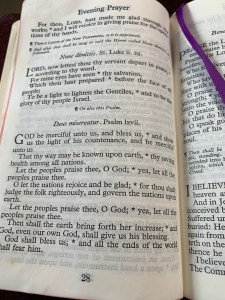
I finally chose my Lenten memory work. I’m adding a Psalm from Evening Prayer (Book of Common Prayer, p.28) that seems appropriate today. I wanted a thanksgiving Psalm, but segued into praise and petition:
Deus misereatur. Psalm lxvii.
GOD be merciful unto us, and bless us, * and show us the
light of his countenance, and be merciful unto us;
That thy way may be known upon earth, * thy saving
health among all nations.
Let the peoples praise thee, O God; * yea, let all the
peoples praise thee.
O let the nations rejoice and be glad; * for thou shalt
judge the folk righteously, and govern the nations upon
earth.
Let the peoples praise thee, O God; * yea, let all the
peoples praise thee.
Then shall the earth bring forth her increase; * and God,
even our own God, shall give us his blessing.
God shall bless us; * and all the ends of the world shall
fear him.

My memory library is growing, and I hold the words and images close, housed by my heart and mindful in my mind, sensed by my soul.

For we are marvelous creatures, you and I, made by a gracious (and marvelous) God, placing us in this world after creating it, after setting the moon and stars in motion, after the mountains and the rivers, after even the animals and the seas. The earth was made for us, to care for and to enjoy. We need only thank Him, obey His commandments, love one another especially, and be fruitful and multiply.

And so I enter my memory library each morning and each evening, making sure I still have other words in residence: Psalm 139, the Lenten collect, Psalm 100 from Morning Prayer… and others I must find hidden on a shelf somewhere.

In this way I bracket my day with Christ, sending an Our Father upwards from time to time, calling his name, breathing Jesus. I border my hours with golden light, the light of His countenance. It is a joyful and miraculous gift to do this, a grateful grace for my life, a song to the Shepherd of my soul.
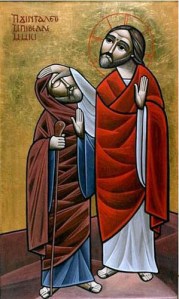
And when my body no longer obeys my desires, when I trip and fall, when I take the wrong path, or illness forces me to silence and sitting, I will enter my library and find the words to fill me with Christ.

We are creatures of memory. We learn from our history, or should. We do the best we can to be honest in reporting what happened before and what must come after, repenting and turning, listening and laughing, and reweaving our world with our Father’s love.

And now I must work on this first phrase, “God be merciful to us and bless us, and show us the light of his countenance…” 

Deo Gratias.

March Journal, Quinquagesima Sunday

My novel, The Music of the Mountain, has received another endorsement, this one from the admirable writer in England, Francis Etheredge, bioethicist and theologian:

“In what is very nearly a dystopian novel, Christine Sunderland takes a much closer look at a person who encounters baptism. In this, the second of her books about a semi-mysterious mountain, she takes up the previous theme of hope amidst destructive trends in society. There are four people at the heart of the book. And, by contrast with an illegitimate, authoritarian, withering of justified dissent, these four are very much at the beating heart of both preserving and advancing a renewal from above.

So, the outer circumstances of the novel are as impenetrably destructive, as the inner group are personally engaged in the intimate struggle to love in the truth. At one point, while we know how each of the four have been affected by the cultural crisis in which they live, there is a pointed encounter between those living the inner life and those seeking to puncture it as abruptly, aggressively, and intimidatingly, as they are unjustified in doing so.

The book is about two men and two women, almost entailing the possibility of a double love story which, in a certain way, is unexpectedly but beautifully concluded. The elderly man, a widowed Anglo-Catholic priest  assists, like an emergency doctor, at the late but timely coming to Christ of an almost atheist, but probably agnostic professor of ethics who is wholly taken up into Christ. While the young man and woman, clearly taking a two stepped kiss to courtship, are equally traced through their first meeting to marriage and a family, albeit the latter is viewed from on High.

Just as the dialogue between those who love is intimately unfolding, just so there is an equally, painful incapacity to even talk, in those who execute the mandate to burn good books. Christine Sunderland’s novel expresses, in the likely reader’s tears, the very contrast between being open to the mystery of life and being hardened by the dictates of an impenitent hatred of what is good, true and beautiful.”

Endorsed by Francis Etheredge, Catholic married layman, father of 11, 3 of whom he hopes are in heaven, whose latest book is Transgenderism: A Question of Identityhttps://enroutebooksandmedia.com/transgenderism/.

Reading and writing and speech itself are gifts given by our God of love, part of the miracle of being human and made in His image. They are graces, mysterious and real, that express who we are and who we are meant to be. They sculpt and carve greater truths through metaphor, symbol, story, and character. And, at the end of the day, they tell us what love is by showing us love, dramatizing love, making love real.

Just so, today’s Epistle is the stunning ode to love that St. Paul writes to the Church in Corinth (I Corinthians 13+): “Though I speak with the tongues of men and of angels, and have not charity, I am become as sounding brass, or a tinkling cymbal…” This poetic chapter describes the nature of love (charity), what it is and what it isn’t, with words that paint images to help us see: “For now we see through a glass, darkly; but then face to face: now I know in part; but then shall I know even as also I am known…”

Sight is again repeated in the Gospel story of Christ healing a blind man. For that is what we are, blind, feeling our way through life, reaching for God, for Eternity, for Love. We know this intuitively but we must act upon it, sculpt our own souls with Christ himself.
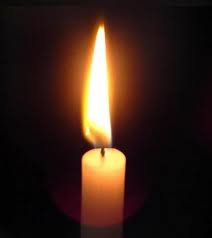
And so we clean out our hearts, confess our sins, receive absolution, and step into Lent to rise on Easter Day. In this way we become part of the music, part of the hymn of love, speaking the words and singing the notes that pull us heavenward. In this way we learn to love as we are meant to love, and we become part of the mystery as we enter the miracle and see Him face to face. We are no longer blind, but can see.

February Journal, The Presentation of Christ in the Temple, Fourth Sunday after Epiphany

This year the Feast of the Presentation of Christ lands on a Sunday, today, February 2, Epiphany 4, shining light on the act of the giving, of the presenting, of the offering of Christ to the world, indeed, to you and me (Luke 22+).
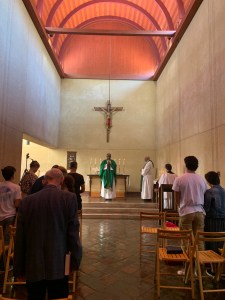
Mary and Joseph are fulfilling Jewish law, presenting their son to God. But what touches me about this story is Simeon and Anna, two prophets who have waited for the Messiah, fasting and praying, having been promised they would see the child before they died. When Mary and Joseph arrive with Jesus, Simeon knows immediately that his promise has been fulfilled.

Simeon’s response glorifies God and is a part of our Anglican Evening Prayer, so it is well known and often prayed by the faithful each evening. It is called the Song of Simeon and the Nunc Dimmitis, Latin for the first words of the canticle. Simeon knows this is the promised one and raises him up in his arms, praising God:

Nunc dimittis. St. Luke ii. 29, BCP 28
LORD, now lettest thou thy servant depart in peace, according to thy word.
For mine eyes have seen thy salvation,
Which thou hast prepared before the face of all people;
To be a light to lighten the Gentiles, and to be the glory of thy people Israel.

And just so, in this scene, we see another epiphany, or perhaps many, as the Holy Child is recognized by the Jewish world and presented to the gentile world as a light to lighten their way. God offers his son to us, presents Him to each one of us, a great and holy gift.

We also learn that Anna “gave thanks likewise unto the Lord, and spake of him to all them that looked for redemption in Jerusalem.”

The presentation of Christ to the world is thus effected through the rituals of the time, uniting us with the Judaic history back to Moses, connecting us with this offering in the temple, bringing that past into our present, to become part of the Christian year on February 2.

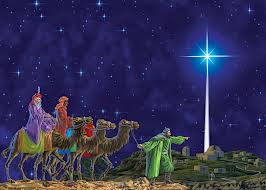
This presenting, this ultimate epiphany of Jesus Christ, the Messiah, dramatizes this glorious, momentous, event for all the world. The world has been prepared with the choosing of the People of God, the People of Israel, and their journey through time to this moment. And then the impossible becomes possible, God enters our world as a baby in a stable. The stars change course. Shepherds hear angels. Kings travel on camels to lay gifts at his feet. The world will never be the same.

And yet the presentation is also the offering of Our Lord to each one of us. Do we accept the gift of Love incarnate? Or are we ashamed to confess the faith of Christ crucified?

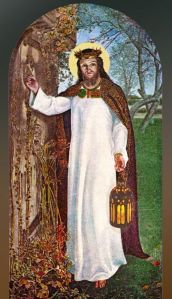
Light of the World, by Holman Hunt

I believe this offering never ends, at least in our lifetimes. He will knock again and again at the doors of our hearts. Some will not hear the knock. Some will hear it late and miss out on early glory. Some will open their hearts to the Lord of Hosts on the first knock, the first presentation.

And will those who invite him in celebrate his presence, sing him songs, love him as he loves us?

For when this happens, another amazing presentation happens. We turn about, and we make our own presentation of the Lord to others. We point to the child born in the stable, this salvation for all people, this light to lighten our way through this life and into the next. We raise him high as Simeon did, praising his mercy and grace.

Luke writes that “the child grew, and waxed strong in spirit, filled with wisdom: and the grace of God was upon him.” When we accept this Savior of the world as our savior, we too will wax strong, be given wisdom and grace. We too will sing songs of thanksgiving and praise. We too will look for every chance to present him to others, to knock on the doors of their hearts.

Deo gratias.

January Journal, First Sunday after Epiphany

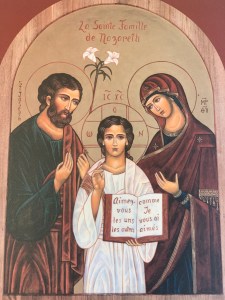
Holy Family of Nazareth, Denise Gosselin Gravel, Iconographer

This year, Epiphanytide, swinging on the date of Easter, a moveable feast, runs a full five weeks. The longest it can be is six weeks, so we are close to hearing all of the lessons appointed for this season of light. Today, the first Sunday after January 6, Epiphany, the Gospel lesson reveals another revealing of the Christ Child, who he is and why it matters.

The story is told by Saint Luke, thought to have been particularly close to Mary, and thus this writer also gives us the main narrative of Christ’s birth. It touches me, as a mother, for we forever worry about our children. My son is fifty-two, and when I learned there were raging fires in Los Angeles on the day his plane was due to arrive from Bangkok (Wednesday) I doubled, no tripled, my worrying. The plane arrived safely and one day I will find out what he saw in those skies, but for now I am grateful he made his connection home to Denver, albeit in the middle of the night. It is moments like these that make me grateful for cell phones, messaging, and even FaceBook. How did we ever manage without instant communication?

But returning to the story in today’s Gospel, about the boy Jesus in the Temple. We are told he is twelve years old and goes missing, at least his parents cannot find him. When they do, they fuss over him asking what was he thinking going off like that. (Sounds familiar.) And of course he replies that he was about his “Father’s business.”

An epiphany. A light shines on Jesus and who he really is.

The story produced other epiphanies in my little brain. He was born a baby, a human baby, and would have grown as we all grow, learning from our environment. He must have absorbed the lessons of the local synagogue, the readings, the conversations, as he grew up, for he needed to know these things, the history and rituals of his people, their prophets, their challenges. And so he is drawn to the temple in Jerusalem when they visit for the Passover feast. Luke writes that they had gone there every year (!) as was the custom. And yet we only have this one account of Jesus questioning the rabbis.

Given the choices all writers make, I have often thought the Gospel accounts were carefully curated. When there is a feeding of five thousand, this is only one account of many feedings we do not hear about. The healings too are probably too numerous to list, both of soul and of body. How many did Christ the Lord raise from the dead?

And just so, Mary and Joseph most likely were challenged with the boy Jesus and his remarkable parentage and his ways of learning, led by his Heavenly Father, guided by the Holy Spirit. This was their twelfth Jerusalem Passover, but Jesus is now of an age – a precocious age as mothers know – when his mental and physical growth take new turns. We call it adolescence. They called it becoming a man.

Today we ponder our time on Earth, Jesus’s time on Earth, and the accounts we are given, so carefully and prayerfully written “for our learning.” We are told in the Collect for Advent II to “inwardly digest” the Word, Holy Scripture. For indeed, these accounts, historical accounts, are food for our souls. Scripture tells us what is important in life, what is good and what is bad. Scripture, and those who interpret these Holy Words for us, gives meaning to our time, meaning to our individual lives. These words set us on the right path, shining a light in the dark forest of our days.

I for one am glad and grateful, for with every lesson, new epiphanies reveal more glory here and now and then in Heaven and eternity. What we don’t know, what we don’t understand, doesn’t matter. What matters is in the pages of this book called the Holy Bible. What matters is what we do about these matters in our own lives.

Are we part of a church community, one that welcomes us on board to sail the seas of our time? For community is one of the pillars found in Holy Scripture – community that teaches us, feeds us, leads us through the rough waters. It is the church family that gives us the songs to sing, the prayers to pray, the eucharists to strengthen our hearts and souls.
The answers to life’s questions are here for the taking. We need only trust and obey as the old hymn goes. Looking for happiness? Trust and obey, for there’s no other way, to be happy in Jesus, but to trust and obey.

One of my grandchildren said she couldn’t find a church she liked. I suppose she thought there was a perfect one, just for her, as if she were at a buffet table, trying each dish. Alas, I told her, every church community is fallen, for it is made up of fallen men and women just like you and me. Find one close by and attend regularly. Be slow to judge and quick to forgive.

For without being a member of the community we call the Bride of Christ, the Church, we will die a slow death from spiritual starvation. We need to be fed, and this is where Christ is, feeding his sheep, caring for you and me. Don’t go it alone, or even imagine it is possible. Hermits are few and far between.

If you want to experience epiphanies of heart and soul, walk through those doors, take a seat, and sing with all your might. Pray prayers of repentance, prayers of petition, and prayers of thanksgiving. Listen and learn from the lessons read and the sermons preached. And do these glorious things with others, your new brothers and sisters, mothers and fathers, grandmothers and grandfathers. One day you will be in their shoes, and you will be given parish children, grandchildren, in your church family. One day you will open the doors for those outside who want to come inside, in from the cold, the damp, and the dark of our world.

One day you will see them from Heaven and you will hear the words, “Well done, thou good and faithful servant. Welcome home.” You will turn and see the Master, the one who questioned the rabbis in the temple and set our worlds in motion. And you will know the ultimate epiphany, Christ himself.

January Journal, Second Sunday after Christmas

My novel in progress, The Music of the Mountain, is set in the month of January 2023. It is a dark and stormy month, a time of short days and long nights. And yet January is a month of epiphanies, of new beginnings, of seeing what we didn’t see before. An epiphany is a sudden thought, a conclusion, an answer. January unveils these day by day, week by week.

But most of all, being the first month of the new year, time itself commands attention. What have we done or left undone in the past year? What do we regret? What would we do differently if we had the year to do over again? We make resolutions to be better.

It is unfashionable to admit fault, to judge oneself, to admit we are not all we should be. We are told that judgment is judged to be unkind, and above all, we must be kind to ourselves, looking for excuses, reasons why we didn’t love enough, circumstances that would send the judge and jury home for good.

Falling short of the mark hurts.

And so during Mass this morning I was glad to be reminded of my failings in the General Confession and the Absolution following. It is a crucial, cross-bearing reality, that we are human beings subject to moral law who will face God’s judgment one day, like it or not. I for one need reminding in this world of no fault, grievance, and victimhood.

And so we acknowledged and bewailed our manifold sins and wickedness we have committed by thought, word, and deed, provoking God’s wrath and indignation. We repent and are sorry. The burden is intolerable… we call on God for forgiveness.

It is good to be reminded of reality. It is good to repent on a regular basis after holding oneself up to the bright light of Heaven. In this way, we choose the best path to take in the new year. In this way we see ourselves as we are, not as we imagine, and allow God to carve away the darkness and bathe us in his light.

Today is the twelfth day of Christmas; tomorrow is the Feast of the Epiphany of the Lord. Epiphany, of course, is when the Magi or Wise Men arrive in Bethlehem, bringing gifts to the Christ Child. Epiphany, then, is the good news sung to the rest of the world, not just the shepherds and the holy family. We are included in this epiphany of light; we travel to the creche and kneel and worship too. We bring our gifts – ourselves. We too have followed the star in the heavens, wondering where it will lead. Could something so grand and cosmic as a star in the night sky shine upon the meager manger in Bethlehem? And yet angels appeared to the shepherds, the great choir singing to the lowly herders.

Christmas tells how the little becomes large, how flesh houses spirit. God becomes tiny and humble; kings follow a star and kneel before him.

To find answers to the human condition, the whys and the wherefores, look to the manger bed and see who kneels before the Christ Child. If kings and shepherds kneel, we can too. If they see, we can see too.

January is the month of the Holy Name of Jesus, so that we give the baby in the manger a holy glory by intoning his name, breathing the name, calling his name.

January is the month of life granted through this Holy Child, but it is also the month of death decreed with the slaughter of our own innocents through abortion. For half a century this month proclaims our grief, prays our petitions as we walk for life all across this nation.

The star is bright in the night sky as we embark on this year in time. We divide our time into months and days and hours, stepping through the squares on our calendars, trying to pay attention to each precious, passing minute. It is too much for our ashen earthiness, and so we take an hour on a Sunday to bundle the time into meaningful notes, and sing a melody of penitence, absolution, eucharistic feeding, and by the end of the hour we see epiphanies meant only for you and me.

We go to church for an hour each Sunday and kneel alongside the people of God, the bride of Christ. For in that humility, epiphanies are born, and we see again. We see the path laid out for us, at least for the next day and week, as we step into the woods of time, marking another year.

December Journal, First Sunday after Christmas

We are in the middle of Christmastide, those twelve glorious days of Christmas ending on Epiphany, January 6.

I have celebrated seventy-eight Christmases on this good earth. If I don’t remember each one, they remember me. 

With each year I have added another layer, another garment, to my Christmas past to create my Christmas present, which becomes indeed a yearly present presented to my heart, mind, and soul. The past does this to the present if we pay attention, or even if we don’t, for today’s Christmas is partly the memories of earlier ones and perhaps even the anticipation of ones to come.

Thus rituals and traditions color our world. We sing the same songs and add new ones. We decorate our homes as if a king were arriving, for indeed he is, and did arrive on Christmas Day. We turn earlier saints into messengers, and invite Saint Nicholas to gift us, arrive on the roof and come down through the chimney to place delicacies in our giant stockings hung with care in hopes he will be there. 

We build anticipation in the weeks before, trying to be good, greeting one another with holiday cheer, wearing holiday colors and hats and tees, singing about a reindeer named Rudolph with a red nose who was humble and then great, or so the story goes.

We prepared for Christmas by thinking of others, teaching our hearts to expand to include another in our thoughts and plans. We bake for them, give them gifts that are wrapped in bright paper with shiny and curly ribbon, so that the joy becomes even more special for it has been hidden, as Jesus is hidden in history and mankind’s retelling.

In these rituals we tell the story of God becoming Man and walking among us. The story is too fantastic to tell. It is too amazing to fathom. So we tell it in our preparations, in our humble human attempts to shine the light on the glory of God and the laughter of his love.

Like Our Lord, Saint Nicholas comes down from stary skies and gives us wonderful gifts. The gifts do not compare to the gift of Christ and Eternity, the gift of God and incarnation, the gift of life over death, joy over sorrow. They do not compare, but they remain our meager attempt to reveal Christmas, the birth of the Son of God, the Messiah, the long awaited one here to set us free from our own captivity of self.

And so we try to be like Saint Nicholas and give gifts and reflect Our Lord Jesus who gave himself to us.

And we try to be like the angels and sing to him in his manger. We sing of the miracle and mystery of that unlikely birth, we harken to the herald angels singing glory to the newborn king, we sing of a silent and holy night when away in the manger there was no crib for his bed, we tell of the little town of Bethlehem and what happened on that midnight clear when the glorious song of old was heard as angels touched their harps of gold, for Christ is born of Mary, and while mortals sleep, the stars proclaim the birth and peace to men on earth.

Indeed, the Prince of Peace, the Lord of Love of You and Me, was born that night over two thousand years ago, and today we sing carols layered upon earlier carols, as humankind tries to express the inexpressible with words and melody.

We teach our children the songs, so that they will teach their children. To help them remember, we dress them to play parts in a stable in Bethlehem. We clothe them with the story of the Christ Child. They act out the greatest story ever told, and each year they add to their own library of Christmas rituals and traditions.

And so I have been graced with seventy-eight years of Christmases. The time is rich and glorious and I wear a tapestried robe of many colors and notes and words. I live out what I have been given, a humble life of gilded mystery and miracle, for each day brings its own gifts of healing, seeing, hearing, being. Every minute is birthed by Christ. We breathe Christmas all year, birthing this Bethlehem child who births us.

We follow the star of Christmas and find ourselves at the cross of Easter. In this journey in time, we learn to love as God loves us, wrapping our hearts with the bright ribbons of Christ, to give ourselves to one another.

December Journal, Fourth Sunday in Advent

There is the silent hush of valley fog enshrouding our house today. The mute world waits, hoping for a sign. A sign of what? A sign of life, life everlasting, before and to come. A sign that we are more than flesh, more than animals on the hunt to survive.
I have long found it interesting that the Jewish world before Christ knew who humankind was and is, knew their identity and mission expressed in rituals and rules. They knew they were made in the image of God, their Creator. Just so, they treasured life, children, families. When they erred, their God called them back to Him and set them on the path to life.

The Greco-Roman world also knew that humankind was not mere flesh, but owned a spirit, a soul.

And so Jesus, the Son of God incarnate, was born into the Roman world, a Jew in the messianic lineage of David. The time was ripe for the two cultures to merge, for the Roman world gave the life-changing message of Christ the forum to broadcast the good news, the gospel. It is in the Roman Mediterranean basin that the first Christian churches would be planted, secretly in homes, then building upon the graves of the martyrs, celebrating eucharists over holy bones.

When Jesus was born in Bethlehem of Judea He synthesized these worlds, baptizing Rome with Jerusalem, and opening Heaven to all mankind. 

Today’s gospel tells of John the Baptist who prepares the way for Christ’s birth, life, death, and life. The great followings that John attracted would shift to Jesus of Nazareth, as our preacher pointed out today. The Baptist prepared the way. And what did he say that prepared the world for the Savior? What could he possibly say that would be enough? Repent, he said, make his way straight. And with baptism, each follower said yes, I will change and I will make the crooked straight in my life.

And so the way was prepared in the hearts of many.

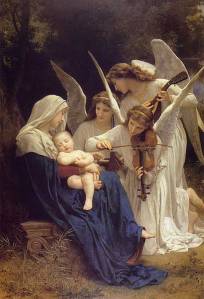
William-Adolphe Bouguereau (1825-1905), Song of Angels (1881)

Just so Advent prepares each one of us to receive the Lord of Lords, to kneel with the shepherds and bring gifts with the kings, to fly with the angels into the starry night of Christmas, Christ’s Mass.

Christmas, full of giving and singing and sharing for a brief time, gives us a taste of glory, the glory of the angels, the glory of life itself, the glory in a newborn baby.

Christmas says you needn’t be great or rich or powerful. In fact, it is better if you are lowly, poor, and powerless. Christmas says look at the baby and sing to him. Thank him. Love him. Invite him into your heart.

As Christina Rosetti wrote in her lovely Christmas sonnet, “What can I give him? I give him my heart.”

May we all experience the glory of the love of God this week, this sacred and holy time, when Christ Jesus came among us, bringing us life here and now, and forever in Eternity.

Come Lord Jesus, come.

December Journal, Third Sunday in Advent

Today is Gaudete Sunday, or Rose Sunday, and Heaven Sunday too. The Third Sunday in Advent is rich with meaning as we prepare for Christmas and the Incarnation of God, come to us to live with us and in us. Such miracle and mystery often astounds me.

The name “Gaudete” meaning “Rejoice” refers to the introit for the day (translated from the Latin):

“Rejoice in the Lord always; again I say, rejoice. Let your forbearance be known to all, for the Lord is near at hand; have no anxiety about anything, but in all things, by prayer and supplication, with thanksgiving, let your requests be known to God.” (Wikipedia)
Indeed, the Lord is near at hand, to be born in Bethlehem soon and reborn in us daily, hourly, with each breath. We need only ask. It is a reminder to be at peace, reconciled to God, with His birth among us, in us. We request what we need and give thanks for the life we have been given. We need not be anxious, but are called to rejoice in the Lord always. It is a good reminder to do so in our worldly world.

We place roses on the altar (no flowers during Advent except for today) and vestments are rose-colored. We consider the “last things” once again, but in the lighter light of Heaven. Having considered Death and Judgment so far, today we hope in Christ to defend us when we die, when we face our examination, or court appearance as it were, that we see what we have done or not done, repent, be absolved and step through the gates of Heaven into the New Jerusalem. It is a good reminder to practice our repentance here on Earth.

The fog drifted into our valley this morning and settled around the hills, obscuring the lower hamlets and allowing the peaks to emerge into light. I watched it swirl and change and move on, as other mists born by the breeze came in, changing shape with each second, opening and closing the planet to the sun.

We too are obscured by the swirling mists of not seeing or not knowing or not being sure of what we believe or who we are. And yet we have a path given to us, a way of parting that fog, if we so desire. We have reasonable arguments for certainty handed to us by the church and a heritage of believers, witnesses who testify to what they have seen and what they know to be true. We need only say “yes” we want to believe, we want to step further into the world of faith, hope, love, and joy. It sounds too good to be true, but it’s true.
And so we look to Mary who said those words, her “fiat”, her “yes”, her “be it unto me…”, to allow her body to be the home of Christ Jesus. We travel with her through Advent, to learn how to say yes as she did, to step into this miracle given to each one of us, Christmas. We walk alongside her, and she with us, for she is our mother.

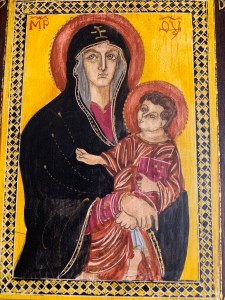
There is a wonderful icon of Mary and the Holy Child Jesus hanging in the great basilica of Mary Major, Santa Maria Maggiore, in Rome. It is said to be painted by St. Luke. Tradition and first century carbon dating testify to the probability that it was. Under the main altar lies the wooden creche. 

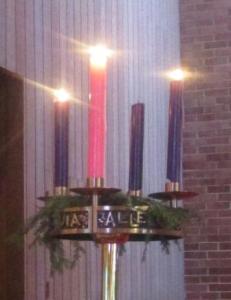
We light our three candles today, including the rose candle, and we recall our ultimate destination, Heaven. As we do, we experience a moment of Heaven on Earth. The candles flame, testifying to the Lord of Lords to come, to be born on Earth and reborn in our hearts.

Yes, come Lord Jesus, come.