
 The opening prayer that collected our small flock together on this brilliantly clear morning in a chapel in Berkeley was the “Collect for the Second Sunday in Advent”:
“Blessed Lord, who hast caused all Holy Scriptures to be written for our learning; Grant that we may in such wise hear them, read, mark, learn, and inwardly digest them, that by patience and comfort of thy holy Word, we may embrace, and ever hold fast, the blessed hope of everlasting life, which thou hast given us in our Saviour Jesus Christ. Amen.” —Anglican Book of Common Prayer, 1928, 92
These opening prayers, written by Archbishop Thomas Cranmer (1489-1556), introduce the Epistle and Gospel lessons for each Sunday of the Church Year. Written at an exceptional time for the English language, the Elizabethan period, we treasure these vivid and lucid expressions, the heart of the appointed – assigned – readings, part introduction, part summary.
Words. Today was all about words. Words in Scripture. Words in prayers. The Word – Christ – the expression of God in human form.
We are to hear, read, mark, learn, and inwardly digest Holy Scripture. These words feed us, both soul and body. For words recreate us, sculpt us. Our beliefs form us; our word-expressions reach out to others, connecting, loving. We make sense of the world around us in words, and if the world doesn’t make sense, we don’t make sense. The body informs the soul. The soul informs the body.
Who are we? What are we? Christ answers these questions, giving each one of us a vision of our own selves as we are meant to be, as His creatures, His children. And with this self-portrait, painted with words, His Word, we are able to live our lives to the fullest, to His glory.
Without these words to mark, learn, and digest daily, weekly, monthly, stepping through the feast of festivals and seasons of each year, we become chaotic creatures empty of meaning and sanity.
 Advent’s daily prayer begins with “Almighty God, give us grace that we may cast away the works of darkness, and put upon us the armour of light…”. To memorize this prayer is to digest it, to send our words to God, expressing our need for re-forming, re-creating. And even as we pray the words, we become clothed in a protective garment, an armour of light, lighting the darkness.
Advent. Sculpting who, what, why, and where we are in time and place is no small thing. Advent prepares us for the next great things – the redemption of the world, the apocalypse. For today’s Gospel is Luke 21: 25+ where Christ describes the signs that herald His second coming, when “the kingdom of God is nigh at hand.”
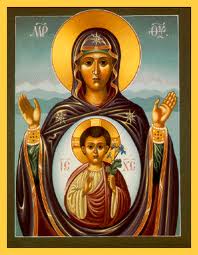 Today is also the theme of Judgment. We shall be judged. The world shall be judged. But Christ takes our part if we desire Him; we are forgiven if we repent. And so we return to words – words to instruct our conscience, learning right and wrong, law and love. Holy Scripture becomes the textbook that teaches us where we have gone wrong, returning us to who we are and are meant to be. We need merely pray our words to Our Lord to be changed, to be redeemed, to be saved.
And so we prepare for the first coming of Christ in a stable cave in Bethlehem. We hear, read, mark, learn, and inwardly digest the Word of God, Christ himself, come to live with each of us, within us, feeding us, walking alongside, revealing who we are in this miraculous mystery we call the world, Heaven and Earth, now and forever.
 The nights have been clear and cold here in the Bay Area. We can see the stars and I reach to touch them, they seem so close. Advent is the time of stars in the heavens. Advent is when we follow the star to Christmas. We reach and we follow the star.
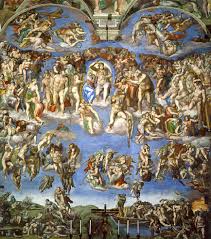 These are big things, subjects we would rather avoid. Especially judgment. We define deviancy down and further down, so that we can deny judging anyone and thus not be judged ourselves. And yet we know deep within there is a moral law all mankind senses, reckoning that a standard has been set, a standard we don’t meet. And with law there is judgment.
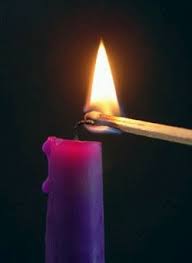 We light our first Advent candle in our Advent wreathe. It is only one small flame in the dark, but it will light the others, each week, until we see the light of Bethlehem, the light of the world, the light of Christ.
 It is good we practiced gratitude for our blessings this past week. Gratitude humbles us. Gratitude says, we owe something to someone else. Indeed. We owe much to those giants that have preserved the West, and fought for our freedoms through war and peace. We owe much to our local church, filled with good souls who try to love us. We owe much to our own families who try to put up with us. We owe much to Our Lord who gave us life itself and continues to breathe life into each day we live.
 We begin at the beginning, the first day of the Church Year. In this new year we open the gates of Jerusalem – and our hearts – to the Messiah as our Gospel reading describes. Today the story begins, and each one of us will play a vital part in the greatest drama of all, life overcoming death, eternally, minute by minute.
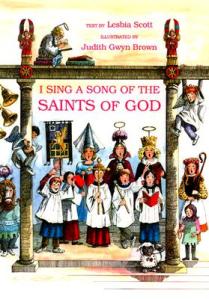 The teachers arrived, followed by the children. We sat around the circle and read the story about the Saints of God (based on the hymn). I tapped my phone and the organ accompaniment began. We stood, singing and illustrating the words with hand movements and twirls. As we sang (and twirled) I pondered the words of this classic hymn (243):
 My recent novel,
  Christine Sunderland
 Christine Sunderland