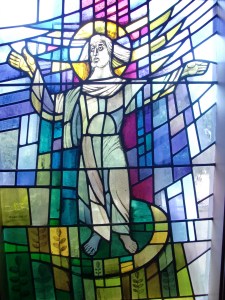
 “Once we came before God’s presence with a song; now we come before his absence with a sigh.” So writes Anglican philosopher Roger Scruton in his beautifully written memoir, Gentle Regrets. The first reference is, of course, to Psalm 100, O be joyful in the Lord, all ye lands: serve the Lord with gladness, and come before his presence with a song… Dr. Scruton’s second reference, that to sighing, is to the sadness that seems to permeate our culture of unbelief, the most prosperous and “advanced” culture in recorded history.
Psalm 100, also called the Jubilate Deo, is part of our Office of Morning Prayer, in the Book of Common Prayer prayed by Anglicans worldwide for centuries. I wondered, what happens to a person’s attitude toward life if he or she repeats this prayer psalm every morning upon rising? Is there a change in the way he sees the world, or even a gradual restructuring of the soul?
I’ve been thinking about this the last few days, having dipped deeply into Dr. Scruton’s words of wisdom. He rightly values the Prayer Book with its Elizabethan English, so suitable to worship God. We sing the words of these prayers, sometimes in melodies, sometimes in chants, sometimes in our hearts and minds, following the rhythm of the phrases like a dance.
I first crossed the threshold of an Anglican Church (then Episcopalian) in 1966, at the age of 19: St. Matthew’s, Burlingame, California. Raised Presbyterian, turned collegiate agnostic, I was unfamiliar with the ritual, the set prayers, the kneeling, the making of the Sign of the Cross, the processions, the candles, the incense. Yet I felt as though I had entered Heaven. I was sure I had; I was totally smitten. I sat in the back pew and drank in the liturgy like a traveler in the desert. I was thirsty and didn’t know how parched I really was until then, didn’t fully understand what I deeply longed for, but here it was, all around me, the sights, the sounds, the smells of Heaven. It was as though I was being held in the palm of a loving God, one who had created me in great joy and was so glad I had come home.
I wasn’t instructed and Confirmed until the following year, but in the meantime I entered, knelt, imitated the others. Since many of the prayers were the same each week, and there were Prayer Books in all the pews, I learned the words quickly and was soon part of the miracle happening around me. I learned how to dance with the Church, a universal dance stretching back two thousand years and celebrated all over the world. Since then, I have come to understand the meaning behind the rituals and the prayers, the Scriptures that ordained the words, the actions, the steps in this dance of worship. I came to understand what happened in what was called the great Sacrifice of the Mass, when the wine became blood and the bread became body in the Real Presence of Christ. I understood how the Liturgy of the Word led to this pivotal moment of bell-ringing and happy holiness – the Collects, the Scriptures, the Creed, the Confession and Absolution, the Sermon. And since then, I have traveled deeper and deeper into the mystery of worship and into the heart of God.
So it was with great joy that I discovered this Anglican philosopher who is also in love with the Book of Common Prayer, who “gets it,” as is said today. And he is right when he profoundly observes that our culture, having trouble finding God, has become sad, “morose.” Many no longer sing to the Lord a joyful song with gladness for they have lost him in a kind of slippery sophistry. Instead, they look to one another, and to themselves, to create gods from their own kind, longing for but not finding true worship. The resulting attitude is one of un-thankfulness, of grievance and complaint, of never having enough, of striving, of racing, of consuming, all in hopes of finding. The old adage, “Count your blessings,” is just that, an old adage and rarely practiced. Today curses are counted rather than blessings.
And so it was that this morning when I entered our parish church I was especially thankful for the words of our Prayer Book, the poetry of the prayers and psalms and liturgy, and most of all for the belief that backs and binds it. I addressed some “proofs” for the historicity of the Resurrection in my recent novel, The Magdalene Mystery, arguments of the mind if not the heart. And in the end, if one can argue the Resurrection, the rest falls into place, at least for me. But here, this morning, in my parish church and recently in the words of my new philosopher mentor, I find argument for the heart and soul. Human beings long to sing to God because we know deep down he exists, that he loves us, and that he has provided a path on earth to Heaven, to one day, see him face to face, no longer through a glass darkly. We long to experience what we suspect is waiting for us, true joy.
And as we sang with the children in Sunday School “All Things Bright and Beautiful,” prayed an “Our Father” together, and led them up the central aisle to kneel at the altar rail for their blessing during the Mass, I knew we had taught them well this day. They had experienced the bright and the beautiful, to be sure, when they entered that hushed space, as they padded up the red carpet toward the tabernacle set amid the flaming candles, as the robed clerics drifted by. “God the Father, God the Son, and God the Holy Spirit be upon you, Natalie, this day and always” the priest said, touching her head lightly with blessing. We each made the Sign of the Cross, and with folded hands we processed out, back to the Sunday School, where we made more animals from paper plates.
It is good for us to pray, to develop an attitude of thankfulness for what we have been given, beginning with life itself, another day on this earth. I recommend an “Our Father” followed by the “Jubilate Deo” each morning, even if it’s in the rush of the early hours, driving to work, waiting for the bus, readying the children for school. Say it regularly and your life will be filled with joy, the jubilate of God, and far less sighing. I know mine has.

 I finally chose my Lenten memory work. I’m adding a Psalm from Evening Prayer (Book of Common Prayer, p.28) that seems appropriate today. I wanted a thanksgiving Psalm, but segued into praise and petition:
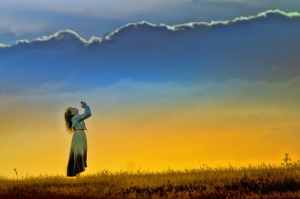 In this way I bracket my day with Christ, sending an Our Father upwards from time to time, calling his name, breathing Jesus. I border my hours with golden light, the light of His countenance. It is a joyful and miraculous gift to do this, a grateful grace for my life, a song to the Shepherd of my soul.
 Christine Sunderland
 Christine Sunderland