
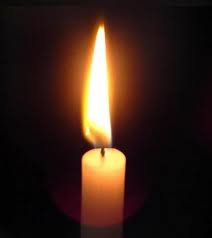
 This year the Feast of the Presentation of Christ lands on a Sunday, today, February 2, Epiphany 4, shining light on the act of the giving, of the presenting, of the offering of Christ to the world, indeed, to you and me (Luke 22+).
Mary and Joseph are fulfilling Jewish law, presenting their son to God. But what touches me about this story is Simeon and Anna, two prophets who have waited for the Messiah, fasting and praying, having been promised they would see the child before they died. When Mary and Joseph arrive with Jesus, Simeon knows immediately that his promise has been fulfilled.
Simeon’s response glorifies God and is a part of our Anglican Evening Prayer, so it is well known and often prayed by the faithful each evening. It is called the Song of Simeon and the Nunc Dimmitis, Latin for the first words of the canticle. Simeon knows this is the promised one and raises him up in his arms, praising God:
Nunc dimittis. St. Luke ii. 29, BCP 28
LORD, now lettest thou thy servant depart in peace, according to thy word.
For mine eyes have seen thy salvation,
Which thou hast prepared before the face of all people;
To be a light to lighten the Gentiles, and to be the glory of thy people Israel.
And just so, in this scene, we see another epiphany, or perhaps many, as the Holy Child is recognized by the Jewish world and presented to the gentile world as a light to lighten their way. God offers his son to us, presents Him to each one of us, a great and holy gift.
We also learn that Anna “gave thanks likewise unto the Lord, and spake of him to all them that looked for redemption in Jerusalem.”
The presentation of Christ to the world is thus effected through the rituals of the time, uniting us with the Judaic history back to Moses, connecting us with this offering in the temple, bringing that past into our present, to become part of the Christian year on February 2.
This presenting, this ultimate epiphany of Jesus Christ, the Messiah, dramatizes this glorious, momentous, event for all the world. The world has been prepared with the choosing of the People of God, the People of Israel, and their journey through time to this moment. And then the impossible becomes possible, God enters our world as a baby in a stable. The stars change course. Shepherds hear angels. Kings travel on camels to lay gifts at his feet. The world will never be the same.
And yet the presentation is also the offering of Our Lord to each one of us. Do we accept the gift of Love incarnate? Or are we ashamed to confess the faith of Christ crucified?
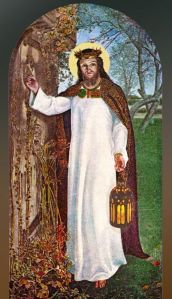
Light of the World, by Holman Hunt
I believe this offering never ends, at least in our lifetimes. He will knock again and again at the doors of our hearts. Some will not hear the knock. Some will hear it late and miss out on early glory. Some will open their hearts to the Lord of Hosts on the first knock, the first presentation.
And will those who invite him in celebrate his presence, sing him songs, love him as he loves us?
For when this happens, another amazing presentation happens. We turn about, and we make our own presentation of the Lord to others. We point to the child born in the stable, this salvation for all people, this light to lighten our way through this life and into the next. We raise him high as Simeon did, praising his mercy and grace.
Luke writes that “the child grew, and waxed strong in spirit, filled with wisdom: and the grace of God was upon him.” When we accept this Savior of the world as our savior, we too will wax strong, be given wisdom and grace. We too will sing songs of thanksgiving and praise. We too will look for every chance to present him to others, to knock on the doors of their hearts.
Deo gratias.
 I am polishing The Fire Trail for final submission to my publisher. It is an appropriate effort to take on in the holy seasons of Advent and Christmas, seasons in which the Word, the expression of God in human flesh, is anticipated and fulfilled.
 Christine Sunderland
 Christine Sunderland