
Monthly Archives: February 2016

Sacred Sanity

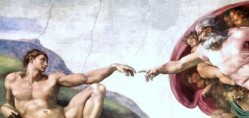
Michelangelo CreationI have been typing and saving selections from our late Bishop Morse’s sermons and writings into Word files to be published soon by the American Church Union. As I type, I can see him saying the words, see his gestures, hear his tone and cadence, his deep and sonorous voice as he preached from the central aisle of churches and chapels.

There are several themes emerging from the lined yellow papers, all spinning around and within the Love of God, but the one that I have found especially true in my own life is the sanity of belief, the ordering of chaos, the means to a meaningful life. Sanity is rooted in the Latin sanitas, health. It has come to mean mental health, the ability to reason within the realm of reality. For the bishop, such sanity led to traces of sanctity.

It does strike me as odd and also tragic, as it did Bishop Morse, that so many don’t see what seems so obvious to many a Christian. It is heartbreaking to see hearts so broken and bleeding in our secular culture today. It is, I suppose, the cost of freedom and love and choice, all intrinsic to the whole cloth of Christian belief. But even so, as I journey into Christ I journey deeper into His tears, weeping for those I love, scattered like lost sheep in the deepening dusk at the end of the day.

There is much in the Gospels about seeing and hearing, watching and waiting, seeking and finding, asking and answering. Because these matters matter so much but are also tightly bound to the world of matter, they are often unseen and half-understood. Christ teaches in parables to help us understand how God has acted to redeem us from our selves, our selfishness. He is expressing the inexpressible, so that we can see and choose Him or not. Poets attempt this realm. I have found in the bishop’s sermons many quotes from Christian writers, from T.S. Eliot and St. Augustine, Boris Pasternak and Fyodor Dostoevsky, words that reflect the great themes of St. Paul who also tried to feed his flock in ways they would understand.

Many do not believe in Christ the Son of God because they think His life and death and resurrection unproven, and belief to be irrational and even insane. To me the Resurrection of Christ has been shown to be reasonably and historically true, certainly as true as the grass is green or the sky is blue. That’s enough for me. That’s enough to set me on my journey of faith and see where it leads. I have not been disappointed.

It leads of course to Christ’s Body on earth, the Church. For the Church, in spite of being composed of imperfect human beings, is the best ark we have. Within this sacred vessel bound for Heaven we feed on Scripture and sacrament, prayer and praise. We have mentors to guide us, brothers and sisters whom we love and who love us, each one finding his own unique God-given identity and purpose. Traveling this Way and with this Truth, I will fully know Life. I will learn love’s demands. With this Family of God, this Body of Christ, I will travel into the heart of God, and He into me. 

We are creatures designed to search for meaning. Without meaning we begin a journey into despair, for the path only stretches forward to life or backwards to death. Deep within we know this, and we search for meaning in little isms, so desperate are we to have a sane reason to continue living. Today there is an array of “meaningful” pursuits that don’t involve belief in God or His manifestation on earth among us. Unbelievers, casting about, create their own religions, whether they be of the earth or of man.

But Love demands freedom to choose. So God gives us choices, and some we make are insane and make no sense and some we make are sane and make complete sense. Some choices allow evil to fester and grow. Some choices distort and maim and kill.

As we try to choose sanely what or whom we believe and how we should order our lives, we should consider whether we desire our short spans to make a difference in this world or the next. Anyone can embrace good works without God (although such efforts are often short-lived and disingenuous), but to say yes to Christ, to ask our Creator to guide our choices, is to allow us to become our true selves, the persons we were made to be. So we ask ourselves, are we traveling in the right direction? Are we knowing joy? Can we say that we we are sane or are we living in a fantasy, phantasmal world of our own creation?

The word fantasy has roots in the Latin phantasia, imagination or appearance, and later phantom from phantazein, to make visible. Phantoms made the invisible visible. Today a fantasy is deemed untrue, imagined.

It is crucial to face what Bishop Morse calls “Reality,” to live a life of sanity and in the end, of sanctity. We are challenged to face the fact of the bodily resurrection of Jesus of Nazareth who called himself one with God the Father. We must look with eyes that see regardless of whether current correctness calls such facts fantasy. Have we not eyes and ears? Can we not see and hear? Have we not minds that can reason? And we must be humble enough to seek help from those who have made the journey before us. So much is at stake. We must ignore the phantasmal shapes, beware and be aware of the watering down of history to suit cultural mood and personal need, and steer away from phantasmal ghouls  wailing the sirens’ song.

We must face these truths and choose the path to Heaven. Then and only then can we know sacred sanity and genuine joy, even embrace traces of sanctity. We can, if we choose Love, sculpt our time on earth with magnificent meaning. Life is so short. We don’t want to miss one second on this reason-able pilgrimage into God.
Listening in the Stillness of Lent

prayerThere is a great rushing about these days and I, living in the world, rush too, doing and thinking and writing, packing my hours and days and weeks, overscheduling, overpromising. The younger generations twitter not only in tweets, but chitter and chatter like small birds, speaking at such a pace my untrained (elderly) ear cannot absorb the frenzy and I cannot interpret the bites of sound flung so furiously and I often ask for repeats but to no avail, for they too race ahead around another corner and beyond into the future.

When do we rest? When do we pause and reflect? When do we listen in quiet for the still small voice of God?

It has been said that the Christian’s growth is two-fold.  A Christian grows into Christ and at the same time Christ takes residence within the Christian. “He in us and we in Him” we pray in the Mass. We receive Christ in the Eucharist and with each communion we invite Him to take over more of our lives. As He grows within us in this sacramental action and as we pray the prayer he taught us to pray (Our Father…) He begins to pray within us, so that our prayer becomes His, our deepest desire. And so we journey through this passage of time on earth, preparing for eternity.

It is so very good that there are regular times in the Church Year in which we are pulled out of our busy lives. We are called, especially in Lent, to observe a different way of living. Essentially we are called to simplify, to remove habits of misspent time, habits of gluttony, and care-lessness, and dance to a simpler tune, a slower and quieter one, so that our slow steps will ease our hearts. So that we can rest. We are asked to take this gift of found time carved from Lenten discipline and use it to love, to love others in care-taking, to love God in prayer-making.

Sundays are days of rest throughout the year. Our Creator in his infinite wisdom decreed in the beginning that we should rest on the seventh day. For Christians this day moved to Sunday to honor the Resurrection. Sundays became sacred, set apart to worship God in repentance, renewal, and regeneration. They are weekly holy-days for the faithful, healthy-days for body and soul.

Studies have found that religious people in general live longer than others. I believe it must be true, at least for true believers, those who practice their faith, integrate their belief into their lives to become whole, holy. Christians live under a law of love that provides order, an ordering of importance, a prioritizing of concern. Having answers to crucial questions, having a map to follow, decreases our stress. We know that we will not always live up to this law of love. We may ignore the answers to the crucial questions. We may forget we even have a map. We err and we stray like lost sheep, we follow the desires and devices of our own hearts, and there is often no health in us. But we also know that we have a loving Father. We repent, we confess, and we return to His law of love. We recall the answers and we follow the route on the map that has been so clearly laid out for us.

The ability to release to a loving God all of this stress and worry, to let Him bear the burden on His holy wood, is a relief giving birth to joy. And in our joy we return to the cross to happily help Him carry it, walking with Him through Jerusalem and through our own lifetime.

Lent is a time of renewal through re-creation. We retreat and reflect, we repent and are reborn, we render unto God what is God’s. We move out of the fast lane and into the slower one. We prune, cut back, and feed. We watch for new growth, meeting Christ in Sunday worship, praying our Morning and Evening Prayers, calling on the housebound, giving to the poor in need and in spirit, embracing the forgotten and lonely who sit alone in the corner of the room, knowing we are embracing Christ.

All the while, in the silence of Lent, we listen for the still small voice of God. Soon, we know, in the killing and burial of our rushed time we will hear His voice. Soon, we know, we will join our voice with His, and His with ours, to rise once again in glory.

Crying for Camelot

FLAG-AT-HALF-STAFFHow does our culture move forward without a recognition of our Judeo-Christian roots,  to reclaim Camelot and that misty kingdom of knights and honor?
A generation born in the 1920’s that included many atheists and agnostics is dying. Whether they are surprised or not when greeted by Infinite Love, the God of the Ten Commandments, we believers are glad those unbelievers understood that Western Civilization depended upon the teachings of Christ, if not belief in him. The “greatest generation” recognized, quietly assumed, that Judeo-Christian roots were essential to the rule of law and respect for the individual.

One of those atheists was Sir John Mortimer (1923-2009). In a marvelous article in the January-February issue of Touchstone, Raymond J. Brown writes about the “New Rules of the Game” in “Farewell, Old Chessmate.” Many of us know Mortimer’s work through the BBC films of his books, Rumpole of the Bailey and others. Mr. Brown quotes Mortimer: “It is good to know that both the faithful and the faithless can still be playing from the same chessboard.”

Evidently, the satirical Mortimer was one of those unbelievers who felt comfortable living in the residue of Christian culture, even indebted to the source of the residue. He appreciated the great Christian contributions to the canon of English Literature and his own contemporary Christian writers:

“No one can deny that the Christian belief in the supreme importance of each individual soul was a great advance on the faith which thought of slaves as soulless. The King James Bible is of extraordinary power and beauty…. Much of the literature I’ve valued, the art I’ve most enjoyed, has been produced by unquestioning Christians. Whether I’m a believer or not, I’m a part of Christian civilization.”   (Where There’s a Will)

As Christianity’s influence has ebbed, Christians have seen the danger signs. Father Richard John Neuhaus (1936-2009) in The Naked Public Square (1984) called for Churches to re-enter the culture, to re-inform the debate in America and the West. With the retreat of Christians from this common conversation, Western culture would revert to pre-Christian chaos: slavery, discrimination, the strong bullying the weak, tyranny to keep the peace. Western freedoms and respect for the individual would be denied in the urgency of efficiency and sameness, soon to be forgotten in the mists of time.

I wonder if Mr. Mortimer considered how future generations would fare when his own generation no longer guarded the gates of Western culture.  As the nihilism of the liberal academic elite polices our public universities man’s natural religious impulse is redirected to saving the earth, saving the whales, saving the purple spotted badger. History of Western Civilization is not required so that an uneducated electorate votes by twittering soundbites and flickering images.

Generations of students have been raised with few Christian moral boundaries. If it feels good do it. Release your inner child or monster. Where Christianity defends the border between right and wrong by denouncing bad behavior, today’s creed encourages grievance tantrums, narcissistic self-pity, angry riots,  silencing free speech by demanding trigger-safe zones. Today’s creed divides and incites. Achievement is discouraged in order to assure equality and lack of offense. Excellence slips into mediocrity, boredom into depression. We reach for pills and cheap thrills in our books and movies.

With the death of Chief Justice Antonin Scalia, America has moved further along the road of indecent descent to a pre-Christian world. A brilliant scholar (and Catholic) who understood the need to preserve right and discourage wrong, Justice Scalia will be greatly mourned by those who see clearly the vital importance of the Judeo-Christian foundation to democracy. Perhaps his greatest contribution was his desire not to legislate but truly interpret the Constitution, empowering we the people to pass good law through elected representatives.

The faithless and the faithful must play from the same chessboard in order for democracy to be passed on to our children. As Mr. Brown concludes,

“The chessboard will likely not be playable, because the same rules, courtesies, limits, traditions, and possibilities will not be recognized by both players, much less understood. There will be no common ground between the believer and the unbeliever – not because militant atheists will have intentionally sabotaged the match, but because Western Christians will have allowed too much accommodation to the world, the flesh, and the devil.”

One is reminded of liberal Christianity, the dilution of belief in pulpit and pew, the subtle changing of the rules of the game to accommodate all comers. Confession is ridiculed, repentance a threat to self-esteem. Unborn babies are considered the property of their mothers, owned and enslaved. To speak against these things is to invite silencing and persecution.

Tyranny is near. As we move into the Lenten season, we must carry the Cross to Easter’s resurrection. We must pray for our nation, for the survival of Western civilization, for that misty land of Camelot that was only a dream but became a reality in Great Britain and her daughter, America.

We must pray that democracy and freedom will not be lost in the mist.

Journeying to Jerusalem

Ash WednesdayI’ve been thinking about the word passion. My bishop often said that passion was the union of love and suffering, love and sacrifice, and I often wondered about that. The root is passio, Latin for enduring, suffering. In the first century it came to refer to the suffering of Christ on the Cross. It appears that love became part of the word passion only after Christ’s sacrifice, when this particular suffering became united with the love of God.

The word passion is used in Holy Scripture in the Acts of the Apostles, where St. Luke writes in the first chapter: “to whom also he shewed himself alive after his passion by many infallible proofs, being seen of them forty days, and speaking of the things pertaining to the kingdom of God.”

Over time, passion came to mean extraordinary feeling, a super-human surge of life pulsing through the heart and soul. While for many years it meant emotional romantic love, it also came to mean a strong liking/loving anything – a passion for painting, for food, for music, etc. It is a word that has grown in power. What is your passion? Follow your passion! I admire your passion…

In fact, passion denotes today an enthusiasm that goes to the heart of who we are and who we are meant to be. It is the God-life within us that urges us to be our purest selves, to train our truest talents, to sculpt our souls and senses into the perfection that God intended when He formed us in the womb. We may have left behind the suffering, enduring, or sacrificial meaning of passion, or have we?

When we say someone is passionate about something there is a sense that that person would sacrifice, go to a great length, to work hard, to discipline and deny, to attain or achieve that something. There is an implied focus, the loss of pleasures or lesser passions, to arrive at the goal: long hard practice to kick that ball down the grass to its win; long hard practice to play Beethoven’s concerto; long hard practice to make the perfect soufflé. When we are passionate we desire to achieve the reward. We sacrifice. We suffer.

Love and suffering. Passion. 

It is no coincidence that the Epistle for today, the Sunday before Ash Wednesday and the beginning of our journey into Christ’s Passion, is St. Paul’s glorious thirteenth chapter of First Corinthians. Naturally, it is all about love (charity):

“Though I speak with the tongues of men and of angels, and have not charity, I am become as sounding brass, or a tinkling cymbal. And though I have the gift of prophecy, and understand all mysteries, and all knowledge; and though I have all faith, so that I could remove mountains, and have not charity, I am nothing. And though I bestow all my goods to feed the poor, and though I give my body to be burned, and have not charity, it profiteth me nothing.

Charity suffereth long, and is kind; charity envieth not; charity vaunteth not itself, is not puffed up, doth not behave itself unseemly, seeketh not her own, is not easily provoked, thinketh no evil; rejoiceth not in iniquity, but rejoiceth in the truth; beareth all things, believeth all things, hopeth all things, endureth all things. Charity never faileth: but whether there be prophecies, they shall fail; whether there be tongues, they shall cease; whether there be knowledge, it shall vanish away.

For we know in part, and we prophesy in part. But when that which is perfect is come, then that which is in part shall be done away. When I was a child, I spake as a child, I understood as a child, I thought as a child: but when I became a man, I put away childish things. For now we see through a glass, darkly; but then face to face: now I know in part; but then shall I know even as also I am known.

And now abideth faith, hope, charity, these three; but the greatest of these is charity.”   KJV

We know only in part what love is, what love demands, what love sacrifices and how it suffers. One day we will see fully. But until then we have Christ’s Passion – His death on the Cross. His resurrection attests to who He is and opens our eyes to the reality, yes, the passion of God’s love. Such love is beyond human understanding, unsearchable in its riches.

And yet we search for love’s riches in the Church, His Body, His Bride. We search and we find, opening the door to His knock, inviting Him in, He who waits on the threshold of our hearts. For He is passionate to be with us and within us, lighting our lives with His brilliance.

When we understand passion, that union of love and suffering, we begin to understand compassion, looking upon the suffering of others with-passion, with the desire to share the suffering, to alleviate it. We begin our own journey of love, into love and its demands, its joy as well as its sacrifice.

And so we approach Ash Wednesday, the beginning of our journey to Jerusalem, our pilgrimage into Lent, into the love of God, into the Passion of Christ, to arrive at Easter and our own resurrections.