
Monthly Archives: April 2016

The Tapestry of Memory

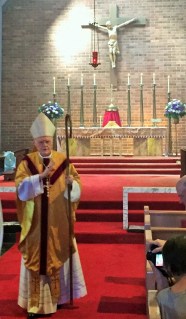
IMG_1326 (5)Perhaps it was the gold vestments against the crimson carpet at St. Peter’s Pro-Cathedral in Oakland that made the Mass of the Holy Ghost one of such deep beauty. Certainly the chanting from the choir loft behind us enhanced this sense of heaven and earth, the light angelic descants swirling over and around our mortal flesh in the weighty oak pews. It was both solemn and joyous, for we were thankful for our archbishop’s careful care over the last year and were happy to witness the installation of our new bishop. 

Saturday’s Mass was one of those moments in history that unites the political and the spiritual. Man has long organized his doings with one another, an activity we call politics, and in this national election year we are keenly aware of this process. We desire freedom and peace, and our national conversations as to how to achieve this in the most equitable manner with the most noble result, occur at set times. We hope and pray that the conversations – the debates, the reportings, and the elections themselves – lead to answers that most of us can live with, peacefully, in community with one another. 

Just so the Church, that Body of Christ on earth, must organize its “political” life within the Church in much the same way. We meet yearly to elect and legislate and found and order anew. But we also protect what has gone on before – those things we have found to be good. We conserve and preserve and build upon the old to create and re-create the new.  

Man is naturally conservative in this sense, that he must build upon his past for good or ill, and that is why change is often difficult, even painful. Instinctively he holds on to his biography, his ancestral beginnings. Intuitively he honors memory, the recording of history whether it be personal, public, or institutional. Today hundreds of years and thousands of photos and documents can be stored in a tiny chip of metal, retrieved with the flick of a finger, so that flexing the memory muscle is not as needed. Or is it? 

It has been observed that we are losing our ability to memorize, losing memory itself, for we have instant access to information. If this is true, then our rituals and storytelling grow even more vital to both nation, church, and temple. Those who have thrown out their past will find their future rootless, their lives or countries or churches built upon sand. 

And so as we convened together in meetings and gathered together for meals this last week, our diocese was charged to remember, to build upon our history as we step into the future. We did this through word and sacrament, prayer and praise. We acted out the great drama of our life together kneeling in pews and sitting on folding chairs. We told our stories, giving life to the memory of who we were and are and who we will be. It was rather like weaving a beautiful tapestry, with each one of us adding a thread to the design. Soon we could see the image we had woven – one of faith, hope, and charity. 

At St. Peter’s on Saturday the archbishop knocked on the narthex doors. The doors flung open, and thirty clergy processed up the red carpet to the altar, two by two, lead by the thurifer, the torchbearers, and the crucifer. The archbishop came last, shepherding his sheep, regal in gold and holding a shepherd’s crook. The gilded robes looked heavy, the miter pressing, and just so his duties must weigh upon his soul, for he must feed and protect his sheep. 

And so the Mass began, and we told our story of God’s great love. We sang our song of confession and absolution, of offering and receiving, of uniting with the eternal in the bread and the wine of the Eucharist. We told our story as we recited creed and read scripture, how God took on flesh to become one of us, to die for us, to live again for us and bring us with him. We told the story again and again, and especially on this Saturday morning in the slanting golden light that fell upon the red tabernacle and white altar, as our archbishop installed our newly elected bishop. We told the story as the bishop received the pectoral cross of our late Bishop Morse, a gesture reminding us to remember our journey to this moment. And we told the story as our bishop received his crozier, to remind him to remember that he must protect and feed his sheep. 

As Ruth R. Wisse writes in the Wall Street Journal, “All that has been earned and won cannot be maintained unless it is conserved and reinforced and transmitted and celebrated.” She is speaking of an “optimistic conservatism” seen in the observance of Passover, seen in the American rituals of Thanksgiving and the Fourth of July. As individuals, citizens, and believers, we can lose it all if we don’t remember, if we don’t celebrate our stories, if we don’t remember to remember.

Making America Great Again

voteI find it troubling how the media exaggerates and condemns discord stemming from political debate.

For discord is the bedrock of democracy. Silence is democracy’s opposite, and should be feared, for it means a drugged populace, whose speech has been taken from them.

As we watch both political parties engage in heated debate, I see the heat as healthy. We should be celebrating the candidates’ right to speak, their passion. To be sure, there are degrees of civility and incivility, lines we don’t like crossed, a continuum that can be slippery, but that is the rough-and-tumble nature of freedom. “Sticks and stones can break my bones but words can never hurt me.” Not entirely true, but true enough. We have laws governing the degree of hurt, of slander, of libel, and when dealing with public figures the laws stretch to accommodate the free speech necessary to the public square.

I celebrate the fierce rivalry displayed over the last year between our many candidates. But I also celebrate those who bemoan the incivility, the name calling, the “tricks” played with “rules” regarding delegate selection. Let those who bemoan continue to be the brave watchdogs that report the crossing of lines and the slipping down the slope of unmannerly dialogue.

All this is good for our country, healthy for America. And there are other kinds of dogs in our political arena – underdogs, those who have been surrounded and bullied by both the left and the right and the media. While it is difficult at times to view Mr. Trump as an underdog, he is clearly beset by his own party powers-that-be, as well as his opposing party and the media both left and right. It is difficult not to root for such a knight clanking clumsily about in his rusty armor, such a strange American hero disguised in rich man’s clothing. For our knights since the time of Arthur and Lancelot are supposed to be gallant and polite. Our heroes are supposed to be in rags. The riches are ordained to come later, after the conquest, like trophies. Mr. Trump is a curious hero appearing on the American scene. He is rich and he is unpolished. Upper classes call such persons “boors.” They are embarrassed by him.

America is not a monarchy and because her people are fighters in both word and deed, they have saved the disintegrating, nominal Western monarchies from foreign occupation. Essentially, America has fought their wars, rescued them. And so when I see the upper crust in Britain and France bemoan our gutter candidates, looking down at such American roughnecks, I wonder at their grasp of reality, their knowledge of history. Remember World War II? Remember the London bombing? Remember Dunkirk? Remember the Holocaust threatening Britain?

The world is affected by America’s national elections. We make a difference in the balance of power, and how we structure our elections matters immensely. While I’m not a fan of the electoral college, I understand its history and the place of state’s rights. As a conservative in California my vote has rarely counted in Presidential elections. I would like to see more enfranchisement and less disenfranchisement. I would like to see, as Mr. Trump would like to see, a complete overhaul of the electoral system.

I would like to see a more honest media, both left and right. I have read again and again allusions to Mr. Trump’s invective against Muslims, Mexicans, and women. The “invective” as I recall regarding Muslims, while poorly stated, called for a temporary ban on non-citizen Muslims entering our country until the borders were better secured against terrorists. Makes sense to me. The “invective” regarding Mexicans, again poorly stated, called for building a wall to keep the drug traffic out and to require all immigrants to enter legally and obey our laws once here. Makes sense to me. The “invective” regarding women, while again poorly stated, concerned a reaction to the slurs against his wife by the Cruz campaign. Makes sense to me.

Mr. Trump does not yet have my vote, such as it is. I am concerned, as many are, as to whom he will nominate to the Supreme Court. I am concerned about religious liberty and compromises he might make with Congress, in his deal making. But then, candidates promise all kinds of things and don’t deliver. This we know. At least he isn’t making specific false promises.

I believe that if America is made strong again, both militarily and economically, many problems will be solved or slowly dissolve. But without a strong military and a robust economy we will not be able to survive the many invasions across our borders that will destroy our culture, silencing our freedoms. Tyranny will reign, and those polished monarchies across the seas with their good manners will not send us aid, for they will have been silenced by sharia law.

It might be the time to elect a bumbling bear of a fighter, an unpolished knight in rusty armor. Perhaps he can improve his manners, polish his act. Perhaps he can be more “presidential” as his wife has urged him to be.

It might be the time to elect a strongman to protect the weak, a strongman who celebrates law, freedom, and the rule of the people. Ineffective leadership at this crossroads in our nation’s history will invite an even stronger regime from outside or from within. Americans want peace at home and abroad, but do they want marshal law, curfews, and a police state? History tells us, in the midst of anarchy, such an answer lurks in the shadows.

Let us celebrate and honor all of our candidates, for America truly has an embarrassment of riches, so many highly qualified men and women of varying ethnicities. The debate has been enriching, informing, and has awakened a sleeping giant, millions of voters paying attention. We are showing the world our greatest strength is our people. We are showing the world we are unafraid of confrontation, of free speech, and of searching for the truth. We may stumble and bumble and even be unmannerly but we will always fight to keep our Camelot democratic and free.

Drenched by Christ

Rain on hillsIt’s been raining here in northern California and our happy earth drinks in the spring drenching, this gift from the heavens. Perhaps our rolling greens will not turn to golden browns quite yet.

It is often these quiet things, these gentle tears of the skies, that delight human senses. We pause and watch and listen. We turn off phones and radios and TVs and ponder, seeing new life birthing in buds and babies, feeling our own beating hearts dance to the rhythm of our breathing.

We are beautiful creatures both infinitely complex and varied, composed of miraculous maps within, historical maps, biological maps, genetic maps. We look to the heavens and see the miraculous maps of the universe, God’s stardust. We are small, tiny parts of a whole, and yet we are giants, of tremendous worth to our loving Creator.

As I stepped through the Holy Liturgy in our parish church this morning, I gazed at the high altar covered with white Easter lilies. I was flooded with wonder. There we were, ordinary folks, sailing in this old ark of a church, taking part in eternity intersecting time. With raspy voices we sing our hymns and the organ pumps out jeweled notes. We are an integral part of the great thanksgiving, the Sunday offering, the Divine Liturgy, the “work of the people.” We hear the silence too, moments of prayer, quiet seconds linking words of confession and absolution, sacrament and scripture. We watch tall tapers flame behind white lilies, a garden holding the tabernacle of God’s Real Presence.

I have found that the Eucharistic liturgy is both earthy and heavenly, uniting our two natures. For the duration of this hour our bodies and souls sing as one, married, united by love.

I’ve been typing up my late bishop’s sermons, and when asked to offer word suggestions for a dedication plaque, I thought of the love of God. Our bishop showed us the love of God, that it was real and living, that it was ours for the asking. And of course, when we are showered with such love we can shower others with such love. It is who we are meant to be, why we were created, to love and be loved.

It is all a mystery. St. John writes that God is love: “He that loveth not knoweth not God, for God is love” (1 John 4:8). But love is far more than a feeling, just as God is far more than wishful thinking. Love is complex and simple, demanding and sacrificial. Just like God. 

So God the Father loves us through God the Son, Jesus, whose very name is holy, one to be breathed in and out with a sacred sense of life and living. It is a name beyond all names, and with the naming of God we pull Him into our hearts and minds and souls, enlivening our bodies with His very breath, the breath of His Holy Spirit.

We have a church conference coming up, an Anglican Synod, and the days together with parishes from many states will be days of mingling the heavenly and the earthly. We shall sit on hard chairs and listen to speeches and reports, but we will also pray together, sing together, and love one another. We shall weave a tapestry of the Body of Christ, so that we may unite as one breath of love, at one in the breathing in and out of the Holy Spirit, the Name of Jesus, to show our world that God is love.

Christ the Good ShepherdToday is called Good Shepherd Sunday. I have a beloved icon that shows Christ in red-and-blue robes carrying a lamb over His shoulders. A wooden crossbeam stretches behind Him. Christ is the Good Shepherd who loves His sheep. He knows them and they know Him. The lamb He carries is like the lamb carried into the temple for sacrifice. We know, of course, that Christ is the sacrificial lamb. He replaces the lamb once sacrificed. For love of us.
I have a recurring nightmare where I am hiking along a steep mountainside in the dusk of evening. I must reach safety before dark and I must watch where I step or I shall fall far into the caverns below. Waking from these nightmares I recall thankfully that Christ will find me wherever I am and bring me safely home with Him. I will not be lost, for not one of His sheep are lost. He is the Good Shepherd.

And because of the Church and its liturgical dance of love, I know His voice when he calls my name. Like Mary Magdalene at the empty tomb, I recognize Him by his voice. Like the disciples at Emmaus I see Him in the breaking of the bread. He is real. He is love.

I also have a recurring dream in which I am flying like a bird, low over green hills, arms outstretched like wings. I can sense in the dream that my arms must push downward through the air so that I can rise, as though I am swimming. It is a beautiful dream, a soaring dream, and one beating with love.

And so like these green hills, drenched and quenched by the rain, I am drenched and quenched by Christ. Christ in sacrament and scripture, in song and dance, in the breath of each day. I know that nightmares will be redeemed by dreams, dark terrors turned into bright joys.

As the clergy and acolytes recessed down the red-carpeted aisle toward the open doors of the narthex, the crucifix held high, the torches aflame, we sang the wonderful Hymn #88, “Jesus Lives,” written by German poet Christian Gellert in 1757 and set to the tune “St. Albinus” in the 19th century by Henry Gauntlett. We are instructed in the top left corner of the page to sing joyously and so we do. I particularly like the first and fourth verses, for they sing of the promise of the Good Shepherd:

 Jesus lives! thy terrors now/ Can no longer, death, appall us;/ Jesus lives! by this we know/ Thou, O grave canst not enthrall us. Alleluia!

Jesus lives! our hearts know well/ Naught from us his love shall sever;/ Life, nor death, nor powers of hell/ Tear us from his keeping ever. Alleluia!

Easter Lilies

Easter LiliesIt is a rich and glorious season, this time of Eastertide. 

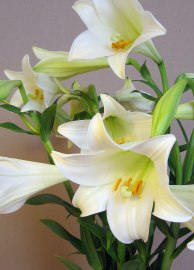
As I plucked wilting blossoms off my Easter lilies near our front door I inhaled the sweetness of those remaining, taking care to avoid the staining powder of the yellow stamens. I then attended the roses that once sat on my dining table and now are over the kitchen sink. Five buds are left with shorter stems clustered together in a small pitcher between sculpted figures of Mary Magdalene and an angel. As I gaze at these reminders of the season, and especially of Easter Day, I wonder at it all.

The season of Eastertide, the fifty days linking Easter and Pentecost, provide a joyful time of quiet reflection on the meaning of the Resurrection. The immense implications of this historical event, when eternity intersected time, continues to stun me. And the scripture readings assigned for these days reflect as well, considering the meaning of this new world that was created by the empty tomb.

And indeed a new world was created with the death and resurrection of Christ. It is a revolution changing everything. In one of his first resurrection appearances to the disciples Jesus gently explains what has happened. As our preacher said this morning, Christ appears to them in an upper room where the doors have been locked. He has passed through material barriers to be in their midst. He has power over the world of matter in which we live. Is he a ghost? A vision?

St. John’s eyewitness account describes how Christ points to his wounds in his hands and his side as proof he is no ghost or vision. The disciples can see and touch him. He has a material body of flesh and blood. He is real. And yet he has the power to pass through matter.

In much the same way he seeks to enter our hearts, our own bodily chambers, to dwell in us. How does he do this? He gives the apostles power to forgive sins by breathing his spirit upon them. From this time on, the apostles, who give life to the Church, act for God in the forgiveness of sins. Why?

Christ desires clean-swept hearts, hearts of light that have expelled the dark. He can only enter a heart that is full of light, enlightened, clean of sin.

It is a profound mystery and yet it is profoundly simple, just as each of us is a profound mystery and yet profoundly simple. All creation teems with intricate complexity yet delightful simplicity. The day turns to night. The rain falls on the earth. The sun shines. And the layered meanings and conclusions of learned theologians can be summed in one sentence: God is love.

Just as I pluck the dying trumpet blossoms with their staining stamens, I pluck out my own selfishness, greed, envy, pride, my own staining sin. I trundle to Mass and confess. I repent and am forgiven. I can now enter the open doors of the Eucharist through prayer and praise, Creed and Scripture, to meet Christ in the bread and the wine. He enters my body, heart, and soul. I am given life and light and joy, having partaken of the divine.

All this Christ Jesus taught and showed in his life on earth, as he walked among us. The week before his death he gave us the Holy Supper and showed how he would return among us again and again with each Eucharist. After his resurrection, he gave us the Church and the way to forgiveness. After his ascension he gave us his Holy Spirit to strengthen, to comfort us. All told, Christ Jesus gave us himself, the only path to Heaven – the Way, the Truth, and the Life for, as St. John writes in today’s Epistle,

 “And this is the record, that God hath given to us eternal life, and this life is in his Son. He that hath the Son hath life; and he that hath not the Son of God hath not life.” (I John 5:4)