
 We are in the season of Epiphanytide, the weeks following the Feast of the Epiphany and leading up to “Pre-Lent”, the “Gesima Sundays”: Septuagesima, Sexagesima, and Quinquagesima. These Sundays in turn lead up to Lent proper, which begins Ash Wednesday, March 2, this year. Epiphanytide can be up to six weeks, swinging upon the date of Easter, which depends upon the full moon (!). Yes, we still have holy days and seasons depending upon full moons, reflecting the two thousand years of celebrating the stunning reality that God came to earth, became incarnate, in the flesh, walking among us.
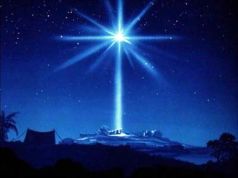
Epiphany celebrates the good news of the birth of Christ, Christ-mass, to our world: the birth of the Son of God. The magi, or kings, or wise men, arrive from distant places bringing gifts. They follow a star that has led them on their journey, a star that history has identified as the conjunction of three cosmic events in the heavens.
Epiphany means manifestation, or showing forth, and in this case a showing forth to the gentile world, proclaiming that the gift of salvation is for all peoples, not just the “chosen” ones.
 In this sense, Epiphany proclaims the equal dignity of all men and women, of all human life. Epiphany says, God loves you no matter who or what you are. God wants you for his own, to be with him in Paradise.
And so the lessons in this season reflect this showing forth, this shining light upon this marvelous truth for all. Today’s Gospel is particularly lovely, for we speak the words of the Centurion in the liturgy of each Holy Eucharist. The Roman soldier asks Jesus to heal his servant at home. Because of his faith, he believes that Christ can heal from a distance. He says: “Speak the words only and my servant will be healed.” And, we are told later that his servant was healed in the same hour.
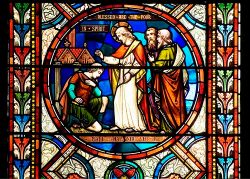 These words are spoken in our liturgy just before receiving the Eucharist, with a slight modification: “Speak the words only and my soul shall be healed.” We repeat these words three times as the celebrant holds up the Host for all to see. Then we line up to receive the Real Presence, the Mystical Presence, of Christ.
It is a mystical miracle, each time, indeed. These homely elements of bread and wine, our simple bodies bowed in penitence and hope, our plea for salvation, our faith that it will be given to us if we ask, conquering death and time.
This is no small thing. And yet we are small, the wafers are small, the offering we make – ourselves, our souls and bodies to be a reasonable sacrifice – is small too. He is the God of small things. He inhabits small things, as Eastern religions have known for a long time. Large things are puffed up and proud. Pride seals off the divine. It closes the door of the heart. Pride – largeness – says I can do it myself, leave me alone.
But we can’t do it ourselves. We cannot save ourselves. We cannot heal ourselves.
Christians are simple people. They face simple truths directly and live accordingly, or at least try not to self-deceive. We are mortal and frail and one day we will die: we need God. We do not love enough: we need Christ. To admit these things is what living is all about. If we want to glory, we glory in Christ himself, in the Cross of Christ, in our redemption.
 Our 1928 Anglican-Episcopal Book of Common Prayer is full of Holy Scripture like these words of the Centurion. And because we repeat many of the phrases each week, each month, each year, depending upon the season, we write these words on our hearts, we inwardly digest them, as one opening prayer says in Advent. The repetition is useful and beautiful, for not only do we learn and digest, but we speak the words together, in unison, in a kind of starry dance. We in the pews become a choir of angels, bathed in the light of Christ.
 It is this light – these starry epiphanies – that I desire to write about in my next novel. I am currently developing the main characters, those who will inhabit the pages, who will hopefully and faithfully shed light upon our world. I study real people through memoir or biography and create
 composites that will become epiphanies, manifestations of the light of God. While I am not creating living breathing human beings as our Heavenly Father does, I pray that Our Lord will speak the word only and they shall come alive on the page, that they shall reflect simple truths of our existence in today’s world, the joys, the pains, the meaningful moments pointing to our reason to be alive at all.
 There was a mighty rushing wind that whirled around our house this last week. The whoosh was ferocious as though a roaring lion were breathing upon our hillside at the base of Mount Diablo. I thought how nature was not always gentle, kind, and caring about humanity but ran on a course of its own. Our house was in the middle of that course, it seemed. Would we be blown into the sea?
 I believe it was Victor Davis Hanson who wrote (probably in his recent excellent book The Dying Citizen) that with false victimhood (and who is not a victim today?) comes denial of responsibility. Guilt is washed away when you are a victim, or at least guilt is explained or excused.
 I thought about this, this morning in the Berkeley chapel, that our God is a God of Life. We celebrated the first miracle of Christ, the turning of water into wine at a wedding feast in Cana in Galilee. The simplicity and need of the act touches me. Had Mary seen him do these things before? She says to the servants, “Do whatever he tells you to do.” She says to her son, “They have no more wine.” And so Our Lord remedies the situation, turning 150 gallon vats of water into “the best wine,” as the master of the feast says later.
 The Cana miracle reflects the living God of all creation, for to turn one substance into another is no small thing, yet is a small thing for him. He charges matter with life, with atoms forming substance. We call this a sacrament and, in the sacrament of the Eucharist atoms of bread and wine become charged with his life. They become “the real substance of things unseen.”
 A friend entered Paradise last night. His soul left his weak mortal flesh to rise to Paradise. He was and is a big hearted man, a loving man, a man of faith and purpose. His good humor humored us all, those who worked with him to witness to Christ through the St. Joseph of Arimathea Foundation in Berkeley. Our Board meetings have been virtual the last few years, so we were denied his physical presence and yet he was there on the screen. He was a layman, a businessman, a husband and father, and a faithful (founding) member of St. Thomas’ Anglican Church in San Francisco. He helped found our St. Ann Chapel at Stanford as well.
 I do not know exactly the time sequences, the order of events, in Paradise, for the simple reason we are outside of time, and as creatures bound in earthly time, we cannot envision Eternity. And yet, as my theological grandson mentioned at Christmas, we sleep until the Second Coming of Christ to Earth and the advent of the New Jerusalem. This New Heaven and Earth will be our home and we shall be given our perfected bodies. Wrongs will be righted, paths will be straightened, and Christ shall wipe all tears from our eyes. We shall be reunited with those who have journeyed before us, at least those who desire to be in Paradise, those who believe, those who claim Christ as their savior and redeemer.
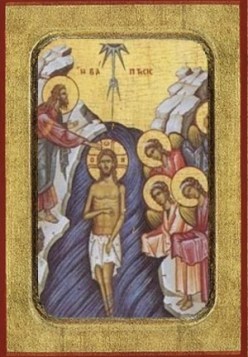 And so this morning as I listened to the Gospel appointed for today, the baptism of Jesus by John, the dove descending, the voice from Heaven saying, “This is my beloved son, in whom I am well pleased,” I thought how my friend entered Eternity and embarked upon this great journey on the eve of the Second Sunday after Epiphany, the eve of the Sunday we celebrate the Baptism of Christ.
 A new year has been marked in the calendars of mankind. Time has been broken into pieces so that we can organize it to form associations with one another through work, play, sickness, health. We set aside times in the future where we promise to be, where we promise to give of our time for that moment, hour, day.
 to prepare. We are warned of waterfalls and cliffs that plunge into the dark abyss.
 St. Luke tells of a woman who touched the hem of the robe of Jesus. She wanted to be made whole. She reached out, hoping, praying. I reached out too. I wanted to be made whole too, although I didn’t realize it yet.
 And it gets better each year, this amazing journey. At the age of seventy-four, I have no regrets that I chose this river. For the Church has been my ark, and we have sailed together, I in her womb of life with those who travel with me. We are the family of God, precious in his sight. We are his bride.
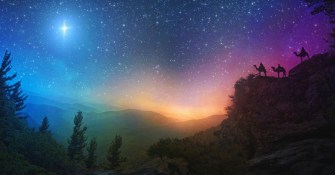 I have always enjoyed the twelve days of Christmas, Christmastide, stretching from Christmas Day, December 25, to Epiphany, January 6, pivoting upon our old year ending and new one beginning.
 His was the light of the world, and the world knew him not. But to those who received him gave he power to become sons of God.
 The true light of the world is the Prince of Peace. He shines a light into our hearts so that we can see our wrongdoings and confess and repent. We then can approach the altar and receive him into ourselves, our souls and bodies.
 Christine Sunderland
 Christine Sunderland