
 We have had a number of changes in our Anglican Province of Christ the King recently, reminding me of the power of change, the movement of the hands of time and the fulfillment of human destiny.
Our Anglican body in the Body of Christ is a stalwart group, having left the mainstream Episcopal Church in 1977, a vital change in itself. We idealistically thought we could start anew and hold on to our traditional beliefs – the creeds, Holy Scripture, Church tradition and exegesis, the life-giving sacraments, the beauty of liturgy, particularly the weekly Eucharist, and we did hold on, treasuring these gifts of faith. All were threatened by the mainstream church, and we jumped ship, as it were, and swam to shore to renew and affirm the Anglican body of the Body of Christ. We needed to build from ground up, although we had clear enough plans as to what we were doing, indeed, what we were saving. We had a firm foundation.
Rather like the Puritan pilgrims fleeing persecution in England and arriving on our shores centuries ago, we knew things would change, and fixing our eye on Our Lord and following him through the wilderness to the Promised Land, we set out to do the job. We have never regretted it, only celebrated what we have built. We gave thanks to God for his benevolence toward us, sheltered by his canopy of love, fed by the great cloud of witnesses who testified to the reality of Christ and his redemption of mankind. We wanted to tell the world the good news, and still do.
Change. There can be bad change and good change. Change can be exciting, offering new frontiers. Change challenges us, forcing us out of our slumber to wake and look around again. Change stirs things up, within and without. But if change is part of the larger love of God, it may hurt, it may be inconvenient and costly, it may take effort, but the reward is great, for the faithful are filled with joy.
 We traditional Anglicans, living lives of faith and practice as best we can, pleasing, we hope, to Our Lord, have structures that curate change carefully, modestly, sagely. We have bishops (the Episcopate) who shepherd the clergy, and clergy who shepherd us, the laity. We have councils and synods and elections and canons and by-laws. We have committees and boards and prayer groups. We have vestries and altar guilds and women’s associations. We have a great foundation going back to the Apostles that allows us to read the map and see the crossroads and make the choices necessary in our world today. And we have inspiring music, penetrating words, poetic chants, and… friendly coffee hours. We have riches that go beyond measure.
All the while we listen, watch, and move with the guidance of the Holy Spirit, or try to.
All the while we are covered by a canopy of grace, knowing our shepherds, our bishops, will lead us where we are to go, as best they can, in humility and prayer.
All the while we are teased by joy, pulled along the path of life by promised delight, in a never-ending dance.
Of course, as my bishop of blessed memory often said, the most healing change is the change of heart, the admission of sin, repentance and penitence, and this fundamental change in attitude places us where we must be, in order to see the greater changes and movements in our world. And the more we practice change of heart and mind and soul, the more we sing and dance for joy. It is a curious paradox, that when we grow small, our hearts grow big. Our eyesight grows sharp and our listening more intense. We see others as sacred, unique individuals; we see all human life as holy and of infinite worth, infinitely complex and diverse. We learn to love as we are loved.
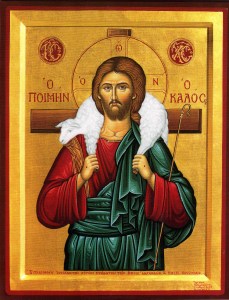 And so we welcome a new Vicar to St. Joseph’s Chapel, as well as a new Rector, who is our newly elected Archbishop (it’s the Archbishop’s Chapel). We have a new shepherd who must look out for sheep that stray and return them to the fold, return them to joy.
Today’s Gospel lesson was the parable of the sheep that was lost and found and the parable of the coin that was lost and found (Luke 15:1+). Our Lord speaks of the “joy in the presence of the angels of God over one sinner that repenteth.” That, of course, is the mission of the Church, and as we live out our lives in the presence of God, doing what we are meant to do, we are here for those lost sheep. We welcome them into our fold, knowing that we too are often lost, and we can turn and change, and return to the fold. This is a blessed assurance, this promise the Good Shepherd makes to each one of us. He will find us and bring us home.
 Today’s Epistle lesson (Peter 5:5+) was written by St. Peter, our brave apostle who jumps into the sea and swims ashore, who follows Jesus to his crucifixion, denying him and then repenting, who tries to walk on water but begins to sink, who witnesses the empty tomb, who leads the others in building the Church. Peter has been many times lost and many times found, so that he knows what he speaks of when he says “Humble yourselves therefore under the mighty hand of God, that he may exalt you in due time: casting all your care upon him; for he careth for you. Be sober, be vigilant; because your adversary the devil, as a roaring lion, walketh about, seeking whom he may devour… ” And on Thursday we celebrate the Feast of St. Peter and St. Paul.
And so we watch and listen and cast our worries at the feet of Our Lord. There are many lions walking about today, roaring, looking for prey, looking for lost sheep that cannot find their way home without God.
It is good to know we are loved and cared for, indeed, treasured by our Creator. It is good to know we can cast our cares upon him. It is good to be among others in a chapel in Berkeley who are sheep like us; a family of God in a fold of Eternity.
 Today is Father’s Day, a day when we celebrate our fathers, if we can. But many are fatherless these days; many never had a father growing up; many have missed something important, a father in the home.
 Just so, we as a nation look to our founders, our history, to be protected from hostile enemies and natural disasters. For if we heed the centuries of fatherly advice, be it Church Fathers or Founding Fathers, successes or failures, we will thrive. We will have a way forward, a standard of measure – The Ten Commandments, the Rule of Law, the Golden Rule. We feed the hungry and heal the sick.
  Through it all the Church has preached the vital importance of families, the vital importance of fathers present.
 As the political rhetoric heats up in our country, it is so good to be present for an hour in a holy place, to rest from the “talking heads” newscasters, and appreciate being surrounded by Eternity, as we sing and pray and kneel and listen. The rest and renewal sends me out into the real world again, driving home on the freeway, dodging the weaving racecars, wondering if this will be the day of my entering Eternity, not merely visiting Heaven in a Berkeley chapel.
 The series shows the real-life world in which these events occurred: the poverty, the challenges of walking the hills and setting up camp, the rivalries and battling egos natural to any group living in such close quarters. The Pharisees and the Sadducees. The lepers, the blind, the lame. There is much drama to portray, and they do it well. There are times when the filming can be too dark, without enough light to see who is speaking, but that seems to be the film fashion today. The Jewish characters have accents as well, adding to the difficulty in understanding the scene, but we have managed to become used to the way of speaking.
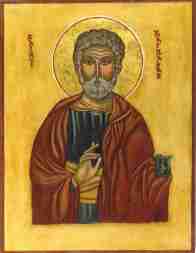 For of course Saul persecuted the Christians in those early days, and his terrible deeds were known and justly feared. He was there at the stoning of Steven. But Barnabas linked the feared Pharisee with the frightened followers, mediated them, and with the addition of Saul, who becomes Paul, the first great Christian theologian is given voice. The Church owes Barnabas a great debt of gratitude, for Paul understood what had happened when the Nazarene lived and died and rose again; he understood the events within the framework of Greek philosophy, for he was Greek.
 The Gospel. St. John xv. 12.
  I always look forward to Trinity Sunday, since we usually sing the majestic, awe-inspiring “Holy, Holy, Holy,” one of my favorite hymns, but I didn’t expect (although should have) “St. Patrick’s Breastplate,” another hymn to the Holy Trinity, a powerful hymn, robust, and commanding. To have these two hymns, accompanied by the magnificent melodic and thundering organ playing six feet behind us! I thought we might soar into the heavens: our little chapel burst with song.
 I wrote of “Holy, Holy, Holy” in my latest novel, Angel Mountain (Wipf and Stock, 2020). Toward the end of the story (plot spoiler!) Abram the hermit finds himself in Heaven, and the great vision of St. John on the Island of Patmos is described, the vision that became the Book of Revelation (some call it the Apocalypse) in Holy Scriptures. In his vision, John describes the angels and saints worshiping before the throne of God.
 So of course our Epistle for today was Revelation 4:1+, reflected in the hymn and the creed (BCP 186). And the Gospel, too, considers what it means to believe the Creed. In this scene with Christ Jesus and the Pharisee Nicodemus, their conversation explores being born again of the Spirit (John 3:1+, BCP 187). For Christ says, “Except a man be born again, he cannot see the kingdom of God… except a man be born of water and of the Spirit, he cannot enter into the kingdom of God.” Christ has come to Earth and a new world has been born among men. We are invited to enter, to come and see, to glimpse Heaven from Earth.
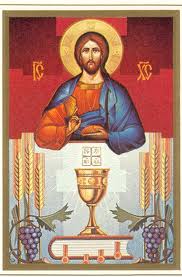 In this sense we are born again in every Eucharist, every song, and every prayer. “For in him we live, and move, and have our being… For we are also his offspring.” (Acts 17:28). For the space of an hour of worship, we live inside this golden reflection of Heaven, fed by God the Father, God the Son, and God the Holy Spirit.
 Christine Sunderland
 Christine Sunderland