
 Having finished a first draft of my novel-in-progress, The Music of the Mountain, I find I need a concise description to answer the question, “What’s it about?”
So tentatively, in an attempt to distill sixty thousand words into a phrase or a sentence, I am sallying forth with, “Saving books in order to save Western Civilization” or perhaps, “A philosophy professor, a history teacher, an honest journalist, and a praying priest, secretly save classic history and literature before they are burned by the Social Justice Committee”. Sounds like Fahrenheit 451, and in some respects it is a modern version Bradbury’s dystopian novel, but much more. Set in January 2023, the Emergency Powers of government has decreed classics to be hateful and has erased those portions of the Internet deemed too white. Libraries are closed due to the pandemic, and will unlikely reopen. So my intrepid professor gathers a few booklovers, former students, to help her save civilization, one shelf at a time. Lo and behold, a secret library emerges!
So the novel continues my fascination with words, and with people, and this time with virtues and memory. Language itself is a test of memory, how we write words into our minds, onto our hearts, onto our tongue in speech. Each one of us is a word, an expression of God’s love and will and design. Each one of us is unique, precious, and loved.
 I believe also, that each one of us is necessary to the plan of salvation. Each plays their part, if only to link to another who links to another who links to another… until we form a sentence, a paragraph, a chapter of God’s will for mankind. Usually, we have no idea who might be the one who links to us, or who we are linking to. Who reads these words, who hears a sermon, who takes an idea from a book or a person and sends it flying through the stratosphere to someone else. Every person counts in God’s plan, and when one is lost (that lost sheep) another must be found. We are letters in the word, cursive dancing across a page, joined with others to form phrases and sentences, that fill the Earth in life and the Heavens in eternal life. My bishop of blessed memory often consoled me with the words, “Nothing is lost. Everything counts.”
And so we plant the seeds of memorized words and phrases in our hearts this Lenten season, to be ready for rising from the earth triumphantly. “O Lord, thou hast searched me out and known me, thou knowest my thoughts long before. Thou art about my path and about my bed, and art acquainted with all my ways. For lo, there is not a word on my tongue, but thou, O Lord, knowest it all together. Thou hast beset me behind and before, and laid thine hand upon me. Such knowledge is too wonderful and excellent for me. I cannot attain unto it…” (Psalm 139)
 Christians believe in a personal God, a God that makes a difference in our lives and in our deaths. He is with us, Emmanuel. The shepherd boy David knew this in his songs in the fields, so that God could mold him to become the origin of the “Line of David” that would send forth the Christ to save the world. No small thing. He was chosen from the Chosen People of Israel and one can see why, “For my reins are thine; thou hast covered me in my mother’s womb.”
And so we sing the song of love, the melody of creation, the hymn of praise to God, our creator, our Father, our Lord, our Spirit. The song begins as a solo, then joins in with others, then a great chorus rises from the Earth, a love song to God.
 That is what Lent is, singing our song of life here among the living, choosing the good and rejecting the evil, cultivating Christ within us to rise on Easter morning.
And that reminds me – my Music of the Mountain is about virtue, what it is, why we need it, how to sing it in our lives. Faith, hope, and charity. Prudence, Temperance, Fortitude, Justice. And, as we heard recently, the greatest of these is charity, love. For without love, we are tinkling cymbals. Without love, we are nothing.
And there is a love story too in my little book, and a past tragedy that needs healing, and heroic visions inspired by those who fought for freedom in the past, and escape stories of the Holocaust, so that we never forget.
But most of all, it is a collection of words and sentences and paragraphs that run and dance over the white pages, creating love and life and… expressions of who we are and who we are meant to be, a love song to life and the Creator of all life.
Thanks be to God.
 Every Lent I choose something to memorize and something to renew that has slipped from my memory. I consider it not only a mental discipline, always good in Lent, but food for my soul. Words are miraculous. If they sit within you long enough, if they travel to your tongue and are set flying into the air, they support an architecture of belief. And so Advent and Lent I consider the passages I will write on my heart.
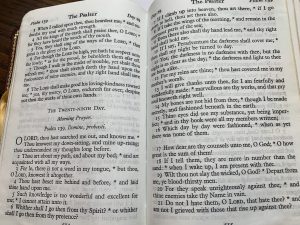 O LORD, thou hast searched me out, and known me. * Thou knowest my down-sitting, and mine up-rising; thou understandest my thoughts long before. Thou art about my path, and about my bed; * and art acquainted with all my ways. For lo, there is not a word in my tongue, * but thou, O LORD, knowest it altogether. Thou hast beset me behind and before, * and laid thine hand upon me. Such knowledge is too wonderful and excellent for me; * I cannot attain unto it. Whither shall I go then from thy Spirit? * or whither shall I go then from thy presence? If I climb up into heaven, thou art there; * if I go down to hell, thou art there also. If I take the wings of the morning, * and remain in the uttermost parts of the sea; Even there also shall thy hand lead me, * and thy right hand shall hold me. If I say, Peradventure the darkness shall cover me; * then shall my night be turned to day. Yea, the darkness is no darkness with thee, but the night is as clear as the day; * the darkness and light to thee are both alike. For my reins are thine; * thou hast covered me in my mother’s womb. I will give thanks unto thee, for I am fearfully and wonderfully made: * marvellous are thy works, and that my soul knoweth right well. My bones are not hid from thee, * though I be made secretly, and fashioned beneath in the earth. Thine eyes did see my substance, yet being imperfect; * and in thy book were all my members written; Which day by day were fashioned, * when as yet there was none of them. (Psalm 139, BCP 514-515)
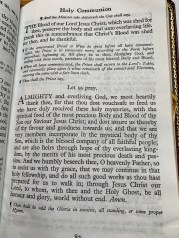 My new memory work is a Eucharistic prayer of thanksgiving, usually said by the celebrant, but in our chapel the people join in. I almost have it down, but phrases keep eluding me so I’ll work on it a bit each evening:
 This week we observe Ash Wednesday, the day when Christians are reminded of their mortality with an ashen cross drawn on their foreheads, as they hear the words, “Remember o man, that dust thou art and to dust thou shalt return.”
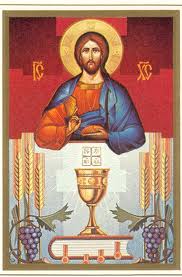 And so we shall become perfect in our new lives, on the new Earth, in the New Jerusalem. What must we do in the Earth-time meantime? We must learn to love, for loving others as God loves us teaches us how to grow into what we are meant to be. It can be no other way. Love is the creative force that lives within us and opens the gates of Heaven when our time comes.
 God’s love for us means we have meaning in our lives today and everyday that we open our hearts to him. Every day we close our hearts we invite despair, for the absence of God in us kills hope. In this same passage we are told by Paul that faith, hope, and charity abide, but the greatest is charity. And yet we must have faith to hope to love.
 High winds and steady rain are sweeping the Bay Area today, rattling the trees, unsettling the natural world in which we live. We are in the season of hoping for spring, for Easter, for resurrection. Seeds deep in the dark earth will rise to the light of day and bear fruit. We prepare for that day, that moment, in the season that is called our life in time, our lifetime.
 In this season of life and death and life again, Christians celebrate resurrection. And yet the promise is more than rising to new life when our bodies die. For God enters our hearts today, if we let him. Resurrection is now, when our spirits are enlivened by the Holy Spirit through sacraments and prayer. Eternity is now, as etched on a monk’s gravestone in the Community of the Resurrection in Yorkshire, for God the Son is present in the bread and the wine. We sing the songs and pray the prayers with others of Christ’s body, so that our hearts will be open when Christ knocks on the door. Do we recognize the knock? Do we know the person that will live inside us, giving us eternal grace and glory?
 Our Lord is like a rainbow, offering us every color in the prism of life. But we cannot see the rainbow if we are blind. Lent heals our blindness so that we can see the colors, so that we can know love eternal, and life eternal.
  Christine Sunderland
 Christine Sunderland