
 We are in the middle of Christmastide, those twelve glorious days of Christmas ending on Epiphany, January 6.
I have celebrated seventy-eight Christmases on this good earth. If I don’t remember each one, they remember me.
With each year I have added another layer, another garment, to my Christmas past to create my Christmas present, which becomes indeed a yearly present presented to my heart, mind, and soul. The past does this to the present if we pay attention, or even if we don’t, for today’s Christmas is partly the memories of earlier ones and perhaps even the anticipation of ones to come.
Thus rituals and traditions color our world. We sing the same songs and add new ones. We decorate our homes as if a king were arriving, for indeed he is, and did arrive on Christmas Day. We turn earlier saints into messengers, and invite Saint Nicholas to gift us, arrive on the roof and come down through the chimney to place delicacies in our giant stockings hung with care in hopes he will be there.
We build anticipation in the weeks before, trying to be good, greeting one another with holiday cheer, wearing holiday colors and hats and tees, singing about a reindeer named Rudolph with a red nose who was humble and then great, or so the story goes.
We prepared for Christmas by thinking of others, teaching our hearts to expand to include another in our thoughts and plans. We bake for them, give them gifts that are wrapped in bright paper with shiny and curly ribbon, so that the joy becomes even more special for it has been hidden, as Jesus is hidden in history and mankind’s retelling.
In these rituals we tell the story of God becoming Man and walking among us. The story is too fantastic to tell. It is too amazing to fathom. So we tell it in our preparations, in our humble human attempts to shine the light on the glory of God and the laughter of his love.
Like Our Lord, Saint Nicholas comes down from stary skies and gives us wonderful gifts. The gifts do not compare to the gift of Christ and Eternity, the gift of God and incarnation, the gift of life over death, joy over sorrow. They do not compare, but they remain our meager attempt to reveal Christmas, the birth of the Son of God, the Messiah, the long awaited one here to set us free from our own captivity of self.
And so we try to be like Saint Nicholas and give gifts and reflect Our Lord Jesus who gave himself to us.
 And we try to be like the angels and sing to him in his manger. We sing of the miracle and mystery of that unlikely birth, we harken to the herald angels singing glory to the newborn king, we sing of a silent and holy night when away in the manger there was no crib for his bed, we tell of the little town of Bethlehem and what happened on that midnight clear when the glorious song of old was heard as angels touched their harps of gold, for Christ is born of Mary, and while mortals sleep, the stars proclaim the birth and peace to men on earth.
Indeed, the Prince of Peace, the Lord of Love of You and Me, was born that night over two thousand years ago, and today we sing carols layered upon earlier carols, as humankind tries to express the inexpressible with words and melody.
 We teach our children the songs, so that they will teach their children. To help them remember, we dress them to play parts in a stable in Bethlehem. We clothe them with the story of the Christ Child. They act out the greatest story ever told, and each year they add to their own library of Christmas rituals and traditions.
And so I have been graced with seventy-eight years of Christmases. The time is rich and glorious and I wear a tapestried robe of many colors and notes and words. I live out what I have been given, a humble life of gilded mystery and miracle, for each day brings its own gifts of healing, seeing, hearing, being. Every minute is birthed by Christ. We breathe Christmas all year, birthing this Bethlehem child who births us.
We follow the star of Christmas and find ourselves at the cross of Easter. In this journey in time, we learn to love as God loves us, wrapping our hearts with the bright ribbons of Christ, to give ourselves to one another.
 There is the silent hush of valley fog enshrouding our house today. The mute world waits, hoping for a sign. A sign of what? A sign of life, life everlasting, before and to come. A sign that we are more than flesh, more than animals on the hunt to survive.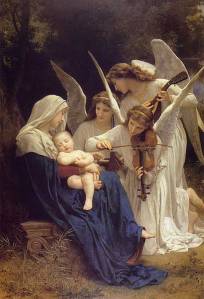
 Today is Gaudete Sunday, or Rose Sunday, and Heaven Sunday too. The Third Sunday in Advent is rich with meaning as we prepare for Christmas and the Incarnation of God, come to us to live with us and in us. Such miracle and mystery often astounds me.
 “Rejoice in the Lord always; again I say, rejoice. Let your forbearance be known to all, for the Lord is near at hand; have no anxiety about anything, but in all things, by prayer and supplication, with thanksgiving, let your requests be known to God.” (Wikipedia)
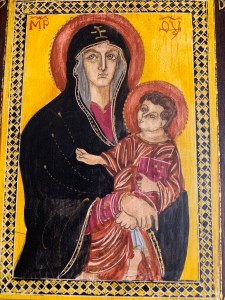 orld of faith, hope, love, and joy. It sounds too good to be true, but it’s true.
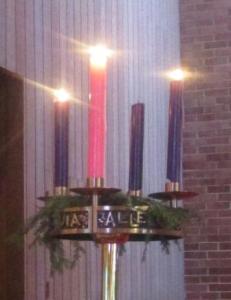 We light our three candles today, including the rose candle, and we recall our ultimate destination, Heaven. As we do, we experience a moment of Heaven on Earth. The candles flame, testifying to the Lord of Lords to come, to be born on Earth and reborn in our hearts.
 The opening prayer that collected our small flock together on this brilliantly clear morning in a chapel in Berkeley was the “Collect for the Second Sunday in Advent”:
 Advent’s daily prayer begins with “Almighty God, give us grace that we may cast away the works of darkness, and put upon us the armour of light…”. To memorize this prayer is to digest it, to send our words to God, expressing our need for re-forming, re-creating. And even as we pray the words, we become clothed in a protective garment, an armour of light, lighting the darkness.
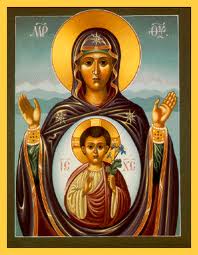 Today is also the theme of Judgment. We shall be judged. The world shall be judged. But Christ takes our part if we desire Him; we are forgiven if we repent. And so we return to words – words to instruct our conscience, learning right and wrong, law and love. Holy Scripture becomes the textbook that teaches us where we have gone wrong, returning us to who we are and are meant to be. We need merely pray our words to Our Lord to be changed, to be redeemed, to be saved.
 The nights have been clear and cold here in the Bay Area. We can see the stars and I reach to touch them, they seem so close. Advent is the time of stars in the heavens. Advent is when we follow the star to Christmas. We reach and we follow the star.
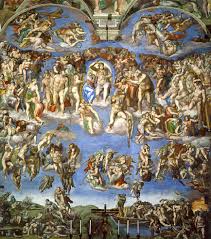 These are big things, subjects we would rather avoid. Especially judgment. We define deviancy down and further down, so that we can deny judging anyone and thus not be judged ourselves. And yet we know deep within there is a moral law all mankind senses, reckoning that a standard has been set, a standard we don’t meet. And with law there is judgment.
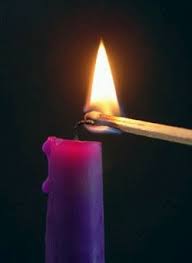 We light our first Advent candle in our Advent wreathe. It is only one small flame in the dark, but it will light the others, each week, until we see the light of Bethlehem, the light of the world, the light of Christ.
 It is good we practiced gratitude for our blessings this past week. Gratitude humbles us. Gratitude says, we owe something to someone else. Indeed. We owe much to those giants that have preserved the West, and fought for our freedoms through war and peace. We owe much to our local church, filled with good souls who try to love us. We owe much to our own families who try to put up with us. We owe much to Our Lord who gave us life itself and continues to breathe life into each day we live.
 We begin at the beginning, the first day of the Church Year. In this new year we open the gates of Jerusalem – and our hearts – to the Messiah as our Gospel reading describes. Today the story begins, and each one of us will play a vital part in the greatest drama of all, life overcoming death, eternally, minute by minute.
 Christine Sunderland
 Christine Sunderland