 The Word in Your Heart: Mary, Youth, and Mental Health by Francis Etheredge (St. Louis, MO: EnRoute Books and Media, 2024)
Reviewed by Christine Sunderland
In this collection of prose, poetry, and prayer, Francis Etheredge, bioethicist, theologian, and philosopher, invites us on a pilgrimage through words and pages, interweaving meditations on the Virgin Mary as protective mother to all, the truth of the human person, and the challenges young people face in today’s materialistic and divisive world. The common answer to these vital questions is found in the Word implanted in our hearts, meaning Holy Scripture to be sure, but also the action of God in history and today, the Word made flesh who dwells among us.
And so, on this journey, we meet Christ and his healing power, for Etheredge has placed the Word in our hearts. We learn about The Neocatechumenal Way, an evangelistic group within the Roman Catholic Church, established in the 1960s, and giving life to parishes by promoting family, eucharist, and community, proclaiming the love of Christ. The Way changed Etheredge and brought him back to Christ and the Church and, on this journey, we see why and how and the importance of growing in a community of persons and words and sacraments, and thus living more fully the time we are given.
The pilgrimage is for real and not mere metaphor: Francis Etheredge and his family of eight join a pilgrimage of youth from London to Lisbon, stopping at Nemours, Lourdes, Pamplona, St. Francis Xavier’s home, Santiago de Compostella, and Fatima. We encounter Mary’s appearances and experience her help and direction. We learn of St. Ignatius, St. James, and St. Teresa Benedicta of the Cross (Edith Stein). We see the power of God working, miracles and more miracles, as we mourn the suffering of the innocent in not only the Holocaust of World War II but in Herod’s slaughter of the innocents and today’s slaughter of the unborn.
The power of God reforms and recreates and burnishes:
“The Lord, like a craftsman, then, takes our whole history and makes a stained-glass window of even the scraps and pieces that we would be happier if they were in someone else’s life or no one’s! But, as beautiful light transfigures everything into a blazing pattern of the Lord’s glorious, redeeming love, let us hope to rejoice that we can see how God has blessed us and that the love of God can show through the whole of our life and so help others.” (76)
Etheredge’s fervent faith is tangible, as is his deep concern for the “needs of young people today!” Thus, he speaks of the Virgin Mary, the power of pilgrimage, the human person, and the love of God seeking to heal the broken hearts and bodies of the young, born into our nihilistic world, an age at war with the spirit of man and the Spirit of God. “This is a book about the power of God to change a man’s life…” he begins, as he shares his own conversion at age forty, one that led him to greater and greater awareness that God had a vocation for him and every unique and holy person.
He writes of the contemplative nuns at The Monastery of Our Lady of Bethlehem:
“Given, then, that the Eucharist, and being able to see the Blessed Sacrament from where they lived in their hermitages, was central to their life, the image of the Blessed Virgin Mary as the ‘Monstrance of the Lord’ comes, it seems, almost to take on flesh in the day-to-day life which these sisters lived: a reciprocal discovery of the mystery of God and of the self – both in community and in the solitariness of their monastic vocation.” (42)
Etheredge’s prose reads like a conversation, an enthusiastic and compelling conversation that answers questions crucial to life and death. Between the conversations and the catecheses he gave during the pilgrimage, lives powerful poetry, rendering depth to the words and offering new ways of seeing. To be sure, within these pages Francis Etheredge offers theology and bioethics for the layperson.
In many ways this is not only words that open doors to places never visited, but it is a rosary (Etheredge’s image) that strings together moments of reflection, instruction, encouragement, and visions of Mary, prayers to live in our hearts, guiding the young (and old) on the next leg of their journey.
Words have power. Here, we see theology incarnated on the page, so that we witness the true nature of the human person, ideas taking on flesh. We ask, what is man? Body, mind, spirit? Can these be divided as is done in today’s materialistic culture where drugs become the answer and then the problem? Is wholeness lost, a holy wholeness, no longer taught to our children? How can we know that wholeness? How can we know our true selves? Francis Etheredge, in these remarkable reflections, grounds theology in reality, and touches us with truth.
And what are the real crises of our youth? Etheredge suggests one is perfectionism, including “body shaming” and the false need for plastic surgery. We see the necessary role of humor in mental health and how to find a harmony of the heart, mind, and body. We consider how the Internet “fashions fashion,” how body parts are for sale, embryos frozen, and the dignity of human life assaulted. All these factors encourage suicide. We question the treatment of mental health problems with drugs, creating side-effects that require more drugs. Shouldn’t we deal with the root causes of abortion and be honest about the true costs to mother, father, family, and society? What is gender confusion? Shouldn’t we listen to the whole of who we are and are called to be? Shouldn’t we be pilgrims, learning the vocation God has ordained for us, rather than what we have planned, or society demands.
Francis Etheredge has words for doctors: they must abide by their oath “to do no harm.” They must treat the whole human person – body, mind, and spirit – interrelated and integrated. For when only part of the person is treated, depression and euthanasia are not far behind.
And as in all of Etheredge’s works, there is goodness and beauty and truth. Weave them into your own heart. For words point to ideas unseen and feelings behind the ideas. Words do this, just as the Word, the Son of God, did this on that first Christmas in a stable in Bethlehem, bringing life and light and hope to a world of death and darkness and despair. Just so, that same Word that came in the beginning, then made flesh, enters our hearts today, bringing life and light and hope to all, especially those confused and suicidal and looking for God in all the wrong places.
One of the right places to find God is in the Church:
“The vocation of the Church is to take us towards heaven, uniting us as we travel there with the host of heaven; and, making good use of our talents and what we do in this life, if what we do is of God, then what we do is already impregnated with the golden destiny of eternal life – however hidden this reality is from us or from others.” (41)
Life is a pilgrimage from birth to death to life in Heaven. We are all pilgrims walking through time, and as pilgrims we search for meaning and for God. As pilgrims we learn to pray and take part in the greatest conversation of all, the Creator with his Creation.
And one last word… I continue to marvel at Francis Etheredge’s pulling together many genres into one book – essay, instruction, poetry, memoir, travel journal, history, even hagiography. Publishers often demand their separation, so that librarians and booksellers and marketers can tag them, shelve them, and brand them. Francis Etheredge defies them all with a certain faith that his writings have their own wholeness, their own life, their own vocation, their own shelf, their own brand, uniquely ordained by God.
Enter this world of truth and beauty. It’s a good place to be, even on a pilgrimage of words, following and welcoming the Word into your heart.
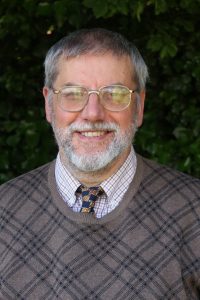 Francis Etheredge is a Catholic theologian, writer, and speaker, living in England. He is married, with eight children, plus three in heaven. Mr. Etheredge holds a BA Div, an MA in Catholic Theology, a PGC in Biblical Studies, a PGC in Higher Education, and an MA in Marriage and Family. He is author of 11 books on Amazon: Amazon UK Amazon US
Visit Francis Etheredge at his website and at Linked-In for book news and blog posts.
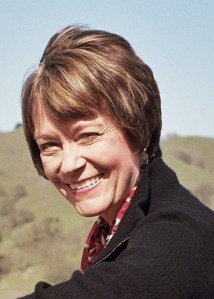
Christine Sunderland serves as Managing Editor for American Church Union Publishing. She is the author of seven award-winning novels about faith and family, freedom of speech and religion, and the importance of history and human dignity. She lives in the San Francisco Bay Area with her husband and a white longhair cat named Angel.

 This week we observe Ash Wednesday, the day when Christians are reminded of their mortality with an ashen cross drawn on their foreheads, as they hear the words, “Remember o man, that dust thou art and to dust thou shalt return.”
 And so we shall become perfect in our new lives, on the new Earth, in the New Jerusalem. What must we do in the Earth-time meantime? We must learn to love, for loving others as God loves us teaches us how to grow into what we are meant to be. It can be no other way. Love is the creative force that lives within us and opens the gates of Heaven when our time comes.
 God’s love for us means we have meaning in our lives today and everyday that we open our hearts to him. Every day we close our hearts we invite despair, for the absence of God in us kills hope. In this same passage we are told by Paul that faith, hope, and charity abide, but the greatest is charity. And yet we must have faith to hope to love.
 High winds and steady rain are sweeping the Bay Area today, rattling the trees, unsettling the natural world in which we live. We are in the season of hoping for spring, for Easter, for resurrection. Seeds deep in the dark earth will rise to the light of day and bear fruit. We prepare for that day, that moment, in the season that is called our life in time, our lifetime.
 In this season of life and death and life again, Christians celebrate resurrection. And yet the promise is more than rising to new life when our bodies die. For God enters our hearts today, if we let him. Resurrection is now, when our spirits are enlivened by the Holy Spirit through sacraments and prayer. Eternity is now, as etched on a monk’s gravestone in the Community of the Resurrection in Yorkshire, for God the Son is present in the bread and the wine. We sing the songs and pray the prayers with others of Christ’s body, so that our hearts will be open when Christ knocks on the door. Do we recognize the knock? Do we know the person that will live inside us, giving us eternal grace and glory?
 Our Lord is like a rainbow, offering us every color in the prism of life. But we cannot see the rainbow if we are blind. Lent heals our blindness so that we can see the colors, so that we can know love eternal, and life eternal.
  American Christian Fiction Writers has published my post,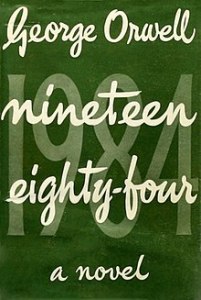
 But most of all, these days remind us of our brutality toward one another. They remind us that this can happen again should we not pay attention. George Orwell wrote two of his novels as dystopian warnings. They are post World War II novels, Animal Farm, 1945 (against Communism) and 1984 (against a tyrannical state). Also affected by the horrors of the second World War, C.S. Lewis wrote his space trilogy, in which the third volume, the dystopian That Hideous Strength, warns against government and science with power not grounded in a Judeo-Christian ethos. P.D. James’ dystopian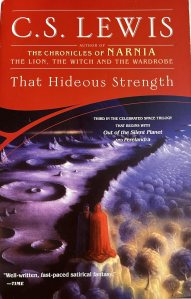
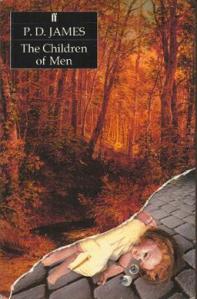 The Children of Men (1992) warns us against a world that deplores life, family, and children, and we see what happens when a generation (or two or three) are not replaced, as has come to pass in America and other Western countries. With a population implosion, at the end of the day those in power will be those who honored children and large families. It may be all about demographics.
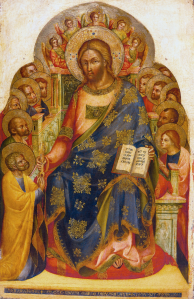 January is a month in which we reflect on our lives. Atheists (and agnostics) reflect on their fitness and changes that will make them more attractive or live longer. Christians may be tempted to do the same, given the culture, but by Ash Wednesday we realize our reflections are different. For we are called to examine our hearts and souls, which, it is true, live within the physical body. But we embrace a moral accounting of our lives. We look to the Ten Commandments and Christ’s Summary of that Law –
 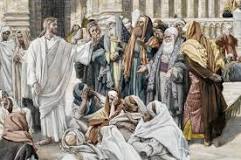 And so, in these three weeks before Ash Wednesday, we seek how to run the race of life, how to be good, how to love. St. Paul this morning reminded us to run the race as an athlete would run, but for an incorruptible crown, by being temperate and disciplined. And Our Lord tells the parable of the workers in the vineyard, that all will be called, ending the passage with the perplexing words, “many be called, but few chosen,” to my mind meaning salvation is for all, but not all will choose to accept Christ as their Lord. Free will allows each of us to reject God or accept him. He will choose those who choose him. That is what love means and that is what love does. And we worship a God of love who loves us so.
 Tens of thousands participated in the
 We too, in America, suffer a blind decadence. We do not see the dangers of open borders or the slaughter of the unborn. We turn a blind eye to a weak military that cannot defend America, and a leadership that is blind as well. What is the truth? What are lies?
 There is a great movement in our land, an awakening. Perhaps we shall correct our course, find our way, point to the one who is the Way, the Truth, and the Light. With the People of Israel, Christians just might forge a stronger foundation for America, the land of the free, the beacon to the world, the hope of the poor and the captive as Emma Lazarus wrote many years ago, words that found a home on the Statue of Liberty in New York’s harbor:
 The season of Epiphanytide, those two to six weeks that hinge on the date of Easter have always been about light and dark, the light of truth and the dark of lies. For us in Northern California it is a winter season, which seems appropriate, given the dark stormy skies broken at times by a piercing sun, low, close to the horizon. The winter sun, traveling in a lower arc over fewer hours in the day seems clearer and more brilliant than it does in other seasons, nearly blinding at times.
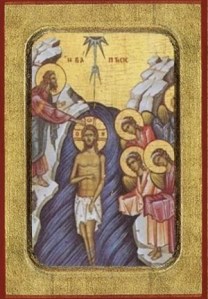
 the fifth Sunday is the parable of the harvesting the wheat and the burning of the tares (a dire warning), and the sixth Sunday is the parable of the laborers in the field (the last shall be first and the first shall be last). Today was the account of Jesus baptized by John, and the Holy Spirit descending upon him like a dove, and a voice from Heaven saying, “Thou art my beloved Son, in whom I am well pleased.”
 I thought about these things in our little chapel in Berkeley this morning as the sun shafted in upon the crucifix and the altar, and the organ boomed gloriously. I thought how simple it really was, this business of seeing, and yet how difficult it was for many folks to be simple as a child, as a baby in a manger under a bright star of the heavens. How simple to say, I’m sorry, Lord. For an hour we sang together. We spoke the words of the liturgy as one body and were fed by Scripture, sermon, and Eucharist. But we also prayed to God the Father that we acknowledged and bewailed our manifold sins… committed by thought, word, and deed. We repented earnestly and were heartily sorry! No longer did we want to remember them, for they were an intolerable burden… We cried for mercy to the Father for the Son’s sake, to be forgiven. We wanted to live in newness of life to the Father’s honor and glory.
 And we sang hymns as the organ trilled, making a joyful noise that rose over the altar to the crucifix and beyond through the clerestory windows, sanctifying the town of Berkeley.
 An epiphany is a revealing, a manifestation, and in this epiphany of Christ to the gentiles the good news of the saving love of God is revealed to those who were not Jewish – the rest of the world, to you and me. Magi, wise men, astrologers, followed a star that they knew was a portent of a great king to be born. As some say today, they followed the science.
 Americans seek the light of truth. They desire to know what really happened on that wintry day in Washington DC. They want to know if there was election interference in the fall of 2020. They seek the light, the light of revelation, the light of truth.
 When the light of Christ shines, when that Epiphany star beckons us to Bethlehem and to the cross, we see in a whole new way. We see that we are so uniquely different from one another. No two persons are alike. I find this to be a great marvel and mystery. We know so much about genes today – the full information helix ladders that define each person from conception – and yet even so, people continue to enthrall me. Those I have known for a time, I see in the light of Christ new features, new qualities, delicate and beautiful, wise and wonderful, thoughtful and full of thoughts. Those I meet for the first time offer a universe of detail, a book of life, a sculpture of many dimensions. All of life is a canvas of incredible beauty and stunning composition.
 We are in the midst of Christmastide, the twelve days of Christmas, spanning Christmas Day to the Feast of the Epiphany, January 6. During this holy time that turns the corner of the old year and slips into the new, we try and make sense of the stupendous events of Christmas.
 And so the Church sings the glories of Heaven meeting Earth, tells the story of Incarnation, humility, and majesty. Each stroke of the painting, each phrase of the poem, each note and word of the carol, relives the story so that we will not forget, for we must not forget.
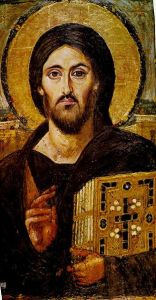 We look back to October 7, 2023, another slaughter of innocents, and we mourn anew. We look toward January and recall the slaughter of the unborn, claiming 100 million lives in the course of five decades of death, and so many generations lost. We have slaughtered our future and armed the present with danger. We have become Rachel weeping for our children.
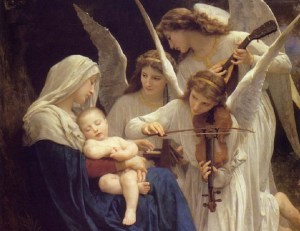 We sing our songs, and we harken to angels singing with us around the creche, these twelve days of Christmas. The magi are coming from afar bearing gifts, for they see the light too. We join together in the Church, Christ’s bride, and form a rosary of prayer and petition and offering.
  It is an unusual year when Christmas Eve falls on the Fourth Sunday in Advent. What is one to do? St. Joseph’s Chapel in Berkeley combined the services, beginning with penitential Advent with purple vestments and segueing into Christmas Eve, Feast of the Nativity, with white vestments. Within these two services, we sang carols with gusto. We ended up with 2 Epistles and 2 Gospels and one Mass. It was all quite remarkable, and allowed our small congregation – a university chapel during winter break – to celebrate appropriately. And it was a visual feast, even changing out the wreathe candles burning brightly alongside our creche. We essentially sanctified the chapel, adorning it in real time with our liturgies, voices, and prayers. We sculpted a work of art, of living art, which is what we were celebrating, the birth of the greatest of all living creations, God’s son incarnate, coming among us, to love us and to save us from ourselves, sin, and death, and to declare victory over all to bring us with Him to Heaven, to life immortal in glorious majesty.
 Our preacher made an important point, that we must practice humility to enjoy life in glorious majesty, just as Our Lord did, coming as he did into such a setting, homeless, fraught with enemies, and yet bearing our burdens, our own Lamb of God taking away the sins of the world.
As the pageantry danced around us, I thought how we were in a new dark age, or darkening one at least, one mirroring Medieval times and earlier. For not only has Christianity been marginalized and threatened, but the general populace is slowly becoming illiterate. Reading and writing has been replaced by images and screens. Sure we can load our phones with books, but that is a temporary measure I sense. Videos are so entertaining, why look at a Kindle page?
Our preacher made an important point, that we must practice humility to enjoy life in glorious majesty, just as Our Lord did, coming as he did into such a setting, homeless, fraught with enemies, and yet bearing our burdens, our own Lamb of God taking away the sins of the world.
As the pageantry danced around us, I thought how we were in a new dark age, or darkening one at least, one mirroring Medieval times and earlier. For not only has Christianity been marginalized and threatened, but the general populace is slowly becoming illiterate. Reading and writing has been replaced by images and screens. Sure we can load our phones with books, but that is a temporary measure I sense. Videos are so entertaining, why look at a Kindle page?
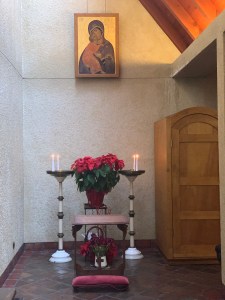 And so how was Christianity taught in the Medieval world? The world of an illiterate populace? Through images – stained glass and sculpture – and through song – hymns and ballads. Memory capacity must have been greater than ours today with no touch screens. And so in our Anglican rite we continue those practices, mostly from habit and love of beauty. We memorize Scripture and Creeds and responses in the Mass. We memorize and recite the General Confession, cleaning out our hearts and minds before becoming one with Our Lord in the Eucharist. We sing hymns, from books with stanzas printed on pages and notes that tell us when to go up and when to go down, how long to hold a note, and even suggestions at the top of the page, like “with spirit” for “The First Noel,” or “with marked rhythm” for “Good Christian Men Rejoice,” or “steadily, in moderate time” for “Silent Night.” But we don’t need those instructions, for the songs are so familiar, thank Heaven, that we live the songs as we sing them, and the Chapel delights in being painted by our voices.
The Medieval world and on for many centuries was an illiterate one. Clergy were trained in Latin, but the populace was illiterate. And not knowing Latin, the liturgies were in themselves in a foreign tongue. Bit through the years, with repetition of the oral traditions and with familiar music and with stained glass stories marching up and down the outer walls, the people became educated in terms of their immortal souls and how to love one another.
Of course mankind never gets it right, with the falling back and moving forward and the darkness devouring the light, until the day comes once again and the light allows us to see once again.
And so how was Christianity taught in the Medieval world? The world of an illiterate populace? Through images – stained glass and sculpture – and through song – hymns and ballads. Memory capacity must have been greater than ours today with no touch screens. And so in our Anglican rite we continue those practices, mostly from habit and love of beauty. We memorize Scripture and Creeds and responses in the Mass. We memorize and recite the General Confession, cleaning out our hearts and minds before becoming one with Our Lord in the Eucharist. We sing hymns, from books with stanzas printed on pages and notes that tell us when to go up and when to go down, how long to hold a note, and even suggestions at the top of the page, like “with spirit” for “The First Noel,” or “with marked rhythm” for “Good Christian Men Rejoice,” or “steadily, in moderate time” for “Silent Night.” But we don’t need those instructions, for the songs are so familiar, thank Heaven, that we live the songs as we sing them, and the Chapel delights in being painted by our voices.
The Medieval world and on for many centuries was an illiterate one. Clergy were trained in Latin, but the populace was illiterate. And not knowing Latin, the liturgies were in themselves in a foreign tongue. Bit through the years, with repetition of the oral traditions and with familiar music and with stained glass stories marching up and down the outer walls, the people became educated in terms of their immortal souls and how to love one another.
Of course mankind never gets it right, with the falling back and moving forward and the darkness devouring the light, until the day comes once again and the light allows us to see once again.
 It has not always been obvious to me that Christmas trees were more Christian than pagan. They are a Germanic tradition, popularized by Queen Victoria (from one of the German states) in nineteenth-century England. To be sure, the lights festooned through the branches (originally real candles) create a magical sense of another world, one we long for but cannot see. But I wanted more of the Good News of Christmas, so I often placed a creche at the base or nearby, thinking surely this is the true meaning of Christmas.
 So in a sense the tree, once decorated (don’t forget the lights), reaches for Heaven, the star on top pulling us higher. We gaze into the branches of our pasts, hoping to understand who we are today and who we will become on our journey into tomorrow. We play carols as we look into the depths of the fir and think about the true meaning of Christmas, the Incarnation of the Son of God come among us.
 We are told by theologians that the tree reappears on Golgotha, that hill outside Jerusalem, many years later. It is on the wood of a tree that Christ Jesus cancels the Fall, raising us up with him in his resurrection. And so on Good Friday we meditate upon the wood of the cross, thinking of Eden and the wood of that other tree with its forbidden fruit. Mary becomes the new Eve, crushing the serpent at her feet.
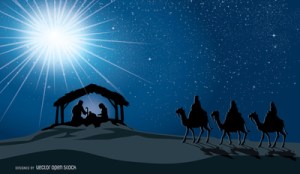 And as I hear the words sung by a choir of faithful, It came upon a midnight clear, that glorious song of old…, or perhaps Silent night, holy night…, I will know I have one foot in Heaven already. Perhaps it is the first rung of a wooden ladder that Jacob saw in his dream.
 Christine Sunderland
