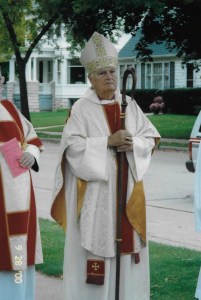
 We are preparing for our annual synod of the Anglican Province of Christ the King, Western and Southwestern States, here in the San Francisco Bay Area. In rummaging through files and Berkeley archives, I came across something I had written in 2000, twenty-three years ago. It heartened me to read it now, in my frail and graying years, as I prepared for our gatherings this week, so I’m sharing it with you, my dear readers.
Millennium Pilgrimage to the Shrine of Bishop Grafton, September 29, 2000
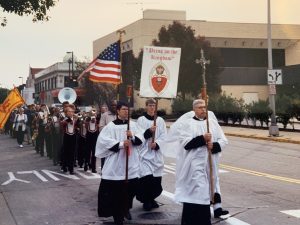
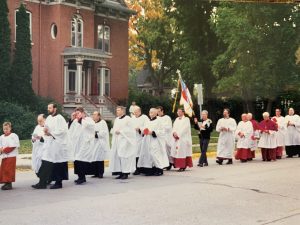
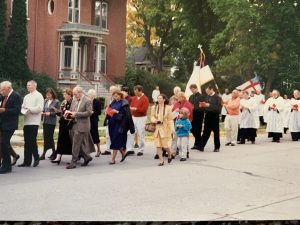
We gathered beneath the turning leaves, shade trees still green but hinting of gold, an aura of promise. Otto carried the flag, a large triumphant one, suitable to his size, and already the breeze played with it. The bishops, their crimson capes flashing against their white cottas, mingled and waited regally. The local high school band, neatly proud in their uniforms, gathered and took their place in the line-up, the tuba, as always commanding the center of attention. We lay folks fell in behind the band, the white robed clergy behind us, followed finally by our leaders coming last, our apostolic episcopate.
A light breeze blew through the overcast skies, the sun peaking through occasionally like sudden bursts of heavenly pleasure. It was temperate still, this thirtieth day of September, as summer lingered, playing the air like a children’s choir. We, the Anglican Province of Christ the King, the orphaned child of the apostate Episcopal Church of the United States, gathered to proclaim our beliefs: our belief in Holy Scripture, in the Creeds of the historic Church, and in the 1928 Book of Common Prayer which embodied these pillars of our faith.
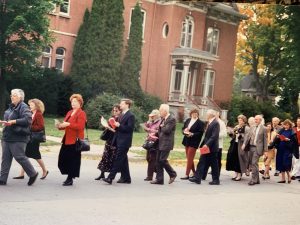
 We didn’t look too regal: a hodgepodge of individuals unlikely to be friends in another time and place. We wore sweatshirts and jeans, tailored Sunday suits, parkas in case of rain, comfortable walking shoes, dangling cameras on shoulders as we maneuvered red booklets of hymns. We chatted as though we were at a church supper, amazed to be here in Fond-du-Lac, Wisconsin, home of an Anglo-Catholic history that went back one hundred years, and home to Bishop Charles Grafton, whom many considered a saint. Indeed, his sarcophagus awaited us in the stone cathedral down the street, a white marble effigy in its own side chapel. But where was he? Perhaps watching, smiling, praying and laughing too, I think. Chuckling with joy that his little seeds were still blossoming, like some winter gardener.
The clergy met yesterday in their Clericus, their national gathering of support, fellowship, and discipline. Here they listened to their Archbishop proclaim where they were, where they had come from, and where they were going. For they are a frontier band, quietly standing up for the old ways, a strange and ironic melding of revolution and conservation. Each one of them, at some point in their pilgrimage to this moment, had met Christ, had known Jesus, his love and his power, and could not turn back. No, they could not deny this knowledge, a familiarity, perhaps even a love affair, with the Man from Galilee, the poor Jewish carpenter who took the world by storm by his simplicity, his love, and yes, his Deity. And more than this they could not deny his presence today, his reality, his explosion in the chalice and the host when they celebrated the Divine Liturgy, the Canon of the Mass. Could any of them be a Peter who denied his Lord? If so, they must be a Peter who also returned to Rome on that Via Appia two thousand years ago, returned to be crucified upside down. No, they could not deny him.
 And so, to continue in their adoration and in their discipleship and apostolate, they formed this renegade band that, over the years, had grown slowly, conquering schisms and power struggles, poverty and alienation. Many traveled all day each Sunday to serve several parishes in rural areas of America, as the number of the faithful multiplied far faster than the number of clergy who would or could give up pension and pride. They built a seminary in California, and trained as many as could be trained, but still the supply of priests never met the demand. A tired band of white-collared creatures clothed in the black of discipline, still they toiled through long weeks, and longer Sundays, offering the cup of Christ to the kneeling faithful, healing souls hungry for him all across this country.
Some said they were the new missionaries, perhaps even the Protestant Jesuits of the modern age, these Anglicans who offered the transcendent, the mysterious, the wondrous to the material American culture, the world of MTV, Hollywood violence and sex, drugs and self-centered creeds. And the people drank their offerings gratefully, those graced with belief, those not yet absorbed by old rebirthed heresy – witchcraft, new age mysticism, Eastern and Western paganism.
So we gathered, about one hundred of us, behind the tuba and the American flag, and set off to a rousing Onward Christian Soldiers, like some Salvation Army Band, this conservative, proper, East Coast, formal-liturgy congregation. God must have smiled.
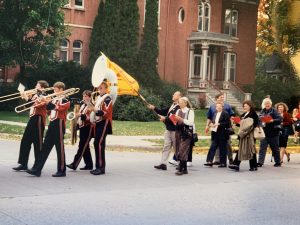 We walked slowly, singing as best we could, some with amber tenor and contralto voices; others, like myself, squeaking along in earnest. The breeze picked up, and the flag unfurled. A video man stood on the corner, catching our moment in history, our very American statement this Saturday morning, on the main street of Fond-du-Lac, Wisconsin. It was only four blocks, but they were momentous blocks to me. I realized my short temporal life meant something when joined with the eternal, and how little it meant otherwise. Somehow, all of us, united through God, and soon once again through his Eucharist, became holy, a part of the universe, an integral piece of time and history. And the cementing factor was love, his love, a love that blew through us as it blew through the trees about us. A summer love, hinting at fall. As the old song went, the times they are a changin’…Would I have felt the same parading for the March of Dimes? Certainly, I would have felt virtuous, but holy? No, I do not think so. This day I felt holy, whole.
Not many stood on the sidewalk to watch our passing. But still, here in this town, we made a public statement of who and what we are. We abandoned our Sunday hide-outs in our ornate and society-sanctioned chapels. We abandoned them for the public square, offering our faith and commitment to our God and our Country for all to see. In this pilgrimage, one of hope and one of penitence, not only personal but civic and social, we became missionaries, apostles as well as disciples, those sent out as well as those who follow.
 We crossed an intersection against a red light as the police protected us from oncoming traffic, and I thought of our penitence. Yes, we had much to be sorry for. An impatient word this morning at breakfast. A twinge of envy and a burst of greed. A surge of gluttony and perhaps a lingering lust. Our bodies continually rearing their importunate demands over our souls. And then there was yesterday’s headlines.
The abortion pill had been approved by the FDA. The words had settled into my soul like dirty silt, a kind of tangible smog, the soot of a volcanic eruption or a vast hillside fire blackening the landscape like ashy rain. All those lives, designed by God, destroyed in an instant, in two days of cramping and bleeding. For some of us, memories of miscarriage surged forward: the hours of loss, the slow dying, as the soul hemorrhages too, the waiting in the hospital bed to learn what we already knew, our children were dead. Rachel weeping for her children… And now, millions would cause this and why? For their own pleasure, their own convenience. Their souls would carry these tiny crosses the rest of their lives, miniature graves covering the green hills of America the Beautiful. So that for every child dead, a mother would mourn forever. Far too many Rachels.
 And then there was the Gospel that morning. How could the FDA choose to release such news on a day with such a Gospel? “But whoso shall offend one of these little ones…it were better for him that a millstone were hanged about his neck, and that he were drowned in the depth of the sea.” The Feast of Saint Michael and All Angels it was, that September 29, and the Epistle reminded us of the dark force that was kicked out of Heaven to Earth. Perhaps today Satan smiled.
The music stopped and we moved on in silence, as the band prepared the next launch of song. We walked slowly now, serious in our quiet, hearing the tap of our feet, the newness of our action worn off, the moment suddenly becoming heavy with reality, yet a heaviness born along in a great tide. The cathedral appeared at the end of the block.
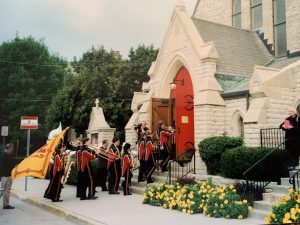 It was a simple stone church, built along the river, framed by shade trees. I thought of villages in England and, had there not been a factory silo over to the right and a Walgreen’s Drugs kitty-corner, I could have fancied I was in the Cotswolds. We crossed the bridge over the stream, and approached the cathedral
The stairs led up to curved red-painted doors, and we followed the flag inside. There, dark wooden angels burst from the side rafters, peering as we found our seats. I knelt and gave thanks as the white-robed priests took the first pews, the crimson bishops moved into the chancel, and the acolytes took their places, candles burning. Today, we, the people, formed the choir.
As the first anthem soared into the vaulted ceilings of carved mahogany, sturdy stone, and stained glass, the notes pairing with the light in a kind of dance, I thought of the Church School Conference. The day after the Clericus, that solemn gathering of our missionary priests, all of us, lay and clergy, met in the hotel banquet hall to talk about our children, how to educate them in the way of Christ, how to teach them sanctity. Perhaps even the sanctity of Bishop Grafton.
We wanted to breathe the breath of life into our young, to give them the spiritual slap on the back of their rebirth, clearing the path for the wind of the Holy Spirit to blow into their hearts. We listened, and spoke, and shared: we sought the secret of passing on the fire, keeping the torch alight, our hearts and minds empty and longing to be filled with wisdom, the wisdom of the teacher of God. We took notes on paper, and questioned and debated, bound together by the love of Christ and the mystery of teaching children. Somehow, each of us knew that in our children lay the life of our world, the life of Our Lord on this earth. It was up to us to link the generations, to bond history with the Communion of the Saints, a communion blown into the hearts of our babies. As each one spoke, I knew it could not be done alone, that each of us would be an integral part in God’s plan, that through each of us he would speak to the rest, that somehow we formed together a giant jewel, each facet reflecting a different color of God’s purpose among us. And so the jewel moved in his light, flashing and crashing about us, inspiring us with his breath, his wisdom, indeed his hagia sophia.
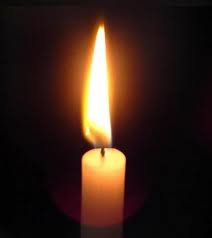 Two priests passed out candles with circular paper holders to catch wax, but we set them aside for now, resting their bases in the book holders in the pew-backs, next to the heavy red hymnals and modern missals. The ancient Mass began, our group living out a rite once home here in this cathedral, but no more, a kind of prodigal returning with no welcoming father. The rite of this modern Episcopal Church no longer celebrated mystery of form and language and deity, but sought the earthly and trendy, having thrown out the anchors of history and creeds. A different wind blew here, a wind of nothing, of no-thing, of whatever, whichever. So we pilgrims returned Bishop’s Grafton’s legacy, after all these years, his legacy of Anglo-Catholicism, the desire to worship God as he has been worshiped for nearly two thousand years of Christianity in the West. We sang the ancient prayers and creeds; we confessed our sins, for we found so many to confess. We accepted our bishop’s absolution, the Church’s absolution, God’s absolution. In this re-found freedom (and indeed, momentary perfection), we joined Christ in the Bread and the Wine, uniting with the Eternal, fed by Heaven, nurtured by God the Son in the mystery of the Mass. We returned to our pews whole, holy, sanctified in our present moment of time, pilgrims at the celestial banquet of the Church on earth.
Last night at our Pilgrimage Banquet we reached our hands in greeting, clasping our other selves, the many people of God, and felt his breath on our cheeks as we kissed. We dined on salmon and beef, in a great and loud celebration after two days of meetings. Warmed by wine and coffee and cherry pie, we looked to the podium to our speaker, a man we hoped would fan the fire and light up the dark corners of our confusion. And yes, with love and with humor, he led us to a greater sense of mission in our world, a sense of being the very flame we so long hungered for. He spoke of History and the strange coincidences, the odd victories, the appearance of forces no-one could rationally explain, the accumulation of facts and the lack of theories. He spoke of God in History, and God in us. And he spoke of our place and time, that the ignorance and lack of faith of today’s people created a great frontier for us. He challenged us and filled us with awe, and perhaps, a little dread at such responsibility. Would we return to Rome to be crucified? Or would we persist in denying Our Lord in our apathy? How many times would the cock crow before we wept? We gathered here to walk together, to talk together. We traveled miles to seek the light, or perhaps to atone, this millennium year, but did we really want to see more clearly or to hear our penance?
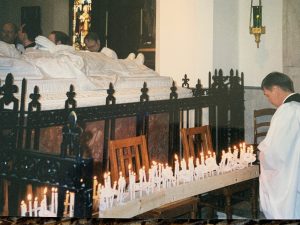 Now, in this historic cathedral, one of the priests walked down the aisle lighting our candles, and we continued the flame along our row, bending the candle deftly to catch our neighbor’s wick. We stood, holding our white rods of fire, waiting. Then, slowly, we followed the procession around the church, under the jutting angels, slowly placing one foot in front of the other, chanting the Litany of the Saints: O God the Father of heaven: Have mercy upon us. O God the son, Redeemer of the world: Have mercy upon us. O God the Holy Ghost: Have mercy upon us. O Holy Trinity, one God: Have mercy upon us. Holy Mary: Pray for us…Saint Michael: Pray for us. Saint Gabriel: Pray for us…The voices boomed through the cathedral space, this sanctuary of God. I thought of the abortion pill. I thought of the large coven of witches here in Wisconsin. I thought of Saint Michael throwing Lucifer out of Heaven. We held our candles firmly in this dark space, a band of ragtag lovers, lighting the darkness with God. We moved down the side aisles to the Shrine of Bishop Grafton. There we placed our candles in troughs of sand. There, below his carved stone effigy, lying spread out over his tomb, the flames burned brightly, and we prayed to this bishop of faith and order, the saint who knew the life-giving importance of the Blessed Sacrament.
We prayed for intercession. We prayed that this saintly bishop would add his prayers to the many prayers of the saints, that he would pray for God’s people on earth to not forget. To not forget Our Lord, to not forget his love and his healing power in the Mass.
Outside, the wind rushed through the trees, and as we left the cathedral, full of God’s grace and power, the leaves burned a bit brighter, catching some of the promised fire of fall.

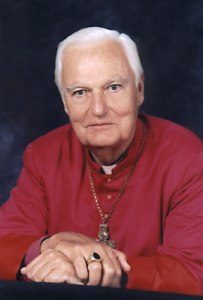 My bishop of blessed memory, Robert Sherwood Morse, often said that we Christians are people of reality. We are unafraid and even eager to find and face the truth, or we learn to be so over time, with regular self-examination, confession, and absolution. This command to honestly examine one’s life, thoughts, words, and deeds, done and undone, is a blessing, growing us into who we are meant to be.
 Observe my cat, for instance. What an amazing creature! Angel is a jumper (perhaps she has wings), able to leap tall bookcases in a single bound. She is in the American History section in this photo, for she has learned how to get my attention. Her next move will be to knock the nearby icons off the wall with her paw. If there is a small book she can maneuver, she will send it flying.
 Now, observe our recent outdoor visitors, beautiful creatures, young bucks, with magnificent fuzzy antlers to be worn off in the fall if not sooner. They are baby antlers, I’m told, and I’m not sure of their purpose, but they will be replaced by the adult ones later, perhaps like our baby teeth.
 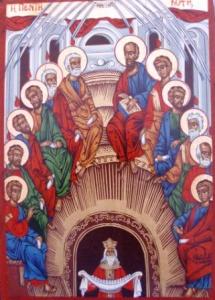 Today we also celebrate the Birthday of the Church, Pentecost, when the Holy Spirit descended upon the disciples in Jerusalem, at a time of a major Jewish festival, bringing in faithful from all parts of the world who spoke many languages. The description of the event is dramatic, for “there came a sound from heaven as of a rushing mighty wind, and it filled all the house where they were sitting… cloven tongues like fire, upon each of them… they were filled with the Holy Ghost, and began to speak with other tongues…” (Acts 2:1+) They would speak to the many foreigners in their own language of the “wonderful works of God.” Christ Jesus had foretold this event, promising that “the Comforter, which is the Holy Ghost… shall teach you all things, and bring all things to your remembrance, whatsoever I have said unto you. Peace I leave with you, my peace I give unto you… Let not our heart be troubled, neither let it be afraid.” (John 14:15+)
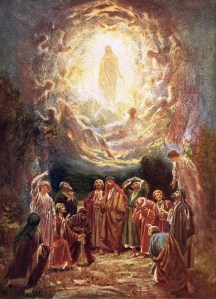 We are in the octave of the Feast of the Ascension, the eight days following Ascension Day on Thursday, the end of the season of Eastertide, and the snuffing out of the fifty-day Paschal Candle.
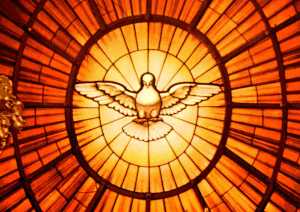 My spirits ascended this morning in church. I experienced a moment of grace, or rather, many moments of grace. The ascension of Christ to Heaven, after his resurrection from the dead, lifts my spirits upwards, to be with him, to encounter him, right there in our little chapel on the corner of Bowditch and Durant. This happens, to be sure, in the Eucharist itself, but the ascending and soaring of our songs of praise, the cantor’s amber rising tones, the organ’s deep notes that flew high into the vaulted dome and out the clerestory windows above, out onto the busy streets of graduation and cars and boomboxes, all pulled me along. Surely I had wings to fly. Surely my feet were no longer touching the ground. I thought of Catherine of Siena and how she levitated during her devotions in her chapel, literally rose a foot or so from the floor. She too ascended in that moment to meet Christ and was given the stigmata, the wounds of crucifixion on the hands, unseen but no doubt felt.
 For at the end of the day, it is love – love of the unlovable, the unwanted, the undesired, the inconvenient – that calls the Holy Spirit to be with us. It is love that responds. It is love that swirls in our little chapel, linking our family of God, and joining us together in the bread and the wine, in the Real Presence of Christ.
 Rogation Sunday doesn’t always land on Mother’s Day, but it seems fitting when it happens. Rogation comes from the Latin rogare, to ask, and in this case ask (pray) for God’s blessing upon the crops, newly seeded.
 Mothers of course can also be fruitful in other ways, creative in endeavors outside the home, for the span of child rearing comes to an end and other doors open, beckoning. Fathers can mother, as well as father. There are times when we share roles for good purpose, but the heart of the mother is to mother, and the heart of the father is to father. Both mothers and fathers can comfort their children in overlapping roles, drying their tears together.
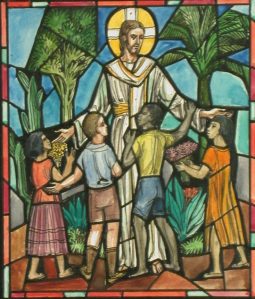 But what about God’s tears for the unborn? What about the seeds that never mature, never become what they were intended to become? What about those children who never take their first breath of life in our astounding world of light and love? What about those mothers who live with their “choice” to kill their own children, the Lady Macbeths who cannot be cleansed, until finally facing the Lord of Life in his Church, confessing, repenting, and being absolved.
 Ritual – saying the same words with each liturgy, weekly or more often – can dull our hearts and minds, yet it can also free us to fully experience God’s presence, in this case his absolution. Memorized words and phrases are engrafted upon our souls, changing us and opening us up to the glories of the Eucharist. There is an action that occurs as we say these words with intent, as we reach for God and God reaches for us. Christ allows the engrafting, for he is the Way, the Truth, and the Life. The Holy Spirit prompts us to repent and to reach out, and Christ carries us to the Father in his arms to be wrapped in love. For, after all, it is his blood shed for us that allows the shedding of our sins, freeing us from death itself.
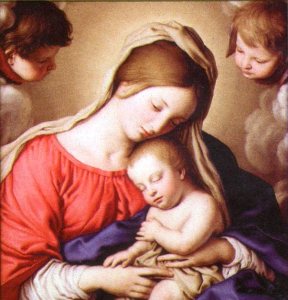 May is Mary’s month too, the mother of all of us, the reborn Eve. She said yes to God’s will in her life, and in that fiat she became holy, whole, full of grace and blessed among women. She gives us her son, and in the giving gives us life forever, should we too say yes.
 Like many around the world, I watched the coronation of King Charles III of England, Scotland, and Wales, in a full replay yesterday. To be honest, I had mixed feelings.
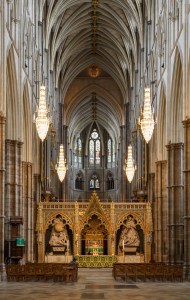 The Abbey design reflects the monastery plan, a long choir and sanctuary, separated from the public by a screen, not affording the best views for visitors. But as Internet viewers, we were treated to views from cameras placed in key locations, so that we had many close-ups of the King and his Queen Consort, a great burden for the principals who must endure close examination worldwide. They do indeed live in a fish bowl.
 And yet, I would have liked to see Queen Elizabeth deny her son – this son – the crown. I would have liked to see William and Kate crowned yesterday. But as an American, what right do I have to comment? I suppose as an inheritor of Western Civilization, the glorious Judeo-Christian history of tradition and freedom, human dignity and brotherly love, that revolutionary way that burst upon the world to remake it, rebirth it, as it did for over two thousand years, I have a heartfelt interest in such civilization’s survival. I have an interest in Christ our King returning to reign in his Kingdom on earth, a Kingdom of justice and mercy, law and order, fidelity and faith.
 We gathered together this last week in the Bay Area for the Thirty-second Synod of the Diocese of the Western States, along with the Diocese of the Southwestern States, Anglican Province of Christ the King. There were numerous events from Tuesday through Friday, forming a rosary of prayer linking the faithful.
 And yet we are bound by time, as our preacher explained this morning. When the risen Christ says to the disciples that “A little while, and ye shall not see me: and again, a little while, and ye shall see me, because I go to the Father” (John 16:16+) they are confused by the time sequence. Yet Christ speaks of eternal time: his ascension to Heaven and then his return, his Second Coming to earth, an event to look forward to. Still, Our Lord doesn’t speak of hours, day, and weeks, months or years. He speaks of a different kind of time.
 The golden thread spun among us weaves the past into the present. As I spoke this last week of the history of our Berkeley Seminary and Chapel, I could see a golden thread linking us to those who came before us, those who listened to God’s voice in their lives and learned to love as God loves. For in prayer, that opening the door of our heart and mind to God, we allow God to enter in, to live within us, to enliven us with his life. Only then can we hear his voice. Only then can we spin our own golden thread to join the others from anywhere and everywhere throughout the world.
 Many doors opened in the last year, for example, doors to knowing Christians in other states, in other countries (Francis Etheredge in England, Monique Robles in Colorado, Michelle Easton and Cindy Rushing in Washington D.C.) How did this happen? How is it I saw a link here, a post there, a friend of a friend who seemed to be singing to me? Grace. Grace notes played a melody of Grace. I heard the song, because of daily prayer and weekly Eucharist (the greatest of all prayers).
 , founded and led by Michelle Easton in the WDC area. They mentor, network, and unite women nationwide with a refreshing and traditional message, one that needs to be heard and supported:
 The CBL Center’s Mission Statement explains their many programs and materials, so educational and encouraging, giving hope to the rest of us who share these values and fear our nation is under attack from within. The threats to free speech, to freedom of worship, to parental rights – to name a few – command headlines today. Free and fair elections have been hijacked. The chilling effect of these developments on family, faith, and freedom, the fear and self-censoring, especially here in California, portend ill for the future of democracy in America and thus in the world. Speak to immigrants who have fled here for refuge. They see the trends, when other Americans seem blind. Immigrants are speaking out and telling their stories of escape to (not from) the United States. We must heed their warnings.
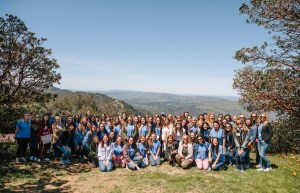 Enter the CBL Center for Conservative Women.
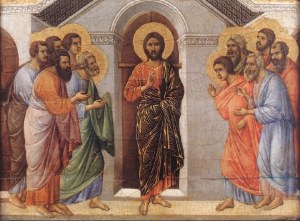 The Gospel lesson this morning, this Sunday after Easter, reminded us all of the message of the Gospels, the message of the risen Christ to his disciples hiding in fear. He gives them peace, the peace that passeth all understanding, the peace that reconciles God and Man, the peace that unites the human family, rather than divide them by skin color. He gives to them, and he gives to you and me, his peace, a love without limits, a love we are called to share with all mankind, a love that banishes fear.
 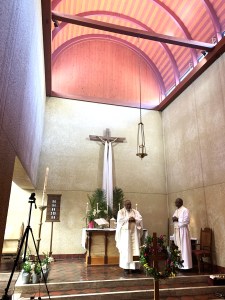 We celebrated the resurrection of Christ this morning in our Berkeley chapel. We proclaimed, “Christ is risen!”, and we replied, “He is risen indeed!” Each year on Easter Day I am profoundly touched by this litany as if I am hearing it for the first time and enjoying that delight of sudden knowing and sudden joy. It’s like raising a bouquet of roses to your face and inhaling.
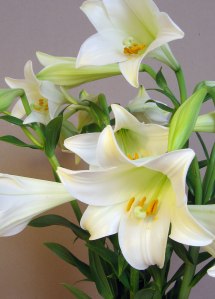 We had family members in attendance, making our grand total twelve faithful! Our cantor chanted and our organist played. We sang until we could sing no more, with many Alleluias and many Christ Is Risens and many He Is Risen Indeeds! Need I say, it was a glorious, wondrous Easter, and I mentioned to one of our grad students, it was a morning not to forget. For the liturgy, with all its sights and sounds and scents, and yes, even touches and tastes, was food for our souls. “Remember,” I said to the young man who just received his doctorate in Chemistry, “this morning. We can recall it in the dryer times, the times of famine and drought, the times when beauty isn’t quite so splendid. We can recall we were here on this day and what we experienced. “I will,” he promised. “I will always remember this Easter.”
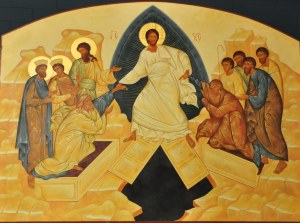 As we entered the chapel and took our seats, I realized another family had re-united with their children home from college. There were several families there in our precious space this morning, several to witness to the love of God on this bright, sunny Easter morning. We precious few, along with other faithful, celebrated together new life, in a newborn baby, in eternal life given in the resurrection of Christ, and in the reborn life given to us in the Eucharist. As each of us received the Real Presence of Christ, once more we knew it was all true, that there is an Infinite Love that turns the Earth through our galaxy and universe, an Infinite Love that took our flesh to die for us, an Infinite Love that wipes away not only our selfishness, our sin, but wipes away every tear from our eyes.
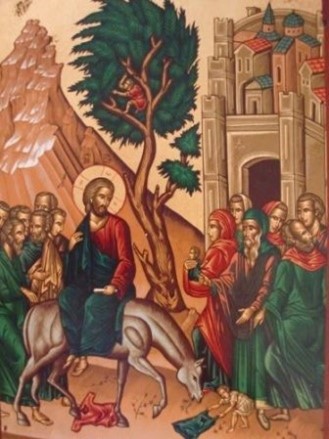 crying “Hosanna in the highest!” As we follow him through the gates of Jerusalem, we invite our readers to enter the gates too, into our stories of redemption.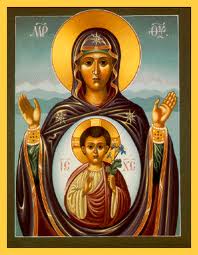
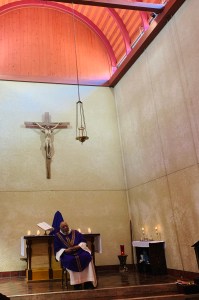 And so we begin Passiontide, the last days and weeks of our journey to Jerusalem. As I listened to our wise, soft-spoken preacher this morning, sitting in a chair before the purple covered tabernacle, in his purple vestments, I marveled how individuals can age like fine wine. Each one of us, so unique, can make the choice to listen to God rather than be as gods. We can choose to step carefully through our own lives and be responsible for the space and time into which we are born. We cannot save the world if we cannot save ourselves. We cannot save ourselves if we do not cherish life at all ages in all stages.
 I often have thought that we are reborn again and again, each time we confess, are absolved, and return to God, clean of sin. And with each rebirth, we grow further into who we are meant to be. It is a lifetime of falling and rising, reaching for his hand. It is a lifetime of silence and sudden speech, of filling the void of our lives with the music of the spheres and learning to dance. We empty out and fill up, again and again, and each time we are made whole, more holy than before. It is a time not to be missed, this time of our lives. To know true joy, we embrace the gift of faith, learning and loving, with liturgy and song and prayer. The Church gives us this chance to live out the time of our lives with God – the Father, the Son, the Spirit.
 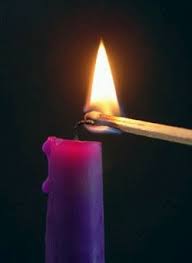 And as I journey, I’m revisiting my Lenten discipline, my “Prayer for a Sick Person.” (BCP 45)
 Christine Sunderland
 Christine Sunderland