
Category Archives: Uncategorized

A Tale Worth Telling

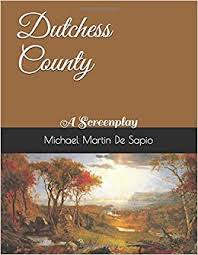
Christine Sunderland reviews DUTCHESS COUNTY: A SCREENPLAY by Michael De Sapio

DUTCHESS COUNTY: A SCREENPLAY is a moving, cinematic, meaningful biopic of Washington Irving (1783-1859), credited with being the first American “Man of Letters” and the Father of the American Short Story. We glimpse a pivotal time in American history—pre-Revolution to post-Revolution, the “Age of Reason” to the “Age of Romanticism.” Irving bridges the Old World of Europe and the New World of America. He influenced many of the nineteenth century English great writers—Scott, Dickens, Thackeray—and in America, Longfellow. American literature gained respect (finally, and perhaps grudgingly).
Irving narrates through voice-overs, depicting dream and fantasy sequences in which he plays a role in the story he is writing. The device allows us to enter Irving’s imagination, while placing him in the historical context of his times. We see the miracle of the story—when the reader lives in the telling.

We see Irving’s use of folk tales and local legends that surround Tarrytown in New York State. These become his stories, and as he listens to local tales, the power of the oral telling is evident. We see the Catskill Mountains, the Hudson River valley, Sleepy Hollow, as well as New York City. We see him write the “Legend of Sleepy Hollow” and “Rip Van Winkle.” Rip Van Winkle, we recall, falls asleep before the American Revolution and awakes twenty years later, after the Revolution. He has suffered a “little death” and resurrection. He returns to his village an old man, a new world surrounding him. He falls asleep in Sleepy Hollow, where ghosts of the original Dutch settlers gather. He awakes having missed the turning point in the history of the Western world, the birth of the New World. Are we asleep today, detached from our history?

Heroes and history are central. Washington Irving, named after George Washington, meets the president as a boy, and George Washington blesses him. Irving’s last work is a five volume biography of George Washington. After time spent with the Iroquois, he states, “It strikes me that our country, young as it is, has a real history behind it. It shall be my task to tell it, and to give voice to its divers people.” His friend Allston states, “You have showed us the value of our history, traditions and legends.” His friend Rebecca tells him it lies with him to save—give birth to—American literature.

The scenes depict a world of ideals, virtue versus vice born of the Judeo-Christian tradition: work versus idleness, business versus pleasure, truth versus lies, bravery versus cowardice, fortitude versus weakness, with the implicit judgments. Christianity forms a background, in conversation about belief and unbelief, in moments of prayer before a white cross, in the claim that without belief one cannot be an artist. For artists must depict suffering redeemed by beauty and truth, darkness turned into light, hope silencing despair. As Irving reads from his beloved’s Bible, left to him after her early death, he moves from darkness into light. He states later, “I am sure that Matilda lives.”

There are many lovely moments in DUTCHESS COUNTY. Upon return from England, Irving writes of the festivities of an English Christmas, not seen in Puritan America. He introduces St. Nicholas flying through the night sky, made famous by Clement Clark Moore in “The Night Before Christmas.”

Thank you, Michael De Sapio, for Washington Irving has been brought back to life, framed in an immensely important conversation about faith, history, virtue, and the miracle of storytelling touchingly and sensitively portrayed. I look forward to the film!

Christine Sunderland


Angel Mountain, New Review by Michael De Sapio

A Contemporary Novel of Timely Relevance

Christine Sunderland’s ANGEL MOUNTAIN is a contemporary novel of timely relevance and timeless spiritual themes. We meet four main characters: an elderly religious hermit and his sister, both of whom survived the Holocaust in Greece; a young librarian out of a job because of ideological intolerance; and a Christian geneticist with a passion for proving the harmony of science and faith. Sunderland skillfully weaves together the lives of these four people against a backdrop of cultural tumult and the volatility of the northern California landscape. As college protests and Antifa-inspired terrorism rage at UC Berkeley, the hermit Abram leads a religious revival from atop the numinous Angel Mountain. Earthquakes and storms threaten, portending an apocalypse. Our characters search for answers and peace in this confusing world, relying on the grace of God and the accumulated wisdom of Western civilization.

ANGEL MOUNTAIN is a uniquely modern and uniquely personal novel, interwoven with places and things familiar to the author. Sunderland’s writing is rich in sensory imagery and also takes ample time for intellectual discussion; the topics touched upon include Intelligent Design, the natural moral law, the American founding, and the Pythagorean harmony of the spheres. While underpinned by a strong conservative philosophical worldview, the novel presents its case in a thought-provoking way that will be compelling to a wide range of readers. Most remarkable is the way ANGEL MOUNTAIN combines contemporary issues with a respect for history and a love of beauty. Sunderland sustains our interest right through the gripping, mystically charged denouement in which we see heaven and earth meeting and eternity intersecting with time. This fascinating novel comes strongly recommended.

Michael De Sapio

Michael is an essayist and the author of two screenplays, The Incredible Life of Joey Coletta and Dutchess County.

 https://www.amazon.com/Incredible-Life-Joey-Coletta/dp/1983126632

https://www.amazon.com/dp/1079116516

Angel Mountain: Reader Views Author Interview

rvlogo1

Reader Views Author Interview about writing and reading and Angel Mountain has been published today by Sheri Hoyte, Managing Editor, Reader Views.

RESOURCE_Template


We spoke of the release of Angel Mountain by Wipf and Stock Publishers under their Resource Publications imprint, the pandemic, the current unrest, and other concerns shadowing America today.

Angel Mountain is available from the publisher, Wipf and Stock, as well as online retailers, including Amazon.com.


Review of Angel Mountain by Reader Views

Angel Mountain
Christine Sunderland
Resource Publications (2020)
ISBN 9781725259805
Reviewed by Sheri Hoyte for Reader Views (06/2020)

“Angel Mountain” by Christine Sunderland is a captivating contemporary novel encompassing issues relevant in today’s world along with the timeless conflict of good versus evil, all wrapped up in a message of grace, love, and hope.

The story follows four characters whose fates intersect on a mountain – Mount Diablo, a magnificent landmark in the San Francisco area. Abram Levin is an 80-year-old hermit who lives in a cave on the mountain he dubs Angel Mountain. It is on Angel Mountain where Abram preaches the words of happiness, love, and grace. It’s also where he meets and rescues Gregory, a Christian geneticist who falls off the mountain trail while hiking one morning. Elizabeth, Holocaust survivor and Abram’s older sister, lives on an estate at the foot of Angel Mountain. Elizabeth hires Catherine to sort and catalog her extensive home library. Brought together by fate, circumstance, and divine intervention, the short time spent together on Angel Mountain changes the course of these four lives for eternity.

“Angel Mountain” is a fascinating, thought-provoking novel. Rich in Christian influence, fans of Christian fiction will devour this story. Its comprehensive passages also offer teachings of the faith for those interested in learning more about the message of Christianity. What I enjoyed most are the different elements Sunderland introduces, such as science, suggesting that faith and science go hand-in-hand and should be considered together. One example is an incident considering the source of light coming from the hermit, Abram’s cave: “Uncreated love, the energy of creation. Light in the darkness. Even the Big Bang, the forming of the stars and constellations, the sun and the moon. Uncreated energy. Uncreated love. We don’t have the words – theological or scientific – to describe the indescribable.”

Sunderland writes with a flair that inspires readers to dig deep within themselves to consider alternate views, beliefs, and opinions with respect and without judgment. Such an important message in our current volatile era. From immigration and individual freedom, to the choices we make, to observations about heaven and eternal life, “Angel Mountain” by Christine Sunderland hosts issues inspiring people to be their very best through vivid imagery, endearing characters, and an enticing plotline. Highly recommended reading!

Endorsements for Angel Mountain

RESOURCE_Template

“In Angel Mountain, Christine Sunderland has created a gripping and theologically rich novel, in which four remarkable people make their way through a shifting cultural landscape ringed with apocalyptic fire, revolutionary politics, and end-times expectancy.”

–Wilfred M. McClay, University of Oklahoma, author of Land of Hope: An Invitation to the Great American Story

“Angel Mountain, which the world calls Devil Mountain, is beyond the reach of the secular city of Berkeley. There is a man living on the mountain who speaks of heaven and hell and good and evil. Just raising these topics is enough to spark concern and violence in his audience. Meanwhile, the world of 2018 is on fire, both literally in the countryside and spiritually in the minds and hearts of the characters of this quietly apocalyptic novel. Perhaps when the world does end, it will end both physically and spiritually at the same time. If so, Christine Sunderland’s Angel Mountain shows how to live in the midst of disaster and how lives can be remade if we have bold enough hearts. Read if you dare!”

–Paul Russell, author of Looking Through the World to See What’s Really There

“I have a certain shelf of books that I intend to read more than once. Christine Sunderland’s latest novel, Angel Mountain, is one of those books that will go on that shelf, for I will read it again. It is not a paint-by-number book. It is a Van Gogh, with poetic hues, chroma, colors, and shades brilliantly flowing in and out from one another creating a literary painting one will not soon forget.”

–Fr. Seraphim, Elder, Nazareth House Apostolate, Taylorsville, Kentucky

Purchase from:      Amazon          Wipf and Stock Publishers

Angel Mountain Published

I am happy to announce that Angel Mountain, my seventh novel, has been published by Wipf and Stock Publishers and is now available on the website as well as Amazon. Many thanks to all who have encouraged this effort over the last two years! The setting is our own Mount Diablo, east of San Francisco, with scenes also in Berkeley and St. Joseph’s Chapel near the university.

Description:

A holy hermit, a Holocaust survivor, a literary librarian, and a Christian geneticist search for peace and happiness in a culture of chaos. Hermit Abram, eighty, and his sister Elizabeth, eighty-four, escaped the Holocaust in Greece and made it to America as children. Elizabeth retired from teaching high school Western Civilization, and Abram, who retired from teaching classics at U.C. Berkeley, converted to Christianity and retreated to Angel Mountain to pray with his icons for the world and preach from the mountainside. Elizabeth hires Catherine, thirty-three, to sort her home library. When Gregory, thirty-seven, a geneticist supporting intelligent design, falls from the mountainside and is rescued by Abram, these four lives are changed forever. The earth quakes, fires rage, and lightning strikes, as antifa protestors threaten the hermit and his friends. Angels bridge Heaven and Earth, and eternity intersects time. Is this the end of the world? Is the kingdom coming?

Endorsements:

“In Angel Mountain, Christine Sunderland has created a gripping and theologically rich novel, in which four remarkable people make their way through a shifting cultural landscape ringed with apocalyptic fire, revolutionary politics, and end-times expectancy.”

–Wilfred M. McClay, University of Oklahoma, author of Land of Hope: An Invitation to the Great American Story

“Angel Mountain, which the world calls Devil Mountain, is beyond the reach of the secular city of Berkeley. There is a man living on the mountain who speaks of heaven and hell and good and evil. Just raising these topics is enough to spark concern and violence in his audience. Meanwhile, the world of 2018 is on fire, both literally in the countryside and spiritually in the minds and hearts of the characters of this quietly apocalyptic novel. Perhaps when the world does end, it will end both physically and spiritually at the same time. If so, Christine Sunderland’s Angel Mountain shows how to live in the midst of disaster and how lives can be remade if we have bold enough hearts. Read if you dare!”

–Paul Russell, author of Looking Through the World to See What’s Really There

“I have a certain shelf of books that I intend to read more than once. Christine Sunderland’s latest novel, Angel Mountain, is one of those books that will go on that shelf, for I will read it again. It is not a paint-by-number book. It is a Van Gogh, with poetic hues, chroma, colors, and shades brilliantly flowing in and out from one another creating a literary painting one will not soon forget.”

–Fr. Seraphim, Elder, Nazareth House Apostolate, Taylorsville, Kentucky


New Post Published by ACFW

April 15, 2020: American Christian Fiction Writers has published my post today, “Sheltered by the Resurrection,” considering how Christian fiction writers move from Lent into Easter in the telling of their stories. Thank you ACFW!

On Presidents, Promises, and Penitence

Klavan.The Art of Making SenseI am reading Andrew Klavan’s The Art of Making Sense, Writings and Speeches 2019. This is not a book about writing to make sense (which I thought at first and probably need), but a book about personal coherency found in a consistency of character, speech, and action. He is speaking of lives that make sense and heroes that make sense, ways of living that make sense. When they don’t make sense, when one part acts in contradiction to another, there is a brokenness, a fissure or fracture of personality. We might call this hypocrisy, for we sense deeply that there is a grand logic to living, to life.

We are driven to create, mirroring our Creator, and this drive is part of the coherency we struggle to achieve. It is this drive, this love of life—human life and all creation—that has been implanted in each of us, that is an integral part of our DNA, that calls us to make sense of our lives and give order to our days.

I believe this desire to make sense, to live moral lives of meaning, is innate in our very humanity. It is part of who we are as thinking, sentient beings. We are creatures of conscience. And yet none of us make sense entirely. We know we are broken. Still, we long to be mended, to be made whole. We believe we should keep our promises, because we want to be whole, honest, trustworthy.

Christianity recognizes this brokenness and provides an antidote. Scriptures, from the fall of Adam and Eve to Judas’ betrayal of Christ, tell the story of mankind’s falling apart and coming back together. They tell of healing the sick, mending the brokenhearted. Christians, of course, believe Christ alone can truly heal us, can make us whole again, once we confess our failings, practice penitence, admitting we do not make sense. We call those failings sins, those betrayals of our true and better natures, betrayals of our Creator. They are times of not making sense, times when we do not live cogent, coherent lives. With belief in Christ and his promises, our souls are mapped with his commandments, and we are placed on a path to wholeness, to making sense.

AMERICAN FLAGAnd so today, Presidents Day, we celebrate America’s presidents, especially President Washington and President Lincoln, leaders that promised to govern fairly and create a more perfect union. They promised to make sense of our country, to offer a refuge to those from countries betraying that promise.
But being human and fallen, even these heroes of our great nation are not always consistent in their morality, and our nation is not always great. Those who study history understand that our heroes will not live up to our expectations. The only way we can explain this in-coherency of character is to admit mankind’s brokenness.

As a voter and a Christian, this admission is a given. And yet, I do make demands on my public servants, hold them accountable, for they represent me in Sacramento, in Washington, and in the world. The first of these demands is that they be honestly trying to make our world, our nation, and our communities make sense, by having a sense of the moral law.

And so when I look at the lives of our American Presidents, I see broken lives, not fully realized. Yet I also see a true and passionate effort do the best, to be valiant and self-sacrificing, given the times in which they lived.

Alexander Solzhenitsyn witnessed to the barbarities of the Communist Soviet Union. He wrote that to do evil man must believe he is doing good. Man covers his conscience with a veil, smothering the accusing doubts. Man wants to believe he is doing good so he ignores the still small voice.

Andrew Klavan writes how bad ideologies act in this way:

A bad ideology is the vehicle by which the fine idea of corruption can spread over an entire society like a fog. In the impenetrable murk of a bad ideology the corruption becomes all-but-invisible until even the best and the brightest can engage in the most appalling behavior completely unawares. (The Art, 21)

And so entire cultures bury the voice of conscience as they rationalize evil by making it appear good. Hitler saw his cleansing of the “unfit” as creating a utopia. America does the same today. Today’s veil is pulled over the holocaust of abortion (over one million babies lost yearly since 1973), under the veil of the mother’s “right” to kill her child because she owns it (a kind of slavery) and a cleansing of the “unfit” who are defined as the unwanted.

Let us learn from our history, that promises aren’t always kept, penitence not always practiced, but that to make sense of our lives and sense of our nation we must promise to try to practice penitence and to seek truth, living lives of meaning and morality, celebrating all life, born and unborn.

A Reading from Angel Mountain, to be Published in 2020

Christine Sunderland will be reading from her novel, Angel Mountain, at the


LAFAYETTE LIBRARY

3491 Mt. Diablo Blvd, Lafayette, California 94549

 SUNDAY, JANUARY 19, 2020, 2-4 p.m.

Angel Mountain, to be published in 2020 by Wipf and Stock Publishers, set on Mount Diablo, is about a holy hermit, a Holocaust survivor, a literary librarian, and a faithful geneticist who meet in a world of earthquake, firestorm, and mob violence.

Free Event—go to Lamorindaarts.org for more info. Six writers will read from their work and visual artists will exhibit their paintings, all from the local area.

From Time to Time

candleFrom time to time I think about time, but especially on New Year’s Day, when regrets are washed with resolutions.

In my novel, Angel Mountain, to be released this year by Wipf and Stock Publishers, a hermit preaches repentance and the coming of the Kingdom of Heaven. A Holocaust survivor reminds her students to remember the past, to never forget. A geneticist sees God in a genome and all creation, and his life is changed forever. A librarian searches for truth in word and story, searching for herself. All of these characters wrestle with time and memory, with past, present, and future, asking, who are we? Where are we going? What are we meant to be?

Christians following the Church calendar of festivals and seasons are reminded that we are in time, bound by time, heading to a place outside of time. We organize our years around time—the festivals of Christmas and Easter anchoring winter and spring—and we populate the rest of the calendar with saints, penitence, sacraments and scripture, telling and retelling the story of redemption: the unloosing of the chains of time, so that we are free to enter eternity, life everlasting.

When I was young I peered down the long road of my life, my future. I knew that death was at the end of that road, that time would stop, but what did that mean? It seemed far off. I didn’t need to think about death for many years to come. Perhaps middle age would be the time to consider the end of my time. Perhaps old age.

Today, at seventy-two, I see the road I have taken in my time on earth differently. Most of the road has become my past; less will be my future. My time will come to an end in a decade or two, or today or tomorrow. As my time slips away, even as I write this, and my present becomes that future my younger self briefly pondered, the value of time remaining looms large and immensely present.

Every day is a gift of time, of life. Every hour, every minute. Tomorrow, surely, the years will run out, the sand in the hourglass will be gone, forming a soft pile of white in the lower chamber.

New Year’s resolutions mark time as it careens into the future. Our secular culture halts for a brief moment on New Year’s Eve or Day to recognize that a year has passed. Many resolutions are material: better diet, more exercise. A few resolutions are spiritual. I will say my prayers. I will listen more. I will love more. The late Archbishop Robert Morse said that he often confessed, “I have not loved enough.”

We can never love enough, for in this time of our lives, we do not know what love is. We guess it is more than a feeling. We intuit that love means the giving of self, the sacrifice of time for another. For that is the greatest gift, the greatest sacrifice, the giving of one’s own time for another. For the gift cannot be retrieved. The time is gone, is past, and lives only in memory.

We divide the time of our lives into units. In times past, the bell-tower tolled morning, noon, and night. Eventually clocks ticked, seconds disappeared, minutes were marked and gone. In time, watch faces bound our wrists to give witness to the time in our lives. Today, bright digits blink on blackened screens. Numbers absorb time, time we cannot save.

Except in memory.

Many have said that dementia is hard to bear. Senility means forgetting, and forgetting buries the self in the past. Our identities have been informed by our past, the good and the bad. So we confess, repent, and are forgiven, so that our slate of time is wiped clean of wrongs done, our bad choices no longer chosen.

As a culture, as a nation, we must remember our story, redeem the bad and celebrate the good of our past to understand our present, and to choose our future.

The Judaic-Christian world is schooled in painful penitence. We are taught to feel guilt and shame. We are taught to look back and assess, to cherish the good and to punish the bad. We are given a measure—the ten commandments, the golden rule—by which we measure our world, ourselves.

And so New Years reminds us to remember, to think back on the year. What was good, what was bad? What should be abandoned, and what should be nurtured? Do I feel shame, embarrassment, or guilt? I try to re-member those memories created in those fifty-two weeks, those 365 days, those 8,760 hours.

We stumble into the bright new season of Epiphany, following the magi following the star, bearing the gifts of time’s terror and history’s memory. Evening darkens our world, and we confess wrongfulness, praying for righteousness. We search for the messiah-king and find him a child in a manger in Bethlehem beneath a bright star.

As evening falls, and earth turns away from the light, we vow to repent daily, not yearly. We resolve to renounce the bad and embrace the good.

Yearly, daily, hourly, we resolve—remember—to love enough, to redeem our past with our memory, to tell the story, our history, to our children, the  amazing story of grace. Like the hermit on Angel Mountain, we tell the story of who we are meant to be, who we are meant to be as a culture and a nation, calling on heaven to re-member us with the light of time and eternity.