Category Archives: Uncategorized

Touching the Untouchable

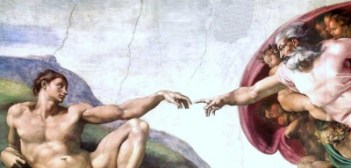
Michelangelo CreationBerkeley was quiet as we drove through its leafy streets to St. Joseph’s Collegiate Chapel on the corner of Durant and Bowditch, one block from campus. Once more, we would join others to pray for peace and freedom in Berkeley.
We parked, and I carried red roses from my garden to freshen the vase beneath St. Vladimir’s icon of Our Lady. I replaced the candles and lit a few, saying a prayer of thanksgiving for the week. I opened the front door and set out a foam-board sign announcing the Mass. I replaced a small notice, missing, announcing, “Singers Wanted.”

Our organist warmed up, the altar candles were lit, and the pews filled. A procession entered as we sang from our hymnals, incense swirling, tapers tall and flaming, crucifix carried by a young acolyte. The Mass began, weaving song and sacrament and prayer through the vaulted dome, through our hearts and minds, settling in. My own heart was grateful for the last few weeks. My friend, who had lay dying, had entered Paradise, carried by Jesus; I witnessed two bishops consecrated in Tulsa, Oklahoma, in a setting of beauty and promise and pageantry; our little chapel had survived the Free Speech Week, peaceful speakers stonewalled, freedom denied by cowardice.

So much had happened in three weeks. It seemed that if we blink, our lives pass by and we are gone. We must not blink, but watch and wait and pray each minute of each day, eyes wide open to truth, our hearts bravely seeking. We guard our time, so that our time is not stolen by the darkness of the night. We offer this time to God, so that it is sanctified by the light of the day. Some say “be present” and it is good advice, that in all of our hurrying and worrying we forget who we are, that we are holy children of God. We are loved by the Infinite One, touched by the Eternal.

My thoughts wove through the dance of the liturgy, and when our preacher spoke of the healing miracles of Christ, how he brought the dead to life, gave sight to the blind, healed the lepers, all with his touch, I saw how the Christian’s time is also touched by God. The Christian’s time, those days on this good earth, is reborn in the present moment, weaving past and future, creating a fine cloth. We look to our past to repent. We offer our leprous hearts to Christ, in confession and Eucharist. Only then can we freely look to our future.

Arms outstretched, our preacher explained how Christ lay his hands on the ravaged flesh of the lepers. He touched the untouchables. We, too, he said, are untouchables, for our hearts are cancerous and in need of healing. Yet, here, in this chapel, before this altar, Christ touches our hearts and makes them whole. The Lord of Life breathes life into us and resets our heartbeats.

Michelangelo’s famous painting of Creation that covers the ceiling of the Sistine Chapel in Rome shows the finger of God reaching to touch Adam to give him life. Whether this is myth, allegory, or literally true is of no matter. It explains the truth of our beginnings, our holy beginnings, the sacred nature of our humanity. We are touched in the womb, enlivened, quickened. We are touched in Holy Baptism and Holy Communion, with water and with wine, with the bread of Heaven in the Mass.

My friend who lay dying three weeks ago has been touched and reborn to new life in Paradise. Each one of us awaits that touching, in the meantime biding this time of redeeming. For in this mean-time, this middle time between birth and death, between the womb and the grave, we touch the precious, present time given to us. We hold it in our palms. We finger its seconds. We listen. We pray. We pay attention to God’s voice in Scripture and Sacrament, his voice spoken by others in the Body of Christ who are also touched and listening. And we go to church to be touched by Christ, to be cleansed, to no longer be untouchable.

In Tulsa, four bishops “laid their hands” upon the heads of the two priests. The priests had risen from a prostrate position on the carpet before the altar, where they formed crosses, their fingers touching one another, gravity pushing their bodies into the carpet that touched them. We sang a litany, invoking the Holy Ghost to touch these men, to fill them with discernment, humility, and holiness. The Holy Ghost came, and through the fingers of the bishops, through this laying on of hands, the Spirit pulsed through the centuries, from Jerusalem to Tulsa on this twenty-first day of September, touching them. Holy oils touched their heads through the hands, rings encircled their fingers, and pectoral crosses pushed against their hearts. They were touched by God.

And our chapel, during this week of Free Speech in which there was little speech and freedom, and a great cost to the community, was untouched by trouble, touched and protected by the love of God, and by the stalwart presence of police.

This morning, in church, St. Paul touched me as I listened to the Epistle for today, with these beautiful words, written in a letter to the Church in Ephesus (today in Turkey):           

I bow my knees unto the Father of our Lord Jesus Christ… that he would grant you, according to the riches of his glory, to be strengthened with might by his Spirit in the inner man; that Christ may dwell in your hearts by faith; that ye, being rooted and grounded in love, may be able to comprehend with all saints what is the breadth, and length, and depth, and height; and to know the love of Christ, which passeth knowledge, that ye might be filled with all the fulness of God. (Ephesians 3:14+)

Rooted and grounded in love, strengthened by the Spirit, touched so tenderly with such power and beauty and truth, knowing the breadth, length, depth, height, love of Christ beyond knowing, filled with the fullness of God. These are no small things. These things tell us who we are and who we are meant to be. These are indeed, wondrous touchings, the hands of God touching our hearts and making them whole.

Someone touched the little sign asking for singers in our chapel porch. What did they do with it? Will they touch the one we put up today? Will these bits of paper and print float down Durant to Telegraph, or perhaps over to Bancroft and Sproul Plaza? Will someone else wonder? Will they touch the scrap from our chapel? Will this touch their heart and soul?

Today, after the service ended, we locked the chapel doors securely. I knew as I switched off the lights, the Sanctus Lamp burning steadfast, that this morning, like every Sunday morning, our songs and prayers and incense and processions had spilled out onto Durant Avenue to the passersby. We, having been touched, touched Berkeley with peace and freedom, with the unsurpassed fullness of the love of God.

Learning to Love

IMG_0044

I’ve been praying for a friend in the hospital. He lies unconscious, his family watching and praying. We too, his parish family, pray for him. He is a strong, larger-than-life man, who always has a smile. His eyes were bright with laughter. He has been an active member of our local parish church, a parish that reminds us that we are both sinners and saints, that what we do with our time given matters.

For every minute of our time on earth counts. It is all weighed and measured. All of us will be found wanting when we return home to God, when we gather by that great river that runs by his throne, but God will supply the difference with our tears, our confessions, and our repentance.

We do not love enough. We are full of ourselves, our prides, our vanities, our selves so sensitive to the slightest slight, so eager to brag and swagger. In church we are reminded of this – our poor, inadequate love – so that weekly we have the chance to clear away the debris of our life, the debris of our un-love. The floodwaters are drained from our souls. We scour our hearts. We make a home for God within us. We begin the week on a Sunday morning, as new creatures.

To begin anew is no small thing. To begin anew each week, having thrown out the old and rotting bits, the ugly bits, the cancerous bits, is to grow strong in the rich soil of other sinners and saints surrounding us. This is what the church offers. For the church is the Body of Christ, our means of salvation, our promise of eternity.

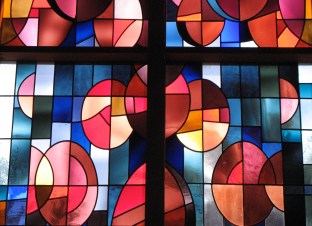
My friend in the hospital is a unique person in our parish, but then each one of us is unique. We are a collection of sharply drawn characters, of many races and generations, of every class and talent. We are so very different from one another, and we glory in our differences, as one appreciates the panes of color in stained glass. What we have in common is that we are Christians, members of Christ’s Body, who become one with one another in Holy Communion. After being fed by the Mass, we mingle in the coffee hour, a family to be sure. There are no differences now. We love one another, or at least try as best we can. Christ has made us inclusive and exclusive at the same time by giving us his own identity, his Body.

We learn all of this through the experience of being faithful, faithful to attending church, faithful to our weekly confession, faithful to the instruction found in the sermon and lessons each Sunday, and faithful to receiving the Real Presence of Christ in us. All this teaches us how to love one another. We are told that God is love. We are told that to love is to suffer and sacrifice for the other, as we see in Christ’s life, death, and resurrection. Through song and prayer, through word and sacrament, we layer this knowledge of virtue upon our consciences, to inform them.

For only with an informed conscience can we know where we have gone wrong. Only with an educated heart can we know the definition of love. Only with such instruction can we find true happiness.

My friend knew and knows this. He knows that in the giving of ourselves we find ourselves. This secret is known by the saints, for the saints were sinners too. The saints saw the flooding of their own hearts, the damage done by the putrid waters, and they sought remedy. Without diagnosis, there can be no remedy. Without remedy, there can be no recovery. The remedy for unhappiness is Christ. The prescription for happiness is Christ.

I am grateful for the weekly confession in the liturgy we make before receiving the Real Presence of Christ: I have not loved enough. I have been selfish and thoughtless. I have been distrustful of God’s plan for me, and too trustful of my own plans. I have done things which I should not have done and not done things which I should have done, and there is no health in me:

ALMIGHTY God, Father of our Lord Jesus Christ, Maker of all things, Judge of all men; We acknowledge and bewail our manifold sins and wickedness, Which we, from time to time, most grievously have committed, By thought, word, and deed, Against thy Divine Majesty, Provoking most justly thy wrath and indignation against us. We do earnestly repent, And are heartily sorry for these our misdoings; The remembrance of them is grievous unto us; The burden of them is intolerable. Have mercy upon us, Have mercy upon us, most merciful Father; For thy Son our Lord Jesus Christ’s sake, Forgive us all that is past; And grant that we may ever hereafter Serve and please thee In newness of life, To the honour and glory of thy Name; Through Jesus Christ our Lord. Amen.  

And so these moldy growths are cleansed away by the Sunday Eucharist. I am reborn once again, ready to set out for Monday and all that it offers, all the opportunities it provides to love. Then will come Tuesday, a second precious set of twelve hours in my life to practice love, to offer myself for others. And Wednesday, Thursday, and Friday, three days of my time, thirty-six more hours to grow in grace. Then Saturday, and finally Sunday, the day of reckoning again, the day of forgiving and feeding, the day of removing the huge weight of the week’s wreckage from my soul.

With the lightening of this burden, I am so much happier.

The fact that self-denial leads to happiness is one of the great contradictions of Christianity and the human condition. For Christianity is all about being human, all about our humanity. It is all about who we are, where we are, and where we want to go in our lives and after. Christ teaches us these things, helps us to understand, lightens the darkness, a true enlightenment.

My friend in the hospital is not alone. He is held close in our hearts as we pray for him. We wrap him in our love, the love of the Body of Christ, his own parish church. And we give thanks for his life now and forever.

Benediction

IMG_3111 (5)There comes a time in one’s life, a time in one’s week, a time in one’s time bracketed by calendars and clocks and digital devices, when the cares of the world seem to weigh heavily, crowding upon one another, demanding attention. The cares of the world – those cares we read in print and view in video – those public cares – layer on top of our own personal cares, until we cry that there is no room for more.
I have found a solution to this problem of crowding: I retreat an hour a week into corporate prayer, that is, praying to God in front of the Real Presence of God, with others beside me, two or three gathered, the priest guiding my meditation. In this way I am praying with the power of the Church, through adoration in the liturgy of Benediction, where the Host is placed on view in a monstrance on the altar.

As Anglo-Catholics, we believe that the Real Presence of Christ is in that Host. It is a mystery, but a reality promised by Our Lord. At our university chapel in Berkeley, we have added a weekday service of noon Benediction (Tuesdays.) It is a time of quiet, a time to contemplate the God who has humbled himself in this way. It is a time to lay before him all those cares of the world, all the burdens of the week. It is a time that trains our inner ear to hear his voice, to receive his blessing, his peace.

Peace is good. But peace is fragile, as we are learning in Berkeley. Peace is not easily found in our public square. Free speech is shut down by threatening violence or violent threats. Conversations are controlled, forbidden, and shamed into silence. So we pray for peace in Berkeley. We pray for freedom to speak, and freedom to think. We pray for peace and freedom, one hour a week in our Berkeley chapel.

We pray for peace in our hearts, that those warring and wearing cares not defeat us. We pray for answers to our problems of the moment, for healing of our wounds and those of our friends and families.

Our priest places the monstrance on the altar, with the golden rays fanning like the sun around the Son, and he takes a seat in the back pew, speaking softly from time to time, helping us in the way of prayer, the words to use, the images to see. He leads us gently as we focus on the golden rays and the white Host in its center.

I wasn’t sure what to expect. But I was stunned by the soothing silence, a silence that slips sweetly into the soul, a healing silence. As the prayers took form, basking in the Real Presence of Christ, my cares were reborn, transfigured by grace. The hour at times seemed long, and I learned patience. But also, the hour at times seemed short, and I feared its ending.

When the hour of Benediction did end, we sang a hymn of thanksgiving. And all week, the golden rays shone in my mind. As the cares of the world and the cares of my life flooded into my days, the golden rays and white Host poured grace into my time. They were like a lighthouse, a bright point of reference and remembrance, a signpost to my true home, a beacon that warned of danger and led to safety.

A family friend returned to his true home this last week, ending his long journey on earth. He was ready, a faithful servant, and God took him home to be with him, to praise him with the chorus of angels. He no longer needs the Real Presence in the Host. He is with God, our very God of very God, our Light of Light.

The light of our sun was dimmed last week, eclipsed by our moon. As I watched the moon throw the earth into darkness, the sun shimmered from behind, forming a circle of gold. The light could not be put out, could not really be eclipsed. Just so, the stars travel the night skies and the moon rises and falls, waxes and wanes over our little planet, Earth. We tumble through a darkness lit by Heaven.

Our hearts are dark, full of grief and grievance, needing such heavenly light. Such light does indeed shine in the darkness, even though the darkness comprehends it not. For God sent his true light into our world to reveal our true hearts, to open them wide, so that we might see and believe, comprehend and repent.

Spending an hour before the Blessed Sacrament amidst the golden rays does indeed lighten our burdens by enlightening our hearts. And as He shines into our souls, He brightens our days to come, until the next hour of Benediction renews that right spirit within us. 

Noon Prayers and Benediction: Tuesdays, St. Joseph of Arimathea Collegiate Chapel, Durant and Bowditch, Berkeley. Schedule can change – please check for updates on the website. All who come in peace are welcome.

Wind and Words and Wine on a Summer’s Day

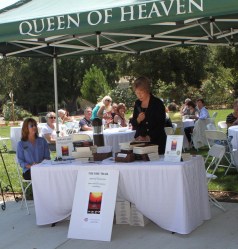
QUEEN OF HEAVEN 8 (2)It was a warm sunny Saturday at Queen of Heaven Cemetery where we gathered for the Bishop’s Vineyard wine tasting. Broad umbrellas and old oaks cast shade over a sweeping lawn. A fountain burbled in the center of a patio. The large buffet was inside, the wine tasting outside, the tables circling the patio. Tickets had been placed in wine glasses for those who registered as they arrived, five tickets exchanged for five samples. The glasses were to take home, a nice touch for this free event.

In addition to the food and wine, a Planning Tour table encouraged us to plan our future residence, with both under-ground and above-ground destinations, our last resting place, as they say. Indeed, cemetery comes from the Greek koimeterion, dormitory, a place of sleeping.

But on this Saturday, above ground, folks sipped wine and nibbled from small plates, mingling, chatting, and possibly planning their final rest, gazing over the flowery meadow where some family were already sleeping. In this way the living and the dead danced with one another on this sunny summer afternoon, the linking enlivening the living.

Knowing one’s days are numbered gives those days rare value. Present time is gilded with past and future. We are “present” more fully in our present moment; we value it; we pay attention. It is good to be reminded of winter on a summer’s day. It is good to be reminded in a Christian cemetery that death opens a door to life.

My second chapter in my recently released literary suspense, The Fire Trail (eLectio, 2016), is set at Queen of Heaven Cemetery, and I was honored to be invited to read the chapter and sign copies of the novel. I sat at a shaded table between the wine and the Planning Tours. Appropriate, I thought, for my heroine, Jessica, likes the planning involved in preparing for one’s death. She likes the orderliness, although not yet a believer in the Christian promise of resurrection.

Jessica sits with her mother at the foot of a giant statue of the Risen Christ, and they speak of the dead, her father and sister resting beneath. She has been called to this place and this moment by duty, the discipline of love. For it is love that brings her to the cemetery, that commands her to be faithful to her mother and this monthly graveside visit. It is love that prompts her to pause in her busy life and remember her father and sister.

On this summery afternoon near the splashing fountain, as I read aloud words from the pages in the open book, a wind came up. I pressed my fingers down upon the rippling edges, continuing to read, trying not to pause in this dance of life and death, of love and loss, a dance that skipped and bowed and twirled within the words and phrases. I tried not to disrupt the rhythm, the rhythm of the language beating time to Jessica’s heart, and I hoped my listeners, holding their wine and gazing toward me, could hear the rhythm and join in the dance, now of wind and words and wine.

Speech is such a precious thing – language expressing thoughts and feelings, a sharing with one another, a connection. When speech is spoken between us, among us, conversation is born, and love touches us in the birthing. The conversation between writer and reader, between speaker and listener, reflects the divine, for it draws us close to one another, that is, if our hearts are open and we respect one another’s freedom of thought and belief. It draws us together, if we speak civilly, if we speak with love. And so love begets love.

Jessica’s journey through the pages of my novel follows a path through darkness into light. Just so, our own life journeys do the same, following paths through sunlight and shadow, all the while knowing this life is but a dim reflection of the one to come. We see through a glass darkly, imperfectly. We gaze upon the cemetery meadow and its sleeping forms beneath. We look up to the open arms of the risen Christ, the windswept skies and golden hills. The cemetery speaks to us of life not death, of light not darkness. It helps us talk to God. The cemetery, with its stones and statues, its sacred sacraments, invites us into a conversation.

The Fire Trail considers these things. It asks where the borders of love lie, where it is we no longer love, where it is we no longer speak to one another. It considers our freedom to speak, not only to one another, but to God. The firebreak in the Berkeley hills (useful a few days earlier in the Grizzly Peak fire) protects civilization from the wilderness. It is a border that protects life and those innate freedoms given to us by God our Creator – freedom to speak, to civilly express our thoughts and desires. It is a border worth defending. For the trail, in turn, defends us. It is a boundary that secures our peace and freedom, that allows us to love one another.

As the wind rippled the pages of my little novel and I said the words printed on the paper, I danced with my listeners. The bodies of the dead were beyond in the meadow, under the grass, but I knew the souls who had once lived in those houses of flesh and bone were no longer there. The bodies were disintegrating, returning to the earth, ash. Those souls who had lived in those houses were beyond, dancing with angels, and touching from time to time the outstretched hands of the Risen Christ.

And from time to time, they touched us all as we gathered together on this sunny summer Saturday.

Discerning the Divine

IMG_3040The booming sound of men voicing liturgical responses, creeds, and confessions has lingered in my memory over the weekend. For St. Joseph’s Collegiate Chapel was fulsome with the sound of unison chants and prayers these last two weeks in our Seminary Summer Session.
I was blessed to be able to attend the Noon Masses daily in our Berkeley chapel, and the images of those hours are carved into my mind and heart – the men in black cassocks, lined on benches against the cream stuccoed walls in the style of an abbey choir. The russet tiled floor gleamed, drawing the eye to the simple slab altar and flaming candles that framed a tented tabernacle. Above, a primitive crucifix hung near the Sanctus Lamp that burned steadily. All was domed by the massive red barrel vaulting and high clerestory windows that sent shafts of light toward us.

Each Mass was celebrated by a different priest, and his unique person tinted the liturgy – his voice, his manner, his stance, his desire, his love of God. Each day we said the same words, prayed the same prayers, sacrificed the same Mass, but each Eucharist was slightly different, enriched by the man celebrating. The liturgies also reflected the Church Kalendar, honoring St. Vincent de Paul, St. Margaret of Antioch, St. Mary Magdalene, St. James, St. Anne, St. Martha. The acolytes and deacons took turns during the two weeks, and we heard varied voices reading the appointed Epistles and Gospels each day.

IMG_3012 (3)Again and again, I prayed for these postulants and discerners. For the students were largely seekers, searching for God’s will in their lives. As bells rang and the Host was lifted high, I prayed for these men who were discerning their future. Did God call them to be priests? Deacons? Laymen? I knew that the discipline of the residential program would test them as they fitted their lives and bodies into the schedule and demands of living in community. I knew that the discipline of their studies would challenge their minds and memory. And in this process of trial, they would hear God’s voice.

The laity that attended classes and liturgies also were seekers. They too, myself included, were listening for God’s voice. For indeed, the Lay Order is a holy ministry, made up of all believers, a kind of priesthood. We have been given the gift of life. How do we honor that precious gift? How do we allow the Creator to live within our gift, his presence in his present? It is not always easy to hear the answer. And the answer can be hard to accept. But God’s voice is present, in Scripture, in Sacrament, in love, in one another in the Body of Christ the Church. It is present all around us if we pay attention. And the Church helps us, trains our ears, so that we can recognize, like sheep, the call of the Shepherd. We can discern his voice. Without the Church we are deaf. Without the Church we live in a silent void.

The clergy came to the Summer Session also to listen, to be renewed. They too were discerners, seeking the next step, the next turn, the next leap of faith that love required. They knew God’s voice could be demanding, could lead to sacrifice and suffering, but they also knew the immense joy of saying yes. They came to instruct and to lead and to listen to their students, but they also came to be led, to be fed, to support one another in this great and grand adventure of holiness.

And so this morning in our parish Sunday School, as the children sang “All Things Bright and Beautiful,” and twirled and praised and laughed, dancing in the circle, on the edges of my hearing I discerned the lilt of men chanting in a barrel vaulted chapel. I heard their silence linking the words and phases. I saw them kneel on the hard glimmering tiles. I heard them listening.

And this morning, as the children settled into a quiet moment, silently nibbling on raisins, and an older child read a picture book to the younger ones, I knew it was all the same, it was all somehow seamless, the seminary chapel and the Sunday School. The children were discerning too, their eyes large, entranced by the creation that God created, by the pictures of the great heavens, the dark night and the bright day, the sun and the moon and the stars, the infinitely varied birds and beasts, the wondrous making of man and woman. They heard God’s words, “It is good.” The children were discerning their own place in this world created by this God who loves them so. And they will go on discerning as they grow in grace, learning to listen with heart and mind, becoming holy and wise in their choices, as they hear their Heavenly Father speak to them.

I look forward to next summer’s Residential Summer Session, usually held the last two weeks of July. I look forward to a rhythmic, poetic, holy time of discernment. But in the meantime, I shall sing and dance with the children on Sunday mornings and, with them, step into the pictures on the pages that are turned by a small hand, as we discern the divine.

The Best Birthday Ever

IMG_2919 (3)I recently turned seventy and the best birthday present ever was to see my son and worship side by side in church, my husband on one side, my son on the other. I thanked God for my son’s miraculous healing. For it truly was a miracle. It was the gift of God’s grace.

I have mentioned in these pages my son’s surfing accident in Costa Rica in early March when he dove into shallow water and the horrific days that followed. It is a miracle that he is alive. The surgeon told him he was given a second chance, a new life, for the surgeon had never seen anyone survive such a neck injury before.

Many of you, my dear readers, prayed for him in those difficult days. It made all the difference. Thank you, my prayer warriors, for you must have stormed Heaven’s gates.

When I saw my son on my birthday, I was grateful. There was no sign of injury. He appeared the same, walking normally, acting normally, healthy, with surgical scars on his neck, front and back, that will remind him of his ordeal and his second chance. My little boy, now 6’3″, forty-four, father to two precocious and precious adolescents, husband to a wonderful woman, had survived. Like the centurion’s servant and Jairus’ daughter, my son lived. And he now carries within him a certain glow, a reborn love. He reached for God and God touched him.

I reached for God in those days following the accident.

There are times in life when my soul reaches into the dark, groping for God. It is easy to find God in Scripture, in the Eucharist, in church, in other people. But in the night-time of our days, when danger growls from the surrounding jungle of our lives, we reach in prayer. We reach for the light, the light of love, of reason, of faith, of truth. We reach for meaning, for answers, so that we might understand suffering. We call, “Lord Jesus, help me.” We cry, “Lord Jesus, have mercy upon me, a sinner.” We pray, “Our Father, who art in Heaven…” And he hears us, as he promised.

When I reach into the dark for God, I know he is there, taking my hand. I don’t always feel it, don’t always experience him, but I know he is there. It is this knowledge that Christians own. It is this certainty that they enjoy. It is this joy that is theirs. The world does indeed make sense after all. It follows natural laws ordained by its creator: laws broken in Eden, but rejoined by Christ on Calvary when he redeemed our brokenness with his death and resurrection. Christ civilizes the jungle outside and within, with his own sacrifice. He atones, making us at-one with him.

My flesh is thinning. I am feeling my age. I move slower, reflect longer, and practice loving others more. I am a child of God, a small part of the redemption of the world, no small thing. When I dive into the shallow waters of this world, when I break the laws of nature and of God, when pride ravages humility, when I ignore God’s commandments of life and welcome Eden’s sins of death, I find myself in the darkness of midday, reaching. I know if I can touch the hem of Christ’s garment it will be enough. He will heal me, for he knows I am too frail to heal myself. He is the master surgeon.

And so on my seventieth birthday we celebrated life. We celebrated eternity. We celebrated our very breath, our bodies, our blood. As my granddaughter lit the candles on the cake I considered my wish. I prayed that grace, abundant grace, amazing grace would visit us all, would cover us and protect us from the dark. For as my bishop often said, “All is grace.”

As I blew out the candles I knew it was true. All is grace. Every single month, day, and hour of my seventy years on this earth has been redeemed by God’s amazing grace.

All Creatures Great and Small

Sunday SchoolAs the world grows more dangerous, church-going becomes more welcome, a true respite and refuge. Worshiping as one chooses is one of the great gifts given to Americans on the wondrous Fourth of July. And each year, as that holiday approaches, I give thanks for the freedom of worship.

In a time of wars and rumors of wars, we enter the doors of our church and are pulled out of ourselves toward something, someone greater. For an hour each week we soar with the birds, dance with the angels, and commune with our God.

Communion with God is no small thing – thought to be revolutionary once and in some cultures still revolutionary. But in Christianity we do just that. The creature communes with the Creator.  The small communes with the great. This is no small thing.

This morning in our parish Sunday School, we started our Summer Sundays children’s program, around the theme “All Things Bright and Beautiful.” We began with circle time and invited Our Heavenly Father to join us. We folded our hands and prayed, “Our Father, who art in Heaven, hallowed be thy name…”

Because we have faithfully invited Our Heavenly Father into our classroom, into our circle, and into our hearts, week after week, year after year, the children knew these holy words. They said them with great gusto, as though sending them up and out, flying through the sky. There was no hesitation. No wondering what the next phrase is. They had it all down. They have been faithful.

We had made a place for God, and we continued with snack, story, song, and craft. All the while God was with us, and his Holy Spirit danced among us, filling us with his joy.

We sang about all creatures great and small, the purple headed mountain, and the river running by. We sang about the cold wind in the winter and the pleasant summer sun, the ripe fruits in the garden – He made them every one! For each little flower that opens, each little bird that sings: God made their glowing colors and He made their tiny wings. As we sang we knew that God was there, prompting us. For he gave us eyes to see them, these bright and beautiful things. He even gave us lips that we might tell how great is God almighty who has made all things well.

As the children raised their arms for “creatures great” and tumbled on the rug for “creatures small,” I considered the preciousness and precariousness of the time. I gave thanks for our country that still allows us to sing to God with our children. I gave thanks for America, her laws, her liberty, and her common celebrations, her Independence Day.

For the Fourth of July is our day of common celebration. It is America’s birthday, and we are one family gathered around the cake aflame with lights. As a nation we make wishes on this day, wishes for peace and freedom, for liberty and law. We form a circle around the cake with its flaming candles, holding hands of every color and class, as we honor one another in word and deed. For we are Americans. And each one of us is bright and beautiful, for the Lord God made us all.

An usher peeked into our classroom. He motioned that it was time for our communion blessings. We formed a line, hands folded, and stepped carefully up the central aisle of the nave of the church toward the altar. As I received Christ in the bread and wine, I gave thanks for this refuge, this church, this respite from the turmoil of the world. I gave thanks for our freedom to commune with God our Creator.

One hour a week we retreat into the warm refuge of the church, this ark of Christ. We sing and pray, and the children lead us in the “Our Father.” A simple sixty minutes of peace. A simple sixty minutes of freedom. A simple sixty minutes of joy, we creatures great and small, communing with Our Lord God who made us all.

Common Ground in an Uncommon Country

The Fire TrailA blistering heat wave finally broke last night in the Bay Area. The fog rolled in from the vast Pacific Ocean, through the Golden Gate, blanketing the towns along the bay with mercy.

We are fragile creatures, comfortable only in moderate temperatures. We require food and water and protection from weather. We don clothing and build shelters. We wonder about the forecast just as our forebears worried. Will the crops survive? Will we survive? We check news reports to be prepared, to protect ourselves. We know we are not immortal, although we pretend we are.

There are also cultural signs that predict shifts in worldwide threats, such as massive movements of populations to safer shores. There are religious signs that predict changes in mankind’s heart, the rising violence among us, the murder of innocents, the hardening of conscience. These signs are not as clear as weather predictions and many do not see them. But they point to a serious change in the climate of our culture, for those who choose to see.

They point to a climate of indifference. A time of refusal to see the trends and face what they portend. With the loss of faith in a God of loving authority, the ebbing of conscience followed, so that the shores of man’s heart are parched and dry. Right and wrong have become personal choice, momentary whim, relative like Einstein’s theory. Authority is questioned, then its demands abandoned. The individual sets his own course without regard for the unborn or the marginalized. It’s all about me.

I am reading a dystopian novel, 2084, by Henry William Kalweit, set in Paris in that year, a city ruled by extremist Sharia Law. The signs of the takeover of France and Europe had been there, clear markers, but ignored in a desire for inclusivity and diversity. Now, in 2084, sculptures and paintings from the Louvre are dumped into the Seine or set afire. Airlines are long gone; televisions forbidden. Transportation is by foot or cart. Justice is swift and brutal in the sharia court. Christians and Jews hide in the underground maze of sewers to survive. It had been a slow takeover of the European demos, but a steady one – through population decline in one group replaced by an increase in another. The signs were not recognized.

In my recent novel, The Fire Trail (eLectio. 2016), the firebreak in the hills above UC Berkeley serves as a symbol for the border between civilization and the wilderness. Fires have jumped the trail from time to time, devouring neighborhoods. Yet the fire trail above Berkeley also served as a break, a border, a wall that keeps out the wild and untamed, protecting the civil and tamed.

And yet the wild and untamed have indeed invaded the campus this last year, once the home of thoughtful rhetoric and reasoned argument. The first casualty of the invasion was law itself, the authority of the collective voice of the people through their vote. With the rule of law unrecognized and unenforced, no one is safe. Anarchy is close by. We saw this in the Berkeley riots over the winter and spring when invited conservative speakers were bullied into silence by an illiberal Left. But the Berkeley police learned from this violence and were able to subdue the most recent disturbance last month.

Democracy is fragile, just like us. It must be nurtured and safeguarded and fed and housed. As citizens and voters we must learn to recognize the signs of democracy’s weakening in order to protect it. We do so by encouraging civil debate, honoring free speech, and respecting one another. We do so by finding common ground as Americans.

As we approach our national Independence Day celebrations, let us give thanks for our freedom, and for this remarkable country. We fought tyranny before, and we can do it again. But we need to recognize the signs. We need to seek common ground in this uncommon country, America.

Ascension

IMG_2718 (2)The sky touches the sea here in Hana, Maui, holding it close as the waters move over the face of the earth. It is warm on this Ascension Sunday, the day we celebrate Christ’s bodily ascension from earth to Heaven, but a cool breeze is spirited ashore. We sit on a wooden deck that wraps our cottage, immersed in sky and sea as though joining them. The blue waters crash and spew against green bluffs and black lava, like sudden memories urging our minds to not forget Memorial Day, and to not forget Christ’s ascension.

For such memory memorializes freedom and those who fought and died for us. Many of those brave men and women who served our country to protect the peace of our shores have ascended ahead of us to God. So it is a time for those of us left behind to give thanks for their courage, to honor those who have gone before and fought for our peaceful gatherings, in churches and squares, in cemeteries and parks.

Today, the 28th of May, is also the second anniversary of our Bishop Morse’s passing into Heaven. God worked through him to touch us. Our bishop often said that it was a matter of saying yes to God, or no to God. If you said yes, as Saint Mary did, said yes to God’s will in your life, said yes to willing his will, God could work through you here on earth. And if he did this, you were changed again and again, transformed and transfigured. When you stumbled, he lifted you up. When you doubted, he infused you with belief. When you despaired, he inspired you with hope. We call this grace, this action of God, and when you say yes, all is grace.

IMG_2755St. Mary’s Catholic Church in Hana was festive this morning as though ascending with Christ. All was light and bright, for the Bishop of Honolulu was visiting to confirm eight children. Arched windows in the white walls leading to the vaulted chancel caught breezes from the sea far below, and the gentle air breathed over God’s people. The acolytes and clergy processed in, lighting the path to the altar with crucifix and candles and Holy Scripture, carried by solemn servers absorbed by the rites of holiness.
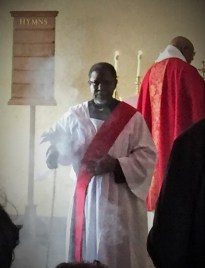
The bishop blessed the water in the baptismal font and sprinkled drops over the congregation in the gleaming pews. After lessons were read and responses chanted, he addressed the candidates standing before him. He explained that in the rite of Confirmation, they would be immersed in the Holy Spirit of God, not only marked with chrism oil on the forehead, but immersed totally in God’s love. They would be given power then to tell the world about God’s love, to allow God to love others through them. He spoke earnestly, from the center of the aisle, allowing God to love through him. He asked them questions of belief, questions of great and holy matters, and they answered yes, confirming the vows made at their Baptism. They said yes in this moment of Holy Confirmation. They said yes with heart and soul and mind. They said yes to God.

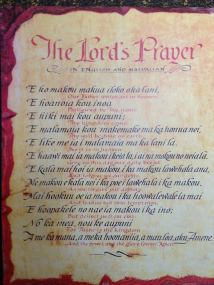
The Lord's Prayer HawaiianAs we witnessed their Confirmations we confirmed our own, ascending with them into Love, into God, this morning in the village church of Hana, Maui. We joined in the singing and praying and thanksgiving. We ascended into the song of love, the song of yes, the song of Scripture and sacrament. In this white church with its polished pews, young and old from all backgrounds joined hands and sang “E ko makou makua iloko okalani…,” “Our Father, who art in Heaven…”

I knew, as we held hands and prayed together, that this is what we must remember, this is what we must never let slip from our memories. We must bind this moment to our hearts and minds. This moment of communion, with God and with our brothers and sisters in Christ, was why our soldiers fought. They fought and died on foreign beaches and in dirty trenches, soaked with Christ’s blood. They fought so that we could hold hands and sing to God today in church, on this Ascension Sunday. They fought so that we could one day ascend with Christ, into Christ, so that we could join earth to Heaven, and Heaven to earth, so that we could become a sacrament of love to our brothers and sisters in this world. So that we, as Bishop Morse often said, could love enough.


Pages of Grace


COVER 5.1It’s been nearly a two-year project, and I’m happy to announce the release of All Is Grace, a Collection of Pastoral Sermons, by the Most Reverend Robert Sherwood Morse (1923-2015), published by the American Church Union. I was honored to edit this remarkable collection and enjoy a remarkable journey.

The gathering of these sermons, written on yellow pads and bits of hotel stationery, also gathered my own life together, pulling in the scattered, shattered bits of grief over his passing. Reaching into the sixties, the words reflected the reach of my own life, having come of age in that tumultuous time. As I typed the words, turning them into digital format, I lived a parallel story that at times intersected with Bishop Morse’s own life.

Those who knew him often recall how they met him, for he changed lives. We all have our stories. The Assistant Priest at our Berkeley chapel regaled to me on Thursday how he and his fiancee were looking for an Anglican clergyman to perform a Nuptial Mass. He was finally directed to St. Peter’s Oakland where,  he was told, they were “more Catholic than the Catholics.” My friend found Father Morse outside, cleaning up the grounds, picking up bits of trash. That was 1969. His friendship with Father Morse continued for forty-eight years. He chuckled, his eyes shining, young again. “We have been so blessed to have known him.” I nodded thoughtfully. Indeed.

My story has been told in these pages before, but humor me, dear reader. Allow me to reminisce a bit too, on the occasion of this publication.

I was a single parent returning home with my four-year-old son. I was looking for an Anglo-Catholic parish, like my friend, for I had fallen in love with the Eucharist, the “smells and bells,” the dance of song, prayer, and liturgy. I was, as C.S. Lewis said, “surprised by joy,” again and again, every Sunday morning. I had tasted Heaven, and nothing could compare. So I looked for Heaven, in February 1977, in the yellow pages of the phone book (remember those heavy doorstoppers?)  I found St. Peter’s Oakland, a twenty-minute drive from our apartment in Walnut Creek. I guessed the parish was Anglo-Catholic since they listed times for “Confessions.” I knew, after the service, I had found my home. Father Morse greeted me on the steps of the church as I was leaving and handed me a pledge card. “Fill it out and come downstairs,” he said simply, after we had chatted a bit.

He was larger than life – 6’3″ – and seemed to float in his white robes. He had a huge smile and a booming voice. He owned a confidence, a sense of knowing, that I trusted. I did as he asked. I was unemployed, but I filled out the card, pledging 25 cents a week. I stepped downstairs to the undercroft. It turned out to be a momentous coffee hour, a historic meeting in which the congregation voted unanimously to leave the mainstream Episcopal Church.

Looking back forty years, I wonder at the miracles that unfolded before me. I learned to be faithful, to worship every Sunday. I worked in the Sunday School, then helped with other projects over the years. He was my priest and my friend and a good listener. He blessed my marriage to a wonderful man who became father to my son and the “wind beneath my wings.” Over those forty years, I listened and I learned. I prayed the prayers and sang the songs. I stepped along the narrow path, to Heaven, both in time and in Eternity.

Bishop Morse is in Eternity now, by the river that runs by the throne of God. He is also on the cover of this book of sermons, and as I opened the first box of books that arrived on my doorstep, I smiled. There he was, his image beneath the large red letters, ALL IS GRACE.

My friend, the Berkeley priest, said he recalled how Father Morse repeated simple phrases, words we could carry with us beyond the Sunday sermon or the weekday office visit. “All is grace!” was one of those phrases. Often we needed more encouragement, and he would help heal our wounds with, “God writes straight with crooked lines,” “God sits in the corner and waits,” “To love is to suffer,” and “The Passion of Christ is the union of love and suffering.” There were many other words that helped us understand who we were and are as human beings, gifted with freedom, created by a God of infinite love.

And it’s so very true. All is grace, for all ends well for Christians who believe in Christ, our God of love. Our dear Lord looks after his sheep. He calls us by name and we know his voice. We are pilgrims on a path through the dark wood of the world, listening for his call in the quiet of the forest. We know we will emerge into the bright light of Heaven, into a chorus of angels and Heavenly host. We know that our suffering is redeemed by God’s grace.

All is grace, for all ends well for Christians who obey God’s law of life and love. His love demands obedience to the Ten Commandments and the Beatitudes. But his infinite mercy offers forgiveness, a chance to repent, to change, to start anew, again and again. These themes live in the pages of Bishop Morse’s sermons, for this Easter 2017 the book has been born, breathing on its own, resurrecting my bishop’s voice.

“I hear his voice,” my friend and others are saying about the book. Yes, and I have been living within the voice for two years. No, forty years. Ever since my son and I visited St. Peter’s and the tall welcoming priest in the white robes greeted us on the steps.

All is grace. Indeed. All is grace.

To order copies, visit http://www.AmericanChurchUnion.com or email sjatc@sbcglobal.net.