
 There comes a time in one’s life, a time in one’s week, a time in one’s time bracketed by calendars and clocks and digital devices, when the cares of the world seem to weigh heavily, crowding upon one another, demanding attention. The cares of the world – those cares we read in print and view in video – those public cares – layer on top of our own personal cares, until we cry that there is no room for more.
I have found a solution to this problem of crowding: I retreat an hour a week into corporate prayer, that is, praying to God in front of the Real Presence of God, with others beside me, two or three gathered, the priest guiding my meditation. In this way I am praying with the power of the Church, through adoration in the liturgy of Benediction, where the Host is placed on view in a monstrance on the altar.
As Anglo-Catholics, we believe that the Real Presence of Christ is in that Host. It is a mystery, but a reality promised by Our Lord. At our university chapel in Berkeley, we have added a weekday service of noon Benediction (Tuesdays.) It is a time of quiet, a time to contemplate the God who has humbled himself in this way. It is a time to lay before him all those cares of the world, all the burdens of the week. It is a time that trains our inner ear to hear his voice, to receive his blessing, his peace.
Peace is good. But peace is fragile, as we are learning in Berkeley. Peace is not easily found in our public square. Free speech is shut down by threatening violence or violent threats. Conversations are controlled, forbidden, and shamed into silence. So we pray for peace in Berkeley. We pray for freedom to speak, and freedom to think. We pray for peace and freedom, one hour a week in our Berkeley chapel.
We pray for peace in our hearts, that those warring and wearing cares not defeat us. We pray for answers to our problems of the moment, for healing of our wounds and those of our friends and families.
Our priest places the monstrance on the altar, with the golden rays fanning like the sun around the Son, and he takes a seat in the back pew, speaking softly from time to time, helping us in the way of prayer, the words to use, the images to see. He leads us gently as we focus on the golden rays and the white Host in its center.
I wasn’t sure what to expect. But I was stunned by the soothing silence, a silence that slips sweetly into the soul, a healing silence. As the prayers took form, basking in the Real Presence of Christ, my cares were reborn, transfigured by grace. The hour at times seemed long, and I learned patience. But also, the hour at times seemed short, and I feared its ending.
When the hour of Benediction did end, we sang a hymn of thanksgiving. And all week, the golden rays shone in my mind. As the cares of the world and the cares of my life flooded into my days, the golden rays and white Host poured grace into my time. They were like a lighthouse, a bright point of reference and remembrance, a signpost to my true home, a beacon that warned of danger and led to safety.
A family friend returned to his true home this last week, ending his long journey on earth. He was ready, a faithful servant, and God took him home to be with him, to praise him with the chorus of angels. He no longer needs the Real Presence in the Host. He is with God, our very God of very God, our Light of Light.
The light of our sun was dimmed last week, eclipsed by our moon. As I watched the moon throw the earth into darkness, the sun shimmered from behind, forming a circle of gold. The light could not be put out, could not really be eclipsed. Just so, the stars travel the night skies and the moon rises and falls, waxes and wanes over our little planet, Earth. We tumble through a darkness lit by Heaven.
Our hearts are dark, full of grief and grievance, needing such heavenly light. Such light does indeed shine in the darkness, even though the darkness comprehends it not. For God sent his true light into our world to reveal our true hearts, to open them wide, so that we might see and believe, comprehend and repent.
Spending an hour before the Blessed Sacrament amidst the golden rays does indeed lighten our burdens by enlightening our hearts. And as He shines into our souls, He brightens our days to come, until the next hour of Benediction renews that right spirit within us.
Noon Prayers and Benediction: Tuesdays, St. Joseph of Arimathea Collegiate Chapel, Durant and Bowditch, Berkeley. Schedule can change – please check for updates on the website. All who come in peace are welcome.
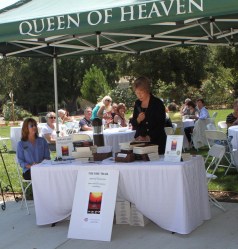 It was a warm sunny Saturday at
  The booming sound of men voicing liturgical responses, creeds, and confessions has lingered in my memory over the weekend. For St. Joseph’s Collegiate Chapel was fulsome with the sound of unison chants and prayers these last two weeks in our Seminary Summer Session.
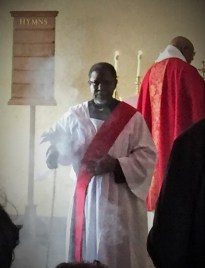 Again and again, I prayed for these postulants and discerners. For the students were largely seekers, searching for God’s will in their lives. As bells rang and the Host was lifted high, I prayed for these men who were discerning their future. Did God call them to be priests? Deacons? Laymen? I knew that the discipline of the residential program would test them as they fitted their lives and bodies into the schedule and demands of living in community. I knew that the discipline of their studies would challenge their minds and memory. And in this process of trial, they would hear God’s voice.
 I recently turned seventy and the best birthday present ever was to see my son and worship side by
  As the world grows more dangerous, church-going becomes more welcome, a true respite and refuge. Worshiping as one chooses is one of the great gifts given to Americans on the wondrous Fourth of July. And each year, as that holiday approaches, I give thanks for the freedom of worship.
 A blistering heat wave finally broke last night in the Bay Area. The fog rolled in from the vast Pacific Ocean, through the Golden Gate, blanketing the towns along the bay with mercy.
 The sky touches the sea here in Hana, Maui, holding it close as the waters move over the face of the earth. It is warm on this Ascension Sunday, the day we celebrate Christ’s bodily ascension from earth to Heaven, but a cool breeze is spirited ashore. We sit on a wooden deck that wraps our cottage, immersed in sky and sea as though joining them. The blue waters crash and spew against green bluffs and black lava, like sudden memories urging our minds to not forget Memorial Day, and to not forget Christ’s ascension.
 St. Mary’s Catholic Church in Hana was festive this morning as though ascending with Christ. All was light and bright, for the Bishop of Honolulu was visiting to confirm eight children. Arched windows in the white walls leading to the vaulted chancel caught breezes from the sea far below, and the gentle air breathed over God’s people. The acolytes and clergy processed in, lighting the path to the altar with crucifix and candles and Holy Scripture, carried by solemn servers absorbed by the rites of holiness.
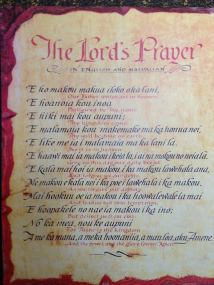 As we witnessed their Confirmations we confirmed our own, ascending with them into Love, into God, this morning in the village church of Hana, Maui. We joined in the singing and praying and thanksgiving. We ascended into the song of love, the song of yes, the song of Scripture and sacrament. In this white church with its polished pews, young and old from all backgrounds joined hands and sang “E ko makou makua iloko okalani…,” “Our Father, who art in Heaven…”
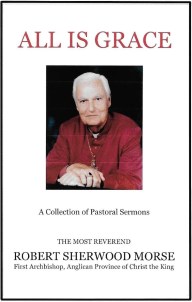 It’s been nearly a two-year project, and I’m happy to announce the release of All Is Grace, a Collection of Pastoral Sermons, by the Most Reverend Robert Sherwood Morse (1923-2015), published by the American Church Union. I was honored to edit this remarkable collection and enjoy a remarkable journey.
 We drove to church in a gray drizzle that watered the earth this Easter of 2017. I looked forward to the flowering of the white cross by the children of the parish. For in this flowering we acted out a wonderful story, and I had a part in the story simply by being faithful.
 An old friend entered eternity this last week.
 Christine Sunderland
