
 It has been said, and I believe it to be true, that sports reflect human passions, both good and bad, and in a sense the playing field hosts the drama of life acted out as if on a stage. Two teams play today on this Super Bowl Sunday. They will work together in tandem to defeat the other, to tackle the other, to make that point. They are as fleet of foot as dancers, playing out their rehearsed moves to best the other.
Competition. There was a time when I thought competing wasn’t fair, since one side loses, and with the wokesters of the last few years we saw what happens when everyone gets a prize and no one wins by merit. (It is curious that sports still exist, and even more curious that all-male teams exist.) And so we hail football, where talent can still claim the day.
Watching the opening ceremonies just now in New Orleans, I realized how powerful the game has become, a national anthem in itself. Patriotic anthems were sung, and flags flown, and the drama of the players running out from the dark tunnel and into the bright stadium pulled us together as one nation. We grieved together too, as we remembered the fourteen recently slain. We play together. We compete together. We celebrate our nation together. And we mourn together.
In some ways the entire game is framed with ceremonial pageantry, rituals in which we act out our human yearning for order and grace and brotherhood. These men have trained their bodies and their minds to perform this dance. They disciplined their flesh to achieve what you and I cannot, and they disciplined their spirits to honor one another by honoring the rules of the game. We see mankind at its best.
Competition is a great motivator. It discourages sloth, appeases anger, celebrates something greater than what was before. To be the best, to achieve that one step that to the crowd in the bleachers seems impossible, is to celebrate humanity, body and soul.
We can see that here, on this field, and even when they pile upon one another like grade schoolers on the playground, we know they will soon stand back and follow the rules. As a mother and grandmother of boys, I wince, hoping no one is hurt, and yet I realize sometimes the stakes must be real, and we the watchers are pulled in as well.
And so the game mirrors our nation’s teams of citizens as they battle with ballots or in halls of Congress. It mirrors our nation’s military, our national team ready to fight other nations, to protect Americans, to keep us safe. For there will always be combat in this world, whether for power, or land, or food, or survival. It is “survival of the fittest” we are told by evolutionary theory. That is the human condition.
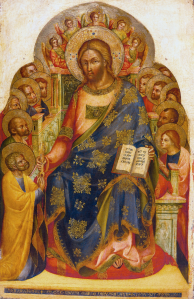 Into this world of charge and tackle enters the Prince of Peace. He does not do battle (although there were some tables overturned in the temple as I recall) but tells us to forgive seventy times seven. He says we don’t need to worry about tomorrow. He says to love one another.
This revolutionary messiah did not bring revolution, as we know, and yet the seeds of order and brotherly love were planted in the rich soil of Judaism, already honoring a code of civility. And thus in that first century came a new way of living together. The Way, as it was first called, would flower in Western Europe and the Mediterranean basin, scribbled by monks and taught on Sundays in sermons. This Way became Christianity, the child of Judaism, and built a culture of freedom and civility, protecting the weakest among us, women and children, honoring God and obeying civil authority. Parliaments grew and became true “talking institutions”, and these forms became congresses made up of elected citizens. Structures of civility forged democracies of thought and action and law and order.
America, like its mother, England, has beaten the odds of survival in our warring world. It is indeed an exceptional country, a city on a hill, a shining light. America says, “See, we did it. We did the impossible. We formed ways of living together, and while we fight one another, we honor the code. Our justice isn’t perfect. We are human. But we try and we do not lose sight of the ball as it travels down the field. We hold our flag high and honor our code of Mosaic mores and Christ’s commands. When we break those rules we expect punishment, for our country is one nation, all judged the same by our blind Lady Justice.
The players are now in a huddle, a bit like Congress, I suppose. They plan the next move. Now they are lined up ready for action. And after the action, we see the replay in slow motion, a ballet on grass. The ball is in the air after much scuffling and grabbing and halting and trying, again reminding me of the playground and perhaps Congress or our local school board.
And it is a playground after all. All of life is a playground not unlike this football game. We play our positions, keeping the goal in mind, following the rules. We hope the referee doesn’t whistle and judge us. It is our national sport and it provides catharsis as we see our own human condition civilized by order and design, a dance of body and soul.
This morning we heard about the wheat and the tares. Christ says he will burn the tares and collect the wheat. In the Epistle we are told to love and forgive one another. Just like football.
 This year the Feast of the Presentation of Christ lands on a Sunday, today, February 2, Epiphany 4, shining light on the act of the giving, of the presenting, of the offering of Christ to the world, indeed, to you and me (Luke 22+).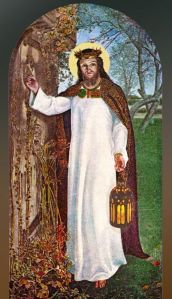
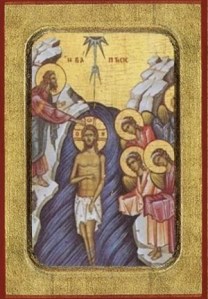 January is a month of renewal and we are in the midst of many renewals and rebirths this weekend.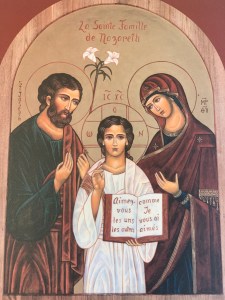
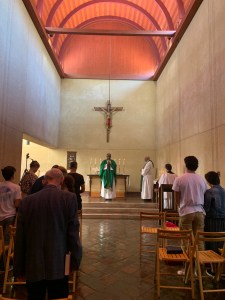 Are we part of a church community, one that welcomes us on board to sail the seas of our time? For community is one of the pillars found in Holy Scripture – community that teaches us, feeds us, leads us through the rough waters. It is the church family that gives us the songs to sing, the prayers to pray, the eucharists to strengthen our hearts and souls.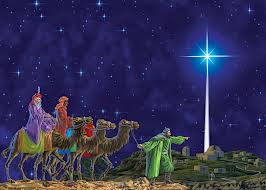
 We are in the middle of Christmastide, those twelve glorious days of Christmas ending on Epiphany, January 6.
  And we try to be like the angels and sing to him in his manger. We sing of the miracle and mystery of that unlikely birth, we harken to the herald angels singing glory to the newborn king, we sing of a silent and holy night when away in the manger there was no crib for his bed, we tell of the little town of Bethlehem and what happened on that midnight clear when the glorious song of old was heard as angels touched their harps of gold, for Christ is born of Mary, and while mortals sleep, the stars proclaim the birth and peace to men on earth.
 We teach our children the songs, so that they will teach their children. To help them remember, we dress them to play parts in a stable in Bethlehem. We clothe them with the story of the Christ Child. They act out the greatest story ever told, and each year they add to their own library of Christmas rituals and traditions.
 There is the silent hush of valley fog enshrouding our house today. The mute world waits, hoping for a sign. A sign of what? A sign of life, life everlasting, before and to come. A sign that we are more than flesh, more than animals on the hunt to survive.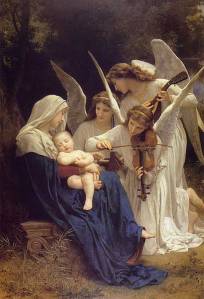
 Today is Gaudete Sunday, or Rose Sunday, and Heaven Sunday too. The Third Sunday in Advent is rich with meaning as we prepare for Christmas and the Incarnation of God, come to us to live with us and in us. Such miracle and mystery often astounds me.
 “Rejoice in the Lord always; again I say, rejoice. Let your forbearance be known to all, for the Lord is near at hand; have no anxiety about anything, but in all things, by prayer and supplication, with thanksgiving, let your requests be known to God.” (Wikipedia)
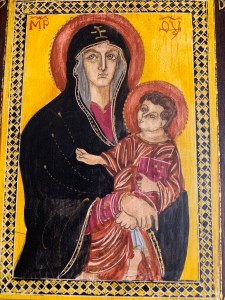 orld of faith, hope, love, and joy. It sounds too good to be true, but it’s true.
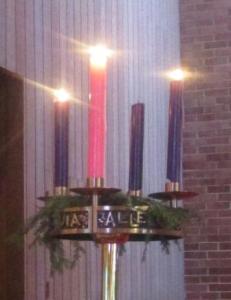 We light our three candles today, including the rose candle, and we recall our ultimate destination, Heaven. As we do, we experience a moment of Heaven on Earth. The candles flame, testifying to the Lord of Lords to come, to be born on Earth and reborn in our hearts.
 The opening prayer that collected our small flock together on this brilliantly clear morning in a chapel in Berkeley was the “Collect for the Second Sunday in Advent”:
 Advent’s daily prayer begins with “Almighty God, give us grace that we may cast away the works of darkness, and put upon us the armour of light…”. To memorize this prayer is to digest it, to send our words to God, expressing our need for re-forming, re-creating. And even as we pray the words, we become clothed in a protective garment, an armour of light, lighting the darkness.
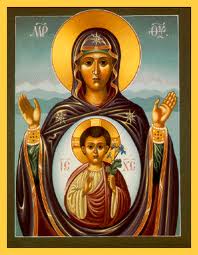 Today is also the theme of Judgment. We shall be judged. The world shall be judged. But Christ takes our part if we desire Him; we are forgiven if we repent. And so we return to words – words to instruct our conscience, learning right and wrong, law and love. Holy Scripture becomes the textbook that teaches us where we have gone wrong, returning us to who we are and are meant to be. We need merely pray our words to Our Lord to be changed, to be redeemed, to be saved.
 The nights have been clear and cold here in the Bay Area. We can see the stars and I reach to touch them, they seem so close. Advent is the time of stars in the heavens. Advent is when we follow the star to Christmas. We reach and we follow the star.
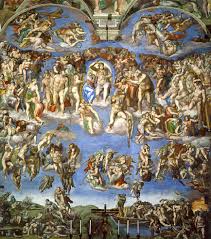 These are big things, subjects we would rather avoid. Especially judgment. We define deviancy down and further down, so that we can deny judging anyone and thus not be judged ourselves. And yet we know deep within there is a moral law all mankind senses, reckoning that a standard has been set, a standard we don’t meet. And with law there is judgment.
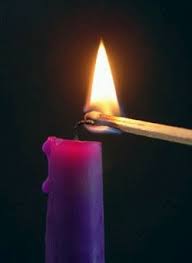 We light our first Advent candle in our Advent wreathe. It is only one small flame in the dark, but it will light the others, each week, until we see the light of Bethlehem, the light of the world, the light of Christ.
 It is good we practiced gratitude for our blessings this past week. Gratitude humbles us. Gratitude says, we owe something to someone else. Indeed. We owe much to those giants that have preserved the West, and fought for our freedoms through war and peace. We owe much to our local church, filled with good souls who try to love us. We owe much to our own families who try to put up with us. We owe much to Our Lord who gave us life itself and continues to breathe life into each day we live.
 We begin at the beginning, the first day of the Church Year. In this new year we open the gates of Jerusalem – and our hearts – to the Messiah as our Gospel reading describes. Today the story begins, and each one of us will play a vital part in the greatest drama of all, life overcoming death, eternally, minute by minute.
 Christine Sunderland
 Christine Sunderland