
Monthly Archives: March 2016

Flowered by Christ

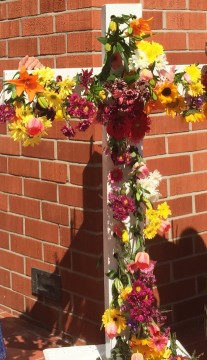
Easter St. Peter's  with family (2)We have a lovely tradition in our local parish church. The Sunday School children and staff “Flower the Cross.” Shortly before the sermon in our Anglican liturgy, during the “sermon hymn,” we process up the central aisle carrying flowers to the chancel steps where a thick white cross, about six feet tall awaits us. The cross has deep holes that penetrate the beams and we insert the stems into the holes. Soon the white cross is covered in brilliant color.

This year as I helped small hands reach for the cross to add another flower, I thought how each of us was like those flowers and stems and bits of green. We each had our own colors and characteristics and we carried them to the cross. We each had our own talents and treasures and we offered them to the cross. We each had our own joys and sorrows and we slipped them into the deep holes of that wooden cross.

The white cross welcomed us, pulling us into its wood, and in some way we became part of that cross of Christ. And with the flowering we were flowered too, changed, reborn into new life.

For Easter celebrates new life, not only spring and its seeds bursting into blossoms, but our own new resurrected life. For forty days and nights we have been dormant seeds buried in the dark soil of Lent. We waited and we watched and we prayed for this glorious Easter morning when death dies and life lives, rising from the tomb, Christ’s tomb, our own tombs.

There is no point to Christianity if one does not believe in the resurrection of Christ and its revolutionary effect upon us all. In the resurrection, suffering and sorrow change into love and joy. Darkness becomes light, and the words of the psalmist are fulfilled: 

“If I say, peradventure the darkness shall cover me; then shall my night be turned to day. Yea, the darkness is no darkness with thee, but the night is as clear as the day; the darkness and light to thee are both alike.” (139:10-11)

Today we are covered by darkness. We hear of wars and rumors of wars, of new horrors, new terrors. Brussels, Paris, London, San Bernardino, Boston, New York, Fort Hood. Evil robs youth of innocence, prompting massacres in schoolyards or classrooms. Darkness spreads across the face of the earth.

And so we reach for the light in the darkness that enshrouds our world, entombs our people. We look to God, the author of love and life. We look to the only man who claimed to be God, who rose from the dead, the one whom St. John describes as “the true Light that lighteth every man that cometh into the world.” (KJV, 1:9)

Why I believe in the resurrection and its challenge and others do not, I do not understand. For the evidence is there, clear as the light of day. But I suppose one must seek it, desire it, even long for such belief. For believing costs us. Believing means turning toward the light of love and away from the darkness of self. My bishop often said, “all doubt is moral.” I’m not sure if all doubt is moral, but I’m beginning to agree that belief requires a change of heart, an honorable discipline, a code of ethics that challenges us to change our ways. It is sometimes tempting to doubt, when belief accuses and demands our time, talent, and treasure. Demands our hearts and souls and bodies.

And so Easter’s resurrection message is a radical one. It says to our world, as Father James Martin writes in the Wall Street Journal, “Listen!” Listen to what the resurrection means for us! For the resurrection demands that attention be paid to a man who conquered death. Attention must be paid to his words, his deeds, his miracles of healing and feeding and calming storms and walking on water. Attention must be paid to his claims to be God, and to his Church’s claims after his ascension to Heaven. For the Church he founded, a stepchild of the Jewish temple, witnessed to Christ’s life, death, and resurrection, again and again, in word and deed. Christians died tortuous deaths for their belief in Jesus Christ and who he was. They did not invent him. They knew him. And the witness continues.

Today Christians die daily for their belief in this God-made-man. They cannot deny Christ, cannot deny his light, his joy, his glory. They have been changed, reborn. They cannot go back to the darkness of self.

On Easter morning I thought of these things as I handed a flower to one of the children and helped her shove the moist green stem into the deep dry hole, into the wood of the cross. In that moment, she was part of the cross. She stood back and smiled, satisfied, and reached for another. Our baskets empty, we recessed out to the Sunday School.

We had given ourselves to Easter’s resurrection cross, and Christ had returned the gift a thousand fold. The dead wood had been reborn. So had we. For each of us had been flowered by and with Christ.

Gates of Time

palm-sunday-globalAs creatures bound by time, we have long been fascinated by the idea of traveling back in time and changing history, be it public or private. Books and movies explore this phenomenon. What if… we ask plaintively. If only… we proclaim hopefully. Regrets can be mended, hurts healed, love renewed, if only. 

Christians are keenly aware of such regret, remorse that leads to penitence. We are schooled in self-examination and confession and repenting, to refuse the evil and choose the good. We look forward because we have looked backward and dealt with our past. In this sense we have traveled back in time, rooting out those weeds in our soul-gardens so that the healthy plants can flourish into the future. We are forgiven. The weeds are burnt to ash. The debt is paid. We start anew with a clean slate so that we can truly love as God loves. 

Today, Palm Sunday, we processed through Berkeley, waving our palm fronds. We re-enacted the drama of Christ riding a donkey through the gates of Jerusalem, the crowd waving their palm branches in joyous greeting. On Good Friday this crowd would shout condemnations not salutations, but today we recalled their happier cry, “Hosanna to the Son of David!” Their messiah had come to free them. 

And of course Jesus of Nazareth did come to free them, but free them from the slavery of sin rather than the emperor. Jesus would pay the price, atone, and with repentance, with re-turning to God, our pasts would be forgiven. Christ would act out God’s huge love for us, act in suffering and sacrifice, to heal our time past, present, and future.

So today, turning the corner of Bowditch and Durant, we followed the cross and the acolytes in their red robes and white cottas, and we followed the thurifer swinging his thurible of frankincense into Berkeley, waving our palms, recalling Christ’s approach to Jerusalem. And just so, we approached the entry to our chapel. As we entered our Jerusalem, St. Joseph’s Chapel, the organ thundered Hymn 62, “All glory, laud, and honor/To thee, Redeemer, King! To whom the lips of children/Made sweet hosannas ring,” and we joined in song, returning to our pews. Looking back, it seems we acted two parts, the apostles following Christ (the cross) into the city (the chapel), and the people who greeted their Messiah-King so joyously.

We moved from the public to the private, from the unprotected outside to the protected inside, a movement from wilderness to civilization. For cities are built to band men together for reasons of mutual safety and comfort. Today countries serve this purpose with guarded borders much as cities once had fortified walls.

Christ entered the city gates of Jerusalem, and he continues to enter our soul gates through the bread and wine of the Holy Eucharist and the indwelling of the Holy Spirit in prayer. For our hearts are gated, being homes of both the uncivil and the civil, the dangerous and the safe, the bad and the good. It is only when we repent, weed out selfishness and pride, that God can enter the gates of our hearts. When this happens we become a haven to the Heavens themselves. We allow God to live in us and through us. He becomes the true saving Messiah.

But we know too that just as the crowd changed their mood on Good Friday and the disciples denied and fled, so we will deny and flee. We will allow other people and other idols (time, treasure, talent) claim our allegiance and our love. We will take the easy way, the mistakenly safe way, forgetting that there is no safety outside the Heavenly gates. 

We cannot change these denials and these wrongs that form our yesterday, our history, but we can repent, turn around, be forgiven because of those Good Friday events two thousand years ago, because of the King who rode a donkey through the gates of our hearts. For he will always be waiting to re-enter those gates. He will always stand outside our doors, waiting, holding his lantern high. 

When he enters and redeems our past, be it yesterday’s past, last week’s or last year’s, he reconciles us to himself. We have changed time, rewritten our lives. Our histories are redeemed if we cry Alleluia on Easter morning. when all history, all time, paused to breathe, when death was conquered. 

But before Easter, and after Good Friday, Christ entered more gates, the gates of Hell. In his love he redeemed every one of us, every lost sheep,  BC and AD. 

For the King of Heaven loved and loves us so deeply that he suffered and died in order to vanquish death. He redeemed us, brought us home, so that we could live forever with him, so that we would no longer travel in time but live and love in all eternity.


Passionate Passiontide

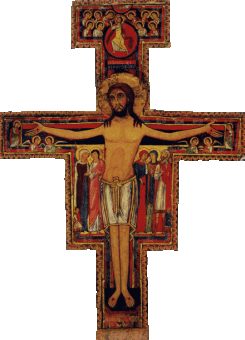
440px-Kruis_san_damianoWe are entering Passiontide, a time when we consider the great sacrificial love of God.

As I watched the passionate protesters at the huge Trump rally at the University of Illinois last week, I was struck by their hatred, not only of Mr. Trump and his supporters but far more importantly their dismissal of his right to free speech. Their own speech was all that mattered to them. They were all that mattered to them. No-one else could speak. Their world was small and dark, turned in upon itself, devouring itself, like cancer or gangrene. Such a world, such a place, Christians call Hell. 

For without God (and Hell is the absence of God), passion is uncontrolled and undirected. It becomes misplaced and dangerous. Whatever our passion might be, if it is not God directed and Christ-filled, it turns inward upon itself. It seeds destruction, including the source of the passion, the individual himself or herself. 

The word passion, as my bishop often said, is the union of the words love and suffering. For God became man to bring us close to him. By taking on our flesh and suffering with us, as we suffer, he redeemed and continues to redeem our suffering, our mortal flesh. We join him on the Cross and we join him in his Resurrection. This is called the atonement, the at-one-ment, for we are pulled into God by his becoming one of us. 

And so today on Passion Sunday the Church pauses and reflects on the Passion of Christ, the last two weeks of Lent – Christ’s painful path to Golgotha, the hill of the skull. All images of Christ in our parish church are hidden behind purple cloths, and we feel a visceral loss of love, to sense in some way what the world would be like without Christ. In the next weeks we will follow Christ on his path to Calvary as best we can, some of us better than others, depending on age and infirmity, time and desire, and most of all, depending on our love, our passion to follow him. 

I have come to believe, in my sixty-eight years, that we cannot experience goodly, Godly, passion without God. And we cannot experience God without the Church, his Body. We are not meant, as creatures created by a loving Father, to be alone, to meet our life’s challenges alone. We are meant to be loved and to love, and we can only do this through Christ and his great gift of himself.

The gift of Christ, the Son of God, was given to us two thousand years ago in Bethlehem and then on the Cross on a hill outside Jerusalem. In those moments, history breathed once again, as the fresh air of God’s love blew upon the world, changing it forever. Mankind turned up another path toward love, learning the meaning of true passion, God-filled love. Those who accept the gift never look back to the dark days of un-love. Those who accept the gift look forward to a lifetime and an eternity of glory and unearned love.

The gift of Christ, the God-Man, the incarnated Son of God, is, as they say, a gift that keeps on giving. With every Eucharist, God the Son is re-membered, made newly present in the Real Presence. With every Eucharist, God the Son mystically enters our bodies and re-members us. As Christ becomes one with our flesh, he dwells within, renewing, inspiring, with his love. His prayer becomes ours, and our prayer becomes his. Every day is an Epiphany, a day of manifestation and seeing. Every day is a day of becoming like the Wise Men at the manger, a day of understanding the manifold works of God. 

For as Christ became at-one with Man, he gave us a means – through his Body the Church – to become at one with him individually. Love is personal, tender, touching. God loves us, each and every one of us, each with our unique personalities. We are precious to him. He loves us personally, tenderly. He reaches out to us and touches us in every Eucharist. 

Only God can order our passions, whatever they may be, to be goodly, to be Godly. And with the ordering of loves, comes the ordering of our sufferings and sacrifices. Nothing is lost. All is offered up to the Cross, and all is returned a thousand fold. 

And so we enter Passiontide, a vigorous ride in and into our life with God. We ride confidently, knowing we are riding high and on to Easter’s resurrection.

Americans and Mr. Trump

voteIn considering the remarkable Trump phenomenon, I watch and I wonder, trying to understand his massive appeal. He seems trumpeted by those outside our nation’s elites – academia, media, politics, wealth.

Those folks outside these exclusive national clubs may not have succeeded as they hoped they would. The American Dream didn’t happen to them or they didn’t have the resources to make it happen. They didn’t make it (for whatever reason) to the top universities to sail into teaching or law or medicine. They couldn’t compete in the world of journalism and publishing and Hollywood, perhaps because of appearance or opinion or luck. They didn’t run for office because of quiet temperament or lack of desire, or the inability to pivot, preach, or promise with fingers crossed. And lastly they didn’t have the financial backing and courage to go into business and take risks, compete for their market share, broker deals so that others would lose and they would win. In the end, they perhaps weren’t competitive, and were happy to allow others do the competing, fight the fight, and provide products at competitive prices.

What does this group who trumpets Mr. Trump do for a living? I haven’t studied the stats but my guess is that they are proudly working class, sometimes working at several jobs, counting on their spouse to do the same. They watch their children bullied in school and on sidewalks and graduating unable to read and not knowing why America is great. All they want is public safety, good schools, and protection from tyrants at home and abroad. Freedom of speech and worship are taken for granted. They work hard, pay their taxes, and wonder why the schools are on lockdown and they can’t own a gun to protect their families and their pastor is going to jail for preaching from the Bible. 

They don’t have the time to study the issues. They aren’t schooled in the national debt and what it means for our future and our children’s future and even national defense. Many don’t understand that growing government means raising taxes or cutting programs. The nuances of numbers require a degree in accounting or economics or at least the time to study the current issues, none of which the working voter has. They are losing their faith in the media’s lockstep endorsements and explanations and they look to someone who says what they mean and mean what they say in words that make sense.

All the while we are seriously threatened by those who hate our freedom, outside our borders and within. We are not only threatened internationally but by homegrown terrorists in gun-free zones and by fellow citizens who would disallow people of faith to practice their beliefs. We are threatened by the dominant culture of self: selfishness, sloth, lust, envy, greed, gluttony, and arrogance, all vices that encourage self-pitying grievance and frivolous lawsuits crippling our courts. We are threatened by the strong who rob and kill the weak in dark alleys and bright abortion clinics.

Mr. Trump says, enough! And the disenfranchised hear him. They understand his message. And as I watch Mr. Trump in the debates what strikes me is his simplicity. A tad arrogant, to be sure, but clear and compelling.

I worked my way through college when college degrees meant something, and today have the rare opportunity, the time, to study issues and candidates, but I still feel incompetent to judge the complicated questions that will make or break our country. It makes sense that the Supreme Court shouldn’t be legislating new law,  but rather interpreting the Constitution. And it makes sense that our three branches of government serve to check and balance one another so that we the people are protected from tyranny. After all, we fought a revolution about that once, as I recall from fifth-grade Social Studies. The First Amendment is still a good idea, or I wouldn’t be allowed to write this or worship as I choose, at least as of this writing.

What I don’t like about Mr. Trump is his apparent arrogance, but perhaps he hasn’t been coached as well as the others on the art of image. He changes his opinions on the issues, but he says he’s learning as he goes. He often speaks in hyperbole, but the media (conservatives and liberals singing together) treats his simplifications as lies. They seem to enjoy misunderstanding his statements even as they reap huge ratings from them which means, of course, huge advertising dollars. When does exaggeration misrepresent one’s position? When Mr. Trump, for example, said he would like to see worse torture than waterboarding I assumed he meant within the law, that he would work to see the law changed. Many presidents work to see the law changed, some work legally and some don’t. Somehow I trust Mr. Trump to work legally, not like others we all know.

Mr. Trump is unpolished. His words are unpolished like many voters. He is a straight-shooter if it is safe to use a shooting analogy. But he listens and he learns and in spite of it all I trust him.

I’m not sure who I’m voting for. I’m undecided, although I will vote for the Republican nominee in the General Election. By the time the primaries get to California there won’t be too many candidates left standing. I long ago studied the two parties, trusting principles over people, and decided that the greatest good for the greatest number was represented by the Republicans. The greatest danger remains clear and present in the history of the last century when Hitler, Stalin, and Mao slaughtered close to 100 million in their totalitarian regimes. Big government stifles freedom and smothers the poor. It curtails creativity and hampers hope. It rewards those who promote bigger government, a self-perpetuating enterprise.

I will vote for the candidate that will work to keep America safe, ensuring our freedom and our future and our children’s future. I will vote for the candidate that will protect my right to worship, to speak, and to defend myself and my family. I will vote for the candidate that understands the need for an educated electorate, beginning with fifth-grade History, Economics, and Civics.

And I will vote for the candidate that sees America as exceptional, a beacon to the world, so that we can welcome more legal immigrants into our national family. They will, to be sure, add their own time and talent and treasure to our unique land of opportunity. Let’s build that border wall so that our laws can be enforced, so that no-one cuts in line. This is America, a land of liberty and justice for all, not just for some.

I have to thank Mr. Trump, for his energy, enthusiasm, and simple rhetoric, albeit sometimes harsh to the ear, has captured the national attention. Voters are listening. Voters are voting. They are taking their place in our exceptional history.