
 A Jewish friend of mine knows all about birds, and she told me this week that she had spotted the seasonal return of the white-crowned sparrow in her garden. She explained that they often return during the ten days between Rosh Hashana, the Jewish New Year, and Yom Kippur, the Day of Atonement.
Atonement calls for confession, repentance, and being once again put right with God. Christians see Christ’s crucifixion and resurrection as providing our atonement, our at-one-ment with God, as my Bishop Morse of blessed memory often said. We examine our hearts, our minds, our deeds, and consider what we did wrong. We desire to wipe these wrongs off the slate of our soul so that the wall of sin separating us from God is vanquished, just as death is vanquished by Christ’s sacrifice.
So welcome, white-crowned sparrow, to remind us of life and death. Just so, Christ reminds us in the Gospel lesson this morning that we are to remember that if our loving Father cares for the “birds of the heaven” he will care for us. We are not to serve two masters, not make idols of the many temptations in our lives. “Be not anxious for your life… consider the lilies of the field…”
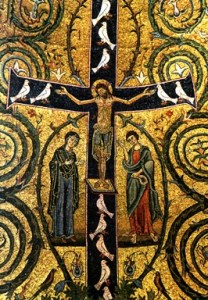 And as St. Paul writes in the Epistle to the Galatians, “God forbid that I should glory, save in the cross of our Lord Jesus Christ, by whom the world is crucified unto me, and I unto the world.” So we offer our lives and all of our worries and needs and yes, our confessed sins, to Our Lord, and he makes sense of them. He returns what we need a thousand fold. As our preacher said, these are returned purified of the sin that was in them. We are at-one with him.
I have found that releasing my sins to Our Lord is like releasing birds into the air. It is a kind of rebirth, a resurrection, to be forgiven again and again, to start anew with a fresh slate. But I must take the time and embrace humility in order to make a full accounting of my life. Are there idols – other masters – that demand worship and service? How do I spend my time, this precious time given to me, my very life? Have the words of my mouth been acceptable to Our Lord?
The Christian life is a glorious one. It is, as our preacher said, good news, gospel. And so it is. Yet it demands self-examination, a purifying, an atoning for our wrong turns so that we will order our loves rightly. Rabbi Meir Soloveichik writes recently in the Wall Street Journal in his essay, “The Meaning of a Yom Kippur Prayer,” that the liturgy combines “the notions of human fallibility and freedom, which together comprise the foundation of repentance and the Day of Atonement itself.” It is our recognition of our human fallibility, our sin, and the use of our free will, our freedom given by our loving God, that “help to heal the past.”
 It is this God-given freedom that allows us to stray and it is this freedom that allows us to admit our wrong turns and like the prodigal son, return home. Western Civilization has been founded upon freedom, this free will to choose, but to repent and atone, and thus relies on these Judeo-Christian values. To abandon this foundation of atonement, as many desire, is to chart a destructive path into the future, to sail into dangerous waters. We pray this will not happen to the West and thus to the world.
And so it begins with each one of us. I have found that if I consider every thought and action of the day, cleaning out my heart, I am able to make room for Our Lord to enter in. I am able to wait, watch, and wonder as my life unfolds before me in marvel-ous ways I could never have seen or expected. Sufferings are sent packing into the beauty of atonement. Grief too, is transformed by rebirth. Bit by bit, day by day, with the help of the Church and her faithful family, my mind learns the art of living for a living God, my heart learns the art of loving for a loving God, and my soul learns the art of singing like the white-crowned sparrow, a song of freedom and flying.
 We gathered for coffee and snacks after Mass this morning, and the chatter flew among us like birds soaring. One thing leads to another, one story to another, and in the sharing of our loves and lives we see the Holy Spirit dancing among us. For we all have sinned and fallen short of the glory of God, and it is this humility and honesty that we share that unites us as the Bride of Christ, the Church. It is this belief in the God of Abraham, in the Holy Trinity, in our Lord Jesus, his death and resurrection, and all that is taught, all the creeds and hymns and prayers, all the sacraments and Scriptures – all of this is part of the Atonement, the at-one-ment with God, giving us many moments of heaven on earth.
 There is something wet outside, coming down from gray skies, straight, then slanted, tapping on my window. Is it rain? How do I know? Do I trust my senses? Do I trust my past that tells me yes, this is rain, and you’ve seen it before. It drops from the skies like that. California doesn’t have enough, we are told, and so it is difficult to believe our senses.
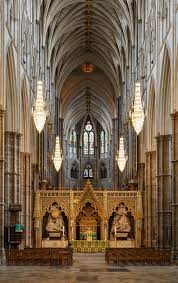 The world has been given a short reprieve from the stifling of debate and the lauding of lies. The world now is watching Great Britain mourn their Queen Elizabeth. A commonwealth of over fifty nations benefited from the virtues she embraced, from the faith she practiced, from her uses of the past to inform the present. Today their leaders and other world leaders are gathering in London. Tomorrow they will pray for the queen’s soul in Westminster Abbey. They will give thanks for her life of authority and her life of truth. There will be processions and hymns and canons saluting. The fanfare reminds us there is more to life than mere matter. There are those we can trust and look up to. There is meaning.
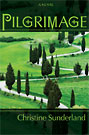 I am one of the blessed ones, graced with belief. I needed reason however, to put the puzzle together, and C. S. Lewis helped with that. Writing my first novel of ideas, Pilgrimage (set in Italy), helped too, for it set out the questions that needed answers. In the writing, the truth emerged. For writing is speech, and speech is love, for thus we meet one another in the pages turned. I continued the conversation in Offerings
 , considering visions and healings in France, and in Inheritance (set in England), praying in the great abbeys and walking through the history of Christianity in the West. These conversations – these paths – revealed the truth of our lives as human beings in this world of time.
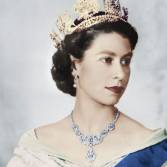 England’s Queen Elizabeth passed into Eternity a few days before America’s memorial of Nine-Eleven, the bombing of the World Trade Center towers on September 11, 2001 in New York. The two events weigh upon my heart and mind in nearly equal measure. Both the good queen and the crumbling towers are icons of Western Civilization; both are signs of a passing age and a loss of innocence, a call to defend freedom in the free world.
 Our World Trade Center was a symbol of our freedom and democracy, our own work ethic, our desire to create and to build, rather than to destroy. The Islamist terrorists chose the towers, for they were iconic symbols of our free world. They also chose Washington D.C. targets, symbols of our nation, of our rule by the people, for the people, through representative government.
 Today those freedoms are once again threatened, not by outsiders, although that may be the case as well, but by our own people in power.
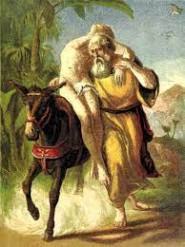 “I am the Truth,” Christ said. And in today’s Gospel we hear the story of the Good Samaritan, the man who cared for the wounded traveler on the side of the road. For we are told to love our neighbor, not only our own family, our own nation, but the family of nations. We are to love one another, care for one another, respect one another. This is the message embodied in Elizabeth, Queen. This is the message embodied in the American founding.
 What is the meaning of life?
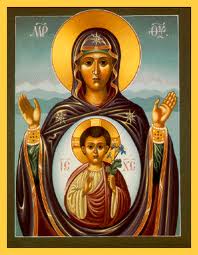 Women were once told, and still are told, that meaning is found only in the workplace. While it is true that meaning is in the work we do, whatever it is, wherever it is, women have a unique work that is their crowning glory, for women give birth to new life. And not only is the woman able to give birth, after carrying the child within her own flesh and feeding that child with her own life-blood, she is given the joyous work of caring for the child after he or she is born. So a mother’s great work is her time in labor, as she labors to birth the child. It is a suffering work of love, and out of the pain will come joy. Soon she will labor in the home and this will become her sacred workplace.
 Such men and such women form the true labor union, the family. Such men and such women need never fear their lives have no purpose or meaning, for if they have indeed formed such a union of labor, formed such a family, they have participated in the grandest of Heaven’s labors – the creation of life, the sustenance of life, the miracle of life.
 And so, while we celebrate the worker, a celebration that is often associated with labor unions, let us not forget the laboring unions nearby, the families, the creating of the future with the creation of new life. Let us labor to not forget what is right and true and beautiful, and right in front of us. Let us celebrate our daily labors of love, our support and comfort for life itself, that union of male and female to create the unborn child in the womb.
 Christine Sunderland
 Christine Sunderland