
 Today is the Festival of St. Michael and All Angels:
“There was war in heaven: Michael and his angels fought against the dragon; and the dragon fought and his angels, and prevailed not; neither was their place found any more in heaven. And the great dragon was cast out, that old serpent, called the Devil, and Satan, which deceiveth the whole world: he was cast out into the earth, and his angels were cast out with him.” (Revelation 12: 7-10, KJV)
And so now there is war on earth and within each of us. For each of us is a house divided between spirit and flesh, and a civil war battles within us.
The mystery of man is the mystery and miracle of spirit within flesh. Unlike angels, who are pure spirit, our spirits are entrapped, or perhaps enthroned, in flesh. We are em-bodied, and we think of ourselves as separate in some way from the houses we live in, instinctively sensing that we will travel on when our bodies die.
We are made up of two opposing forces and we yearn for peace. And to add to the battle, the great deceiver enters our hearts and minds, telling tales, tempting and tricking since he was kicked out of heaven.
I have long been fascinated by our dual natures and all of my novels have, to some extent, explored the borderlands of mind and body, heart and soul. We live in an unbelieving age, and yet we long for belief. We long for the union of our disparate parts, a wholeness, an understanding as to who and what we are. We are told by materialists that we are only matter, but we don’t believe them, or at least we don’t act as if we believe them. They are deceiving themselves. We are far more than mere matter, we say; we truly do matter.
Words—in speech or on pages—are one way we have been able to unite mind and body. For the words are seen and interpreted by our flesh, our eyes, our ears, our brains. To write down words, as I do now, I must engage fingers, muscles, eyes as well as heart and mind and soul. I hold a pen or tap a keyboard to give physical reality, flesh, to my thoughts, and not only mere reality, but entire universes mapped with reality.
The miracle of language, that graduate degree in consciousness, with its intricate architecture we call grammar and structure, with its melody of image, metaphor, and symbol, with its rhythm of phrases beating to one’s heart, or breezy as one’s breath, links us, one with another, so that once again, flesh is happily linked by spirit. This happens—remarkably without notice—between speakers side-by-side, face-to-face, through words heard. This happens—again without thought—between readers separated by miles and years, by space and time, through words written. Only through this astounding miracle, this breathtaking mystery of the physical (our bodies) linked to the spiritual (our thoughts ) by means of language, can we know those from the past, can we connect to those who wrote on paper and parchment, who introduced themselves to us through language.
These words I write today, on this mysterious and miraculous Feast of Michaelmas, are not new; the dance has been ongoing, a symphony of sounds that plays in my pages. Archangel Michael, who plays a key role in my current novel, Angel Mountain, reminds me today of these mysterious realities, our human nature, our very creation, life itself.
For we are stunningly beautiful creatures, you and I. We were made and destined for glory and the angels help us to remember this. Other dark deceivers hover in the shadows, twisting and denying, tempting us to belittle, to make little, the glorious. We were made in the image of God, and one day we will go to God, to become fully realized in Heaven.
As a Christian, I have visions of that fullness now, in the Church—in its theology and sacraments, its family of God, its living testimony to historical truth, witnessed and scripted in codices. I am blessed beyond measure by such fullness, such treasure, a wedding feast awaiting my daily presence, if I so choose to accept the invitation.
For I have the freedom to choose the light or not, to choose life and love or not, to choose Heaven and glory or not. I have the freedom to become what I was created to be, and to see the face of God in glory, a creature united in spirit and flesh.
And to see Archangel Michael and all the Heavenly Host.
 I have been reading Dr. Wilfred McClay’s recent book on the history of America, Land of Hope: An Invitation to the Great American Story (Encounter, 2019).
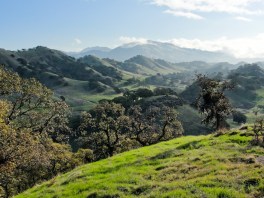 26,000 words and counting.
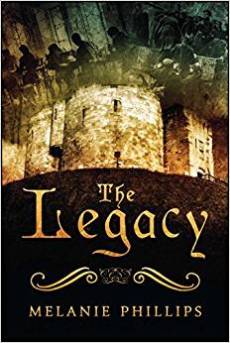 The Legacy, a first novel by the bold British journalist Melanie Phillips, is a page-turner involving layering mysteries. The mysteries interweave through time to the present day, in a story set in England, America, and Israel.
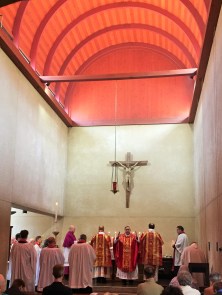 I recently had the blessing of taking part in our annual Anglican synod, a gathering of clergy and laity that meets to discuss and decide many issues relating to this part of the family of God, the Body of Christ.
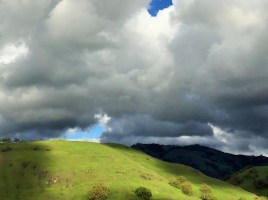 Northern California had a good drenching these last few weeks. The hills are an incomprehensible shade of green. When the winds blow billowing white clouds across the skies, I understand what God meant when he said, “It is good.”
 Christ is born, God incarnate, in flesh, lying in a manger.
 In my next novel, I would like to explore thanksgiving – giving thanks – so I’m setting the story in November, the thankful month that turns away from Halloween and is born on All Saints Day. November gives thanks for our veterans – all those who keep us safe from those who would harm us. And finally, November celebrates our national holiday of Thanksgiving, a time of giving thanks for the founding of America, for those who fled tyranny in foreign lands and came to our shores to found our great land of freedom with its liberty and law, its celebration of human dignity.
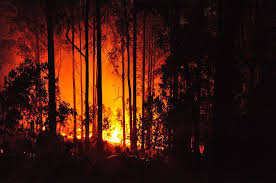 The fierce firestorms that have devoured our beautiful North Bay counties and blanketed the Bay Area with smoke remind us of our helplessness in the face of the natural world.
  Berkeley was quiet as we drove through its leafy streets to St. Joseph’s Collegiate Chapel on the corner of Durant and Bowditch, one block from campus. Once more, we would join others to pray for peace and freedom in Berkeley.
 Christine Sunderland
