
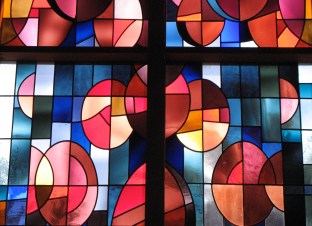
I’ve been praying for a friend in the hospital. He lies unconscious, his family watching and praying. We too, his parish family, pray for him. He is a strong, larger-than-life man, who always has a smile. His eyes were bright with laughter. He has been an active member of our local parish church, a parish that reminds us that we are both sinners and saints, that what we do with our time given matters.
For every minute of our time on earth counts. It is all weighed and measured. All of us will be found wanting when we return home to God, when we gather by that great river that runs by his throne, but God will supply the difference with our tears, our confessions, and our repentance.
We do not love enough. We are full of ourselves, our prides, our vanities, our selves so sensitive to the slightest slight, so eager to brag and swagger. In church we are reminded of this – our poor, inadequate love – so that weekly we have the chance to clear away the debris of our life, the debris of our un-love. The floodwaters are drained from our souls. We scour our hearts. We make a home for God within us. We begin the week on a Sunday morning, as new creatures.
To begin anew is no small thing. To begin anew each week, having thrown out the old and rotting bits, the ugly bits, the cancerous bits, is to grow strong in the rich soil of other sinners and saints surrounding us. This is what the church offers. For the church is the Body of Christ, our means of salvation, our promise of eternity.
My friend in the hospital is a unique person in our parish, but then each one of us is unique. We are a collection of sharply drawn characters, of many races and generations, of every class and talent. We are so very different from one another, and we glory in our differences, as one appreciates the panes of color in stained glass. What we have in common is that we are Christians, members of Christ’s Body, who become one with one another in Holy Communion. After being fed by the Mass, we mingle in the coffee hour, a family to be sure. There are no differences now. We love one another, or at least try as best we can. Christ has made us inclusive and exclusive at the same time by giving us his own identity, his Body.
We learn all of this through the experience of being faithful, faithful to attending church, faithful to our weekly confession, faithful to the instruction found in the sermon and lessons each Sunday, and faithful to receiving the Real Presence of Christ in us. All this teaches us how to love one another. We are told that God is love. We are told that to love is to suffer and sacrifice for the other, as we see in Christ’s life, death, and resurrection. Through song and prayer, through word and sacrament, we layer this knowledge of virtue upon our consciences, to inform them.
For only with an informed conscience can we know where we have gone wrong. Only with an educated heart can we know the definition of love. Only with such instruction can we find true happiness.
My friend knew and knows this. He knows that in the giving of ourselves we find ourselves. This secret is known by the saints, for the saints were sinners too. The saints saw the flooding of their own hearts, the damage done by the putrid waters, and they sought remedy. Without diagnosis, there can be no remedy. Without remedy, there can be no recovery. The remedy for unhappiness is Christ. The prescription for happiness is Christ.
I am grateful for the weekly confession in the liturgy we make before receiving the Real Presence of Christ: I have not loved enough. I have been selfish and thoughtless. I have been distrustful of God’s plan for me, and too trustful of my own plans. I have done things which I should not have done and not done things which I should have done, and there is no health in me:
ALMIGHTY God, Father of our Lord Jesus Christ, Maker of all things, Judge of all men; We acknowledge and bewail our manifold sins and wickedness, Which we, from time to time, most grievously have committed, By thought, word, and deed, Against thy Divine Majesty, Provoking most justly thy wrath and indignation against us. We do earnestly repent, And are heartily sorry for these our misdoings; The remembrance of them is grievous unto us; The burden of them is intolerable. Have mercy upon us, Have mercy upon us, most merciful Father; For thy Son our Lord Jesus Christ’s sake, Forgive us all that is past; And grant that we may ever hereafter Serve and please thee In newness of life, To the honour and glory of thy Name; Through Jesus Christ our Lord. Amen.
And so these moldy growths are cleansed away by the Sunday Eucharist. I am reborn once again, ready to set out for Monday and all that it offers, all the opportunities it provides to love. Then will come Tuesday, a second precious set of twelve hours in my life to practice love, to offer myself for others. And Wednesday, Thursday, and Friday, three days of my time, thirty-six more hours to grow in grace. Then Saturday, and finally Sunday, the day of reckoning again, the day of forgiving and feeding, the day of removing the huge weight of the week’s wreckage from my soul.
With the lightening of this burden, I am so much happier.
The fact that self-denial leads to happiness is one of the great contradictions of Christianity and the human condition. For Christianity is all about being human, all about our humanity. It is all about who we are, where we are, and where we want to go in our lives and after. Christ teaches us these things, helps us to understand, lightens the darkness, a true enlightenment.
My friend in the hospital is not alone. He is held close in our hearts as we pray for him. We wrap him in our love, the love of the Body of Christ, his own parish church. And we give thanks for his life now and forever.
 There comes a time in one’s life, a time in one’s week, a time in one’s time bracketed by calendars and clocks and digital devices, when the cares of the world seem to weigh heavily, crowding upon one another, demanding attention. The cares of the world – those cares we read in print and view in video – those public cares – layer on top of our own personal cares, until we cry that there is no room for more.
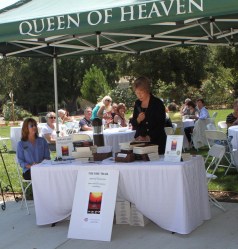 It was a warm sunny Saturday at
  The booming sound of men voicing liturgical responses, creeds, and confessions has lingered in my memory over the weekend. For St. Joseph’s Collegiate Chapel was fulsome with the sound of unison chants and prayers these last two weeks in our Seminary Summer Session.
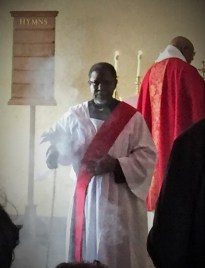 Again and again, I prayed for these postulants and discerners. For the students were largely seekers, searching for God’s will in their lives. As bells rang and the Host was lifted high, I prayed for these men who were discerning their future. Did God call them to be priests? Deacons? Laymen? I knew that the discipline of the residential program would test them as they fitted their lives and bodies into the schedule and demands of living in community. I knew that the discipline of their studies would challenge their minds and memory. And in this process of trial, they would hear God’s voice.
 I recently turned seventy and the best birthday present ever was to see my son and worship side by
  As the world grows more dangerous, church-going becomes more welcome, a true respite and refuge. Worshiping as one chooses is one of the great gifts given to Americans on the wondrous Fourth of July. And each year, as that holiday approaches, I give thanks for the freedom of worship.
 A blistering heat wave finally broke last night in the Bay Area. The fog rolled in from the vast Pacific Ocean, through the Golden Gate, blanketing the towns along the bay with mercy.
 The sky touches the sea here in Hana, Maui, holding it close as the waters move over the face of the earth. It is warm on this Ascension Sunday, the day we celebrate Christ’s bodily ascension from earth to Heaven, but a cool breeze is spirited ashore. We sit on a wooden deck that wraps our cottage, immersed in sky and sea as though joining them. The blue waters crash and spew against green bluffs and black lava, like sudden memories urging our minds to not forget Memorial Day, and to not forget Christ’s ascension.
 St. Mary’s Catholic Church in Hana was festive this morning as though ascending with Christ. All was light and bright, for the Bishop of Honolulu was visiting to confirm eight children. Arched windows in the white walls leading to the vaulted chancel caught breezes from the sea far below, and the gentle air breathed over God’s people. The acolytes and clergy processed in, lighting the path to the altar with crucifix and candles and Holy Scripture, carried by solemn servers absorbed by the rites of holiness.
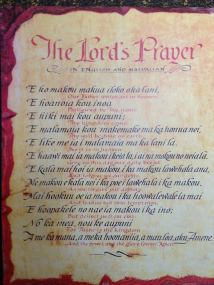 As we witnessed their Confirmations we confirmed our own, ascending with them into Love, into God, this morning in the village church of Hana, Maui. We joined in the singing and praying and thanksgiving. We ascended into the song of love, the song of yes, the song of Scripture and sacrament. In this white church with its polished pews, young and old from all backgrounds joined hands and sang “E ko makou makua iloko okalani…,” “Our Father, who art in Heaven…”
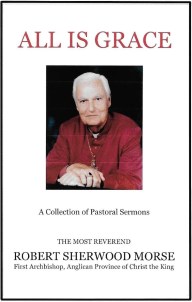 It’s been nearly a two-year project, and I’m happy to announce the release of All Is Grace, a Collection of Pastoral Sermons, by the Most Reverend Robert Sherwood Morse (1923-2015), published by the American Church Union. I was honored to edit this remarkable collection and enjoy a remarkable journey.
 We drove to church in a gray drizzle that watered the earth this Easter of 2017. I looked forward to the flowering of the white cross by the children of the parish. For in this flowering we acted out a wonderful story, and I had a part in the story simply by being faithful.
 Christine Sunderland
