Category Archives: Uncategorized

An Expanding Universe: New Review by Francis Etheredge of Inheritance, a Novel

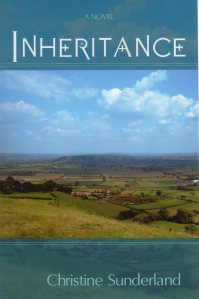
Inheritance (A Novel), by Christine Sunderland, Waterford, VA 20197: OakTara Publications, 2009, 290 pages and additional notes.

Reviewed by Francis Etheredge

“The gentleness of truth” (cf. Dignitatis Humanae, 1)

Will this book get a hearing? When the volume is turned up, what happens to that ‘still small voice’ of God (1 Kings, 19: 12) which, nevertheless, is striving to be heard? What happens to the gentleness of truth that has its own power of persuasion and passion for life?

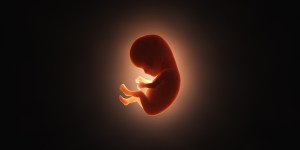
It is truly outrageous what can happen to a woman. There are unforgettably graphic images of a woman suffering from a crude attempt at an abortion; and, in a sense, these are rightly unforgettable. We do not want our sisters, wives, mothers, daughters, nieces, friends or indeed any woman to go through this! But why, in view of the graphic nature of what happens to a woman, is there no perception of what is happening to the child? A clump of cells is not a child. From conception, which means a beginning, an embryonic person increasingly makes visible the boy or girl from present from the first instant of fertilization; but then the person goes on unfolding as he or she discovers interests, talents and the ongoing relationships which, already, have spread from the immediate family to doctors and nurses and well-wishers. If the world could see what happens in an abortion would it cry out? In 1948 The Universal Declaration of Human Rights included the right to life – but only Germany has enacted a law embodying this protection in the 1990 “Embryo Protection Act”. Where and when will the gentle truth of conception being an irrevocable beginning get a hearing?

“Taking the time to ‘be with child‘”

As we will see in this, the third book on pilgrimage, we discover that the whole trilogy is like an expanding universe: the characters travel from a specific starting point and, as a kind of law of love, they are turned inside out; indeed, maybe it is in the nature of a journey into God and His Church that our reason for seeking God turns into a reason to help others. In other words, taking the three books as a whole, there is a wonderful expansion of the central characters who, as they are drawn into the drama of life, engage more and more with the needs of the most vulnerable people that they meet.

Christine Sunderland is sparing when it comes to detailing what suffering people have gone through – but gone through suffering they have and, indeed, are still going through suffering, for it always has an aftermath, which is very much a part of the book’s account of what suffering is. So the tragic loss of Madeleine’s daughter and her own inability to conceive a child with Jack, is transformed in the course of the trilogy’s exploration of the needs of a wide range of how children can be helped.

On the other hand, she does give us a multifaceted point of view, going from person to person, situation to situation, giving a variety of experiences, opening all the while the hope that help helps what we are going through to go beyond the pain to the purpose which makes the pain blossom. We need the presence of others, just as we need the help of God, to turn us into life when the temptation is all too present to end it.

There is, too, a liturgical structure to the book wherein what we experience turns out to be a lived, liturgical passage through the life, death and resurrection of Christ. This “entering” into the life of Christ is as real for us as it was for Christ; however, just as His suffering took man, male and female, into His heart, so sharing our suffering with Him enables us to take to heart what is happening to others. Indeed, like breathing, unless we pray, our expanding universe is going to contract; but, if we pray, there is the possibility that our expansion, even if it is slowed, will continue.

“Vulnerability”

At the same time, however, as the books progress, we hear the heart-rending stories of a number of people, some of whom hide, as it were, the hurt and suffering they have been through. Others, however, open their hearts and make known what has happened in their lives and, by implication, how God has helped them to love. A Christian monk, in the hope of helping prisoners with whom, briefly, he shares a cell, opens his heart to them and tells of what he went through in his childhood. The whole scene is beautiful, one of many, but this is particularly due to the fact that the two men to whom he speaks, respond so well:

The burly one laid his thick hand on Cristoforo’s shoulder. The lad tapped the friar’s arm. Cristoforo’s tears fell onto the cement floor [of their cell] as he wept, he sensed he had fallen into a pool of love, a pool that would wash him clean. (p. 282).

The author, Christine Sunderland, then, expresses both development and imperfections in her central characters, increasing their credibility while, in addition, there are surprising changes of heart and, in a sense, there is no one too rich or too poor to be helped and to be helpful. So we move in a very plausible world even if, sometimes, it seems as if the power of a hardened heart is overwhelming, like a reckless driver racing up onto the pavement and through people’s lives as if indifferent to the possibility of their injury or death, all the while pushing forward a personality that seems to be as psychologically brutal what is both denied and unaddressed is serious. What is more, what takes over is a kind of protective pride – not of people’s vulnerability but of the very image that it is possible to project: the image of being untouched by personal suffering, all the while engaged in a “cause” and a social position that somehow signifies the opposite.

“A time to weep, and a time to laugh” (Ecclesiastes, 3)

At different times, however, the people whose lives we particularly share, albeit for a while, pass through a variety of “moments”, which includes breaking down, where breaking down is more about being remoulded than disintegrating. The reader shares this experience, powerfully, being moved to tears; indeed, for some of us, who swore ourselves to silence as we suffered growing up, this is a trembling experience of accepting a vulnerability we once rejected. But maybe this is the point: that we cannot be humanized by what we experience if we do not let it undo the proud demeanour which is really a kind of armour; but what, in the end, are we defending ourselves from – for there is either suffering or suffering! There is the suffering that shuts us off from others, like strangling the desire to say what we are going through or there is the suffering which enables us to share the suffering of others and to “be with them”.

“An inheritance entails history”

Throughout the three novels, there are various accounts of the history of Christianity in each country which serves a variety of functions, rooting the reader in specific sites and their spiritual significance, giving credibility to the title of history professor – but also situating Christianity in its local and global dimensions. At the same time as there is a variety of denominational “passages” that the characters come from and go through, there remains a question in the mind of the reader: Why do the main characters “stop”, as it were, at Anglo-Catholicism when, gradually, they have come upon a Catholic inheritance that yet remains, to a degree, distant and unassimilated? Thus the reader has the impression of an ongoing journey that, in a hidden way, is diverted from reaching its goal. So, in one sense, there could be a late sequel to this trilogy where, both by going back to the origins of Christianity – the central characters would go forward to Rome. Will Christine Sunderland write that sequel or does the reader, from whatever denomination he or she comes, or none, determine that there is a home beyond the guest house, as it were, in the presence of which we constantly live but which, as yet, the threshold is a step too far.

So I hope you begin at the beginning, both with the trilogy on pilgrimage – but also with the recognition of the reality of your own life; and, therefore, I encourage you to identify with one of the main characters and to journey with them moving across, as it were, if another character opens up another aspect of your life. But, just as we are dynamic, moving in a variety of directions to go forward, so is God leading a history that is yet to be fully inherited – either here or in eternity.

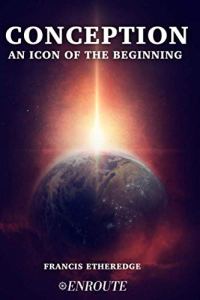
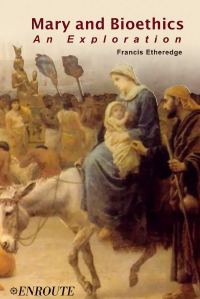
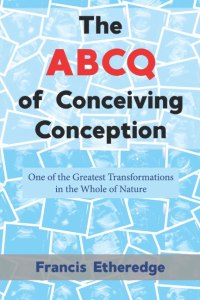
Francis Etheredge, Catholic husband, father of 11, 3 of whom are in heaven, author of 13 books on Amazon, particularly, The ABCQ of Conceiving Conception, Conception: An Icon of the Beginning, and Mary and Bioethics: An Exploration  (all En Route Books and Media).

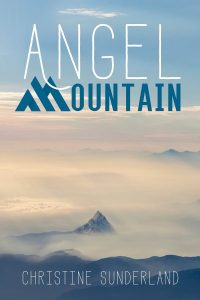
Christine Sunderland is author of seven award-winning novels about family, faith, freedom, and the sanctity of human life. Her most recent novel is Angel Mountain (Wipf and Stock, 2020) set in the San Francisco Bay Area.

THE FIRE TRIAL and ANGEL MOUNTAIN: Reviews by Francis Etheredge Posted

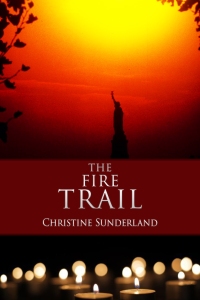
I am pleased to announce that the Homiletic and Pastoral Review has published Francis Etheredge’s reviews of my recent novels, The Fire Trail (eLectio, 2016) and Angel Mountain (Wipf and Stock/Resource, 2020) in May and July, respectively.

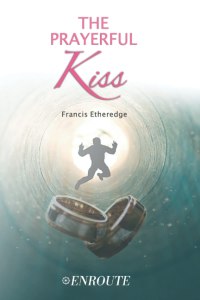
My review of The Prayerful Kiss by Francis Etheredge is now on the HPR site as well in the July Book Reviews listing.

Also, on LinkedIn, click here for a most encouraging introduction to my work by Francis Etheredge, so appreciated! Thank you, Francis, and thank you, David Meconi, SJ, of the Homiletic and Pastoral Review, America’s foremost pastoral publication. Since 1900. Highly recommended; browse the many articles and reviews in this excellent publication.

June Journal, Second Sunday after Trinity

Trinity is the long green growing season, the season of life. Our parish altars are draped in green, and our clergy are vested in green, changed only for saints and martyrs and other special feast days. It is fitting, although way beyond due, that the lives of a generation of unborn babies have been saved, will enter our world of oxygen, breathe their first breaths, cry their first cries, and begin their greening, their growing outside the womb. Earlier, they grew inside, fed not by oxygen but by their mother’s life. And now, they are allowed to breathe the air of our world, to live. Already, in just two days, thousands of lives have been saved.

This was a great course reversal for our nation and for the world we influence. This has been a victory for all humanity. And it must be added that this recent Supreme Court ruling did not stop abortion entirely, but bravely allowed we, the people, to decide, state by state, with our vote. For nearly fifty years we have lived with the monstrosity of the Roe v. Wade decision that said there was a right to abortion. It has been a great shame and stain upon our nation, and the violence condoned and even celebrated over these years has only encouraged more violence. For if the least of our people, the most innocent, are not protected, no one is protected.

We have seen this violence grow year by year since 1973. Those lucky enough to be chosen to be born in these years have grown up with the culture telling them that life has no meaning. They grew up, these chosen ones, surrounded by death, listening to the creed of self that silenced other creeds, other speech. This creed of self shouted through screens, from rooftops and public squares, hate expressed with automatic rifles. For without meaning, without love, nothing makes sense. Without God, there is no right and wrong, no true authority.

Without belief in a loving and revelatory God, the God of Abraham – of Jews, Muslims, and Christians – nothing makes sense. Without his loving law written in stone and taught by his Son, anarchy reigns. Without confession, there is no absolution.

And so, as Americans express their opinion on these weighty matters of life and death in state elections in the next few years, we become Solomons, and we pray for Solomon’s wisdom, not to harm these babies. We pray that we recognize those candidates who embrace life, so we can weed the wheat from the chaff.

Other countries seem perplexed by our drama of choice, the extremes we seem act out. But we are many states united in federation. When law is legislated by the courts, especially the federal (national) courts, it bypasses the voter. We as Americans demand a say in these vital issues. We demand that we decide when life begins, when the killing is allowed, and why. Nine justices should not be deciding such things. And so the Supreme Court on Friday said, yes, you may vote on these issues from now on. They moved the decision to the states.

There will be states – such as my own, California – that retain the hideous killing of the unborn. There will be others that honor those innocent lives.

In 1973 (to my knowledge) we did not have the images and science of when life begins. Science has discovered since then many glorious things about our humanity. We can see the first movements in the womb, and we know the full, unique, genetic identity exists at the moment of fertilization, a moment when this new life, new human being is created.

Those who believe in God generally believe in the soul or spirit, and it is at this moment that God “ensouls” this new life, so that the mother, the father, and God have all come together to create this unique, mysterious, miraculous creature we call a human being. For excellent explanations as to how this happens, described so that we laymen can understand, see the work of Francis Etheredge, especially his recently released ABCQ of Conceiving Conception (En Route, 2022), reviewed in these pages.

One would hope and pray that many Americans will examine their views in terms of life and death of the unborn. Many desire peace and go along with the cultural messaging, which has been heavily pro-abortion and highly pressured, even threatening. Perhaps now they might reconsider, consider there are many of us who desire life. They will not be alone.

And we desire life for both mother and child. For the mother who kills must live with the horror of what she has done. We pray for those who have participated in this grisly act, from pressure or fear or career demands. We pray these mothers (and fathers) be healed, so that they can embrace the joy of all creation, all human life.

There will be increased resources for mothers, increased funding and increased care. We will embrace these children; we will embrace these women; we will embrace life. Our Lady Mary taught us how to do this.

It is curious that the President who appointed the justices that overturned this bad law, that allowed a generation to be born, was a rather unconventional troublemaker, according to many. He was a rough and ready cowboy, albeit a New Yorker in a suit, an American true in heart, a maverick outsider who came to town and turned the tables. Those who manned the tables – the real moneychangers – turned on him but he didn’t flinch. He was a lone ranger, a new sheriff in town, a man with a big heart and unfailing courage. He faced the mob daily – the lies, the collusions, the tearing down, the death machine, many in his own party. But he was a bit naïve; he trusted his administration to give sound advice, to support his vision. But he learned the hard way, through experience, that they didn’t like his style.

May God bless President Trump, for he listened to God’s voice, without flinching. Those whose lives he saved will one day see what a momentous moment this has been and will thank him. Ballads will be sung, for history has been made. He has opened doors and let in light. He has welcomed the children, as we are all commanded to do. 

I will never forget a comment made by a friend of my son, sometime in 1990 or so. Born in 1971, he said that he wouldn’t be here, wouldn’t be alive, if he had been conceived a year later. His mother, unmarried, probably would have had an abortion. Why? Because like many she thought that if it was legal, it must be okay. And of course there were no ultrasound images, no genetic discoveries yet. There were only questions as to when life began.

And so I have been singing a Te Deum on and off all weekend, the thanksgiving prayer that St. Ambrose and St. Augustine sang when Augustine emerged from the baptismal pool in the cathedral of Milan. I saw the pool in the crypt many years ago, uncovered by excavations. 

It is a historic time, a moment of great celebration, but it is only a turning point, a place in time where we have taken a new direction as a people. We have given life to many with this court decision. We need to give life to every American conceived in this great nation, the land of the free and most of all, the land of the brave.

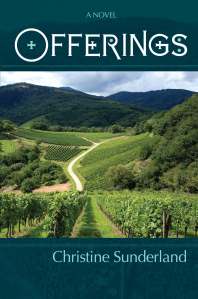
Providence and Pilgrimage: New Review by Francis Etheredge of Offerings, a Novel

Offerings (A Novel) by Christine Sunderland, Waterford, VA 20197: OakTara Publications, 2009, 249 pages and additional notes.

Reviewed by Francis Etheredge

“We live like a vine – Entwining and Entwined”

In this second book of Christine Sunderland’s trilogy on pilgrimage, the story builds on the first book but, as written, it could be read without it. In other words, although there are one or two backward glances, as it were, the second book is a sufficiently enthralling read to be enjoyed independently of the first one. However, given that this is the second part of a trilogy, there is both continuity and development of character; but, in addition, there are a multiplicity of new threads which make this a definitely enriched addition to the whole. Therefore, perhaps contradicting myself, let the reader be encouraged to begin at the beginning and start with book one. In general, and in book two, there are a variety of reasons which prompt the characters’ journeys. However, because there is an intermittent link with people who are connected to Christianity, in one way or another, it is as if the principal travellers are bumped, as it were, onto a pilgrimage.

On the one hand, human lives are twining around each other, not in any sense strangling each other so much as finding that growing together, even if there seems to be a different rate of growth between characters, does not separate but supports each of them; and, on the other hand, the wider denominational distance, as between Anglo-Catholics and the Catholic Church seems, at times, like a live electrical coil inducing a current in a wire. In other words, the proximity of the travellers-come-pilgrims to members of the Catholic Church and her mysteries seems to be a positive influence on them.

“Starting Points: Providence and Pilgrimage”

It could be we are going, ostensibly, to find a person who can help us; but, in the course of that search we may discover that, in fact, we need a more radical help. Or we could be the prayer companion of one who does not pray but begins to experience the relationship out of which prayer pours. Or we could be young and unattached and discovering the possibility of a vocation to marry. It is not so much, then, that there is one answer to these questions as that there could be multiple answers, each of which comes to the surface in its own time and needs its own remedy; and, therefore, it is to Christine Sunderland’s credit that she has brought out a number of these threads and shown how, in the end, they weave together different lives and their problems – but all, as it were, in search of the one God who is with us all, at all times (cf. Jn 14: 16-17). While, then, it could be argued that if we are not a Christian how can God be with us, there is also the path to God which each one of us treads, perhaps unknowingly to begin with but, in view of God’s searching for us, it is not so much discovering God as discovering God is with us. So, whether we are a “Sunday Christian” or “too busy” to be about searching for God, perhaps the point is that events in our lives can be, as it were, the stone that we trip over or the rock that we stand on (cf. 1 Pt 2: 7-8).

“Take up your cross and follow me” (cf. Mt 16: 24)

What, then, is a cross? In the case of Jesus Christ, it was the will of His Father that He accept the agony of both the thought (cf. Mt 26: 42) and the reality of His crucifixion at the hands of men, brought about by the ‘father of lies’ (cf. Lk 4: 13) and the weakness of human beings (cf. Jn 19: 12). The cross, then, is a suffering that is not taken away but which we are strengthened to endure (cf. Lk 22: 43).

It could be, then, that we have seriously failed, that we suddenly need an operation, that we have been too driven and too professional to be personable and that we do not even know the history of our family or that we think that we are called to one vocation but events reveal that we are called to another. Whatever it is, then, that comes into our life, God allows it because He is greater than what it is and can bring about a good beyond what we ordinarily experience. Thus Joseph, son of Jacob, who was betrayed by his brothers and sold into slavery, in the end rose to prominence in Egypt. When, in the near future, a famine came he was overseeing the solution and not distraught by the problem; and, therefore, when he was finally reconciled to the brothers who rejected him, he was able to say: What ‘you intended against me for evil, God intended for good’ (Gn 50: 20).

So we could say, our sufferings expose our vulnerability, even showing us that we are not invulnerable to temptations to adultery, to suicide, murder or whatever the sin we are tempted to commit. While discovering our vulnerability, like recognizing that black-fly always attacks the stalk or permeable underside of the leaf, we also discover the tempter’s way of stalking our weakness – but more significantly, we discover that we need an event, very often, to turn us out of our routines and to live in view of eternity: of the possibility that we will die one day. Will we have met our Creator before we die or will we be confronted, and possibly affronted, by the presence of a Stranger-Lord who will listen to what is in our heart? Will God find love in us or only an immersion in ourselves?

“Moral or material miracles?”

In the end, just as we are travelling through a modern world of cars, phones and laptops, as well as restaurants and farm life, there are still the poor who need help, people who need operations, but also the different possibilities of healing – whether that of being enabled to live with a disability or an illness or the actual healing of them. Indeed, it is a profound question as to why one person is given the gift of healing, while another is helped by an interior healing, even to the point of recovering or rediscovering the Christian Faith. Thus we are taken through innumerable places, each of which draws on what gave it existence and history, as well as how it is lived in the present and what difference it makes to visit it, even now.

In view, then, of the complexity of our lives, our habitual religious habits or the neglect of the questions which open upon eternity, we cannot possibly foresee all the ways that we are brought, by God, to an encounter, with Him; but, in reality, and this book succeeds supremely well in this, there are so many interconnecting strands that if we needed a contemporary account of the providential love of God, we can begin to find it here, in this trilogy on pilgrimage. I very much look forward to reading the third and final book.

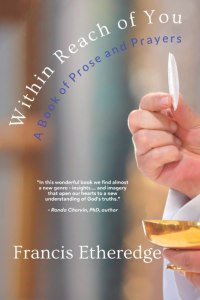
Francis Etheredge, Catholic husband, father of 11, 3 of whom are  in heaven, author of 13 books on Amazon, particularly, The Family on Pilgrimage: God Leads Through Dead Ends: https://enroutebooksandmedia.com/familyonpilgrimage/; and, as a variation on the theme, a more domestic pilgrimage through the Covid-19 lockdown, in Within Reach of You: A Book of Prose and Prayers

Christine Sunderland is author of seven award-winning novels about family, faith, freedom, and the sanctity of human life. Her most recent novel is Angel Mountain (Wipf and Stock, 2020) set in the San Francisco Bay Area.

June Journal, First Sunday after Trinity, Octave of Corpus Christi, Father’s Day

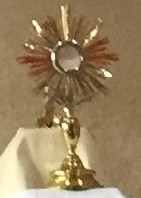
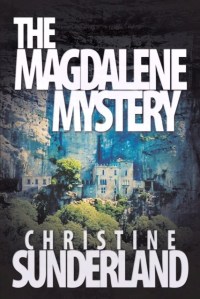
We are in the octave of Corpus Christi, the celebration of the Real Presence of Christ in the Holy Eucharist. The celebration falls on the Thursday after Trinity Sunday, marking the end of the seasons of Eastertide, Ascensiontide, and Whitsuntide, a span of rebirth that now continues in the Holy Eucharist. In my fifth novel, The Magdalene Mystery , I included a Corpus Christi procession, the traditional Rome solemnity, processing from the Lateran Basilica to the Basilica of Mary Maggiore. It is a kind of pilgrimage (and part of the ancient pilgrim’s route), praying with one’s feet, the Host in a monstrance on an altar within a canopy, carried reverently in the procession. It is a somber but happy celebration of the Presence of Christ among us and within us, an ongoing feeding in this life that continues the work of rebirth and re-creation and salvation begun in Baptism. 

It is a mystery and miracle, this intersection of time and Eternity, made accessible to those who believe. I can only witness what I have found to be true, that regular reception of Christ in the Holy Eucharist strengthens me, gives me direction for the day, for the week, for my time on Earth. And it is not all my imagining, my conjuring. Something wonderful happens. I am slightly changed with every Mass. I have looked into my heart and confessed my sins; I have been forgiven and cleansed; I have been fed with the Real Presence of Christ; I have sung thanksgivings and glorias; I have been a physical part of Christ’s Body the Church and at the same time allowed Christ’s Presence in the Host to sanctify me, ready me for Eternal Life. Mystery and miracle; repentance and rebirth. Every time.

Today is Father’s Day as well, a time to honor the fathers in our lives, wherever they be. God the Father reached into our world to give us his son. And God the Father created fathers and mothers to have children and celebrate their life and love together as families. Man is fallen, however, and the ideal is not always lived out. Still just as God the Father reached into our time to redeem us, so we reach for the ideals he has given us in this life. And when we fail, we confess, repent, and are reborn to try again. Christ reaches for us and raises us up on our feet again. We have the Ten Commandments as the foundation for morality, and we have Holy Scripture and the Church leading us, teaching us how to love, interpreting Eternity in real time. We are not alone.

And so we are enter the Trinity season, a season of God the Father, God the Son, and God the Holy Spirit. It is a green season of growth, a time to enrich our souls and bodies with the knowledge of God. We recite the ancient creeds that distill this marvelous theology into poetic phrases of jeweled meaning. Behind each word and phrase is a world of words, a library of thought, discoveries made by our Fathers in God, our clergy. We are given this wealth of wonder and in our limited time on earth we try not to squander. We live life with love. We seek the truth and beauty of all creation and sanctify it.

In The Magdalene Mystery, to be re-issued this year by En Route Books and Media, I attempted to create a work that embodied our faith. The characters seek answers in Rome’s churches, through clues in the Apostles Creed, and slowly, praying with their hearts and minds, and yes, their feet, they discover the truth about what happened two thousand years ago on a hill outside Jerusalem and in a cave-tomb three days later. They learn what we can know of history and what we have good reason to believe.

Today as I listened to our Father Napier in our Berkeley chapel preach on these many glorious things, he offered an image I will never forget. He said he had considered we might have a Corpus Christi procession in the streets of Berkeley, but he wasn’t sure how such a procession would be received. Then his face glowed as he said quietly, but then, you see, we are all monstrances in the streets of our towns. Christ is in us and we are in Christ, as Scripture said today. When we receive the Bread of Heaven, Christ’s Real Presence, we become living monstrances.

And so Christians walk the earth, carrying Our Lord with them, within them, to love one another.

Drawn Through Time to Eternity

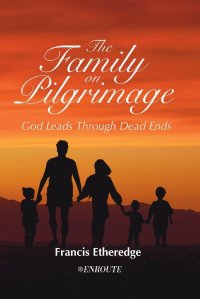
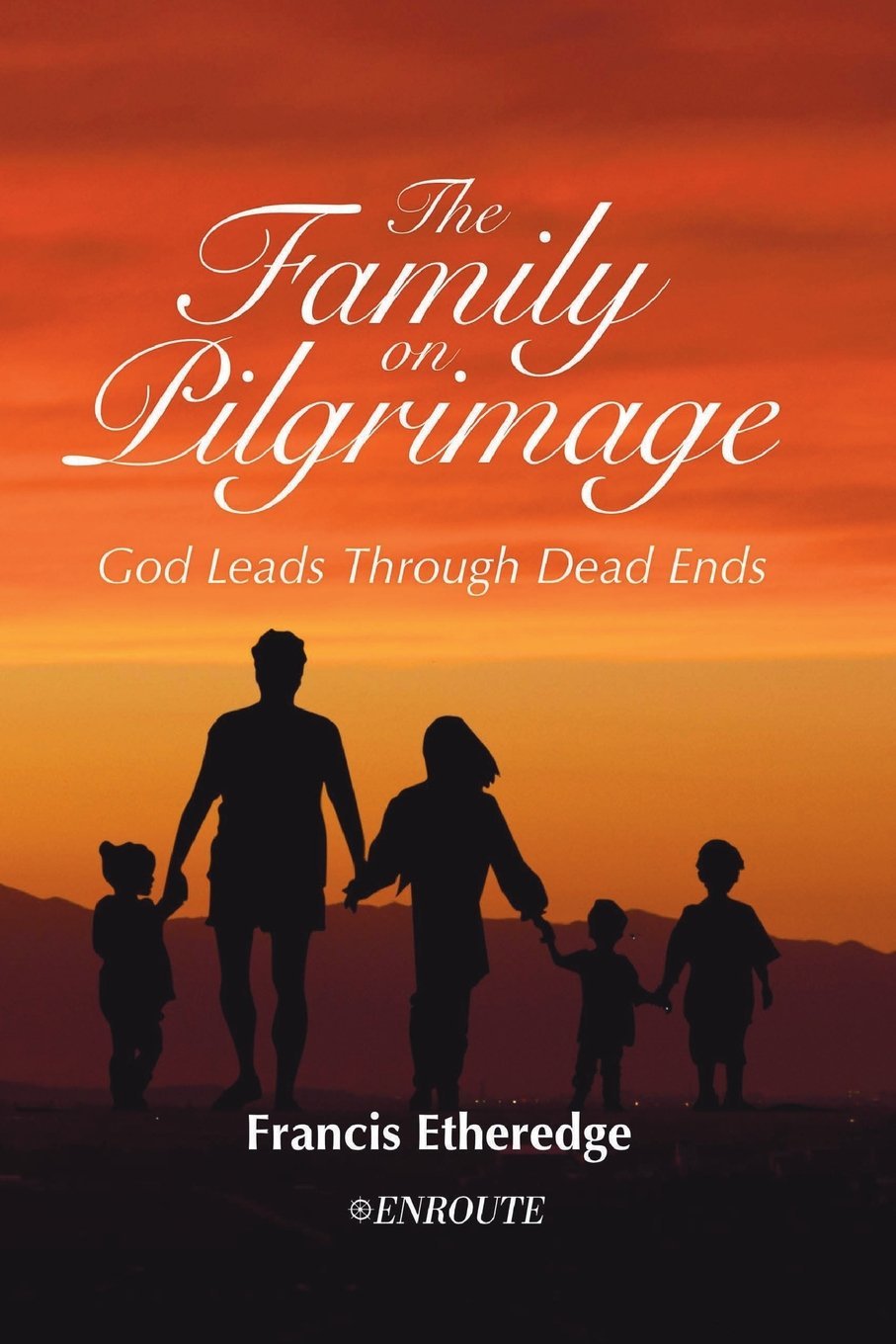
THE FAMILY ON PILGRIMAGEThe Family on Pilgrimage: God Leads Through Dead Ends (St. Louis, MO: En Route Books and Media, 2018) by Francis Etheredge

Reviewed by Christine Sunderland

The Family on Pilgrimage is a many-layered collection of poetry and prose with its own family of contributors, enriching the reader’s pilgrimage through these pages. Indeed, this book is a pilgrimage into pilgrimages, and while it is said that in a pilgrimage one prays with one’s feet, I prayed with my mind, heart, and soul, as images followed one after the other, signposts along the way.

In this sense we travel with the author to many places – Francis Etheredge’s own suffering past, his redemptive present, and by inference his glorious future:

“Indeed, that the whole of humanity is on a vast passage through the vortex of time to eternity; and, if it is possible, I hope that passing from this life involves passing through the utter reaches of the universe to marvel, once more, at the magnificent splendour of creation before, finally, meeting the Creator.” (17)

Francis Etheredge welcomes us into his family, to pray alongside, our feet stepping in time. Thus, the book is a family of pilgrimages, each with its own tenor and tone. This is not to say that there are no real accounts of the Etheredge family on pilgrimage – to Milan, Cracow, Loreto – as well as accounts from his children – Grace, Teresa, and Peter. In these journeys, we experience the challenges of this family of ten, as they trust God for their needs.

Indeed, we trust God to meet our needs along the way too. We ask Him to meet us where we are, and this prayer focuses us on Him. And so, as “God Leads Through Dead Ends,” He transforms the apparent dead ends into living ends that glorify our Creator and fill us with joy. As we seek God, searching for answers and healing, we see that each day is a pilgrimage from dawn to dusk, listening for His voice in His Word. We see more clearly friends and relations and hear their voices. We are drawn into creation, into life, to breathe in and out the Holy Spirit in our own time.

And yet as Christians our starting point goes back to the Old Testament and, “taking a new beginning in Jesus Christ, continues into the present.” (9) We seek big answers to large questions: the who, what, and why of life. What are my talents? What is my vocation, my purpose? What is the meaning of life, my life? We “journey into the mystery of God and His Word” (18), “into the Lord’s presence,” “breaking and sharing the Word and the Word of the Eucharist.” (19)

I have often reflected that in the parish church, we journey from Baptism at the entry font to Confirmation and Eucharist at the altar. At the end of our journey in time, we cross into Eternity, our coffin carried from outside to inside, up the aisle to the Real Presence of Christ in the tabernacle. In this pilgrim requiem, the earthly pilgrimage ends and the heavenly one begins.

Such a pilgrimage reflects the love of God, for “we are part of a great exodus: a passing of people from slavery to freedom: from being estranged from others to being fit for friendship: from an unwillingness to live forgiveness to love’s possibility of the gift of eternal life.” (25)

Thus God recreates us, using the experiences in our pilgrimage on earth in time. Francis Etheredge describes how he searched for his vocation, his marriage and family, but he is not “lamenting what did not happen but, rather… reflecting on what does happen: what the Lord in His wisdom is even now permitting to be possible.” (26) Without these decades of searching he would have been a different person and writer.

The Family on Pilgrimage sanctifies the ordinary with the extra-ordinary, our lives with sanctity. We see this in marriage:

“The reality of conversion is not magic… and moves in a mysterious way amidst the warp and weave of actual lives… there is no doubt that the constant help of word, liturgy and community throw light on the ‘everyday’ nature of the Christian Faith and its being lived; and… exposes the truth that Christ is present in marriage in a way that can only be described as constantly turning water into wine.” (cf. Jn 2:5-1) (163)

In this sense our Christian path becomes an ongoing miracle of turning the water of our lives into the wine of sanctity. We are blind but now we see, for Christ tells us, “Apart from me you can do nothing.” (Jn 15:5) What do we see? The truth of our sin, of our need to change course with His help: “God finds us where we are and takes where we cannot go.”

We are embodied words of God, a part of the history of salvation, from the Creation to the end of time. This is the great mystery of being human, a human being, the mystery of being open to life and thus to marriage and children. We are a part of this history, its past, present, and future, the family of God.

And yet radical reformation is sometimes needed. Like the Prodigal Son, extreme measures wake the sinner to his sin and recreate him, giving him hope in this Creator God who recreates from nothing. For God is ever-patient, ever-returning, and just when we are “beneath the waves and time… suddenly His help is understood…” (63) and we learn we are “sinner[s] in need of a saviour.” (86) 

Etheredge speaks of pilgrimages as a time when God commands our full attention, for we are away from the day-to-day distractions of life. I have found this to be true, not only in trips that remove me from my daily life but on a Sunday morning, going to Mass with a pilgrim’s heart, waiting to hear the Word from Him, through the Scripture, through the sermon, through the singing and chants, to hear with my heart what He desires of me, and with this, a further glimpse of who I am meant to be. Just so, a pilgrim may set an hour apart in the evening to pray and listen to God’s voice. It is in the setting apart, the use of our time and attention, that we become pilgrims.

And so in our pilgrimage through life God uses our challenges to complete and recreate each one of us, to become our true selves. It is as if our sufferings are ingredients recreated in glory. We are pilgrims, being drawn through time to eternity, recreated with each step. Every beginning and ending can become bookends for a pilgrim’s prayer, an ongoing invitation to God to be present, to enlighten, to partake in our lives.

Such enlightenment is part of the “vocation of the writer” to speak to today’s culture. As Christ multiplied loaves to feed thousands, He gives writers words to feed thousands, words multiplying when shared. May Etheredge’s words multiply and enlighten our dark, for today our greatest sin is that we are “radically incapable of recognizing the quality of all human beings in the gift of human personhood…”, the right of unborn persons to live.

Pilgrim writers embody words. Just as every life is a growing creation from the moment of conception, with many parts forming the whole, Etheredge cautions that to see ourselves as the potter and not the clay may be a tempting illusion: “What looks to us as a mess and a – wandering all over the place may, in reality, be the indications that our life is being shaped rather more than we are the shaper.” (234) Writers embark on their own pilgrimage, looking to reflect the Maker in their creations, sculpting yet being sculpted.

Yet, Francis Etheredge adds, God gives everyone this creativity through the work they are called to do, and thus writers must ground the truths of God in reality, in the activities of men and women on earth. In this way the family expands into the family of God, the human family in the present day as we step through our lives from conception to death on this earth, and each of us provide the “constant opportunity for God to act in whatever way will bring the good we need.” (243)

And what about the words we choose to use, in writing, in speech? What kind of language will lead us to the true Word? Francis Etheredge closes with this prescient poem:

Bruised or Well-used Words? 

When the heart spikes and the tongue spits 
words through the bashing impact of pain, 
bruised words which disfigure the still discolouring wound, 
– bearing the blunt hurt 
they bludgeon understanding and aggravate grief. 

Left for a while, these prayed, 
aggravated insights evict the venom within, 
becoming middling words, 
like an arrow pulled from the wound, 
too fresh to be anything but singularly painful; 
and yet, the point pulled, 
they start drawing the unforgiving infection: 

the rebellion; the protest; and the vengeful bite. 

Fiction or fact, there is “within and between” 
the truth told in different ways, an exploration, 

now in human history, 

now in an account that goes to places where the heart, 

perhaps too painfully pierced, 

is visited more easily by a stranger to the original experience. 

But well used words, softly saying what hurts but helps, 
alight like butterflies, almost too gently to be noticed, 
trailing evidence of passing into thought the word which 
opens the heart to the Word within the word, 
which knows the words we need 
to hear the truth that heals. (245-6)

Deo Gratias.
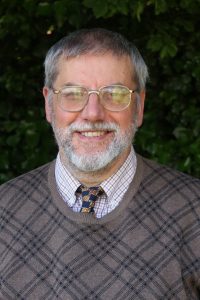
 

francis.etheredge-200x300


Francis Etheredge, Catholic husband, father of 11, 3 of whom are in heaven, is author of 13 books on Amazon. Visit him at LinkedIn and En Route Books and Media


Autosave-File vom d-lab2/3 der AgfaPhoto GmbH

Christine Sunderland is author of seven award-winning literary novels about faith, family, and freedom. Her most recent novel is Angel Mountain (Wipf and Stock, 2020) about a Christian hermit living in sandstone caves east of San Francisco.

 

June Journal, Trinity Sunday

Holy_TrinityTrinity Sunday, the week after Pentecost in the Anglican calendar, merges life and death and life again into God the Father, God the Son, and God the Holy Spirit. This past year we have padded along a pilgrimage path, beginning with Advent and ending with the Trinity season. We followed the birth, life, death, and life again of Our Lord Jesus Christ, as he revealed himself to us, in ways we could better understand God’s threefold nature.

The Holy Trinity, we are told, is all about love, love between the Father and the Son. The Spirit coming at Pentecost, is the Spirit of the Father and the Son, the Spirit of love. He came upon us and continues to come upon us, to dwell within us, to inspire us. He is life itself, and so, from conception to grave, Christians celebrate the life they are given.

The husband of a friend died suddenly last week, and we gathered at St. Peter’s Anglican Church in Oakland yesterday to both mourn and celebrate him with a Requiem Mass. The shock of the sudden death lingers with us, a reminder that every minute, hour, day, is precious. Somehow, the Requiem, with its words of sadness and joy intermingled, helped our grief. For life is like that, both glorious and sober. We live on earth a span of time and then enter the next great adventure, that is, if we have been reborn of Spirit.

The Gospel this morning spoke Our Lord’s words about this rebirthing, this being reborn:

“Verily, verily, I say unto thee, Except a man be born again, he cannot see the kingdom of God. Nicodemus saith unto him, How can a man be born when he is old? can he enter the second time into his mother’s womb, and be born? Jesus answered, Verily, verily, I say unto thee, Except a man be born of water and of the Spirit, he cannot enter into the kingdom of God. That which is born of the flesh is flesh; and that which is born of the Spirit is spirit.”

The Sacrament of Holy BaptismWe call this Baptism, being born of water and the spirit.

Are we ready? Have we been reborn of the Spirit in Baptism? Has love entered our hearts to take root and produce good fruit? While we do not know the number of our days, or the time of Christ’s return, we do know that our days are numbered and Christ will return. And so we watch and wait, our lanterns lit.

And as we wait and watch, we are cradled by the Church. We sing, “Holy, Holy, Holy! Lord God Almighty! /Early in the morning our song shall rise to thee: /Holy, Holy, Holy! merciful and mighty,/ God in three Persons, blessed Trinity.” (266, Reginald Heber 1827) This glorious hymn is based on today’s lesson from Revelation, describing St. John’s vision of Heaven and the throne of God (Revelation 4:1+). 

And so we are rooted in this life, with this vision of God. The Holy Spirit gives us eyes to see beyond this world, for we will travel to Heaven one day, whether we are warned of our death or whether death comes suddenly. We need not be afraid. We need only embrace and celebrate the good news of life and love eternal.

RAINBOWAnd like John, we are called to share this hope, to encourage this being born again, this “walk in the Spirit.” We are called to gather at the Holy Table each week, to share the Eucharistic meal of life, the Real Presence of Christ. For in this gathering, we know the Spirit flies among us like a dove, like a rushing wind, like the rainbow light that falls through the clerestory windows high above. We sing together, we pray together, and as we do, we are united in the love of the Holy Trinity, this Spirit weaving among us. As we gather, we celebrate life here and life eternal, bathed in the love of God.

When Does Human Life Begin?

ABCQ FRONT COVERThe ABCQ of Conceiving Conception, One of the Greatest Transformations in the Whole of Nature by Francis Etheredge (St. Louis, MO: En Route Books and Media, 2022, 199 pp.)

Reviewed by Christine Sunderland

I have often reflected on mankind’s tendency to rationalize thought and behavior, to give reasons – excuses – for the manner in which life is lived, both individually and as a society. We are all people “in relationship” to one another, Francis Etheredge explains, and we must construct ways of living in community.

For this reason, this need to respect one another’s common humanity throughout the world, we seek to forge law and custom that theoretically support human life as lived together.

C.S. Lewis called this moral law the Tau, a deep, indwelling sense of right and wrong that, when we feel others might question our behavior or beliefs, urges us to provide reasons, rationalizations for our actions. We want our conscience to approve or at least look away.

In The ABCQ of Conceiving Conception, One of the Greatest Transformations in the Whole of Nature, Francis Etheredge, Catholic theologian and bioethicist, goes to the heart of this desire as he gives us the ABC’s as well as answers to the Q’s, the questions.

In the ABC’s, he considers the scientific definition of conception, the moment new life is formed, when the egg accepts the sperm, closing upon it. This is the moment of fertilization as well as the moment when God ensouls this new creation, this new life. This is the moment when the person is given the genetic mapping that will propel him or her forward through life, through birth, growth, maturity, old age, and finally, death of the body and release of the soul. The genetic code is set at this moment of fertilization, of conception, the beginning of both being and becoming.

Why, one wonders, is this simple and clear argument met with counter-arguments? Why are there questions, the “Q” of this title? The questions come from the desire to have our way, to trample on others to get our way, to choose our own path regardless of others.

Francis Etheredge challenges the rationalizations given for abortion to be a legal right. One of these rationalizations is viability, the ability for the embryo-child to live independently outside the mother’s womb. Does viability occur at 15 weeks? 20 weeks? Full term? And yet, he answers, the newborn baby wouldn’t meet this standard. Many adults do not meet this standard. Individuals stricken ill or handicapped would not meet this standard of independence.

How has this legalization of abortion affected the human community? Abortion, at full term and on-demand in some States, has become the seedbed of other dark and unstable social ills, causing, I believe, the collapse of the family and leading to mass shootings, criminality, and disorder. For when we turn our back on other living human beings, we turn our back on all humanity, the human community. When we legalize the taking of innocent life, we live for our own pleasure and will.

We live in a world of materialism that reasons we have a duty to ourselves to act in any way that expresses our feelings. Materialism says there are no other values than our own perceived values. Materialism says there is no truth outside our opinions. There is your truth and there is my truth. There is no objective “Tau,” no moral law that mankind is subject to. Materialism says we are only body without soul, only flesh without spirit. We are animals, creations of instinct. We are mere matter, so we don’t matter. Anything goes.

And yet deep down we do not believe this. We make excuses to explain bad behavior, the murder of an innocent life that gets in our way, a child we choose to die.  We believe we must have an excuse for this legalized genocide. We know it was wrong to kill in the past, is wrong to kill in the present, and will be wrong to kill in the future. We make excuses.

I am deeply grateful for Francis Etheredge’s contribution to the debate of when human life begins, particularly in light of the upcoming decision of the Supreme Court regarding Roe v. Wade. Modern science tells us clearly that life begins with fertilization. In this book the science is explained, and we are given the philosophical and theological arguments that complement this knowledge. With great care and conviction, Etheredge leads us through the reasoning to the truth of the moral law and what it means to be human.

We are persons in relationship to one another, Francis Etheredge explains. The family is our first experience of this – mother, father, relatives. We are also the greater human family, and how we treat any one person affects how all persons are treated. We must protect human identity and dignity throughout the world, and we begin by honoring those nearest us.

We begin, Etheredge argues, by allowing human beings, upon conception, the full rights of the human race, the right to “completing human development.” As members of the human race, we do not have the right to treat “the human person as if he or she is a product to be manipulated.” (38)

For science has learned that from the first contact between sperm and egg a new entity is created, the dynamic embryo. This is a “dynamism that unfolds the uninterrupted presence of the person from conception… the first and irreversible moment of fertilization; and, therefore,” Etheredge adds profoundly, “this constitutes a nature sacrament: an outward sign of the inward action of God bringing the whole person to exist from the very first moment of fertilization.” (75, 95)

Thank you, Francis Etheredge, for showing us who we are and who we are meant to be, for reminding us that we are, after all, more than matter for we truly matter:

“As we emerge, then, from our national identities and increasingly recognize that abstract truths about human personhood, that to be a human person is to be a human being-in-relation, need  ‘returning’ as it were to the concrete reality from which they came – we will appreciate more and more that parent and child, brother and sister, aunt and uncle communicate the profoundly interpersonal structure of human identity.” (167)

And lastly, because the human being is formed at the moment of conception, he or she has full right to legal representation from that moment of conception, just as any human being would have such a right. It is “the court’s role to protect all innocent human life.” (181)

Francis Etheredge has made a vital contribution to the human community, for we are the family of mankind and the family of God. We are brothers and sisters accountable to one another, in relationship, a true sacrament of human dignity. We are not alone.

francis.etheredge-200x300Francis Etheredge, Catholic husband, father of 11, 3 of whom are in heaven, is author of 13 books on Amazon. Visit him at LinkedIn and En Route Books and Media.  

PRESS PIC smallChristine Sunderland is author of seven award-winning literary novels about faith, family, and freedom. Her most recent novel is Angel Mountain (Wipf and Stock, 2020).

June Journal, Feast of Pentecost (Whitsunday)

PENTECOST ICONI have long loved the Festival of Pentecost, for it is the coming of the Holy Spirit upon the disciples, the breath of God, like cloven tongues of fire. This coming of the Spirit of God is the creative force of life itself manifesting at this moment in history.

And thus the Church is born, born of this promised Spirit, promised at the Ascension by Christ, to give these men and women strength to do the work of God on Earth, through the Church, the Bride of Christ. 

The Creator of the world, and of you and I at the moment of conception in the womb, continues to recreate his creation through his Holy Spirit. And so we sang this morning, “Come Holy Ghost, our souls inspire,/And lighten with celestial fire…” (217). We desire to be re-created, made anew, given the fresh breath, his breathing, the wind of God blowing upon us, among us, stirring us up.

St. Luke describes the scene, this birthday of the Church, in Jerusalem:

“WHEN the day of Pentecost was fully come, they were all with one accord in one place. And suddenly there came a sound from heaven as of a rushing mighty wind, and it filled all the house where they were sitting. And there appeared unto them cloven tongues like as of fire, and it sat upon each of them. And they were all filled with the Holy Ghost, and began to speak with other tongues, as the Spirit gave them utterance. And there were dwelling at Jerusalem Jews, devout men, out of every nation under heaven. Now when this was noised abroad, the multitude came together, and were confounded, because that every man heard them speak in his own language. And they were all amazed and marvelled, saying one to another, Behold, are not all these which speak Galilæans? And how hear we every man in our own tongue, wherein we were born? Parthians, and Medes, and Elamites, and the dwellers in Mesopotamia, and in Judæa, and Cappadocia, in Pontus, and Asia, Phrygia, and Pamphylia, in Egypt, and in the parts of Libya about Cyrene, and strangers of Rome, Jews and proselytes, Cretes and Arabians, we do hear them speak in our tongues the wonderful works of God.” (Acts 2:1+, BCP 180)

The Jewish festival of Pentecost (fifty days from Passover) had brought pilgrims from afar, speaking other languages. It was perfect timing for the Church to be born, for God the Holy Spirit to descend upon the apostles. The sound was like a mighty rushing wind; they saw cloven tongues like fire descend upon each one of them. They were given the ability to speak in other languages.

This was a mighty event, to be sure, a moment in human history that would change the world forever. This was a moment that gave mankind the creative force of God the Creator. And with this Holy Spirit we are filled with God, when we pray, when we worship, when we call upon him. 

PentecostThis creative Holy Spirit continues to recreate each of us and our world. Each breath we take, each day we live, is spurred by God’s life within us. We are in-spired, breathed upon, by God. We need only ask.

When we were baptized this new life came upon us, recreated us. Other sacraments bring the Holy Spirit to us as well, just as the cloven tongues of fire came upon the disciples. We too, experience this transforming recreation of our souls and bodies, not only in Baptism, but in the Eucharist, in Confirmation, in Penance, in Anointing of the Sick, in Matrimony, and in Holy Orders. These are moments in our lives when God recreates us, makes us whole, makes us holy as we were meant to be. (The English Church sometimes calls Pentecost the Festival of Whitsunday, for Confirmations became a tradition on this day, and the wearing of white.)

imagesIt has been said that we are People of the Book, along with Abraham’s other descendants, Jews and Muslims. We bring God among us through our stories, many true history, many parables. And it is in this greater story of man, of humanity, that we learn who we are as God’s children.

For he loves us. He shows us ways of knowing him and of loving him back. He shows us ways that he can enter our lives and our hearts. He shows us ways we can find the Way, the Truth, and the Life. He reaches out to touch us as we reach out for him.

This is good news. And we remind ourselves of this good news as we celebrate the drama of salvation throughout the year in ritual and song. We celebrate creation and recreation, the jeweled moments we experience in our span of life in this time, until we arrive at the Heavenly gates and see him face to face.  

I have been memorizing a prayer, and this week I learned the third verse:

“May thy Holy Spirit cover and protect us daily, with mighty angels an prayers of the saints.”

Amen. Come Holy Spirit, come.

Pilgrimage and the Pursuit of Meaning: New Review by Francis Etheredge of Pilgrimage, a Novel

pilgrimage_bookcover

Pilgrimage, a Novel, by Christine Sunderland (Waterford, VA 20197: OakTara Publishers, 2007, 176 pages and additional notes.)

Reviewed by Francis Etheredge

“Ask, and it will be given you” (Mt 7: 7)

Historically, pilgrimage was to a place where heaven and earth met; and, indeed, a number of saints travelled in the hope of the will of God becoming clearer as to whether or not to enter a religious order or to found one. There are a variety of pilgrimages in our own time, whether from a single parish to a particular shrine or place of priestly formation. Or, as with the case with St. John Paul II, he began with the youth and families of the world what he had been doing as a Bishop in Krakow, Poland. Thus the youth of the world being called to meet St. John Paul II at a specific venue, as at Denver, Colorado, or families travelling to a destination to be together with other members of the Church in the presence of the universal shepherd, as at Milan or Dublin. Many people go on these pilgrimages to experience the providence of God and to have, as it were, a meeting with Jesus Christ in His word and His sacraments; and, hopefully, to come to a clearer understanding of a vocation, such as marriage, the priesthood, the religious life or some form of the single life.

The book, then, raises a number of questions about the value of a pilgrimage for married couples, whether as part of a large group or not, but certainly with the impulse of spiritual direction inspiring it; and, at the same time, there can be many unexpected signposts illuminating an answer to prayer that is perhaps more of a zigzag than we would like but, as St. Teresa of Avila is reputed to have said,

“The Lord writes straight with crooked lines”.

Thus pilgrimage can be a more specific journey, a priestly prescription of an itinerary for a hoped-for remedy for an unabating crisis, assisted more by a chain of contacts with people who knew the priest who set the wife and mother in motion, as it were, because of a specific need to resolve what has hitherto been unresolved.

Thus it is with this book, a married couple are set in motion by a priest’s response to the woman’s haunting grief; and, therefore, once it is clear what has happened, the book travels a labyrinthine, even tiresome journey through restaurants and shrines, perhaps communicating that irrespective of the purpose and the relative comfort – the elements of prayer and perseverance are still necessary and, just as we can weary of eating if we have overeaten maybe, if we have no habit of prayer, pressing on from place to place can almost exhaust our spiritual response and make it seem that, for all the abundance of good food and wine, interiorly it is as if we are in a desert.

The accompanying husband, then, discovers a limit to his endurance of his wife’s desire to visit one more shrine, one more place that turns up, almost like the gift of a child to a bereaved mother, but then disappears again – but having left, somewhat mysteriously, a note to another destination, another chapel to visit, the husband’s patience wanes. So there is a kind of duality to the husband and wife. The husband hopes for a cure of his wife’s ever present distress and engages, somewhat ambiguously with a very attractive psychotherapist, as a default hope that if the pilgrimage does not work then there is another, more familiar remedy in the wings ready and waiting; except, however, the challenge of the wife’s distress seems, almost inadvertently, to tempt the husband to find relief from his wife’s unrelieved angst. Remember Abraham and Sarah who, in seeking to fulfil the promise of God that they would have a child. even though ‘it had ceased to be with Sarah after the manner of women’ (Gn 18: 11). After what seemed interminable waiting they decided on their own solution that Abraham would ‘go in to’ (Gn 16: 2) Sarah’s slave girl, Hagar, and having a child with her which, as the story unfolds, shows the impossibility of adultery being the solution to the intimate life of husband and wife.

Having allowed the reader to share, as it were, the husband’s impatience there are pivotal moments in which, what seems so likely to be an account of a worsening situation adds up, little by little, to have a number of twists and turns which reverse the tendency to see everything as the wife’s “condition”. Their lives open out, towards the end, into a kind of conversion, because the wife now looks back to what cannot be changed with a new acceptance of the past and looks forward to what has opened up new possibilities and promises, for both husband and wife, filling them with the hope of life-still-to-be-lived – not in some vague and general way but in the concrete opportunity which arose in the course on their pilgrimage.

Madeleine, the protagonist, says, “I would not have sought … [Christ] as I did, had I not suffered”.

The wider question, to which we all seek an answer, is precisely this: “What is the point of our suffering?” On the one hand, there can be an abandonment of hope and a deepening helplessness in front of what we are going through, like writhing in a swamp and, with each weaker struggle, we slip, inexorably, deeper into the mire. Or, on the other hand, there is a quest for meaning which is almost like walking on water, in that what should destroy our lives has, mysteriously, provided an impulse to begin a search which, as it were, answers an invitation to seek, literally, to live out of the hope of answering the question which drives us, distraught as we are, to find an answer. In a way, Christine Sunderland epitomizes the contrasting help of psychology and spirituality. In the dialogue between husband and wife there is, as it were, the articulation of the problem on the basis that we discover ourselves in the communication of what is within us; and, at the same time, we discover the limits of human communication. So the spiritual help of the priest shows that there is a way beyond human help, although it can start through the humanity of the help of the priest, which takes us to where a different kind of encounter begins: the encounter with the saving love of Jesus Christ who meets each one of us to the extent that we are willing to meet Him.

Maybe this is a particular choice for our times: to accept the “darkness of faith” and to seek without altogether knowing what will answer our question or, by contrast, to be destroyed by the uncertain quest. What makes the difference? Perhaps you find the answer in this first book of a trilogy on pilgrimage: pilgrimage, prayer and the sacraments of the Church. At the same time, however, in the mixture of Christian denominations, and a certain sense of a semi-permeable membrane there is, in the visiting of Rome, a wider implication of the husband and wife’s pilgrimage being a part of a wider dialogue, between Rome and the Anglican Communion, or individuals within it, especially in view of St. John Paul II’s called to see the ministry of Peter as a ministry of unity (cf. Ut Unum Sint, That They May all be One).

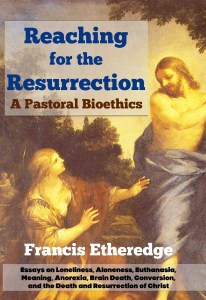
Reaching-for-the-Resurrection-Web-Cover-050122THE FAMILY ON PILGRIMAGEfrancis.etheredge-200x300Francis Etheredge, Catholic husband, father of 11, 3 of whom are in heaven, author of 13 books on Amazon, particularly, The Family on Pilgrimage: God Leads Through Dead Ends: https://enroutebooksandmedia.com/familyonpilgrimage/) and, more recently, Reaching for the Resurrection: A Pastoral Bioethics: https://enroutebooksandmedia.com/reachingfortheresurrection/.