Category Archives: Uncategorized

The Question of Civilization

703683What is civilization? And more particularly, what is Western Civilization?

I have been pondering this question, particularly in light of the demise of Western Civilization course requirements on university campuses across the nation. We are told that these classes are elitist, that they promote only the West and shun the rest, and we need to be more inclusive, study all civilizations equally. (Perhaps that wouldn’t be a problem if all were actually studied; but in many schools, the student chooses, and often neglects Western histories when left on his own.)

In my reading and unraveling, there appears to be an odd word game at play here. To be sure there are many civilizations throughout the world and in time, and this meaning of the word “civilization,” that is, any society of people and their culture, recognizes this. All are worthy of study.

What is more to the point, however, is how to conserve those aspects of a civilization we find valuable and necessary, i.e. those ideals of the Western world, going back to Athens, that we find crucial to free peoples today. Many of these aspects, these roots and ideals, are found in other cultures in varying degrees, planted by the West through colonialism. This is not being elitist or exclusionary. It is simply true.

Clearly there are aspects of civilizations that we might not want to encourage on our shores. The tyrannies of the Islamic State and of the Communist State come to mind; repressive and corrupt governments come to mind. We are not keen on beheadings and lawlessness and military dictators. We like free elections and freedom to travel and own property. Western democracies are (or should be) favored because liberty, limited and representative government, free speech, the freedom to worship and assemble, the rule of law, are lauded as ideals.

What happens when we fail to teach our children the history of these ideals found in the development of the Western world? What happens to our electorate when we say North Korea and Iran have equally good forms of government and pose no threat?

In my ponderings, I’ve come up with a working definition of civilization, which one of my characters poses in my novel-in-progress, The Fire Trail, a story about the borders of civilization and the wilderness:

A civilized society is a culture in which the common good is desired and advanced, but individual life and liberty protected, in which the natural world is controlled but cultivated and cared for, in which respectful debate is fostered and slander discouraged, in which social charity is promoted, yet private property protected, in which the rule of law and representative government work to provide peace at  home and to defend our borders.

A cousin to the question of civilization is the question of the Christian influence in Western Civilization’s development. They are interwoven, for Christianity’s inherent belief in progress, of bettering oneself and one’s community, as well as the value of the individual, spurred Western Civilization forward. The work ethic was largely a Christian ethos that has become secular through time. Eastern civilizations did not develop in this way, for life was circular and determined by fate; one worshiped one’s ancestors and was not so concerned with one’s descendants; happiness was to deny the real world and retreat into a mystical present.

Christianity, in its theology of the Fall of Man in the Garden of Eden, recognized that at that moment man turned away from God, to make himself godlike. Instead of godlike, however, he became primitive, savage. By recognizing this original sin, Christianity claimed that God saved man from himself, and death, through God’s Incarnation; man was shown sacrificial love. The Judeo-Christian tradition, i.e. the Western tradition, embraced the ideals of honor, sacrifice, communal charity, protection of life, liberty, and yes, claimed a path to happiness, not just its pursuit. The idea of the noble savage, a romantic primitivism embraced since the eighteenth century (from Rousseau, Mead, Marx, and Engels to Karen Armstrong), does not hold up to reality. The natural world is a wild world, one that humans must tame, just as we must tame the wildness within our own hearts.

Aristotle is quoted as saying, “the purpose of politics is not to make living together possible, but to make living well possible.” It is most certainly both. And these are also purposes of Western Civilization, to create a culture that cultivates freedom of expression through word and image, one that encourages our nobler side, our more sacrificial and heroic side, one that teaches us to love. It does this by ensuring peace and prosperity, and by passing on these ideals to the next generation.

On Mediums and Messages

Declaration of IndependenceIt is a truth universally acknowledged that the medium, if not the message itself, shapes the message, midwifes the message, and delivers the message.

Marshall McLuhan (1911-1980), a Canadian philosopher of communication theory, not only foresaw the Internet but bequeathed this popular phrase, “The medium is the message.” Since I work with words and consider them the material of miracles, I like to think that words are powerful on their own, anywhere, in any medium. But lately I have been considering how powerful the medium is truly becoming, far more than McLuhan could have dreamed.

In our parish church we use a Eucharistic liturgy that can be dated to the eleventh-century Sarum rite in Salisbury, England; the daily hours, the psalter, go back to seventh-century monasteries. But more to the point is that many generations have said and say these same words, as though taking part in a great drama, each Sunday. The words form phrases of timeless truth that were honed and perfected in Elizabethan translations of the Latin Mass, so that in many ways what we say evokes a Shakespearean play. The words are big words with large theological consequences of sin and redemption, sorrow and joy, darkness and light. These words make a difference in our hearts and lives, here and now. The language serves a clear purpose, to bring us in from the profane and secular world so that we can partake of the sacred and holy one, uniting the two. The language rebirths and recreates us, returning us to the secular world to be living mediums for the message. Our lives become words and the medium merges with the message in our own bodies.

In the liturgy, the medium that holds these words, this message, is print on paper, pages in our prayer book or hymnal. But the same words come to us through the medium of our own speech as we say and sing them and through the medium of our ears as we hear them said and sung. A fourth medium for these words is found in the actions of the liturgy: kneeling, making the Sign of the Cross, genuflecting, processing to the altar, receiving Christ in the bread and the wine. These acts, these movements of our bodies, are probably the most powerful medium for this message.

A sixth medium for this Sunday morning message is found in the shared experience of the congregation: the sharing of the space, the language, the speech, the processing, the saying and singing, the shared prayers and creeds spoken in unison as one voice. There is also the sharing of the meaning of the words, the call for penitence, the general absolution, the sharing of the bread and wine, so that we become one body, Christ’s Body, the Church.

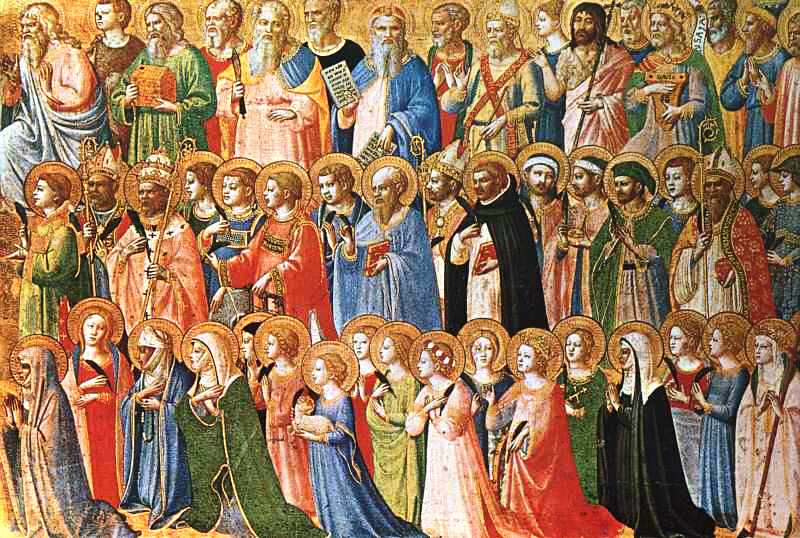
A seventh medium is seen in the sharing of the message throughout time and space, with those believers before us and those believers after us. The sharing extends spatially outside our own parish to the greater world, and we call this the Communion of Saints.

So ritualistic liturgy (“the work of the people”) is propelled by seven mediums nearly simultaneously, providing a powerful experience of meaning, of message. We have pulled the heart from each word; we have traveled centuries with each word; we have looked into Heaven with each word.

Such ritual is part of social constructions as well. Where it is ignored, society becomes deconstructed, torn apart. Where it is recognized as necessary, society weaves together, for a commonality is shared. In a democracy, we are reminded of such shared values through mediums of patriotic rituals: celebrating national holidays with parades and ceremonies, saluting the flag, reciting the Pledge of Allegiance, singing patriotic songs, honoring memorials, monuments, and heroes of our shared history. When these mediums of our nation’s message are ignored, democracy is threatened, for we act as individuals or self-interested groups rather than as one body, Americans with shared ideals expressed in common language and recalled through common history.

As we approach our nation’s midterm elections, messages and mediums become hugely important. Illiteracy and short attention spans demand entertaining mediums, TV and sound bites. Voters choose candidates and policy based on flashing images and pulsating phrases, delivered by powerful interest groups. A candidate must be politically correct in appearance, attractive and charismatic. Votes are cast for race, gender, and other superficial standards.

It would not matter if these were high school elections for cheerleader or class president. But, as we have seen in the last two presidential elections, telegenic does not mean experienced and pretty words and phrases do not equal sound policy. Words are mediums for something greater; they must point to keeping us safe and our communities law-abiding. They must reflect constitutional protections to freedom of speech, religion, association.

Our diverse peoples, the glory of our nation, must melt into one pot we call America; we must share language and history; we must not forget who we are, but keep the message alive with each generation through the medium of patriotism. If we do not do this, we shall fragment, weaken, and be conquered by those who do not appreciate our American message.

And so, as the words thundered in my ears this morning in our little church, as I sang with my brothers and sisters, as I united with believers around the world, past, present, and future, I looked ahead to this moment in our national history, this first Tuesday in November of 2014, praying that the many voices of America would reflect educated choices, ones that respect law, liberty, and freedom of expression, ones that  understand the power of this American message expressed in the greatest medium of all, a single vote.

Gifts of God in a Parish Church

We got off to aApostlesCreed2 slow start this morning, for on the way to church I realized I had forgotten my reading glasses. To go back or not? The thought of not being able to see the words, to sing the hymns with my parish family was a sad one. We took the risk of being late and went back home to fetch them. (Note to self: place extra reading glasses in car and other well-used locations.)
Once back on the road, winding along Highway 24 past Lafayette and Orinda, home towns of my childhood, and through the Caldecott tunnel, I quieted my mind for Mass. I wondered, as I have often wondered, what God would give me today, what he would show me. I took on the heart of a child, opening my eyes to all around me. I considered my week and my many strayings, my sins, large and small, especially the hard-to-see sins of attitude and desire and fear and worry. I cleaned out my heart.

The day was bright and clear, promising increased warmth with Santa Anna breezes. Leaves were changing and golden patches had appeared among the still-green oaks. (Flocks of swallows have been swooping and looping over our back yard, wings catching the light, and baby birds have emerged from bushes, strutting and looking at their world with curious awe.) Greens were greener today, the blue sky bluer. The earth sparkled. I wondered what gift God would bring me as we drove to church, as we covered a bit of the earth’s round surface, and within my wonder a prayer formed and grew, asking for eyes to see. For I have found, if I can see it, there is always a surprise gift. I just need to pay attention.

We parked and crossed the new courtyard that now welcomes us to worship in our century-old church, St. Peter’s Anglican in Oakland. We climbed the steps, entered through the wide open doors, and stepped into the narthex. We found seats in the nave. As I knelt and said my prayers of thanksgiving for the freedom to worship, for the clergy, and for the people of the parish, an opening prayer I learned long ago, I considered my brothers and sisters all around me in the pews.

There was a sense of quietude this morning, of calm, a quiet that continued even as the liturgy began, even as the Scriptures were read, even as the Canon of the Mass invited us all to take part in the great work of the people, the action of the Eucharist, the sacrifice of  Christ reenacted each Sunday morning. These were clearly all great and good gifts, but I sensed there was another, and I watched and I waited, saying the prayers and singing the praises, confessing and receiving absolution, partaking in the Real Presence of Christ.

It was a re-freshing Eucharist, an hour of sustenance. Each Eucharist, I have found, is different, each liturgy while being the same is never the same. A new color is painted on my soul, a new note added to its melody, another flock of birds turn their feathers to the sun, and I always marvel in curious awe.

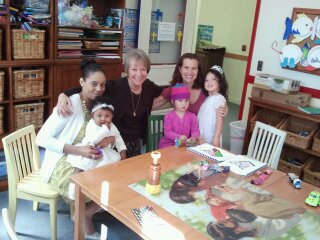
002After Mass, I visited the Sunday School to see the children, and I found my gift.

Two of my former students (from twenty-five-plus years ago) sat side by side with their children. The two generations, three, counting myself as I joined them, gave witness to the love of God. The room had been redecorated since then. We had all taken many paths since then. But there we were, living testimonies to the teaching of the next generation, having found our own unique paths back to church.

In the chaos of a world that devalues family and marriage and commitment, it is good to have a parish family to weave us all together again. Many of my former students from the ‘eighties live far away. Most have experienced or been touched by heartbreak, divorce, loss and tragedy. Even believers in an ordered, religious, path through life, one of sheer joy and redemption, cannot help but be tossed and turned in the storms of today’s culture. So, just as the medieval monasteries gave shelter from the wilds, just as they turned the swamps of Europe into fertile valleys and named stars through telescopes, so little parish churches today, like ours in Rockridge, keep us safe and teach us how to live. They offer peace; they offer family; they show us the why of existence, who we are and who we are meant to be. They give us a way forward to believing in God, or to fortify that belief, a path to understanding his great love. And on the altars of these churches God is re-presented to us, given to us, sacramentally.

We cross the courtyard and enter the silence, carrying hearts of turmoil laced with selfishness, confusion, and distrust. We are blind but want to see. We spend an hour with God, in God, and he with us, in us. When we leave, when we cross the courtyard and re-enter October 2014, we are changed and renewed.

Our eyes  have been opened. We can see the many gifts given. Now we can turn and give them to our children and they to their children.

Flying the Flag

american-flag-2a2My novel-in-progress, The Fire Trail, is progressing. But little did I know, when I set this novel in Berkeley in September of 2014 (a decision made at least a year ago that almost seemed arbitrary), that so many events would collide in this month that illustrated my themes.

I’m not sure why I didn’t focus on the Nine-Eleven tragedy to begin with, but I didn’t. I was thinking of the time of year, time of sunset (and thus daylight versus darkness). I was thinking of temperature and dryness, and well, naturally, fire hazards. I wanted school to be in session, so that sort of ruled out the summer months, and while dry it needed to be beautiful with a trail that students would run. September seemed the answer. I plotted the month out, day by day, wondering how many weeks the plot should encompass. How long does it take for two strangers to fall in love?

The story begins on September 3 and my characters appear in the next few days. In real life, wars around the world had been escalating over the summer. Malaysia Airlines jet disappeared, becoming a “ghost” plane, never found. Russian fighters shot down a passenger airline over Ukraine. Islamic terrorism was rising and homegrown terrorists from Britain had usefully dangerous passports into the West. Journalists were beheaded and their killers boasted. Events, again and again, and seeming ongoing, verified that the Western Civilization’s borders were being breached by fire.

The President addressed the nation on Wednesday, September 10, the night before the Nine-Eleven memorial. His words seemed too little too late, but indicated a more forceful course in military action. Many Americans hoped and prayed that a clear message would be sent, that we would fight for our peaceful world, we would die for our freedoms. We were still the power that defended liberty and representative government.

So I finally realized my story had placed the September 11 memorial of the Twin Towers attack at its very heart. The story’s action would rise to this point, and then fall away from it. For in our own American history, September 11, 2001, will remain a watershed moment. It is an event that changed us as a nation, woke us up. Some have gone back to sleep, but, thank God, some have remained awake, watching and listening, if not always alert. Those who see the threat for what it was and is – an attack on our way of life as Americans – turned to examine our culture to understand how to be better prepared. Those who recognize the flames coming toward them are sounding the alarm. They are working hard to keep the fire trail clear, retain a true fire break.

Democracy requires patriotism, a civic devotion instilled in school. Classical societies knew this. Our founding fathers knew this. Many have recognized that a good society must cultivate good citizens, men and women educated according to a value-laden curriculum, instilling virtues that allow them to live peaceably together in pursuit of the common good and individual happiness. Instead, the last sixty years has seen a steady erosion of this foundation. Academia has grown cynical and elite and out-of-touch with what actually produces the culture that allows them the liberty to speak, to be cynical and elite and out-of-touch. The ivory towers, like Babel, have risen higher and higher, the windows darkened with ivy, the rooms dim. Patriotism has not been fashionable. Inclusiveness has prevailed. The American way, the way of Western Civilization, these elite say, is just one way among many. We are not exceptional.

Alas, it is not one among many and we are indeed exceptional. America is truly a shining city upon a hill, as was Athens and Rome and Paris and London to the degree that they allowed democratic values to thrive. Over two millennia the development of free thinking peoples and their systems of governing has been unique to the West. So what happened? How did freedom and the flag become something to look down upon from on high? How is it that our homegrown intellectuals sneer and deride the stars and stripes?

Yale historian Donald Kagan writes in the Wall Street Journal:

“Jefferson meant American education to produce a necessary patriotism. Democracy – of all political systems, because it depends on the participation of its citizens in their own government and because it depends on their own free will to risk their lives in its defence – stands in the greatest need of an education that produces patriotism. I recognize that I have said something shocking…”

Indeed. Too many schools haven’t taught love of country for generations, and battles continue to rage in school boards over teaching patriotic curriculum, American history that explains who we are, what we stand for, and what we have to lose if we don’t fight for those ideals.

These are urgent matters for our country. So as I tell the stories of Jessica and Zachary, two grad students at U.C. Berkeley who have come of age in this world and question some of its assumptions, I marvel at how these events have supported my September themes. For Berkeley celebrated the fiftieth anniversary of the Free Speech Movement, and this last Wednesday crowds gathered at Sproul Plaza around the corner from my little publishing office. Aged speakers reminisced how they defended free speech by standing on top of police cars with bullhorns.

Today, political correctness reigns at Berkeley and those speakers have become faculty. It is their turn to squelch opposing points of view, promoting those professors who agree with them, isolating those who do not tow the party line. As they preached their creed around the corner from my office, I was meeting with a committee dedicated to establishing a Center for Western Civilization on the corner of Bowditch and Durant. I didn’t realize it at the time that we were huddled and planning quietly while the free-speachers were calling for free tuition and telling tales of sixties sit-ins. I read about it later in the paper and I smiled.

I have reached September 11, 2014 in my manuscript and have written Zachary’s reflections on this horrific day, for reflections on history reflect my character’s character. Soon I shall write the reflections of his mother Anna, and lastly, the reflections of Jessica. And so I shall weave American history into their stories, to enrich what it means to live in this exceptional land of liberty.

And I’m going to place an American flag on the porch of Comerford House, the center of the action. It shall ripple in sunlight and in shadow, high above the bay, looking out over shadowy Berkeley and the shimmering San Francisco skyline and the Golden Gate. It shall mark the fire trail that runs behind the house.

To read the first six chapters of The Fire Trail, go to www.LibertyIslandmag.com, click on Open Range, or find my Creator page.  

Singing with Angels

330px-Guido_Reni_031Today is the eve of the Feast of St. Michael and All Angels, or “Michaelmas.” Michaelmas marks the end of harvest, the beginning of fall and the shortening of days.

I believe in angels. They have fluttered through my life, ordering and arranging, guarding and nudging, strengthening and leading. And so today in church I was especially pleased to rediscover this marvelous hymn, #122, sung to a traditional Irish melody:

Angels and ministers, spirits of grace,
Friends of the children, beholding God’s face,
Moving like thought to us through the beyond,
Moulded in beauty, and free from our bond!
 
Messengers clad in the swiftness of light,
Subtle as flame, as creative in might,
Helmed with the truth and with charity shod,
Wielding the wind of the purpose of God!
 
Earth’s myriad creatures live after their kind,
Dumb, in the life of the body confined;
You are pure spirit, but we here below,
Linked in both orders, are tossed to and fro.
 
You do God’s bidding unshaken and strong;
We are distraught ‘twixt the right and the wrong;
Yet would we soar as the bird from the mesh,
Freed from the weakness and wonder of flesh.
 

Percy Dearmer, 1867-1936

Angels are “free from our bond… free from the weakness and wonder of flesh.” We, however, are “Dumb, in the life of the body confined… Linked in both orders… tossed to and fro.” We are made for another country, to be sure. We are alien creatures on this earth, sensing another home, a home calling us. Each time we respond to goodness, beauty, truth, and love we are touched by this heavenly world. We are pulled. Each time we pray, each time we make the Sign of the Cross, each time we receive the Holy Eucharist, we reach and touch heaven. We are both body and spirit, unlike angels, who are only spirit. We have a foot in each world; we straddle two countries or perhaps toggle between.

And it is true, as Father Dearmer says, that our flesh is both weak and wondrous. Today, as cultural forces seek to merge the male and the female, to create androgyny and deny gender, I see this wonder disappearing. Men and women were created to be delightfully complementary to one another; they are uniquely different and yet when joined together they produce new life. So within the sacred union of marriage, God works these miracles, transforms our fleshly weakness into creative strength. He unites heaven and earth through our flesh.

Michael the Archangel is described in Scripture as the great warrior-angel who defeated the rebel angel Lucifer in the war in heaven.  And of course there are choirs of angels, angels appearing to comfort and guide as well as protect, messenger angels bridging heaven and earth. There are many accounts of people seeing angels, often testimony of children whose vision is unguarded.

Angels are “unshaken and strong,” but we are torn between “right and wrong.” And yet, angels help us to choose when we are torn and strengthen us in our good choices. For angels wield “the wind of the purpose of God.”

I pray for such a wind daily, especially as I work my way through the first draft of my novel-in-progress, The Fire Trail. I know that I cannot write it alone. I need help and, as I reach for help, angels lift up my hands to the heavens, leaving my feet firmly planted on earth. I can feel the stretch of my soul, my mind, my heart, and sometimes it hurts.

I pray for such a wind for our nation and those of the Western world, as we fight to defend our boundaries, both of liberty and land, as we build a wide fire trail to keep out those who will burn to ash our way of life, our freedom.

I pray for the angels all around us to open our eyes that we may see the truth. And I thank God for Father Dearmer and his dear portrait of our ministering heavenly friends.

As the Mass ended this morning, we sang another powerful hymn, #600, and my husband turned to me to whisper, “My favorite.” The organ thundered and as the crucifer and torchbearers recessed triumphantly down the aisle, followed by the clergy in their gleaming white robes, we sang, “Ye holy angels bright, Who wait at God’s right hand,/Or through the realms of light/Fly at your Lord’s command,/Assist our song, For else the theme/Too high doth seem/For mortal tongue…”

On Tax Collectors and Free Speech

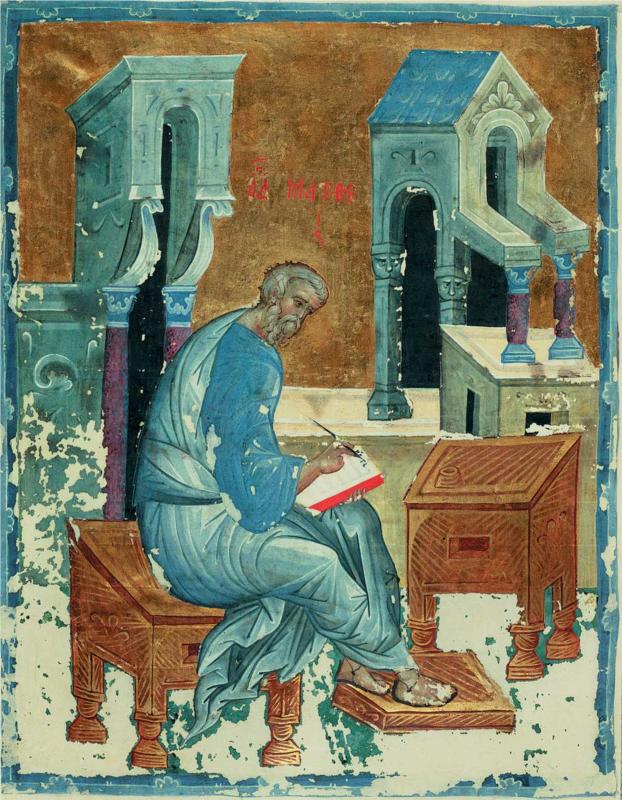
Matthew.EvangelistToday is the Feast of St. Matthew, Apostle. Matthew, also called Levi in Scripture, was a Jewish tax collector. He was one of those who, like most of us, live and work in the secular world. Some compromise their beliefs to do this, or maybe don’t examine too closely their Sunday creed versus the world’s weekday creed. How else could they survive? Some simply turn a blind eye to the world around them, or the world of their temple or church.

In Matthew’s case, he collected more than was owed. The difference was his very living, so he found himself caught in a corrupt system, hated by his own people. Christ pulled him out of this world and into discipleship. When Christ commanded, “Follow me,” he followed. In his case, it meant leaving his other world behind. He didn’t seem to hesitate.

So we too must make this choice in our own lives: how we spend our time, how we vote, what we read, what we say, what we teach our children, what we model to our children. Some of us make radical changes in direction; some continue on the same paths. We compare our lives to lives like Matthew. How do we measure up?

One of the larger issues today is the nature of man and woman. The Judeo-Christian tradition gives clear definitions, and provides models for family life, community life, national life. But with the receding of faith, these definitions have been increasingly challenged, and no where more so than in our institutions of higher learning.

In America, land of the free, we celebrate and enjoy freedom of speech and peaceful assembly, or at least we try to. So we debate these questions openly. We give these questions air to breathe. If we do not, the debate will die and so will our culture.

In researching my current novel-in-progress, The Fire Trail, I learned more about The Anscombe Society, a group begun at Princeton in 2005 promoting chastity outside of marriage, offering a sexual ethos for students. The Stanford Anscombe Society, the student group at Stanford University in Palo Alto, California, defines its mission as follows:

The Stanford Anscombe Society (SAS) is a student group that promotes discussion regarding the roles of the family, marriage, and sexual integrity in the lives of Stanford students both now and after graduation. SAS is neither religiously nor politically affiliated, instead basing our positions on human principles. We hold that the family is the key unit of a stable society, and we define the family as one man and one woman bound together by marriage, along with any children that they might have. SAS defines marriage as a union, until death, between one man and one woman. We promote the idea that sexual integrity is necessary for this family unit to be successful.

This group was denied by the university partial funding for their conference at Stanford last spring. The group was recognized as a student group, but since a “politically correct” minority of students objected, the university bowed to these objections. The Society still had their conference, welcoming all points of view in a civilized, open and respectful debate (see http://www.stanfordanscombe.org/ for videos of speakers and student interviews).

Also, in California, there have been instances where Christian groups have been forced off campus because their leaders were Christian. The court ruling said that all groups on campus must make their membership as well as their leadership be “open to all comers,” i.e. they must allow, for example, an atheist to lead their group. What is wrong with this picture?

The borderlands between the secular and the sacred have always been fraught with danger. But since we do not want to live in a theocracy, nor under a totalitarian regime, we champion freedom of speech, freedom of worship, and open debate. We support communication of belief, or nonbelief, and peaceful assembly.

The fire trail protecting freedom from tyranny is not as wide or protective as it once was. I am so very grateful to The Anscombe Society for speaking out and encouraging open conversation. I am grateful to Elizabeth Anscombe (1919-2001), a British philosopher considered by some to be the greatest in the twentieth century. A professor at Cambridge, she made the case for family values, monogamy, the definition of marriage, arguing and reasoning as a trained philosopher. This is a debate we must not silence; we must not allow irrationality to breach the trail and burn to ash this public conversation.

And I’m grateful for St. Matthew, who, it would appear, did not hesitate to obey his Lord. I am thankful for his Gospel, especially precious at Christmas, for his “good news” is the only account of the wise men bringing their gifts to the Christ Child, a manifestation, or epiphany of the Incarnation to the greater world.

And as I worshiped in my parish church this morning and listened to our own fiery preacher (from a Jewish tradition) describe St. Matthew, I gave thanks once again for my freedom to worship and for our preacher’s freedom to preach. And I once again realized, as I gazed upon the medieval crucifix that hangs over the tabernacle holding the Real Presence of Christ, that all my choices were made easy with the first, the choice to follow the truth, just like that tax collector in Capernaum.

Secret Stairs in Berkeley

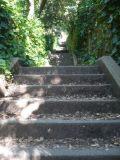
secret stairs 1I’ve been studying a map of Berkeley and the secret stairs of the Berkeley Hills produced by the Berkeley Path Wanderers Association. The characters in my novel-in-progress, The Fire Trail, follow these steps that bridge roads winding into the forests above the university campus, winding up to the Fire Trails.

It is curious how maps organize a broad range of information and yet at the same time help the eye to focus and pinpoint one spot. Maps are like our brains, full of detail, a network of perception of both the past (memory), the present (observation) and the future (plans). Like this shiny unfolded paper that covers my desk, we too are mapped with broad ranges as well as focal points; our brains are miracles of design, epicenters of will and desire.

Novels are stories that connect the dots, draw the lines between moments of intense focus. These moments are often crises producing turning-points. A main crisis propels the major arc of the novel along, as sub-crises propel the chapters, and sometimes even sub-sub-crises propel the scenes. The process is much like walking through Berkeley, coming upon secret stairs that connect the winding roads; sometimes we rise and sometimes we fall.

History is full of these patterns, and these crises often catalyze action, focusing our attention, the attention of our community, the attention of our country, the attention of the world, upon a single incident. The crisis we remembered this week was the horrific bombing of the World Trade Center thirteen years ago on September 11. Our television screens invaded our homes with the shocking news, and although there had been many smaller crises leading up to this one, it was this one that caught our attention, that became America’s and the Western world’s turning point.

We had not been attacked on our own soil since Pearl Harbor in 1941. Our violence since then had been self-inflicted – shootings, riots, demonstrations. Some of us, in our arrogance, tried to deny it was the work of a foreign enemy. How could anyone do this? Each of us recalls, like the day that President Kennedy was shot, where we were and what we were doing when we found out, when we first saw the plumes rising, heard the rumble of the falling towers. It was as though the jets had sliced a knife into our hearts and minds. Our safe and civilized world crumbled; the map of our culture had been ripped apart and was increasingly incomprehensible. Life, liberty and the pursuit of happiness were threatened; our freedom of speech – in word, deed, and worship – was attacked.

They say that the West experienced a similar shock as it counted its dead in the aftermath of World War I, a war we memorialize this year, begun one hundred years ago. Then too, the fire trail was breached, and the flames of barbarism crossed into our peaceful lands, threatening to destroy all that the West had built, over thousands of years since Abraham (then Abram) was called to leave the pagan world of Ur. World War I was a turning point, a catalyst that produced nihilism and despair, Lenin and Hitler and Mao, Nietzsche’s superman and the cold liberal arrogance of academic elite reigning from their own towers, these of ivory.

Church and temple imploded, divided on the path to take. Many of the once-faithful claimed God to be dead, or at least sleeping. Many delighted in such a claim, worshiping themselves and contributing to the anarchy of self-gratification now so fashionable. And so, darkness descended upon the Western world, lit here and there by communities of traditional believers, those who held onto their map, saw the way forward clearly in Scripture, Sacrament, and Creed, and who lit their candles, calling all to come and worship.

There have been three beheadings in the last month, at the last count, and I suppose now the world is watching and counting. We are finally focused. The many lines, the many roads, the many intersections where we weren’t sure which way to turn, have all converged in a single place on our map. Like the World Trade Center bombings, these violent images have stabbed our hearts and minds.

Through it all, the lights lit in our churches and temples burn brightly, calling us together, to gather as one heart and one mind before God. And as I knelt in the pew this morning in St. Joseph’s Chapel in Berkeley, my minutes and days of the week, however scattered, were gathered together in that single hour of worship. In that hour of song and praise and penitence and communion, all that was past was brought into the present and redeemed. All that would come in the future lay in God’s palm, cradled.

The connecting stairs were no longer secret passageways, but right there in beautiful bold print in my Book of Common Prayer. The paths led sensibly through the dark and into the light between the onionskin pages of my tattered Bible. Sin was forgiven, death destroyed. I could turn again, re-pent, re-form, in this weekly turning point. I could face the days ahead of me, the chaos of the world, the burning of the good and the beautiful and the true. For here was the essence, the distillation of the good, the beautiful, and the true. Here was life, for me and for each of us. Here was love that passeth all understanding, love that made sense of all maps.

Crossing the Courtyard

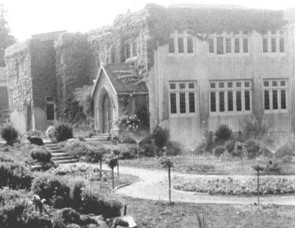
St. Peter's, 1913

St. Peter’s, 1913

Our parish church, St. Peter’s Anglican in Oakland, is building a new courtyard. Over the summer we have entered the church through side doors and back doors. We have peered over broken-down walls and into churned-up soil and rock. Along the way we unearthed our original cornerstone, laid in 1913. Somehow it was buried when a new church was built alongside the old in 1957. 

There has been much discussion, weighing in, rethinking this and deciding on that, in the process of executing the architect’s vision for our courtyard. Are the colors compatible with the existing buildings? Should there be a lych-gate or just a gate? How high will the brick walls be exactly? Did we really have to remove the palm tree? When will it be finished? In time for our organ concert? When will the elevators for the handicapped be done?

There has been much sighing and wringing of hands and raising of brows, then chuckling and open palms and leaving it all to God. Somehow we have weathered the great questions and agreed upon sensible answers. God has been good.

Today, finally, we could see how it all might turn out. Planting beds are marked. The brick wall (not too high) is finished, an inviting border. Soon the patio will be laid. Soon the front doors will be opened, their chains broken, and soon we will once again cross the threshold of our church, leave the secular behind and enter the sacred.

The sun came out this morning as we peered over the low brick wall. The heavy fog that settles upon the Bay Area this time of year had burned away. The earth, its gravity holding our church fast on its rim, was turning slowly, away from summer into autumn in this part of the world, away from winter into spring in other parts. For us here, on this part of the planet, daylight shrinks as the dark of night expands.

I’m glad to have a sacred space hugging the edge of the earth so firmly, and I’m glad to have a courtyard that links the secular with the sacred, that points to the light in the darkness.  Crossing such a space is a preparation, a time to quiet the mind and heart before kneeling in a pew to worship God. It is a time to bridge two worlds – that of God and that of man.

In the end, that is what Christians do, or are called to do. Each of us is a kind of courtyard, a linking and a joining of the secular and the sacred, of earth and heaven. We have experienced the transcendent, God become man, God giving himself to man in the Eucharist, God living within man through Eucharist and Spirit. But we are all only partly finished courtyards, I fear, for each of us has a long way to go for our gardens to flower, for our patios to be solid enough to bear much weight.

But we open our gates, and we invite those outside to come inside, to leave the noise and enter the quiet. We say, come, look and see what we have seen! Come, know the peace of God. Come, be healed. We witness to transcendence, here in our earthy world, an increasingly dangerous and barbaric world.

The Gospel for today was the healing of the man who cannot hear and cannot speak. He was deaf and dumb. Christ charges him and the witnesses to tell no one, but they do anyway, “beyond measure astonished, saying, ‘He hath done all things well: he maketh both the deaf to hear, and the dumb to speak.’ ” I too am beyond measure astonished when I enter our holy space and gaze at the altar and its tented tabernacle resting in its garden of fiery tapers. I too want to tell about it, for my ears have been opened and my tongue loosed. I too have been healed of apathy, despair, depression, heartbreak, fear… to name just a few demons. I too have been forgiven my sins. Once, long ago, I was invited to enter through a gate by someone, like me today, grinning and beckoning from a courtyard, calling me to cross the threshold and enter the church. And once I entered, I knew, from the beauty that engulfed me, that I had left the secular and stepped into the sacred. And I was beyond measure astonished.

Soon our courtyard will be finished. Soon it will invite the halt, the lame, and the blind to enter this holy home of God and be healed. Soon it will witness to the world the incarnation of God, to Emmanuel, God with us. For the 1913 church and the 1957 church are now joined by the 2014 garden court, the child of a century of worship, a century of incense, candles, and song, a century of transcendent beauty.

http://www.saintpetersoakland.com

Traditions and Arrangements

Writing ImageIt is Labor Day, a time to honor work, the working man and woman, those who contribute to our world with their time, talent, and the sweat of their brow. It is appropriately also a time to send our children to school to learn how to do this, how to use their lives productively, how to work and to become responsible for their hours and days. So I turn to one of my many labors, my novel-in-progress, hoping to one day carry it to full term and allow it to breathe.

In creating the back-story for one of my characters, I have revisited the huge topic, Western Civilization: what it is and do we want to preserve it, and if we do, how do we go about it?

I am a saver of cogent words, powerful words in print. I snip bits from newspapers and magazines. I file them, where they sleep until resurrected in a moment like this when I am constructing a novel, drawing the blueprint that will become a huge house of many rooms. I am an architect, I suppose, in the planning stages, building inch by inch, word by word, scribble by scribble. Each room is a character, and they meet from time to time in the house, rub shoulders, touch one another’s minds and hearts and souls with their hopes and fears and regrets. Some rooms are dark, some light, some warm, some cold. They are all under the roof of my little novel, linked by halls and doorways and stairs.

The bits and pieces snipped and saved, ideas that will flow into these rooms are expressed by many ponderers from the English-speaking world. They voice concern, and rightly so, that without the Judeo-Christian underpinning of Western culture, the free world will collapse. One doesn’t have to be religious to worry about this… one merely has to face the reality of such a loss and how it would affect, at the very least, our ideas of liberty, law, and democracy.

Thomas Jefferson’s words decorate his memorial in Washington, D.C.:

“God who gave us life gave us liberty. Can the liberties of a nation be secure when we have removed a conviction that these liberties are the gift of God? Indeed I tremble for my country when I reflect that God is just, that his justice cannot sleep forever.”

Jefferson, a skeptic, is referring to slavery, but these words could have been written today. We all wonder, believers and skeptics, whether our liberties can be secure when we remove the author of the liberties, and when we remove the idea that these freedoms are gifts not rights.

Peggy Noonan writes that there are reasons for traditions and arrangements, some are good, some not so good, ways of doing things learned from experience. These ways have also risen from religious roots. Through the centuries since the birth of Christ, the West, under the influence of the Judeo-Christian social philosophy, has organized life based on the belief that God exists, that he loves and desires us to love, that he made man to be a free, thinking, creative being that would respond to him in turn, freely, thinking, and creatively. Behind the rule of law, behind our institutions of family, church, government, and free press, supporting our right to organize our workers, to gather in peaceful assembly, even behind our table manners and Robert’s Rules of Order, lies the Judeo-Christian definition of man and his purpose. So there are reasons for our traditions and arrangements in the Western world; there are reasons we labor to protect them.

The traditions and arrangements have changed from time to time, tweaked here and there, discarded here and restored there, fought over, around, and within, in word and in deed. Slavery challenges and condemns us, in the Classical world, among African tribes, and on American plantations. Today a child in the womb is seen by some to be owned by the mother, the unborn having no rights. Across the world, children are bought and sold, trafficked for labor, sex, surrogacy. Women are in bondage, jailed, beheaded. Believers are martyred. We see these things, we judge them to be right or wrong, and we labor to change them. So there are times when we need to alter traditions and arrangements to better reflect the Judeo-Christian definition of man and his congress with one another. But without the ideal, the standard by which to judge, how can we decide, act, affect the real world?

It is a conundrum, for our ideals of respect and liberty prevent coerced belief, even if belief may be necessary to uphold that liberty. So folks speak of a public square where we honor these ideals and seek common ground to move forward. They say we must reflect before deserting traditional definitions of marriage and family, that is, a man and a woman raising their own children. These arrangements have held and continue to hold society together. Studies show that the father is more committed, the mother more protected, the child more loved, when this traditional view is encouraged by government representing society. There is less delinquency and fewer single parent households.

I believe in the author of this code of life, this Judeo-Christian God, so it is easy for me to believe in these traditions and arrangements. I believe there will be a judgment (perhaps it’s ongoing) – a reckoning not only I will face but the world as well. We reap what we sow.

But I also pray that those who do not share my belief in that God, consider embracing his traditions and arrangements that have been honed through the centuries. If skeptics value liberty and the rule of law, respect for gender and race, care for the poor and handicapped, the unborn and the aged, if they desire freedom of thought, speech and worship, they would be wise to support the institutions that uphold these Western ideals.

I suppose the world is much like my blueprint for the mansion with the many rooms. Every person is different, unique, but together we have a common humanity. We share the earth and we share a long history. We live under the same roof of suns and moons and stars. We meet in common areas to agree upon traditions and arrangements, but we must build on those of the past, rather than begin anew each time. We nail and we hammer, we add here and pull away there, but we must consider why we do what we do and what we shall lose if we don’t. We must not forget how we arrived at this place, in this time, and why the rooms were decorated and arranged just so, before we tear them down. We must recall, if we are graced with belief, who labored to create this great house, our world, and that he calls us to love one another as he has arranged for us to love.

And it’s good to remember President Jefferson’s words, that our liberties are gifts from God our creator, and be thankful.

On Earthquakes and Apostles

Isola Tiberina.2The earthquake in Napa registered over 6 around 3:20 this morning. I woke and felt the house sway back and forth as though it were tossing in a stormy sea. I wondered if this was it, the time of reckoning, the end of it all. Would the walls collapse? Would the gas water heater explode? The epicenter – Napa – turned out to be a ways away from our town, but close enough that we felt the quake’s strength in our East Bay community. But the quake was a reminder of our human fragility and a reminder of time running out.

We checked for damage and found none apparent, so we trundled off to church to pray for those hurt, to pray for our raging world, to become one with one another and God in the Eucharist, and later to celebrate a parishioner’s birthday (ninety-nine!) with a festive lunch. As I knelt in the oak pew, I recalled today was the Feast of Saint Bartholomew, one of the twelve apostles, thought to be the same as Nathaniel, brought to Christ by the Apostle Phillip. I saw suddenly in my mind his beautiful church in Rome.

SAN BARTOLOMEO, ROMEIn the middle of the Tiber on an island the shape of a ship stands the ancient church of San Bartolomeo, Saint Bartholomew. I have long loved this church, for its setting amid the rushing waters and leafy banks as well as for its graceful vaults running up side aisles, its colorful apse. But when I enter and pause at the foot of the central aisle to gaze up towards the high altar, I invariably smile.

Altars in Christian churches have been sanctified by the bones of the martyrs since the earliest days when women cleaned the saints’ bodies and buried them outside the walls of Rome. It had long been the custom for pagan Rome to visit their dead and remember them on their anniversaries with outdoor suppers over their graves. The custom continued with the Christian martyrs, a custom that evolved naturally into something more than a memorial meal. For the holy bones seemed to work miracles. So when Christianity became legal, it was natural to build churches over these graves, to celebrate with holy suppers of thanksgiving, Eucharists, and when these sacred relics were threatened by eastern invasions they were brought inside the city walls for safety.

Thus throughout the Christian world altars are sanctified by the relics of the martyrs, relics placed beneath in what is sometimes called a confessio or witness to truth. Saint Bartholomew, Apostle, lies under the altar of San Bartolomeo in Rome on the Tiber Island, in a large boat-shaped reliquary that bears the altar table above it. There is something earthy about this dark sarcophagus in this bright and lofty church, so I often experience a frisson of joy, seeing this union of Heaven and earth, which of course, is the action of the Holy Eucharist in each Mass that will be celebrated on that altar.

Little is known of Saint Bartholomew whom Christ describes as “without guile,” meaning ingenuous, honest. Bartholomew had asked whether anything good could come from Nazareth. He soon had his answer; he recognizes Christ for who he is; he is present at the Ascension. It is said that he preached in India and Armenia, where he was martyred, flayed and crucified upside down. His relics found their way from Armenia to Rome and were placed under the altar of St. Adalberto, now to be called San Bartolomeo.

When we visit San Bartolomeo in Rome we usually come from the Aventine Hill, descending along the stone path from the gardens of Santa Sabina, following the river walk under the plane trees, the waters rushing below. Soon the island comes into view, and we cross an old stone bridge, the Ponte Fabricio, to the Isola Tiberina. In ancient Rome a temple of healing stood here; a hospital remains today. We enter the marbled and gilded Romanesque-Baroque church and, after pausing at the foot of the central aisle to view the the tomb holding the high altar, we visit the side chapels.

In 2000 Pope Jean Paul II dedicated these altars to the martyrs of the 20th and 21st centuries. Each chapel recalls regions and regimes where Christians died for their witness to truth, to Christ: Asia, Oceana, the Near East, Latin America, Africa, Communism, Nazism, Spain and Mexico. The Community of San Egidio, a lay fraternity of men and women who pray for peace and care for the poor in Rome, look after these memorials.

In many ways this church embodies the resurrected church of today, one reborn again and again in the blood of these modern martyrs, one intensely full of the Holy Spirit, of suffering. And as I worshiped in my own parish church in the Bay Area this morning, I thought of this Apostle without Guile, this Apostle of Truth, Saint Bartholomew, who was not afraid to witness to God becoming Man and living among us, dying for us, rising for us, with us. Such a witness, seen in the Basilica of San Bartolomeo on an island awash by the tumbling waters of Rome, is encouraging. We too are awash in such dangerous tides that threaten to flood our parish naves. We too sail in an ark of faith and we too pray for the courage to witness.

pilgrimage_book_coverI set a scene on this island in my first novel, Pilgrimage, and a more dramatic scene on the Ponte Fabricio in my recently released novel, The Magdalene Mystery. Both novels are about truth and healing, about navigating dangerous waters in arks of faThe Magdalene Mysteryith, about allowing the past to inform our present through the lives of saints and martyrs.

Thank you, San Bartolomeo, for being without guile.

http://www.sanbartolomeo.org; http://www.sanegidio.org