
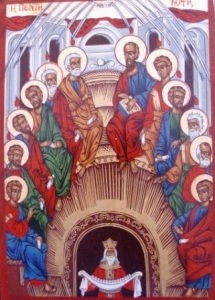
 The Feast of Pentecost, the celebration of he descent of the Holy Spirit upon the disciples gathered in Jerusalem, is one of the most dramatic scenes in the New Testament, and while I have always been astounded at the Gospel and Epistle for this Sunday, today I considered one phrase our preacher said.
He said the Holy Spirit was the fountain of life. Creation. Baptism. The Spirit upon the waters… stirring us up (like the Advent Collect, yes).
In Baptism we are given new life in Christ, becoming one with the Bride of Christ, the Church. We are given new life through water and Spirit.
And May is the month of life, of birth, for we celebrate mothers and the life they welcome, or we mourn the life they reject. We look to Mary in May, the month of our lovely and loving Queen of Heaven, who shows us how to say yes to the Father, say yes to the Son, and welcome the Spirit into our hearts and lives and families. For the Holy Spirit descended upon her, the power of the Highest overshadowed her, and she conceived in her womb the Son of God.
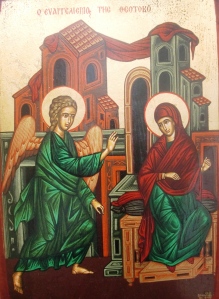 And, as she was commanded, she named him Jesus, this Holy Spirit child, this quickening of Our Lord in Mary. She said yes, be it unto me according to thy will. (Luke 1)
Just so, we say yes to the Holy Spirit descending upon you and me. In this way, we take part in creation, the creation only you and I can create. For each one of us is unique; each one of us has a singular gift, a creation for mankind, one that will light the dark for others to see. We must offer this gift, for no-one else can offer our gift in our own unique way.
I love meeting people. For each person is a sacred story, with stories within the story. I look at a new face and wonder in awe at this unique person, for as the Psalmist says, “I will give thanks to thee, for I am fearfully and wonderfully made: marvelous are thy works, and that my soul knoweth right well.” (139) Each person is marvel-ous, awe-full, full of mystery, miracle, and majesty.
And so when I heard the Epistle this morning I could hear the rushing mighty wind, could see the tongues like fire touch each disciple, filling them with the Holy Ghost. I heard them speak in tongues, different languages, so that they could witness to the diverse travelers to Jerusalem, “of every nation under heaven.” How could these Galileans speak in all these languages? I too was amazed at the dramatic scene. (Acts 2)
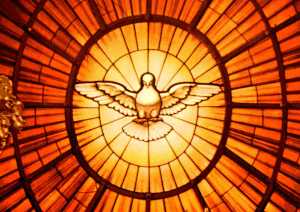 The Spirit gave them the words, reversing the story of the Tower of Babel, uniting, not dividing, loving, not hating. With words.
You and I are words, expressions of the Holy Spirit’s creative act. We say yes to such miraculous powers of creation, for in the Gospel today, I was enlivened, reassured, by Christ, for he says that the Spirit will teach us all things. We must not let our hearts be troubled or fearful, for the Spirit gives us the peace of Christ. He descends upon us to dwell within us. (John 14:15+)
Tongues of fire. The metaphor reminds us of the glory we have been given, all in a simple answer to what we are called to be, to do, with our lives. All we have to do is say yes. Just like Mary, our dear mother, and like the millions (billions) of faithful throughout the world.
We too will be given what we need to speak the language of Christ to the world. We too will witness to what we have seen and heard. In our own unique, diverse, marvelous way. With our own words, witnessing to the Word made flesh who dwelt among us.
And we behold his glory.
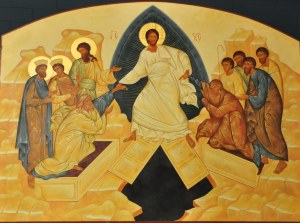
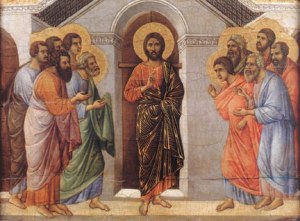 Today is the last Sunday in Eastertide, the celebration of Christ’s resurrection from the dead, and with his conquering death, we too are resurrected, now and when our bodies die, releasing our souls to fly heavenward.
 And should we be confused as to the meaning of these events, we look to the Early Church and the letters of Paul and others who trained these baby Christians to become adults in Christ.
  Nevertheless, in the time that is ours, the life we own, we witness to the God of love who created you and me. We witness to life, from the baby in the womb to the last days of our elderly to those suffering early deaths. We witness to the family, the life blood society that trains our children to be truth-tellers too when they come of age. We witness to the delight in being a woman or a man, knowing that we are made in the image of God, Imago Dei.
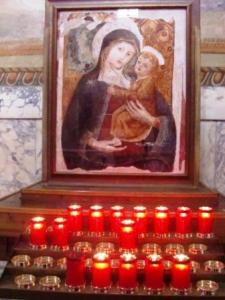 In this month of Mary’s May, we thank Our Mother Mary for saying yes long ago in a village called Nazareth. Her fiat made all the difference to the world, our world. Our fiat makes all the difference too.
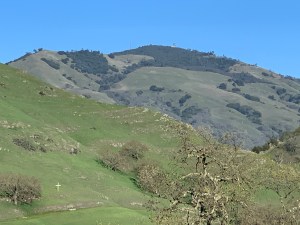 It’s a beautiful spring day here in the Bay Area, a time to appreciate the beauty of the natural world as it is reborn each year, giving us a good greening before the dry season turns the grasses brown.
 It is said that when writers send their manuscripts out into the wide wide world it is like sending a child away to school. At some point, we just say, okay, fly. But don’t forget who created you! Still we think of all the changes and additions we still need to make – create another plot line, another character, another setup and payoff, another scene, another dialog. That’s when I tell myself, breathe, breathe, breathe the name of Jesus.
 We had a lovely annual Church Synod last week, another extended family gathering of the faithful which is one part reunion, one part inspiration, one part meeting and greeting, one part fellowship, and many parts encouragement. We live in a challenging time for the Church – any church – a hostile time in which we must not throw pearls before swine, must choose charitably, desire dutifully, and trust Our Lord completely. We are the music of the mountain (plot spoiler), each note, each hymn, each concerto. We all play our part.
 Thinking about my draft again, and all the stories I didn’t tell, all the loves I wanted to include, all the mysteries and miracles of life that are stacked in folders all around me that didn’t make the cut (there’s still time I tell them). At the end of the day, what I have not packed into these chapters is huge and daunting and waiting to be included. Alas, I tell them, sometimes less is more…?
 Happy Eastertide to all!
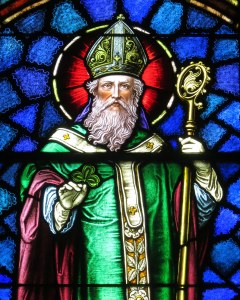 Happy St. Paddy’s Day! And Passion Sunday. And the Fifth Sunday in Lent. We journey together within the Passion of Christ, to Palm Sunday, Holy Week, and Easter, Resurrection Day. My bishop of blessed memory often said that passion is the union of love and suffering. At the age of 76, I think I am beginning to know what he meant.
 I’ve enjoyed writing a bit about Heaven in my current novel, as I did in Angel Mountain, using theological texts as well as Near Death Experiences. I don’t make things up from whole cloth, but journey into the what-ifs that are presented by other witnesses.
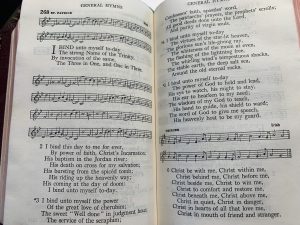 St. Patrick is said to have authored Hymn #268, “I bind unto myself to-day/ The strong Name of the Trinity/ By invocation of the same/ The Three in One, and One in Three. It covers the Faith in five verses that ride a powerful melody of serious commitment, a binding, an oath taking. Then the tune shifts to a light dance calling on Christ to be “with me, within me, behind me, before me, beside me, to win me, to comfort and restore me, beneath me, above me, in quiet, in danger, in hearts of all that love me, in mouth of friend and stranger.” It’s a hymn, an oath, to the Trinity, one of the doctrines developed by the Early Church and debated. It clearly is a teaching hymn as most were and are, full of theology, images, words, all helping us understand who we are and who we are meant to be.
  Many of my ideas come to me while sitting on a folding chair in our Berkeley chapel and singing and praying the Mass. Today an obvious thought landed in my aging brain, that there is a parallel between the story my main characters are acting out and the history of western civilization.
 But what occurred to me during the liturgy today was that what they are doing in the pages of The Music of the Mountain is what the monks did in the northern monasteries of Europe in the early medieval world when they copied manuscripts to save the classical/Christian world from disappearing. This is the thesis of the wonderful history by Thomas Cahill,
  And so as we consider memory and memorizing and remembering. Like my four friends, I am working on my Psalm, and this year I might actually have it down, but the last line keeps eluding me. Still, twice daily I feed on Psalm 139, as we feed on the loaves and fishes multiplied in the Gospel this morning, as we feed on Christ himself in the Eucharist each Sunday, as we travel to Jerusalem and the great events of salvation and resurrection.
 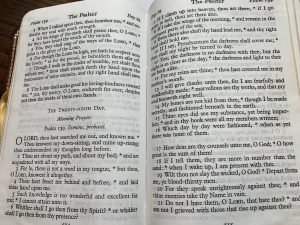 O Lord, thou has searched me out and known me…
 This may be the greatest human error of all, to not face up to our failings. I believe that a good number of women who rally and march for “a woman’s right to choose” have made the wrong choice in their past. For them to protect the unborn today would mean they must face what they have done.
 O Lord, thou hast searched me out and known me…
 Having finished a first draft of my novel-in-progress, The Music of the Mountain, I find I need a concise description to answer the question, “What’s it about?”
 I believe also, that each one of us is necessary to the plan of salvation. Each plays their part, if only to link to another who links to another who links to another… until we form a sentence, a paragraph, a chapter of God’s will for mankind. Usually, we have no idea who might be the one who links to us, or who we are linking to. Who reads these words, who hears a sermon, who takes an idea from a book or a person and sends it flying through the stratosphere to someone else. Every person counts in God’s plan, and when one is lost (that lost sheep) another must be found. We are letters in the word, cursive dancing across a page, joined with others to form phrases and sentences, that fill the Earth in life and the Heavens in eternal life. My bishop of blessed memory often consoled me with the words, “Nothing is lost. Everything counts.”
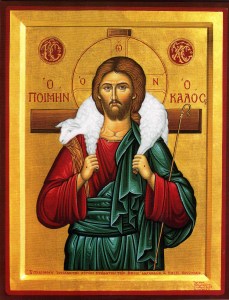 Christians believe in a personal God, a God that makes a difference in our lives and in our deaths. He is with us, Emmanuel. The shepherd boy David knew this in his songs in the fields, so that God could mold him to become the origin of the “Line of David” that would send forth the Christ to save the world. No small thing. He was chosen from the Chosen People of Israel and one can see why, “For my reins are thine; thou hast covered me in my mother’s womb.”
 That is what Lent is, singing our song of life here among the living, choosing the good and rejecting the evil, cultivating Christ within us to rise on Easter morning.
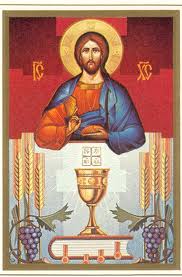
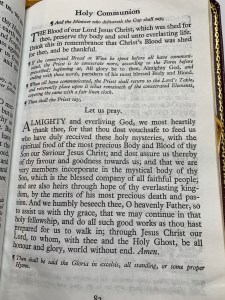 My new memory work is a Eucharistic prayer of thanksgiving, usually said by the celebrant, but in our chapel the people join in. I almost have it down, but phrases keep eluding me so I’ll work on it a bit each evening:
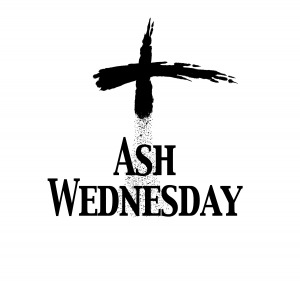 This week we observe Ash Wednesday, the day when Christians are reminded of their mortality with an ashen cross drawn on their foreheads, as they hear the words, “Remember o man, that dust thou art and to dust thou shalt return.”
 And so we shall become perfect in our new lives, on the new Earth, in the New Jerusalem. What must we do in the Earth-time meantime? We must learn to love, for loving others as God loves us teaches us how to grow into what we are meant to be. It can be no other way. Love is the creative force that lives within us and opens the gates of Heaven when our time comes.
 God’s love for us means we have meaning in our lives today and everyday that we open our hearts to him. Every day we close our hearts we invite despair, for the absence of God in us kills hope. In this same passage we are told by Paul that faith, hope, and charity abide, but the greatest is charity. And yet we must have faith to hope to love.
 Christine Sunderland
