Tag Archives: Christmas

The Story of Christmas

Flight into Egypt, Giotto, 1311

Flight into Egypt, Giotto, 1311

Today, the fourth day of Christmas, is also the day we remember the Holy Innocents, the children slain by King Herod. 

The story of Christmas is a story of love, joy, and peace, but woven through it is also deep malice, murder, fear, and escape. In this sense it is a classic human story. It is a story that includes each of us, weaves us into its joy and pain. We experience Mary’s confusion when she learns she will be with child, without a husband in a culture that stoned women for this offense. We hear her faithful and mighty “be it unto me…”, her assent. We follow her to Elizabeth’s and know the joy of her holy child moving in her womb. Then we travel with Mary to Bethlehem for the tedious business of government taxation. We follow her, as she follows God. We hear the innkeeper send the holy family to a hillside cave, to give birth among the straw, among the animals, like an animal. 

The story of Christmas is our story, our human story of redemption, and each of us is woven into it through the miracle of time. A glorious king is born in a humble stable. Angels appear to shepherds and announce the birth in song. The shepherds listen and follow. Wise Men from the East follow a bright star to worship the Christ Child. They too, listen and follow.

But this is not fiction or fable. This is history, the real world of the first century in the Roman Empire, where passions burn, where bad things happen. Herod plots to kill the newborn king, a perceived threat to his own throne, and slays children under two years of age in Bethlehem. As Jeremiah prophesied, “there was a voice heard, lamentation, and weeping, and great  mourning, Rachel weeping for her children, and would not be comforted, because they are not.” And we weep too for these children. We weep for our own children lost each year.

And so we remembered them today, on a clear crisp day in a parish church in Oakland, California. We remember this violent loss of innocent life, these holy innocents. Even in this great event, the birth of the Son of God, human will is not circumvented but allowed its freedom. Herod may act, just as others have acted throughout history. What God offers his precious children is a way out. He sends angels to guide us, to point to the right path. We have the choice to listen and follow, or to turn away.

It is, of course, an angel who warns Joseph in a dream to flee to Egypt to escape Herod. And it is an angel who tells Joseph to return to Israel after the death of Herod. Joseph listens and he follows. “And he arose, and took the young child and his mother, and came into the land of Israel…and dwelt in a city called Nazareth.” (Matt. 2:21-23) And so another prophesy was fulfilled, that He would be called a Nazarene.

The drama of the Christmas story has been cloaked with sweetness and light, an iconic beauty that is not unfitting. Yet the world of the Holy Family was not so unlike our own today, as we watch young martyrs die in Iraq, and allow holy innocents to die in the womb.  Our story is the same story, one of choice, to listen and follow or to turn away. We can be part of God’s story or be part of chaos and death. We must choose, and these are the only choices. There is no middle way.

And in order to hear the angel’s voice, we must be part of Christ’s Body, the Church. We must follow the commandments given, to love one another, to worship God on Sundays. Only within this world, this baptismal font of life, can we hear God’s voice. And through sermon, Scripture, and Sacrament, in time we come to understand what we are hearing. We approach the vision of God. We enter the vision.

We are part of this Christmas story and we must tell it again and again. We gather our families on this holy day to tell the story. As my own family read, in turn, from Luke 2, each person taking a part, I was filled with a joyous peace. God was with us there in that small gathering of fifteen, from Aurelia, 9 months, to Rudy, eighty-four. The tree twinkled, and a grandson, age fourteen, began, “And it came to pass in those days, that there went out a decree from Caesar Augustus, that all the world should be taxed…” God smiled on us as we told the story of his birth in Bethlehem. The angels sang with us, “The First Noel, the angels did sing…”

This story of God’s love is a story that is being proved by science, more and more each year. Eric Metaxas, author of Miracles: What They Are, Why They Happen, and How They Can Change Your Life, recently wrote in the Wall Street Journal that science is now making the case for the existence of God, an Intelligent Designer. Mr. Metaxas writes that “the odds against life in the universe are simply astonishing.” And that includes our own good Earth. The predictions of Carl Sagan in the sixties that life might exist on other planets have been discredited by scientific numbers. What happened? Where did we come from?How does life exist? Atheists are reconsidering.

If we are wise men and women who seek the truth about our created world, we will look to Bethlehem. We will see ourselves there, caught in the drama of existence, the struggle between good and evil we know so well. We will listen to the angels and follow the star. For the story of the journey of Mary is the story of Christ in us, with us, as he was in and with her. It is the good news that the Intelligent Designer is this same God.

The baby born in Bethlehem on that starry night is God’s love letter, his Word incarnate, written on our hearts. “Be not afraid,” he says, “I love you… I am with you always, even unto the ends of the earth.”

Gloria in Excelsis Deo!

The Nativity of Our Lord

I was thinking about the weaknesses of the flesh, especially the aging flesh, as I realized I had driven off to church and the Christmas pageant, without my glasses. I turned around and retrieved them, so all was well, and I could read my lines and music, gold halo on head, white robe donned, even wings yearning to fly. After all I was an angel, a key role in the Heavenly Host.

But now, this afternoon, reflecting on this morning’s beautiful Fourth Sunday in Advent, it is fitting to consider our decaying bodies. It is fitting to tell the story of Christmas with every generation present, to tell the story of the glorious Incarnation. It is fitting to include the prequel of Adam and Eve and their tragic decision about that apple long ago. Our flesh, after all, is what incarnation is, a word meaning literally, in the flesh. The Incarnation itself, that moment in history two thousand years ago when God took on our mortal flesh to reverse that choice in the Garden of Eden, is an event we have come to know as Christmas, derived from the Old English Cristes moeses, “the Mass of the festival of Christ.” 

The Incarnation of God in human flesh, Christmas, while certainly overladen and hopefully not disguised with modern excess, still celebrates the kernel of this festival of love. Gift-giving is about love. Hospitality is about love. Christmas concerts celebrate love. The story of Saint Nicholas, fourth-century Bishop of Myrna known today as Santa Claus, is particularly about love. We delight in love when we light the fir tree to honor the Tree of Life, the Cross, for indeed, the tree that bore the tragic fruit becomes the wood that holds the loving sacrifice for mankind. Mary is the new Eve, Christ the new Adam and the bearer of the fruit of salvation, the giver of incarnate love.

So the other day, when the huge fir tree worked its way through the small backdoor of our home and the needles flooded our living room, making quite a mess, I embroidered the event into my tapestry of Christmas. When I climbed the ladder to string the lights and run the garlands glittering and dancing through the greens, I embroidered the moment into my tapestry. When I crouched under the lower branches and poured two jugs of water into the bowl (a thirsty tree) I wove this action, which has become over the years its own ritual, into my Christmas tapestry. These are the small ones, the blessed ones. There are so many other rituals and symbols, far more famous: the evergreen wreath with its symbols of life, the candles with their flames of light and hope, the glorious music (Handel, Bach, Vivaldi, to name a few) and the charming carols that retell the story again and again. So rich a season! So rich a tapestry! The beauty may be too great to bear.

But I shall wait for Christmas Eve for the ornaments, collected over the years, to be hung by one of our grandsons. And I shall wait for many more moments like this, this week of Christmas, and shall weave them into my life. 

All the rituals of Christmas, and they vary from family to family in details but not essentials, express this stupendous miracle, one we can’t find words for: love come down among us. C.S. Lewis said that there is a difference between believing in a god and believing in this God. This God, this specific God, makes it clear that there is nothing vague about Christian belief, and who this God is, what he is like, what he does for us. It is as though the sensory details of our physical world, our bodies, are part of this God, this Creator. He knows us; we reflect him in some mysterious way. He became one of us to know us better. And since that moment outside Bethlehem when eternity intersected time, the world has been changed. We saw love incarnate. We saw truth and we saw beauty and and we saw goodness. 

Christ, the Son of God, taught us how to be changed. He gave us ways to heal our corrupt flesh, our destructive selfishness, our hurtful pride. Love one another, he said, as I have loved you. 

But, many ask, how do we know this child in Bethlehem, this carpenter from Galilee, is the Son of God? Wasn’t this all made up by fanatics? 

We know this because of the resurrection stories that refused to die. Because Jesus the Christ (Greek for the anointed one, messiah in Hebrew) conquered death, and thus he was divine, outside mortal time, with power over mortal flesh. Because he did these things, and we trust the accounts, we listen to him. His words speak deeply to us about our lives, our world, and how to love one another. He perfects us through simple belief, repentance, and intention to follow him. He raises us with him through his own death and resurrection, for that wood of the Cross bridges Heaven and Earth, God and Man, Love and Un-love. But we must experience our own “little deaths” of self to find our true and beautiful and good selves. 

We know this carpenter was the Second Person of God because of the foolhardy yet loving behavior of his followers, the first Church. These were ordinary folk who changed dramatically, caring for the poor, protecting human life, irrespective of age, gender, race, born and unborn. He preached that the poor in spirit will inherit the Kingdom of Heaven, the mournful will be comforted, the meek will inherit the earth, those who hunger for righteousness will be filled, the merciful will be shown mercy, the pure-in-heart will see God, the peacemakers will be called the children of God. The two “Beatitudes” that follow are warnings to his followers about their future martyrdoms. And it is these martyrdoms, beginning with Nero in 67 A.D., that powerfully witness to this Galilean carpenter being the Son of God. These saints believed he was divine, and in this sense were in love with him, and they died painful deaths to witness to their belief, and to their love. They changed our world forever. 

And so, as I took my little place with the other angels and shepherds in the chancel of our parish church, and as I gazed upon Mary and Joseph and the baby (we had a real baby this year, three months old), I gave thanks. I gave thanks for another year of life, but more importantly, another year as a Christian. For my Christmas tapestry is growing, as I added another pageant to my weave. My fellow Christians dance among the threads, singing and praising God, Gloria, Gloria, Gloria in excelsis Deo, the heavenly angels’ song to the earthly shepherds that starry night, Glory to God in the highest and on earth peace, goodwill to men.

Deo gratias and Merry Christmas!

Gaudete Sunday

???????????????????????????????The heavens opened early Thursday morning, and rain poured upon our California soil, slaking the thirst of the earth but soon bursting gutters and filling low places with floodwaters. In drought-plagued California, we didn’t dare complain, but were thankful.

We live in the foothills of Mount Diablo, and while our house is on bedrock, our northern hillside falls steeply into a ravine. Friday morning we noticed part of the fence was missing, and it had taken some of the landscaping with it as it slid to the bottom of the hill. I thought, as I have thought many times, how suddenly nature makes short work of man’s efforts to tame her, shattering our pride.

The earth is drying out now, and this morning we headed for church, bundled up for temps are in the low fifties (cold for us). The skies had changed from threatening to sudden beauty, with white clouds scuttling against brilliant blue patches, the low sun clarifying the air as though trying to fit more light into shorter days.

And in this winter-scape we prepare for the light of the Incarnation, to me always a stunning event, one repeated in a different way on humble altars in glorious Eucharists. It is Advent, and we prepare for Christmas, the coming of the Christ Child, God becoming one of us, with us, Emanuele. We celebrate the love, sacrificial and humble, of a God who loves his creation so much that he would do such a thing, that he would be born in a manger-cave, among animals, to a poor, devout Jewish couple who believed in his angel messengers and obeyed them.

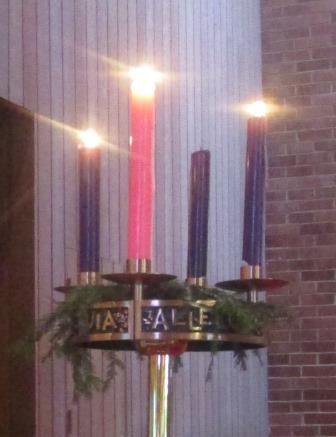
And so, stepping into the warm nave of our parish church, the symbols of the space textured this story of miraculous birth. The Virgin Mary and her holy Child stood to the left, Gospel side, a bank of votives flaming at her feet. Three of the four Advent candles in their bed of greens had been lit (two purples and one rose). The American flag stood proudly, a testimony to our freedom of worship. Against the red brick apsidal wall, the white marble altar was draped in purple, and six tall tapers burned on either side of the purple-tented tabernacle. A crèche set in greenery, to the far right, Epistle side, told the humble story of glory, this huge contradiction, one of many fascinating ones in our faith, of glorious humility. Somehow true glory can only be found, we are told, in true humility. Somehow true joy can only be found in true sacrifice. Somehow the Creator must become part of his creation to save it from itself.

I love Advent III, called Rose Sunday, Gaudete Sunday. We light the rose candle along with the first two purple candles. Today is Gaudete Sunday because of the opening prayer, the Introit: Gaudete in Domino semper, or Rejoice in the Lord always… Rose Sunday is a break in the penitential purple of Advent, and this is the only Advent Sunday we have flowers on the altar. We emphasize the joy of anticipating Christmas rather than the penitence of preparing for Christmas.

In the daily readings of the Morning and Evening Prayer offices, the mood is definitely one of penitence and preparation. Most of the readings have been Old Testament prophecies, warnings, and judgments in Isaiah and the Psalms. We read the early chapters of the Gospel of Mark, of the beginnings of Christ’s ministry, but not the Christmas story, not yet. But most fascinating are the chapters in Revelation, or The Apocalypse, the great vision given to St. John on the Island of Patmos, detailing the end-times, the last days, the Second Coming of Christ.

We have been immersed in these daily prayers, not reflecting the coming of Christ to Bethlehem but reflecting the Second Coming of Christ in Judgment. We are “woken up” with these future realities, these warnings and visions, given a “heads up.” Are we ready for Christ to come? How will we fare when judged? Have we loved enough? Have we cleaned out our hearts to receive him? For he will not enter a cluttered heart fettered with sins, the detritus of selfishness and pride, envy and greed. There will be no room for him in such a heart. We need to make room for him.

So Advent, often called “Little Lent,” reminds us of the four great events, the adventures, to come to us: Death, Judgment, Heaven, Hell. How will we – our lives – be measured?

This morning I entered the nave of our warm parish church and knelt in a pew, giving thanks for the clergy, the people of the parish, and the freedom to worship. I asked God to clean out my little heart, to remove all the obstacles to his advent in my soul. My gaze fell on the purple-draped tabernacle and knew that this weekly ritual, this rite, would set me right with God. I knew that the habit of confession would serve me well in the time span of my life, would ensure that I have the time of my life, ride the waves of glory in this great adventure. I knew that, encouraged by the words of the liturgy – confession, absolution, the great action of the Mass, Holy Communion – I would unite once again with Christ, in bread and wine placed on my tongue. I knew that each Eucharist prepared my heart and soul, mind and body, for the great Feast of the Lamb that would await me in Heaven. And I wanted to be ready. I wanted as many Eucharistic feasts as I could manage before then, readying my heart and soul. I want to sing with the angels and the saints.

I also love Advent III because we usually practice (after Mass) for the Christmas Pageant. Young and old gather together to portray our story of redemption, beginning with the Fall of Adam and Eve and ending with the Nativity of Our Lord, the beginning of our salvation, the antidote to the Fall. Lessons are read and carols sung. We rehearsed today; next Sunday we don costumes and prayers and wings (I get to be an angel, and yes, even with wings…) We have a five-year old Mary and an eleven-year old Joseph.

The days are wintry and short. We prepare to celebrate Christmas, the year of our Lord, Anno Domini, A.D.  Some of this sense, this pairing of season with humble glory, has been captured by the poet Christina Rossetti:

In the bleak midwinter, frosty wind made moan,

Earth stood hard as iron, water like a stone;

Snow had fallen, snow on snow, snow on snow,

In the bleak midwinter, long ago.


Our God, Heaven cannot hold Him, nor earth sustain;

Heaven and earth shall flee away when He comes to reign.

In the bleak midwinter a stable place sufficed

The Lord God Almighty, Jesus Christ.


Enough for Him, whom cherubim, worship night and day,

Breastful of milk, and a mangerful of hay;

Enough for Him, whom angels fall before,

The ox and ass and camel which adore.


Angels and archangels may have gathered there,

Cherubim and seraphim thronged the air;

But His mother only, in her maiden bliss,

Worshipped the beloved with a kiss.


What can I give Him, poor as I am?

If I were a shepherd, I would bring a lamb;

If I were a Wise Man, I would do my part;

Yet what I can I give Him: give my heart.

 Christina Rossetti (1830-1895), “In the Bleak Midwinter”


 Yes, Advent is a time to give him our hearts: clean, ready, and open.

Thanksgiving for Hana

HANA-LANIThis Thanksgiving weekend we spent giving thanks for Hana, Maui. We arrived in the dusk of Tuesday evening, flying low along the coast from Kahului to Hana. Darkness was descending quickly and a thick fog enshrouded our small nine-seater plane. I knew that Hana Airport had no radar, and if we could not land due to poor visibility we would turn around and return to Kahului Airport, where we would need to rent a car for the two hour winding trip to Hana.

Suspended in the fog, it seemed we were floating. I began to pray. Then I sensed the plane had curved out to sea searching for visibility pockets, but it was actually making a different approach, coming in from the south. Soon we saw the coastline of land and sea, the gentle green shape of Ka’uiki Head reaching out from Hana Bay, with its lighthouse alight and welcoming, and soon we heard the wheels touch the landing strip. We rolled between the lights flaring along the sides of the runway. Safe. With bowed heads we maneuvered through the exit door and climbed down the rope ladder to terra firma.

The pilot explained he used GPS (I suppose I should not have worried) but when he said that he missed the “twilight cutoff” by one minute I asked what he meant. “I’m not allowed to land at the Hana Airport after twilight.” “Oh,” I said. One minute? My prayers were needed after all.

The temps have been on the cool side even for this rain forest on the eastern shore of Maui in the middle of winter, but in spite of winds and gray skies, rain has been mostly at night and we have been able to walk a bit. But the loveliness of Hana isn’t just the tropical temperatures, the palms, the roaring surf, the little drinks with umbrellas, but rather the people. Over the years we have come to appreciate this village that nestles under the volcano Haleakala, that is protected by Fagan’s Cross standing like a beacon on one of the green foothills.

And so I wrote Hana-lani, a love story set here, and in the dreaming and the courtship of words and phrases and sentences, as I married language that reflected the many colors, sounds, and fragrances, with the family and faith of Hana, I’ve been blessed by the warm hospitality of the folks that live here. We return to Hana, it is true, to rest, relax, and listen to the surf (and sip a few Mai Tais) but also to enjoy the people.

We are in our gentle years and not quite as active as we once were, but the paths that meander over the lawns of our hotel are kind and beckoning, with views of the sea and the spewing white foam. And from our veranda we can see Ka’uiki Head, the same scene that’s on the cover of my novel. At night, surf pounds and rain rattles the roof. In the day, we read and rest, and I create my next scene in The Fire Trail. And all the while, I say my prayers of thanksgiving as we slip into Advent and the marking of a new Church Year.

St. Mary's Hana compOur time in Hana has been appropriately bracketed by Eucharists celebrated on Thanksgiving and today, Advent I. We climbed the white stairs to St. Mary’s and entered through an arched portal into the airy space where prayers mingle with breezes wafting through open windows. It is a white church, set on a green hillside, Fagan’s Cross higher up, and the volcano behind that, and today the chancel was splashed with purple hangings for Advent. Four Advent candles nested in their greens and the Lady altar had been lovingly decorated with flowers (we joined in a Rosary before Mass). The polished wooden pews have comfortable kneelers, and for this I am grateful, because I like to kneel when I pray.
They say that gratitude is a good cure for depression (and drug-free), forcing one to turn outward and less inward, becoming a bit more selfless and a little less self-centered. I think there is truth in this, and it is also true that it is a good preparation for penitence, a cleaning out of the heart. For when I am thankful for the blessings of each day, beginning with the blessing of waking to the day itself, I am humbled. And in the humbling I see places in my heart that need cleaning out… dark corners where envy, pride, idolatry, sloth, gluttony, wrath, and all their many many relatives, have hidden. It is good to give my soul a good sweeping, to let the fresh air in, just as the breezes blow through the windows of St. Mary’s.

In this holy season I will re-learn the Advent collect in the Book of Common Prayer

ALMIGHTY God, give us grace that we may cast away the works of darkness, and put upon us the armour of light, now in the time of this mortal life, in which thy Son Jesus Christ came to visit us in great humility; that in the last day, when he shall come again in his glorious majesty to judge both the quick and the dead, we may rise to the life immortal, through him who liveth and reigneth with thee and the Holy Ghost, now and ever. Amen.

I will re-memorize these words and place them in my newly swept heart. I shall hold them close, so that I may retrieve them at any moment in any place during this holy season. They are words that sum up our hopeful faith and faithful hope, these sixteenth-century phrases of Bishop Cranmer. I would like to have that armor of light. I would like to rise to that life immortal. 

Advent St. JSo we trundled up the stairs to St. Mary’s and worshiped God with the lovely people of Hana. Many ages formed the congregation, and while I was pleased to see so many children, I was equally pleased to see the respect paid to the elderly. No one was left out, and we visitors were greeted with vine leis, a sweet kindness.

Sometimes we sang together in Hawaiian, sometimes in English, as we accomplished the “work of the people,” the Holy Liturgy, joining together in the great action of the Mass, with Scripture, sermon, creed, confession, consecration of the bread and wine, communion. In this huge prayer we took part in a drama enacted throughout the world and throughout time, and we sang with the angels and saints in Heaven. I think God was pleased with the offering of his children in Hana. 

We have entered Advent, the season of the coming of Christ Jesus among us, humbly as a child who donned our flesh and shared our sufferings, so that he could unite with us and carry us to Heaven. We now look to Christ’s coming again, his second advent, in glory to judge the living and the dead. Will we be ready? We are told it could happen now, tomorrow, the next day. So we practice penitence, as we wait for that glorious advent; we cast away the works of darkness and put upon us the armor of light.

The Light of Candlemas

It was with some surprise and great thanksgiving that I received word yesterday that my novel The Magdalene Mystery received First Place in the Feathered Quill Book Awards for 2013. 

I was surprised again when I woke this morning, recalling this bit of news, and when I saw that it was raining, however lightly (our first real rain in California for months), I became deeply grateful, thinking that perhaps the drought was lessening. But later as I entered the warm sanctuary of our parish church, leaving the cold outside, and stepped up the thick red carpet of the central aisle, I sighed in wonder. 

I knew today was the Festival of Candlemas, the celebration of the presentation of the baby Jesus in the temple in Jerusalem. I knew it involved candles and I even recalled we in the pews held white tapers that would soon be lit by acolytes, and we would light our neighbor’s, fire catching fire. But I wasn’t prepared for the brilliance of the candles on the altar as I entered: two large candelabra, each bank holding seven flaming white tapers, framed by eight giant candlesticks aflame. I had entered a holy home, this bright house of God and his fiery love. I was cradled by the warmth and light of the space, as the clergy and acolytes processed in, swinging incense and holding the crucifix high before the burning torches, the celebrant gliding royally toward the high altar with his royal gold and white cope. We sang with many voices joined together as one, “As with gladness men of old/Did the guiding star behold; As with joy they hailed its light, Leading onward, beaming bright; So most gracious Lord, may we/Evermore be led to thee…” (52).

The nave and sanctuary shimmered in the candlelight, a contrast to the dim and wet cold outside. And so we celebrated this moment in history, when God the Son moved from the private space, the home, and entered the public space, the temple. The light of heaven entered the darkness of our world. And thus we celebrated with light, the flame from the altar lighting our tiny wicks, the candles held so carefully, so hopefully, and we turned to light the next. 

We held our flaming candles as the Gospel was read from the central aisle. In this passage, Luke 2:22+, the elders Simeon and Anna witness the appearance of their Messiah. They had waited and prayed; they had been promised this moment. Simeon took the child in his arms, blessed God, and said, 

‘Lord, now lettest thou thy servant depart in peace, according to thy word: for mine eyes have seen thy salvation, which thou hast prepared before the face of all people; a light to lighten the Gentiles, and the glory of thy people Israel…’

These words, “Simeon’s Song,” have become a treasured part of our Evening Prayer Office. We re-affirm that we too have seen this salvation, we have seen this light that enlightens, we too know this glory that came to us from the People of Israel.

Today we ended the season of Christmas, forty days after this most holy birth-day, a time span set by Jewish law, the “law of the Lord.” Today we re-affirmed that the light of the world has come and continues to dwell among us, with us, enlightening us.

The Magdalene Mystery is largely about affirming that light. How do we know this remarkable God-story is true? How should we treat those first-century documents we call the Gospels? How do we know that the account of the empty tomb is an accurate witness? Did Mary Magdalene even exist, let alone see the risen Christ?

From Dan Brown to the Jesus Seminar to the “New Atheists,” folks have spent a good deal of time and energy trying to prove the Incarnation and the Resurrection did not happen. There must be much at stake. And there is. 

My little novel has been roaming the world since June 2013 when it first was released, when it was born. As an author I feel like a mother who has given birth and sent my child, my words, out into the world to fare one way or another, to hopefully provide a flickering flame to lighten some of the darkness.

So it is a sweet moment of delight that I experience this weekend, a time in which The Magdalene Mystery has been honored on this weekend of Candlemas, when Mary presented her son to the temple, and thus to the world. 

And now, as I glance out my window, I see the sun has burst upon my watered garden, turning the grays to greens. And I believe I see a dusting of snow on the top of Mount Diablo. 

Deo Gratias.

Epiphany Life

I was sad when I took the Christmas tree down this last week, so I played familiar carols as I climbed the ladder to reach the glittery star. The star came down without a fuss, but the garlands refused to go, remaining stuck in the brittle and sharp needles, so I worked them out gently. By the time I was finished, my hands and arms were scratched with the dead bits of gray-green, bits that once breathed life. I stacked the assorted boxes now filled with decorations in the garage and marked them “2013 Christmas.” I reached for a broom and began sweeping up, looking to Epiphanytide. 

Epiphany in our culture is largely lumped into Christmas and forgotten. Most folks don’t wait until January 6 to celebrate the visit of the Wise Men who followed the star to the manger. Most jump to New Years and now buy cards (according to the stores) for Valentine’s Day. 

But I have always loved the season of Epiphany, which bridges Christmas and Lent. Epiphany is the shining star itself – it is a time of discerning what Christmas means to us, what the full implications are of this extraordinary event in time. One of the most beautiful and concise statements of this illumination is in the Epistle to the Romans, the Anglican reading for this morning, the First Sunday after the Epiphany. St. Paul writes to the church in Rome:

“I beseech you therefore, brethren, by the mercies of God, that ye present your bodies a living sacrifice, holy, acceptable unto God, which is your reasonable service. And be not conformed to this world: but be ye transformed by the renewing of your mind, that ye may prove what is that good, and acceptable, and perfect, will of God.”  (Romans 12:1+) 

I have been recently praying for discernment about a certain challenge in my life, and St. Paul reminds me that discernment only comes when the door is open to God. We present ourselves as a living sacrifice, holy, acceptable, for God’s service. We are told that this might mean something uncomfortable, non-conformist, even counter-cultural. For we are transformed, not conformed. We have opened the door to God with the offering of ourselves. Now God is able to transform us, for he can enter in. How does he do this? By the renewing of our minds. And when our minds are renewed – through Scripture, prayer, worship – we are given discernment. We begin to know the will of God.

Knowing the will of God is, I have come to believe, pretty much a ticket to happiness. The problem most often is not knowing, not seeing through the haze of our blurred vision, a fog created by our own blocking of God’s entry into our lives. We call this, of course, sin – the lists of ways we close the door, blur the vision. But we can clear the haze and open the doors. The first step is offering ourselves to God so that the light of that Bethlehem star can shine into our hearts and minds.

I don’t want to be like my dead tree. I don’t want my faith, my spiritual life, my life itself, to be brittle and sharp. I want the beauty, warmth, and love of Christmas – God coming among us, taking on our flesh – to stay with me. I want to continue the transformation that began in the manger. I want to renew my mind again and again so that I can discern God’s will, so that I can know happiness.

I was thinking about this in church this morning. The nave and sanctuary were like my fresh tree used to be, full of color and light and sweet fragrance. The red carpet led to the altar where candles flamed amidst red poinsettias. Light streamed down from skylights onto the medieval crucifix and tented tabernacle. As I returned from receiving the Eucharist, stained glass transformed the sunlight into jewels that danced upon the oaken pews. I had entered Christmas, was inside the Incarnation, inside the beating heart of God.

Christmas, I knew, would always be with me, but only if I chose to open the door, chose to be part of Christ’s Body, chose to be transformed with the renewing of my mind, chose to be living and not dead.

The Light of the World

My Christmas tree is falling in upon itself. The branches no longer reach out. They bend down, spilling an even deeper sweetness into the room. As I gazed upon the tree last night, with the mini-lights still multicolored and twinkling, it was as though the tree had become solid and whole, no longer made of many parts, many decorations. The tinsel garlands had merged into dim shadowy beds of green needles. The miniature Raggedy Anns that I had strung across the apron of the tree, slept silently in their soft nests. One ornament had been batted down by one of our cats and its shards long ago swept up. But the others had sunk further into the dark hollows and had moved in. Even the star with its sideways tilt seemed happy with this home. The tree was nearly alive. 

I have become used to the Christmas tree occupying a corner of the room. My evening routine included lighting the tree so neighbors could see it through our arching windows. But the Twelve Days of Christmastide are nearing an end. I shall have to take the tree down soon. I shall have to remove the mini-churches dangling precariously from bits of wire, the red and gold balls with their fine filigree, the cut glass baubles with their Victorian fringe. I shall pause over each one, thinking when and where it was found or who gave it to me. The tree holds much of my family history, much of my past. 

With the turn of the year, as we round the corner and find ourselves in 2014, we turn our hearts and minds as well. We have pondered the old year and now embrace the new. We look ahead; we resolve to be better. We put away childish things, as St. Paul says, and don garments that bear the weight of adulthood, the resiliency of responsibility, the solemnity of choice. How shall we spend our numbered days in 2014? 

Those days grow longer, as the thin piercing light of winter takes on the mantle of spring. Already I’ve noticed the extra light, and it’s only been two weeks since the solstice. But the sun is still low in the sky, blinding in the beginnings and endings of the day, as though accusing me with its circle of seeing. I cannot hide in the shadow of winter. I must face the light of Epiphany and the new New Year. 

Shadow. Light. In the thin piercing light of the New Year, in the brightness of Epiphany’s traveling star, I resolve to watch and pray. I resolve to listen with greater care to hear God’s voice, discern his will for me. I resolve to begin my day with the aid of prayer and end it with the light of confession, to peer into my heart and expose the shadow. The wise men followed the star because they watched the heavens. They found the manger with its hosts of angels and dazzling light. They fell on their knees and worshiped, offering the Christ Child gold for his kingship, frankincense for his priesthood, and myrrh for his burial. I too want to follow that blazing star to Bethlehem. I too want to offer gifts. 

Christina Rossetti (1830-1894) wrote in her poem, “In the Bleak Midwinter”:

Angels and archangels may have gathered there,
Cherubim and seraphim thronged the air;
But His mother only, in her maiden bliss,
Worshipped the beloved with a kiss.
What can I give Him, poor as I am?
If I were a shepherd, I would bring a lamb;
If I were a Wise Man, I would do my part;
Yet what I can I give Him: give my heart.
 

Epiphany means “manifestation,” a revealing, and this visit of the gentile kings to the newborn Messiah enlightens the entire world of mankind, embraces all nations and all races. God is made manifest. Now one of us, he gives us a way to partake in his divinity, if we choose to do so. As one of us, taking on our flesh, Christ pulls us to him. With him we rise. With him we open Heaven’s door. 

As I take down my Christmas tree, I know that I have been once again reborn in that moment in Bethlehem. Christ is the star that lights the dead tree of our dying world, so that when our own flesh falls in upon itself on the last of our numbered days, we shall “rise to the life eternal.”

Yet what can I give him as I enter this glorious Epiphanytide? It’s so simple. I can give him my heart.

Christmas Choices

It often seems when our family gathers at Christmas that the many activities, the many foods, the many gifts, the many reunions of cousins and brothers and sisters, fill the rooms to bursting, leaving no room for the story of the Incarnation. So, unhappily, on the birthday of Our Lord we are pulled away from him, away from the story of the Word made flesh, and God’s still small voice is muffled by the loud chatter of Christmas.  So I tried something new this year at our family gathering.  The grandchildren (age 12 through 20) read the nativity story aloud as we sat before the twinkling tree and the crèche figures arranged to the side.

The tree was bright and shimmering against a window of foggy sky, but the crèche – the fired clay figures of Mary, Joseph, the Christ Child, the shepherds, the wise men, the sheep and cows – was dim and gray-blue, almost shadowy, set upon the river-rock hearth. The rough clay figures seemed more real than the fir tree, as though they were earthen, solid, but somehow eternal.

Our readers began with the words of St. Luke, “The angel Gabriel was sent from God unto a city of Galilee, named Nazareth, to a virgin espoused to a man whose name was Joseph, of the house of David; and the virgin’s name was Mary…” These words tell of the great event we call “The Annunciation,” when Gabriel announces to Mary that God has chosen her to be the mother of his son. It is a precious and fabulous moment in history, for while Mary was chosen, she still had to choose.

Sr. Mary Gabriel Whitney OP of the Dominican Sisters of Mary, Mother of the Eucharist, relates this pivotal moment in a charming ballad included on the CD, Mater Eucharistiae: 

And so on that day
The whole human race
Held its breath to hear the answer
Of the Queen of Grace.
 

The whole human race. Indeed, we all held our breath.

My grandchildren continued St. Luke’s account. We heard how Mary visited Elizabeth, mother of John the Baptist, and how Mary sang the song we call The Magnificat, magnifying and rejoicing in God her savior. We learn of the historical census decreed by Caesar Augustus, how Mary and Joseph went up from Galilee to Bethlehem, the City of David, how she brought forth her firstborn son, wrapped him in swaddling clothes, and laid him in a manger, because there was no room for them in the inn. We then see the bright angels appearing to the shepherds and bringing the good tidings of great joy… that a savior has been born, who is Christ the Lord, and they would find him wrapped in swaddling clothes, lying in a manger. We learn of the wise men from the East who follow a star to the manger where the young child was. Finally, we hear how all fell down on their knees and worshiped the Child.

It was a short reading, but the story of the Incarnation settled upon our souls, warming us. For a few minutes we recalled why we were celebrating on this 25th of December, 2013. For a few minutes we re-called the Lord of Hosts and his awe-full act of love, coming among us as he did.

I often think how God chose to come to his people, in this moment in time. I think of Mary and her choice, her answer. I wonder at the choices we make minute to minute, day to day, the power each of us has to shape our world by what we do or do not do. In a way, the whole human race holds its breath to see what choices each of us will make this day, this hour, this minute. For every choice creates our future as the People of God and as the people of the earth.

This morning I worshiped at First Presbyterian Church in Berkeley with my son, his wife, his son (11), and his daughter (8). My father, my son’s grandfather, Carl Thomas, was youth pastor there in the early fifties (I was five), and today my son attends a Presbyterian church in Boulder. So I sat on the long cushioned pew with my son and his son, and thought of my father and his charismatic, loving ministry. The pastors today no longer wear the long black academic robes my father wore. The building from the fifties had been replaced by a modern one in the eighties. But the cross stood strong and present before us, and the simple service echoed my childhood memories.

Thick candles burned and large tables of sand stood to the side. Long white tapers were laid out nearby. The pastor asked us to consider the old year, the ways in which God had answered our prayers and the ways in which we thought he had not. He asked us to pray for the new year, one in which God would be present in our choices. Earlier, a speaker had said he had gone on a mission with open hands and had returned filled and transformed. So we prayed into the silence, reaching deep into God’s heart, and then, one by one we rose, lit a taper and gently shoved it into the sand. Soon hundreds of candles burned before us, each one reflecting a prayer to choose with open hands and hearts. I lit my candle off my grandson’s and shoved it into the sand alongside my son’s. 

As the Twelve Days of Christmas bridge the Feasts of Incarnation and Epiphany, they arc New Year’s Day. It seems a fitting cluster of events: the Word made Flesh, dwelling among us; the old year turning into the new, and our consideration of past and future, our choice-resolutions; and finally, the manifestation of the Word to the world, the light banishing all darkness.

Each of us plays a crucial part in this pivotal time. We are part of the greatest drama on earth. We look back to Christ’s coming in Bethlehem, and we look forward to His second coming to earth, this time in judgment and glory. We make our New Year’s resolutions, choosing his light, opening our hands to be filled with good things, so that we may be transformed, so that we may magnify the Lord. 

Like the Queen of Grace, we pray, “Be it unto me according to thy word.”

Great Expectations

Much has been written about holiday stress. I think it’s largely the excitement of great expectations.

America was founded as a Christian culture, and so Americans celebrated through the centuries the great festival of Jesus the Christ’s birth, the historic story of God becoming man. The eighteenth and nineteenth centuries enhanced Christmas with many rich traditions and glorious music, and it is this European Christmas (particularly from Germany and England) that provided us with wreathes, Christmas trees, and Saint Nicholas. When, in 1823, an American named Clement Clarke Moore wrote a poem called “The Night Before Christmas,” Saint Nicholas became a marketing opportunity not to be missed. The Santa spin-offs are familiar to us today as gift-giving required gift-buying, a boon to the December economy.

It is also true that in our American religious melting pot, the Christian story became diluted, nudged gently into the background, to be increasingly adapted to other beliefs so that folks from other traditions could join our celebration of Christmas. The story of the holy child born in Bethlehem, the fearsome angels who sang to the shepherds, the bright star that led the wise men to the manger-cave, became replaced by Rudolf and Santa and other elfin tales, but Christmas was still a time of excitement. Hollywood helped keep this altered  (and stunted) version alive, to be sure. Sleigh bells rang, jingle bells jangled, and Frosty the Snowman took center stage. The Grinch stole Christmas. Even the charming Dickens story of Scrooge, while focusing on brotherly love and remorse of past deeds, didn’t tell the story of God becoming man in Bethlehem. Charlie Brown and his Peanuts insisted that even scraggly Christmas trees are valued, a true morality tale, even if the Christ story wasn’t actually mentioned. Santa received his mail in the North Pole; letters were carefully scribbled by hopeful children. Sometimes the Christian story – this story of God coming among us, revealing his love so tangibly and historically, almost too good to be true – is simply sidetracked with an emphasis on a children’s pageant gone wrong or right, or stories focusing on the rituals themselves, as though these symbols and mysterious behaviors appeared from nowhere.

My generation, those baby-boomers who grew up in the fifties, lived and breathed these traditions and all the excitement of waiting those twenty-five days in the cold of winter. We loved Christmas, and still do. We waited and we watched, and we wondered if we would get even one thing on our careful list. On my tenth Christmas Eve, I peeked out my bedroom window and saw my father carry a bicycle from the garage, into the living room. I grew up a little that night, but even so I still believed in the God of Bethlehem, being a pastor’s child. And even after the Santa let-down, we continued to love Christmas – the colors, the songs, the smell of fir and pine and apple and cinnamon. We loved the garlands and the glitter and joining with others from church to sing carols to the aged and the ill. It was magical. It was mysterious. It was holy.

In fact, we invested a great deal of ourselves into this holiday, unlike any other holiday during the year. Sure, Christmas marketing added to the hype over the last few decades. But every year we wanted Christmas to be, well, Christmas. We had and have today great expectations. 

Now grown-up with children of our own and grandchildren too, we bake and we buy and we decorate our homes. Our “to do” list has nearly buried some of us with deadlines and time challenges, and we say we are stressed. We buy more, wrap more, and eat more, borne on this powerful desire, or perhaps a needy greed, to make the joy of Christmas Day meet our great expectations. Even Christians find it difficult to find time to go to church, to visit the needy, to say their prayers. Even Christians forget the true meaning of Christmas, so distracted we are by meeting our own expectations.

It is no wonder folks feel stressed. But I think such stress, such excitement, such looking forward, is also a reflection of the huge importance of this holy day and of the looking forward to Heaven. God cannot be forgotten. The story of Bethlehem will not be buried by reindeer and sleighs. Indeed, the traditions and the seemingly secular stories reflect the Christian God-story. They remind us of this historic event, ask us to recall and re-member the hope of Heaven we are given in this child, Jesus, Christ the Lord. Candles burning are lights in the darkness. The tree is new life shimmering with the light of heaven and the color of joy in the ornaments and tinsel. Santa flying through the sky demanding we be nice not naughty reflects the God of the Ten Commandments, of the Second Coming and the Judgment, and Santa giving magical gifts reflects the God of mercy, love, forgiveness. He is a Santa who, as a reflection of God, lands on each individual roof, goes down each chimney, arriving inside the heart of the house, the hearth. Like God the Son, he comes to earth to give us gifts. He wants us to be with him in eternity, to climb onto his sleigh and soar into the sky. He wants us to know how much he loves each one of us, holding us in his huge heart, calling us by our Christ-ian names.

All of these rituals create mystery and miracle. All of these help us re-call God among us. We know in our hearts that God is Emmanuel, God-with-us. We know even in this fallen world of suffering and sickness and sin, that God will and does redeem us, if we want him to.

We have great expectations of Heaven. At Christmas we desire to recreate a little of that Heaven on earth, in our homes and gatherings. We open the doors of our homes to guests bringing in cheer, coming in from the cold dark into the warm light. We open the doors of our hearts to loving each other a little more. We open all these doors to God the Son, the Christ Child in Bethlehem, the one who makes Christmas for each of us come true.

And the Word was made flesh and dwelt among us, and we beheld his glory, the glory as of the only begotten of the Father, full of grace and truth.   (John 1:14)

The Adventure of Advent

This morning in church I thought how rich a season this is, this season of Advent, this season of coming, these four weeks in which we prepare for the Feast of the Incarnation, the festival known as Christmas.

I continue giving thanks, thanksgiving that our culture still recognizes the feast of Christmas. There remains among us a spirit of giving, of love, of sharing. True, we are bombarded by ads and the commercialization of this pre-Christmas time, but even so, the ads enjoin us to give, to buy gifts for friends and loved ones. St. Nicholas with his bags of gold for the maidens who wanted to marry returns as Santa Claus in the malls to question children as to their gift lists. His presence (and presents) assures them this is a magical, a mystical, season.

True also, we as a culture seem to have lost the reason for the magical mystery that weaves through these twenty-five days. Yet weave into our hours and days it does, and we buy fir trees to festoon with lights and hang sparkly, memorable ornaments on bits of wire. We light our trees and stack our gifts, mysteriously hidden beneath wrappings and ribbons. These traditions pull us through an unbelieving desert, a parched time, hopefully to a time of belief once again.

Those of us who believe already in the Incarnation of God in Christ in Bethlehem two thousand years ago, a historical intersection of eternity with time, sometimes become impatient and critical of the mania that seems to possess the rest of us, according to the media, as though their madness pollutes our holy time. But perhaps we should be grateful that folks want to buy gifts for others, and that retailers offer discounts so that they can do just that.

Those of us who believe already in this God of love and joy and salvation and eternal life need not pay much attention to the crowds storming the stores. We begin a lovely and sensitive time, a delicious time, this time of little Lent, a time of waiting for the great Advent of Our Lord, the coming of this child born to a young virgin in a manger-cave. Today, on this first Sunday in Advent, we begin our prayers fitfully, each evening, saying the assigned Collect, a prayer that gathers us all together, collects our minds and hearts:

ALMIGHTY God, give us grace that we may cast away the works of darkness, and put upon us the armour of light, now in the time of this mortal life, in which thy Son Jesus Christ came to visit us in great humility; that in the last day, when he shall come again in his glorious majesty to judge both the quick and the dead, we may rise to the life immortal, through him who liveth and reigneth with thee and the Holy Ghost, now and ever. Amen.

We wait and we watch. We put upon us the armour of light. We lighten, enlighten, our homes to prepare for this great coming of Christ. We teach our children the meaning of the twinkling stars on the sweet smelling branches and the four Advent candles we light in turn each week, as we count the days and wait and hope and pray for our redeemer to come to earth. It is a dark time in a sense, a time of watching for the greatest light to appear among us, a light to banish the dark, a glorious light.

We sing carols to tell the ancient story, a story renewed each year, one that settles into our souls like seeds planted in fertile ground, seeds sprouting from our watering. The carols are part of the watering. Worship in church in Advent is part of the watering. The seeds feed too upon our prayers and the words we commit to our minds and hearts in these holy weeks.

Advent is a great reminder. It is a season set apart from the rush of shopping and decorating, or perhaps a season overlaying this rushing busy-ness. Somehow Advent intersects our time, just as God intersected all time and became one of us. Advent reminds us of the great truth, the great reality, the great love of God for each of us. For a few days and weeks in the cold of winter and the long dark of night we are reminded that our lives have meaning, that each of us is a star in God’s heart. We are reminded that “he shall come again in his glorious majesty to judge both the quick and the dead, (and that) we may rise to the life immortal…” We are told once again that God loves us… that he loved the world so that he gave his life so that we might have everlasting life. And it all began in Bethlehem on that first Christmas night. It all began beneath a starry sky as angels sang and shepherds knelt and kings offered their gifts.

So too we offer gifts to one another at Christmas. So too we kneel before the manger and before the altar where Christ is rebirthed with each Mass. So too as we receive him in this purple penitential season, our hearts are washed clean and our souls watered anew. So too we sing our praises with the angels on high.

Some call these stories myths. But myths are true. They tell the greatest truths of all, who we are, who we are meant to be. They answer the great questions why and how? They tell of God our creator, of Christ our redeemer. They tell us of love incarnate. These myths tell a glorious truth.

We light our Advent candles, the single purple one this first evening. Slowly, as we learn our Collect by heart, engrafting the words onto our souls, we change into something slightly different than we were before, something slightly more glorious, something slightly closer to heaven, something holy, as we taste a bit of heaven in this holy season.

This is the adventure of Advent, the coming of Our Lord upon earth.