Monthly Archives: May 2014

Thursday in Florence

Climbing the Stations of the Cross to San Miniato BasilicaOne of my favorite places to take photos of this Renaissance city, parted by the River Arno and rejoined by the many picturesque bridges, is the Piazza Michelangelo and then higher up the hillside, the Piazza San Miniato al Monte. Both are walking distance from the Ponte Vecchio, although a bit of a hike.

It was Ascension Day and a good day to climb the hill by way of the Stations of the Cross, a broad staircase still used on occasion for Lenten liturgies, with giant wooden crosses placed at intervals. I was perhaps the only one in sight that paused at each cross and repeated a prayer, making the sign of the cross and genuflecting, for I have been trying to increase my public witness bit by bit (grace at restaurants, etc.). At the tenth station, we arrived at the Piazza Michelangelo, where a broad viewing terrace welcomes tour buses, wedding photographers, and wide-eyed visitors snapping photos.
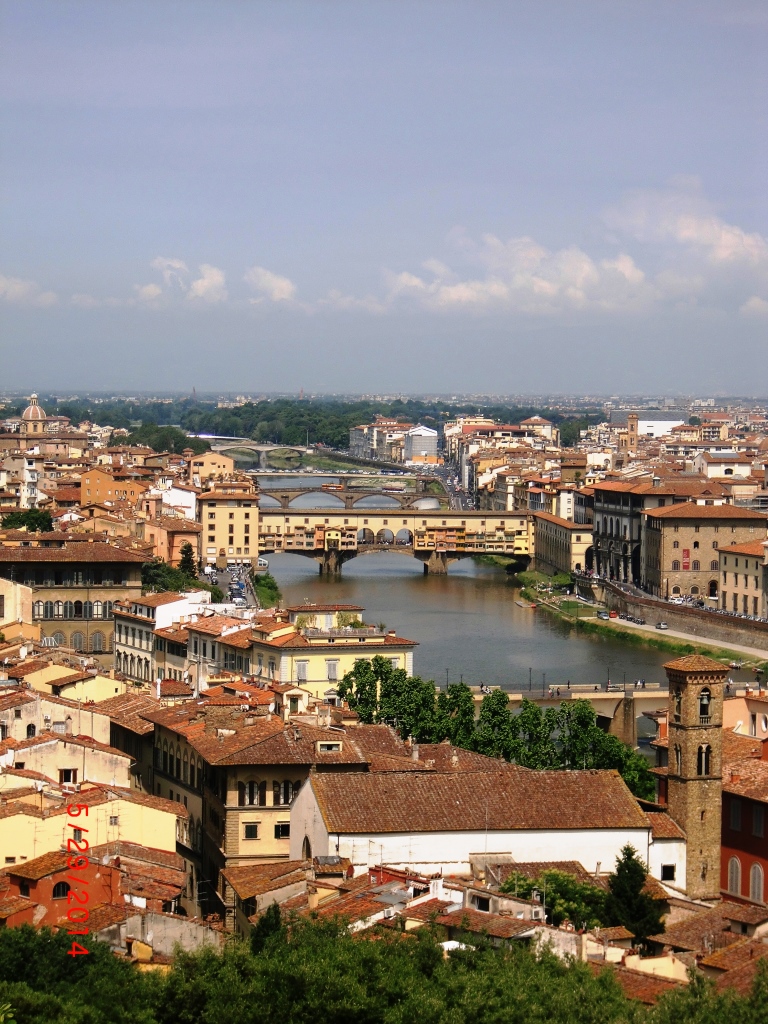
Ponte Vecchio from P. MichelangeloFlorence spread before us, a 180 degree panorama. The domes rose from the red tile roofs, the city bordered by the green Tuscan hills of Mary’s May. The skies were blue for the moment, a celestial dome much more expansive than Brunelleschi’s, an opening between billowing clouds blown by the wind.

We continued up the stairs, completing the stations, to San Miniato, a medieval-Romanesque basilica honoring an early Christian martyr. We have in the past heard Dominicans chanting the noon office in the crypt where the relics of the saint lie under the high altar, but today we heard only the sounds of school children and their guides, moving from one aisle to another, their faces rapt, looking up in wonder.

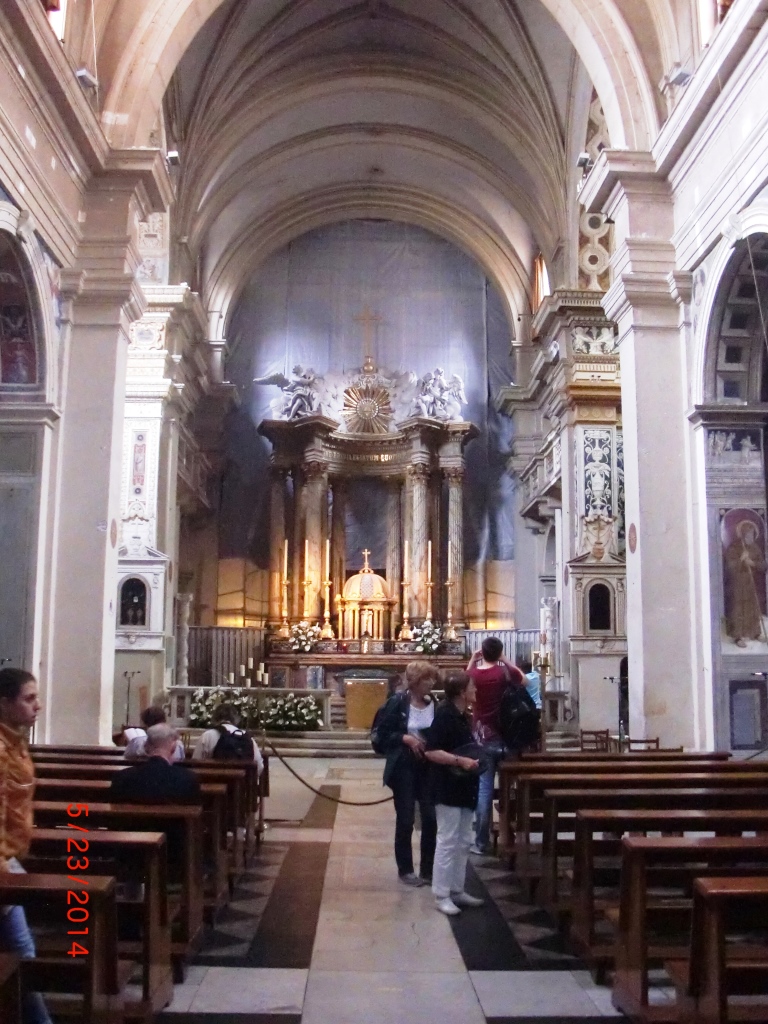
San Minato InteriorIt is a colorful church, with frescoes and mosaics and a haunting sense of the past, of the holy, of stepping into sacred space. We rested in a pew in the nave and I thought of Madeleine and Jack in my novel Pilgrimage who visit San Miniato, where she experiences another step in her healing. The church calls one to simplify, to be quiet, to listen to the still small voice of God. It’s vastness and its beauty filter into the heart just as perfect harmonies capture the ear. And perhaps it is the balance, the proportions of such a place that delight the eye. Perhaps it is the sense of history. Perhaps it is the mysterious mystery of God reflected in both the movement of the arched and vaulted stone and the pastel figures peering from the walls, these saints telling the story of God and his great love walking among us. My own concerns seem small in such a place, as though outranked by the luminous, but also there is a sense that they have been absorbed by God through my prayers. All I need do is give them up, give up my everyday worries and little fears. All I need do is say yes to God. God gives us the means to be happy, he shows us how. We merely need to say yes, to listen, to obey, to repent.
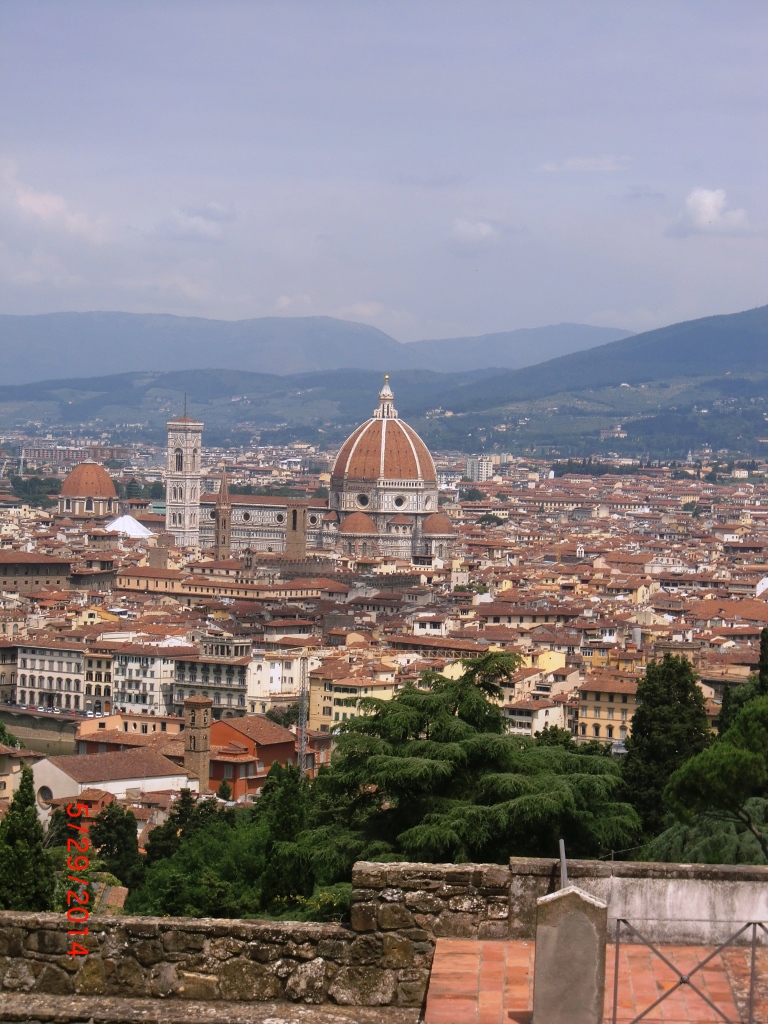
The Duomo from San MiniatoSo I generally do that, again and again, repenting again and again, saying yes again and again, as I sit in a pew and gaze about me in such a holy place. Finally, emptied and full-filled, I leave through the bright doors onto the even brighter gravel terrace as though in a trance, changed. Florence lies before me, the same but different, more a background to life than life itself, not nearly as interesting and colorful as the mystery of the heartbeat of God, of his coming among us, dying, rising, and ascending to Heaven.

Ponte VecchioWe followed the stairs down the hill to the river and found a cafe for lunch. We said little, contented with the peace of San Miniato, not wanting to lose any of it, holding it close. Words returned slowly, and we took more photos of the river and the quaint old bridge. We shared a some Chianti and pasta. We sighed and were thankful. It was a good Ascension Day, full of resurrection and new life.
Wednesday in Florence

Gift Shop, Fraternities of Jerusalem, La Badia, Florence

Gift Shop, Fraternities of Jerusalem, La Badia, Florence

We found the Monastic Community of Jerusalem on the Via del Proconsolo, in residence at La Badia (the Abbey) Fiorentina. Via del Proconsolo runs between the Duomo (the apsidal end) and the River Arno. We had heard these Brothers and Sisters sing the noon office in Rome at Trinita dei Monti and looked forward to visiting them in Florence. We stopped in early to visit the gift shop, Monastica (only open 10-12:15, 3-6:15 p.m. Tues-Sat, Mon, 3-6).

There was singing coming from the shop. As I looked over the cards, icons, and books, blue-robed Sister Sara explained that the CD was a new recording of the chanting there at the abbey, “Vergine Madre, Figlia del tuo Figlio.” Happily the CD’s were for sale. I also found a book on the Benedictine abbey in English, with a detailed and colorful history, going back to its founding in the tenth century by the wealthy Marquise Willa of Tuscany.

I thanked the ingenuous sister, who glowed with happiness, for the presence of these Fraternities in the many cities of Europe (now twelve locations), with their unique charism, to “live in the heart of the city in the heart of God”:

“The monks and nuns of Jerusalem strive to put the prayer in the heart of the city and carry the city in the heart of their prayer. They want to create an oasis in this urban ‘desert’ of alienation and anxiety, loneliness, yearning or indifference by ‘giving life’ to a place of silence and prayer which would be also a pace of welcome and sharing.” (fr. their brochure)

These young people are city dwellers who rent their housing and work part-time, part of the Diocesan church, have  no walled cloister, but only the cloister of silence and prayer. They sing the morning, midday, and evening hours of prayer in four parts. They bear the name “Jerusalem” because this city is patron to all cities; it is was the city where Jesus Christ lived, died, and rose to new life; it is where the Church was founded and where the first Christian communities were born; it is a symbol of our hope in heaven.

I thought of my friends in Rome. Sister Emanuel and the Missionaries of Divine Revelation in Rome bring the the Church into the secular world through education, by teaching the truths of the faith; Father Paolo and the Camillians bring the Church’s healing to the sick, the dying, the suffering throughout the world. The Fraternities of Jerusalem live and work among those who live and work in the cities, bringing to them the life of prayer and peace and beauty, an oasis in the desert. I am so thankful for all of them and have been so blessed to witness their work.

When I introduced myself to Sister Sara in the shop I explained about my little book, and she seemed eager to receive a copy, that the language was not a problem. So we have a new friend in Florence now. When you visit say hello for me (and do the same in Rome with Father Paolo and Sister Emanuela).

Sta. Croce, Florence

Sta. Croce, Florence

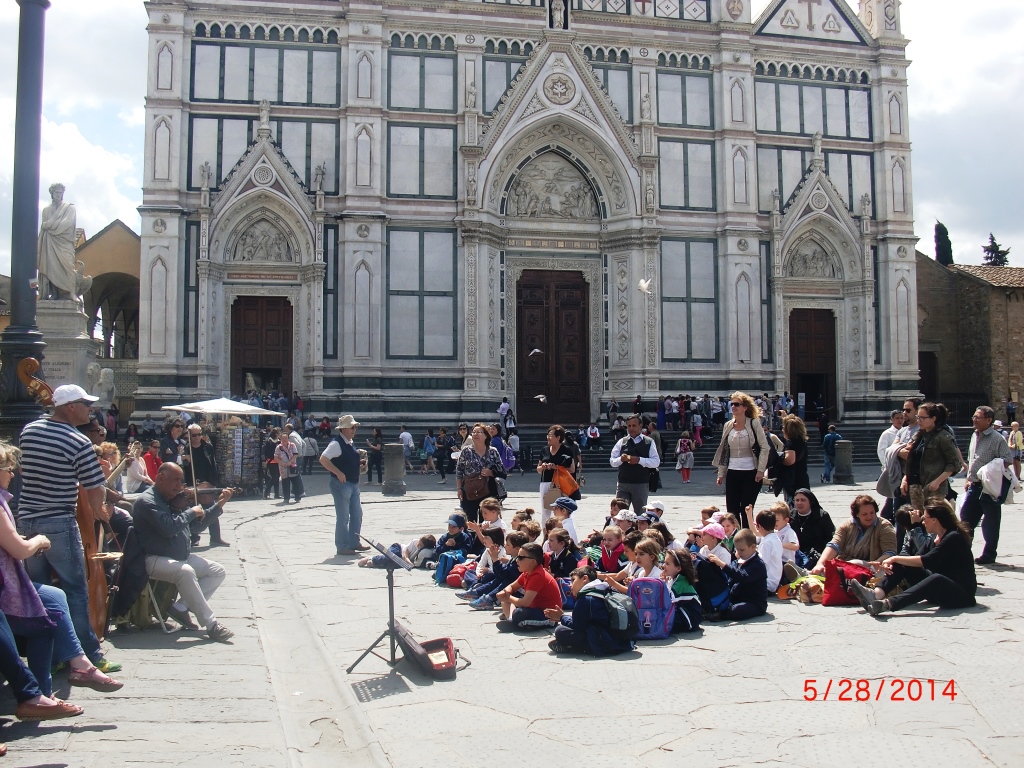
Before returning for the 12:30 prayer office, we braved a windy alley leading to Santa Croce basilica and the broad square spread before this white Franciscan church. Leather factories and shops lined the piazza. A band played Italian songs before a group of young school children sitting crosslegged, entranced. Pigeons fluttered and tourists snapped photos of the massive facade. The day was coolish with billowing clouds streaking the skies, covering the sun, but the drama played in the skies was welcome.

Children, band, and basilica

The line for a ticket (6 Euro, about $10) was not long, and we soon were moving through the vast basilica, past glimmering  apses of stained glass, into the southern transept chapel where Renaissance masters depicted the last days of Christ. There are many famous paintings here, but I always recall my characters visiting in Pilgrimage, my first novel, about a journey of healing through cities and villages in Italy. Even so, they have used the ticket proceeds well, allowing access to many restored masterpieces, with English information panels, something I don’t recall from before and definitely worth the admission.

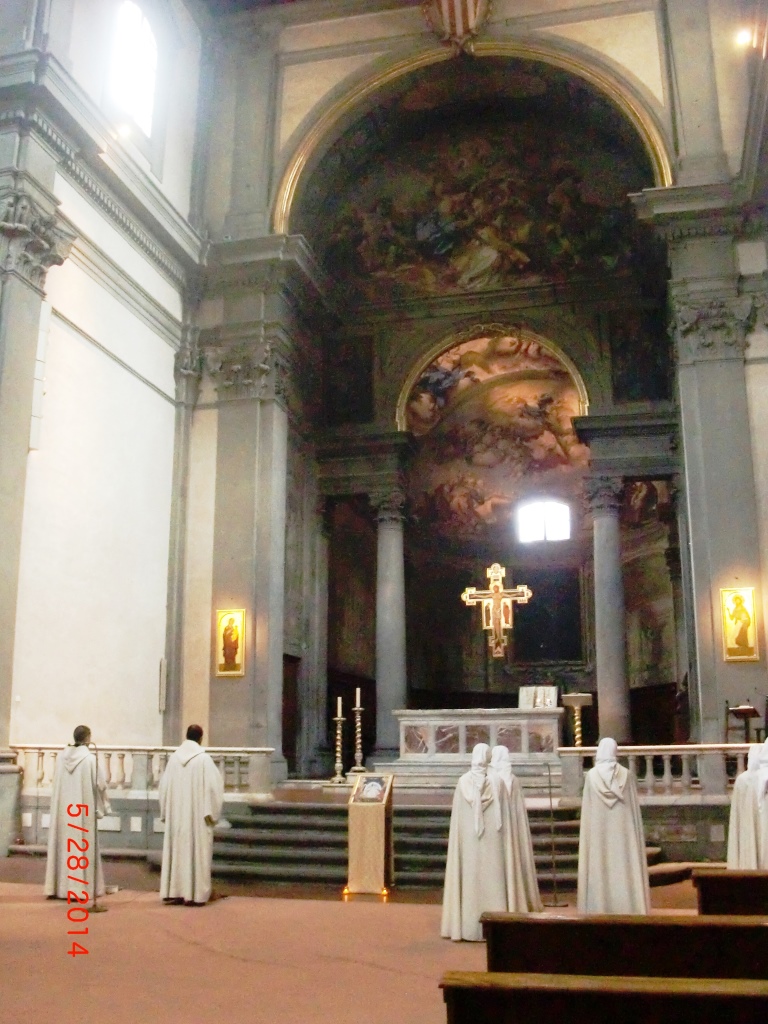
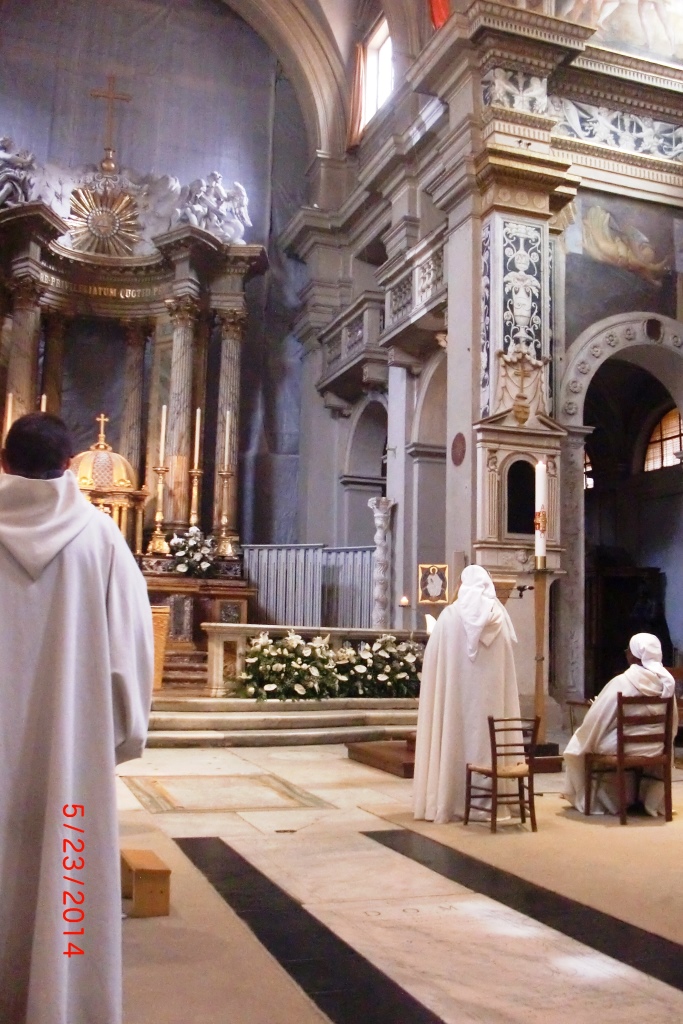
Badia Crucifix.Monstrance.croppedIt was time for our noon prayers and we headed back to the Badia to hear the Sisters and Brother and spend a quiet half hour praying for Florence, our families and friends, and the world. We tooks seats in the wooden pews and gazed about the old church with its vaults and frescoed apsidal ceiling. The space is larger than Trinita dei Monti in Rome and smaller than St. Gervais in Paris, with (it appeared) transepts, chancel, and nave of equal length, in a Greek cross plan. Before us, on the altar, a golden monstrance held the Host for adoration, and a number of faithful knelt before the Real Presence of Christ, spending a few precious and sacred minutes with God. Three Sisters knelt too, keeping watch.

Fraternities of Jerusalem.FlorenceSoon, more Sisters and Brothers entered and knelt. Their white robes fell to the floor, and it was as though they blended into the pale marble so that they would not distract us the focus of prayer. Icons, newly painted, stood to each side on massive pillars, and a painted crucifix hung high. A life size icon of Christ stood before the Holy Sacrament Chapel off the north transept. The Renaissance church had been gilded by these icons, and the eye was drawn to them for contemplation.

The grace and beauty of those thirty minutes restored my soul. We prayed with the figures in white, focusing on the vivid cross, and as the chanting of the psalms winged through the air, a quiet settled upon me. Gone was the rush of tourists and crowded sidewalks, the noise of traffic and sirens, the elbowing and push of tour groups eager to own Florence’s treasures. Here in this space, in this moment in time, in the middle of the desert, we listened to the singing as we prayed too.

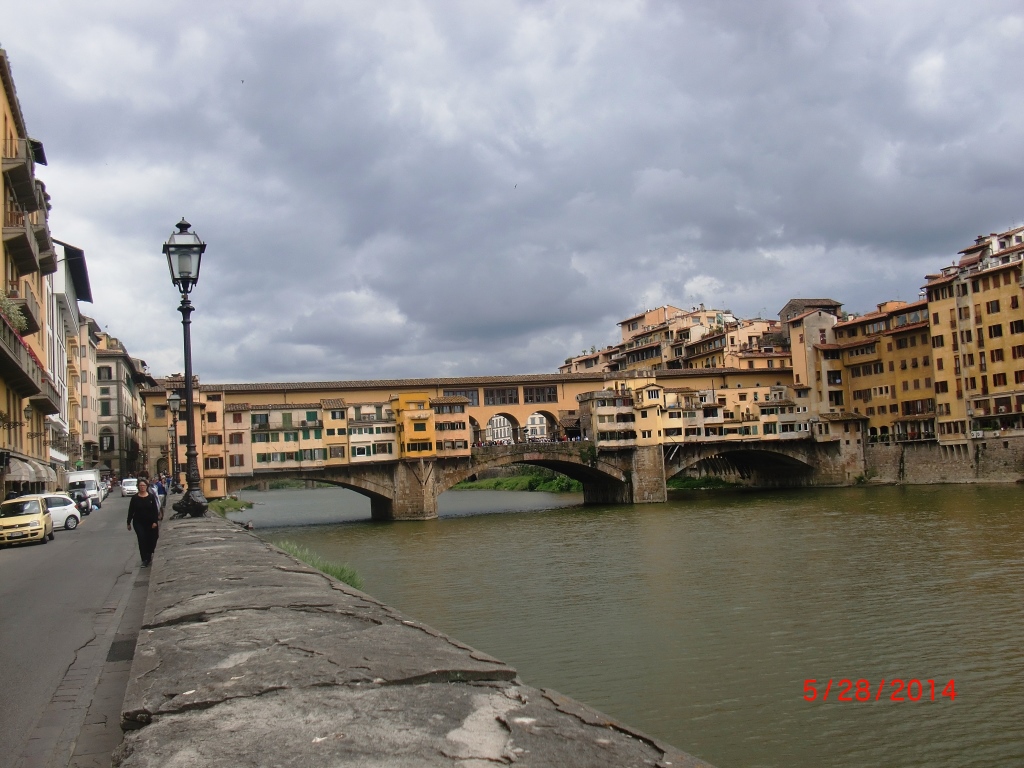
Ponte Vecchio, FlorenceWe left silently, our hearts open to the world in a new way, open to God. We followed the road to the river where the gray and white skies hung low over the high waters, past the Ponte Vecchio, to lunch along the way back to our hotel.

A good first day in Florence.


Sunday in Roma


Chiesa La Maddalena

Chiesa La Maddalena

Today is the Birthday of Saint Camillus, founder of the Camillians, Servants of the Sick. This year has been a celebration also of their fourth centenary, to end on July 14, 2014. It was natural for us to worship at La Maddalena, the order’s home church in Rome, for Mass, but we had other reasons to visit the golden baroque church one block from the Pantheon.

We first met Father Paolo Guarise, Vicar General and Priest-in-Charge of La Maddalena, a year ago when we visited Rome. The Madgalene Mystery was soon to be released and I wanted a contact person to whom I could send a few copies as a small thank you for the church (two chapters are set there). The story of that meeting can be found in an earlier blog, but suffice to say that Father Paolo was most generous with his time and attention and we have kept in touch. So we wanted to see him once more, in hopes of absorbing some of his love and energy and inspiration. And all the giant posters advertising the Camillian celebrations, posted on every church door in Rome, said he would be the celebrant. (I also wanted to give him a few more copies of my little novel.)

Nave, S.M. Maddalena

Nave, S.M. Maddalena

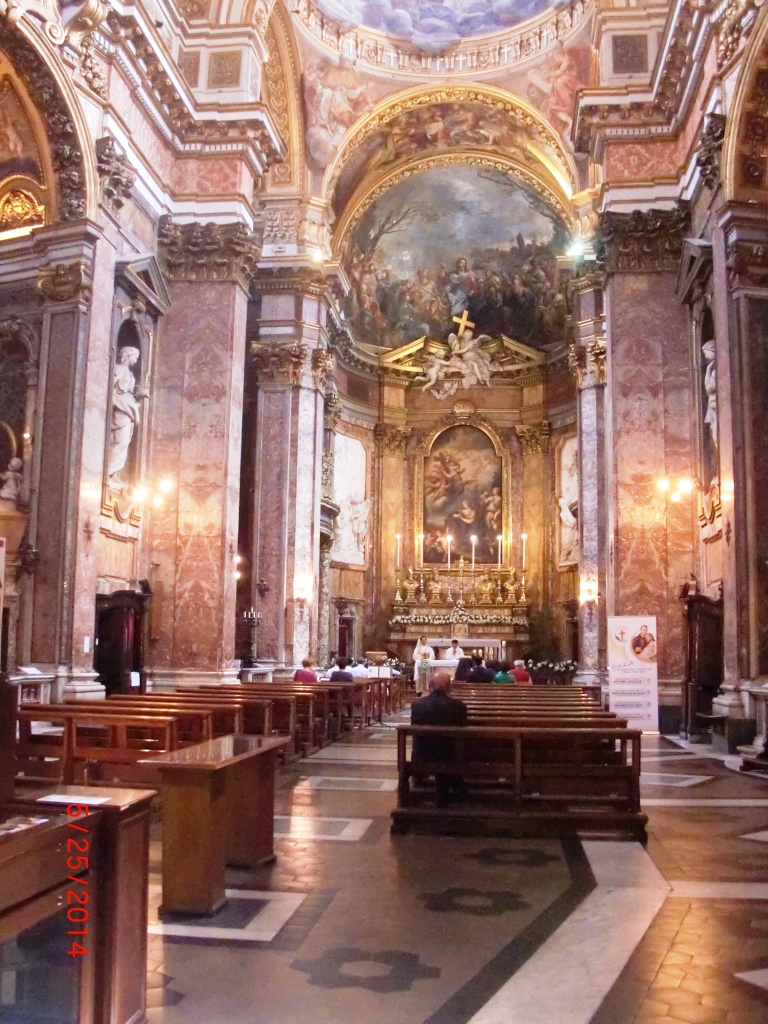
We arrived early and absorbed the beautiful space of gilt and marble. La Maddalena is not a large church (compared to some basilicas in Rome), so the color and glimmer and proportions lift the spirit intimately, as intense beauty often does. I turned to gaze up at the baroque organ loft behind us, gilded and dancing over the front door with its saints and angels. Higher above was the Camillian red cross, the same as the one emblazoned on the brothers’ black cassocks. It is the red cross that was eventually adopted by the Red Cross organization, one seen worn by those Camillians caring for the wounded on the battlefields of the last century.

The Holy Crucifix that spoke to Saint Camillus has been moved from the south transept chapel to a more visible site off the narthex, on display for the year but eventually to be returned to the chapel. The cross spoke to Camillus when he was discouraged with his work, nursing the sick and suffering in Rome:

What is afflicting you? Go on with this undertaking and I will help you, because this is my work and not yours.”

It is good to be reminded that we are merely custodians, caretakers, given bodies and minds for a time on this earth. Our work is his work. To be sure, we are of immense value, unique creations, and if we say yes to God, allow him to work within us, he will work his will through us. We need not worry too much, as San Camillo did, about succeeding in every task. We say our prayers, are obedient to his commands, and we let him do his work in us, through us. We plant seeds, not knowing if they will be reaped or even who will reap them, for we may not be doing the reaping.

I have found that when I stand aside, getting out of the way, waiting and wondering what God has in store for  me (never knowing for sure), I see miracles happen. This is the thrilling joy of being a Christian. This is why, as St. Paul says (and Sister Emanuela too for that matter) we cannot be tepid in our faith. For we are part of a great drama, the salvation of the world. We are players, not directors.

Procession, S. Maddalena

Procession, S. Maddalena

So we arrived and took seats in the polished wooden pews and knelt and prayed and watched and waited. I lit a candle before the Madonna of Health in the south aisle, a charming image said to have worked miracles. I inhaled the flowers filling the chancel. I watched others step in quietly and and take their seats. I wondered what God would show me this day, the Birthday of San Camillo.

The procession formed off the sacristy in the north aisle and about twenty Camillian brothers robed in white processed down the north aisle and up the central aisle. They took their places and the Mass began. While in Italian, the liturgy was familiar, and I felt a part of it in spite of not knowing the language. The service ended with singing before the relics of San Camillo in the south aisle.

Procession, Birthday S. Camillus Mass

Procession, Birthday S. Camillus Mass

After many arranged photos of the fathers and brothers with the Camillian lay family who had come on pilgrimage, we greeted Father Paolo and chatted a bit. Father Alberto, the Secretary General for the Camillians, took photos (thank you, Father). Then I met an Irish priest who asked if I would tell his group about my novel set in this church. I was stunned to be asked to say anything in this church of St. Mary Magdalene, where such beauty often leaves me speechless, and I’m still not sure it was real. But I did speak, I think, and from the podium’s mike I mumbled and stumbled, trying to summarize the key points of the novel: Mary Magdalene and the first century Christians, the Apostles Creed and the triangle churches in Rome, the clues and the quest of my heroine, Kelly, the love story, the suspense story, the desire to correct Dan Brown, and a consideration of how scholars approach New Testament history, showing the preponderance of evidence for the Resurrection.

Christine with Father Paolo and Harry, the Medieval Magdalene in the background.

Christine with Father Paolo and Harry, the Medieval Magdalene in the background.

I wasn’t expecting such a welcome and interest from these lovely people from Australia, the Philippines, England, and northern Italy. The copies of The Magdalene Mystery I brought for Father Paolo soon found their way into the hands of these faithful folk and it is with great thanksgiving that I know they will circulate in these countries. We continued our lively chat in the adjoining house over a buffet lunch. Mary Magdalene smiled, the angels fluttered about us, and San Camillo was gratified for his Camillian children from around the world, that they had a home in Rome like La Maddalena, his own church.

I think I absorbed some of Father Paolo’s joyful energy. It radiates to all who work with him. Christianity is contagious, as they say, for it’s true. Thank you, Father Paolo and the Camillian brothers and lay family for your warm welcome. Thank you for your good work in Rome and, through these caring brothers and sisters, in the world. You are a true son of San Camillo.

For more information about the Camillians, visit http://www.camilliani.org/

Friday in Roma

Trinita dei Monti, Spanish Steps

Trinita dei Monti, Spanish Steps

The Church of Santissima Trinita dei Monti commands a magnificent view of Rome, located at the top of the Spanish Steps. But inside you can hear the Brothers and Sisters of Jerusalem sing the Psalms in a glorious Renaissance Baroque church where they are now in residence.

We first heard them sing their prayers in Vezeley, France, and often in Paris at St. Gervais near the Hotel de Ville and Notre Dame on the river. They are young, for the most part, men and women who work part time, rent their own accommodations. They gather for meals and to sing the ancient monastic offices. They are assigned a church to care for and to give a public presence to their prayers. Their mission is to pray for the city. They are now also located in Strasbourg, Florence, Mont St.-Michel, Brussels, Montreal, Rome, Magdala (France), Tarbes (near Lourdes, France), Cologne, Gamogna (Italy), Pistoia (Italy).

Brothers & Sisters of Jerusalem, Trinita dei Monti, Singing Noon Office

Brothers & Sisters of Jerusalem, Trinita dei Monti, Singing Noon Office

When I heard they were in Rome I knew we would visit to hear them sing the noon prayer office at 12:30. These prayer times originated in the earliest days of monasticism, when a 24 hour cycle was kept, consisting of seven “offices.” They usually form a thirty minute pattern with singing of the Psalms (in the local language), readings of Scripture, a short homily, intercessory prayers (often sung as well), and praise prayers (sung.) Today one can hear various communities sing the morning, noon, and evening offices. Some sing more – the Augustinian nuns at Quattro Coronati sing five or six offices a day, open to the public. They welcome visitors who keep the silence. Many offer booklets to follow along and join in.

I have always found the half hour a happy one, a time to gather myself together once again before God, a time to pray for my family and those I know who are sick (one friend in the last stages of cancer) and to pray for those who have asked for my prayers. I try and think of those who are needy and unhappy and for whom the Holy Spirit wants me to pray. I try to listen to God’s voice during these blissful moments as the ethereal sounds of the song-prayers fill my ears.

Music, Spanish Steps

Music, Spanish Steps

I was particularly thankful for their presence in Rome, and within walking distance from our hotel. We stepped into the bright gracious nave and found seats in the first pew. Soon the white-robed men and women took places on kneelers and pads before the altar, and began to sing. The sound is like larks singing, but with a depth provided by the men’s harmonies, and I often think Heaven might be like this – the praising of God for all he is and does, through whom we live and have our being. I hope so.

Piazza Espagna

Piazza Espagna

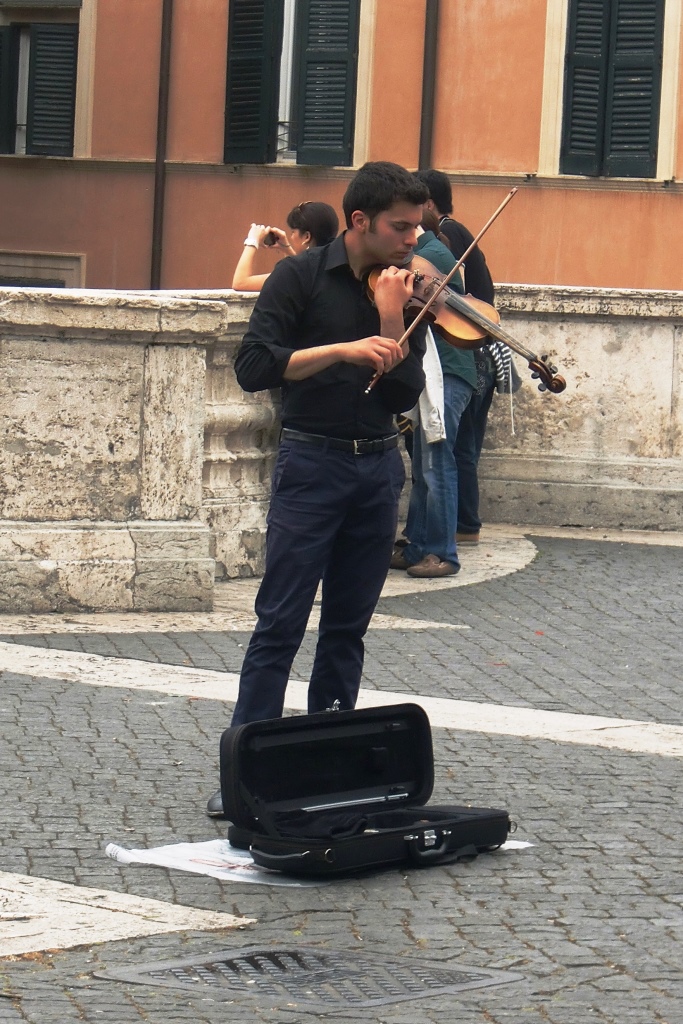
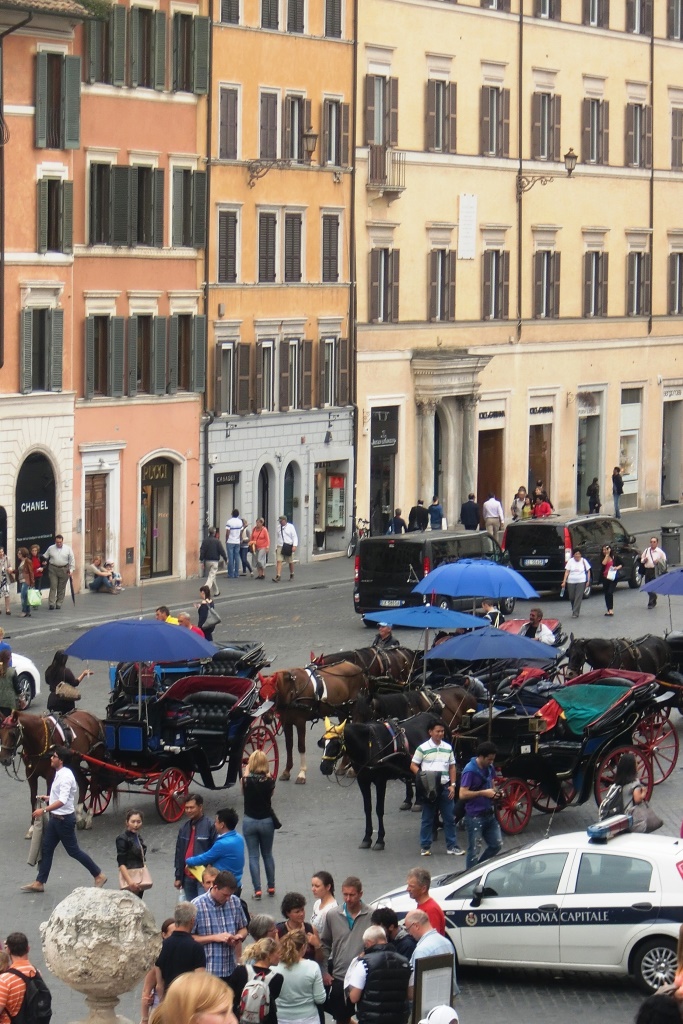
It had rained during the night, and the skies were gray when we had entered, but the sun came out when we left, and we carefully made our way down the Spanish Steps, past a violinist, for soup and salad at Babington’s Tea Shoppe, across the street from the house of Keats and Shelley.

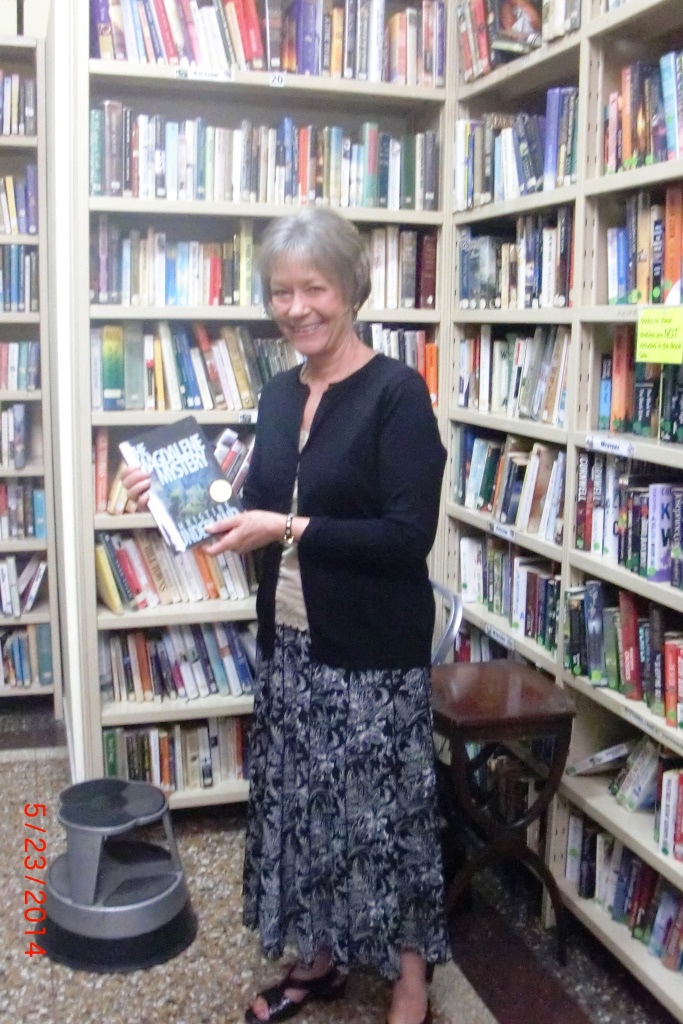
Christine, S. Susanna English Library

Christine, S. Susanna English Library

Later in the afternoon, we stopped by the American Church of Santa Susanna and learned they were closed for restorations, but the library was open. I left a copy of The Magdalene Mystery and chatted with the ladies running a book sale. I explained that the story took place in part at Santa Susanna’s and they were intrigued. It was a story about truth and lies, I said, and the historical evidence we have that supports the Gospel accounts that it was the risen Christ and not a gardener that appeared to Mary Magdalene that first Easter morning. They nodded graciously, probably wondering at this chatty American.

The Fraternities of Jerusalem: http://jerusalem.cef.fr/

Chiesa Santa Susanna:  http://www.santasusanna.org/

Thursday in Rome


Santa Sabina, Aventino, Rome

Santa Sabina, Aventino, Rome

The weather has remained warm here in Rome so Thursday we headed for the leafy Aventino district, home to the once-imperial palaces that became churches in the fourth and fifth centuries.

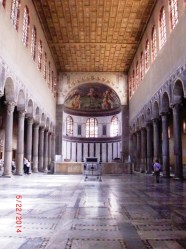
Santa Sabina was quiet  as we entered  the vast space and considered the miracle of  the life of Saint Dominic. For it was here he established his university for seminarians and it was here that he and Saint Francis met. The two orders of friars reformed the Church in the twelfth century, long before Ignatius of Loyola and Martin Luther. 

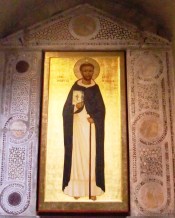
Saint Dominic

Saint Dominic


As always, I think of my characters here in the church they visited – Jack and Madeleine in Pilgrimage – and how the experience of these many churches in Rome healed Madeleine and changed her life. Each time I visit I find that I am changed, a new part of me is revealed. God writes straight with my crooked lines once again in this holy city, at least he keeps trying.

Alessio under the stairs

Alessio under the stairs


We  walked on to San Alessio, which always makes me smile. The young man of a wealthy family converts to Christianity and renounces his wealth. He travels as a beggar to the Holy Land and returns, unrecognizable to his family. He lives under an outdoor staircase of his former home. When he dies the family learns the truth of who he is from a note clasped in his hand. A remarkable story, mythic in the sense of family separation and attempted reunion, the transforming nature of becoming a Christian and then living in a pagan world or a pagan family. But the most remarkable part of the story is that the faithful have kept the staircase and you can see it – a kind of relic – in the north aisle off the entryway. It is surrounded by statuesque marble and a sculpture of Alessio sleeping, but there it is, ancient wooden – fragile – stairs. Only in Rome, I often think. But then my next thought is, only in Christianity do you find the humble made great, the earthy made sacred. We are a sacramental faith, allowing God to work through the matter of our world, to make matter matter by sanctifying it.

We continued to San Anselmo, a great Benedictine church and seminary with an incredible colorful icon like crucifix over over the high altar. And we always enjoy visiting the gift shop in the garden. I can never resist the Trappist chocolate for sale. I asked the attendant if they had a replica of the crucifix, but alas, no. (Maybe on the next visit, I thought, as often happens.)

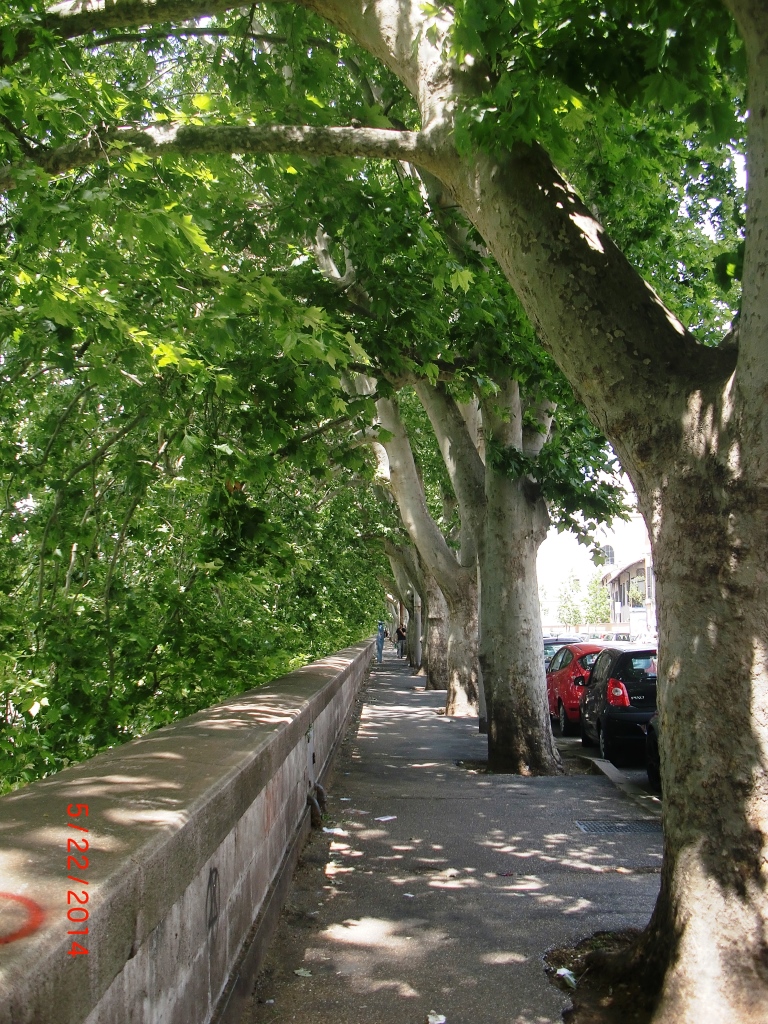
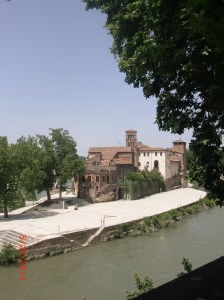
Tiber WalkWe followed our usual route, after visiting the three churches on the Aventino hill, down the path beyond Santa Sabina, leading to the river, then along the river to Isola Tiberina. This is a charming walk, and in May green with leafy trees and shady. The river rushed below us, tumbling between the stone embankments, and we passed several bridges before reaching Ponte Fabricio, a location in my novel, The Magdalene Mystery. This area along the river is ancient, home to

Isola Tiberina

Isola Tiberina

the old Jewish quarter during the first century where trading ships docked at the wharves. The main Synagogue stands along the route to the right of the Tiber. St. Paul must have known this area, and St. Peter too, among many others mentioned in Holy Scripture. All these people peopled my thoughts as I walked toward the church of San Bartolomeo (thought to be Nathaniel in the Gospels) in the center of Isola Tiberina, Tiber Island.

San Bartolomeo

San Bartolomeo

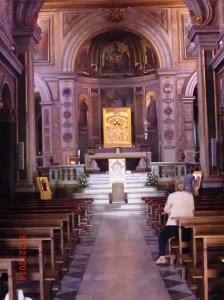
We entered the church and stepped into this warm, colorful, holy space. The tomb of Bartholomew is under the high altar. His relics lie in an ark-shaped sarcophagus that literally supports the altar. The side aisles have numerous chapels dedicated to modern martyrs – Nazism, Communism, Asia, Americas. It is an intimate church, unlike the great basilicas, and the small shop off the south aisle has lovely icons and posters for sale. This year they had a giant poster of the martyrs for ten Euro (about $15). It will be a challenge to pack it (ah, I’ll fold it I am sure, then try to iron it), but I couldn’t resist.

We headed up the river for more strolling under the giant shade trees, more photos of the Tiber, toward Piazza Navona for eggplant parmigiana and pizza and cokes.

A colorful, charming, day full of the past enlightening our present, full of fresh air and old stone and river walks. Just about a perfect day.

Wednesday in Roma

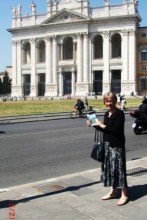
Christine w.TMM, S.John LateranWe visited St. John Lateran, San Giovanni in Laterano, this morning. 
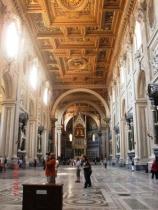
The gracious basilica, set back behind a swathe of rough lawn, pavement for crowds, and hawkers of scarves and jewelry, has grown more dear to me with each visit. Huge and imposing the first time, it has revealed its beauty and history over the years. It is the Pope’s cathedral, his seat as Bishop of Rome, and is seen often on telecasts of sacred events. 

S.John LateranIt is also a location in my novel, The Magdalene Mystery, where more of the mystery is solved and more questions are raised. It is the home of a gift shop run by the Missionaries of Divine Revelation, an order of nuns called “the green sisters” because of their forest green habits. 

Christine with Sr Emanuela, S.John LateranI first met Sister Emanuela, an English nun of this order with a lovely Irish accent, about five years ago when I was pitching my first novel Pilgrimage to some of the shops in Rome. The next year she took us on a lovely tour of the Vatican Museums. We kept in touch. You just might see her in The Magdalene Mystery in that Laterano scene. It was good to see her today – her eyes alight with the same twinkle of joy she has always shared with everyone. We chatted, catching up on the miracles in our lives, stunned by the love of God. She gives group tours of sacred art and recently has been in demand as a speaker. She is on fire with the faith, a miracle among us. I always learn from Sister Emanuela. She has a way of putting things clearly, to the point, with a great generosity of spirit and always a healing sense of humor.
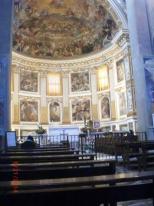
Chiesa Quattro Coronati, Noon OfficeWe left St. John Lateran and walked a few blocks to Quattro Coronati, the Church of the Four Crowned Saints. Once a medieval fortress, you step through two courtyards to reach the front door. Popes hid here when the Lateran was threatened. So touched was I by its intriguing history and the Augustinian nuns in residence who sing the daily prayer offices, that this church was a key scene in my first novel, Pilgrimage. By grace, we arrived for the last part of the noon office, a great blessing to hear them sing again.

We trundled down the hill toward the Coliseum but San Clemente was closed for lunch; it was after all nearly one o’clock. Alas, I was not surprised. This four-levels-of-history church is a popular one, run by Irish Dominicans if I recall correctly, and they have always kept the morning/late afternoon schedule. Sensible.

So we were sensible too, and headed for a bite, club sandwiches in an air conditioned bar, for the day was heating up.

S. John Lateran Reliquaries

S. John Lateran Reliquaries

HolySacrament Chapel, S.John Lateran

Holy Sacrament Chapel, S.John Lateran

Cloisters, S.John Lateran

Cloisters, S.John Lateran

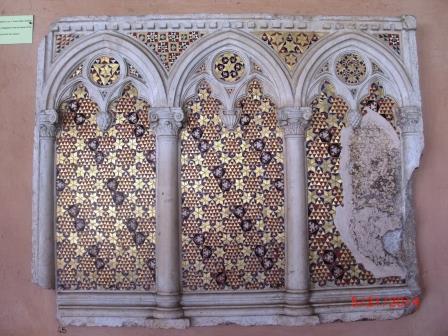
Mary Magdalene Altar Front, Middle Ages, Cloisters, S.J.Lateran

Mary Magdalene Altar Front, Middle Ages, Cloisters, S.J.Lateran

Chiesa Quattro Coronati Entrance

Chiesa Quattro Coronati Entrance


Tuesday in Roma

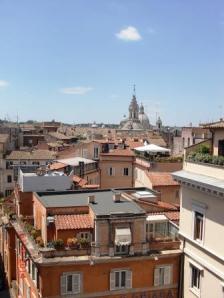
Rooftops and Domes.webWe woke this morning to sunny skies and cries of gulls. We have returned to Roma, the cradle of the early Church where Christianity sanctified paganism, transforming shrines, to many unkind gods, with altars to the one God of love.

I noticed a difference from earlier visits. Even in Pope Benedict’s time, more signs were written in English; more churches opened wide their doors. Here and there we could take photos in spite of the competing gift shops on the premises. But Pope Francis has continued the Welcome with open arms. Come in, come in, come and see, the churches of Rome say. And we come in, well in the coming. From all the world, and happily, gratefully, we come in. Visitors throng these holy spaces, politely and quietly and reverently. They peer inside the confessio beneath the high altar of Mary Major’s basilica. With great excitement and tender joy, they point to the bit of wood in the baroque silver ark. It’s from the crèche in the manger, they say. It’s sanctifying the altar above it. Take a photo with me and the holy wood to show back home! And so God sends us his love letters.

Rome is a jewel box of relics, and most of these bones and artifacts, I believe, are genuine. They have long and detailed provenances going back to the time when they arrived, mainly in the fourth and fifth centuries. When Christianity became legal, Empress Helena, mother of Constantine, made it her mission to bring back to Rome all that she could find from the Holy Land. She ordered basilicas built and oversaw the digging. Others also brought to Rome holy relics over time, such was the passion to portray to the world the living story of salvation. Here is Christ’s birth, here is his life, here is his death! they said. Come and adore! Rome may have been the center of empire, but it soon became the center of Christendom. It became the center of the story of love.

Lunch S.Maria sopra Minerva.webI’ve also noticed more and more religious, brothers and sisters, wearing habits, dusting the streets of Rome with many muted colors. They sit on steps with bag lunches and hurry through back doors into sacristies. Masses and celebrations abound. Christianity is visible, tangible here, if one pays attention, present in a good way. Joy and color and music and the meaning of life paint the city. The secular world seems at times to run parallel, separate, but in reality it is woven into the fabric of the sacred. It is good to hear the bells ring as air-brakes squeak and tour buses open doors to visitors hungry for the life-blood of Rome, the Church and the love of God.
Churches we visited today: 

Santa Susanna, the American Catholic Church in Rome – closed for restoration, alas. But their English library was open and I found my trilogy still there, under S in Fiction. One of the ladies said Hana-lani had been checked out. But The Magdalene Mystery had not found its way to a shelf, so I shall drop a copy off this week. 

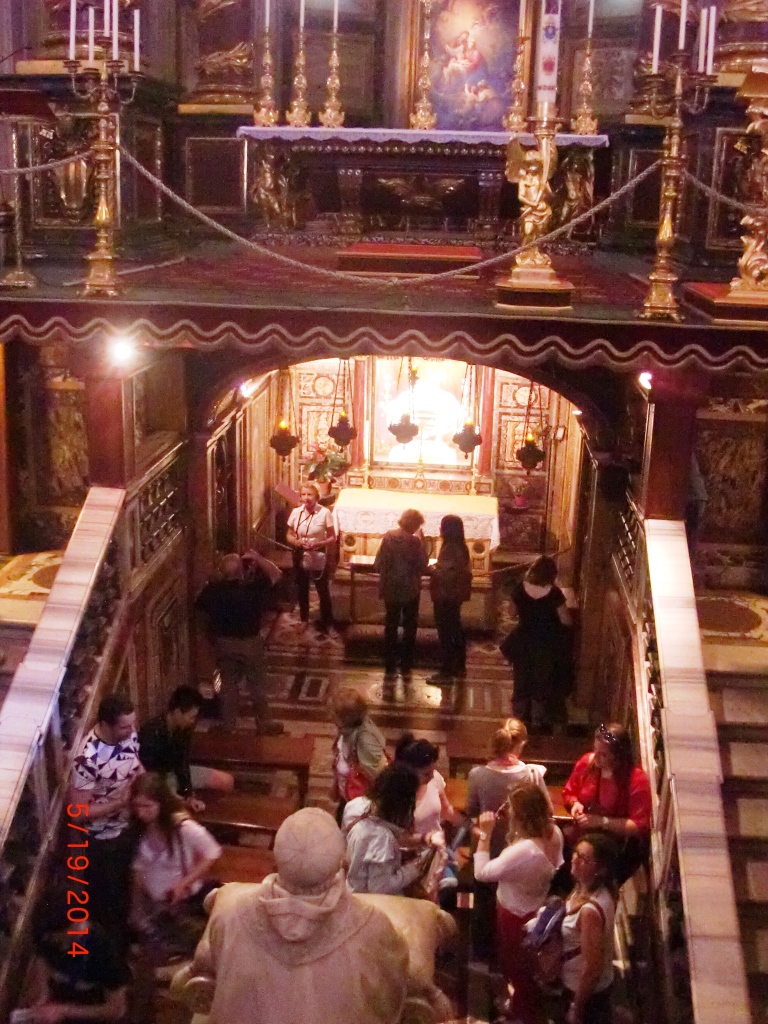
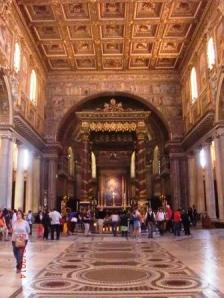
S.M. Maggiore.webSanta Maria Maggiore – the greatest Marian shrine in the world. We heard singing in the Holy Sacrament chapel where St. Luke’s Madonna is honored, the Madonna humble and earthy, painted on wood. At the head of the main nave, under the high altar the holy crèche has returned after a time of restoration. As we stepped down the marble stairs to the confessio I wondered in awe once more, amazed by God’s goodness to give us these humble bits of himself, here in this twenty-first century, bits to help us in our sacramental journeys. The gift shop has new offerings of the Lucan Madonnas, the Salus Populi Romani (Savior of the Roman People). I had not seen these last year. Another change.
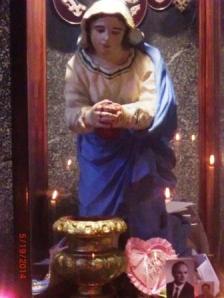
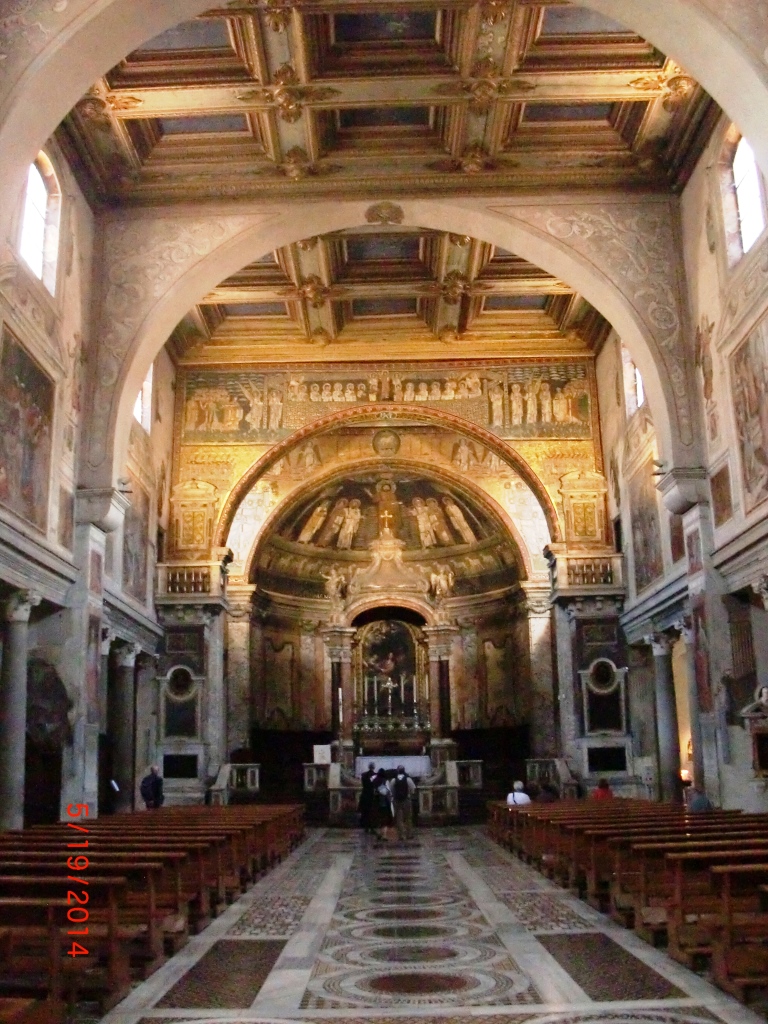
Saving the blood of the martrys.webSanta Prassede – the church dedicated to the sainted sister who cleansed the bodies of the first martyrs, saved even their blood to be hidden in the family’s well. Here too can be venerated the column of Christ’s flagellation. It’s an ethereal church, built over the first-century house church of Prassede’s family (her father thought to be a Roman Senator, converted; St. Paul preached in their house.) 

Chiesa del Gesu – the main Jesuit church in Rome, alongside St. Ignatius’s rooms. The church is a beautiful baroque gilded space with an ethereal ceiling, but I always head for the Madonna della Strada tucked away in a northern chapel. Brought in from the street for safekeeping by Ignatius, she has worked miracles ever since. A charming rustic icon on wood; prints are available in the gift shop off the southern aisle. I say my evening prayers before the image I took home and framed, alongside the Salus Populi Romani, both from many years ago. 

Santa Maria sopra Minerva – “Saint Mary over the Minerva shrine” – again a sanctification of the pagan, just as the neighboring Pantheon had been transformed to Santa Maria of the Martyrs. This Santa Maria over Minerva has cerulean blue ceilings bounding over a three aisle nave. I understand why they hold concerts here. There is a good deal of Renaissance art as well. Fra Angelico is buried here; Fra Lippi painted the walls. But my goal as always is to visit the tomb of St. Catherine of Sienna who lived in the adjoining convent, and whose body lies under the high altar. They carved a white sculpture (alabaster I think) to house her body and she lies behind a side glass panel, visible beneath the altar. She was a political saint, I often think. Only a third-order Dominican, she was illiterate, and dictated her correspondence. Born a twin, the twenty-fifth child to a couple in Sienna. She became an anchorite, and Dominican, then brought the pope back from Avignon through her cogent letters and travels. In Pisa she received the stigmata as she prayed in adoration. Humble and great, she was open to God’s will. 

San Sylvestro in Capite in Capite because the head of John the Baptist is in a shrine to the north of the narthex. San Sylvestro because it was the burial place of Pope Sylvester who is believed to have baptized Constantine, so he was the first pope in the newly Christianized Rome and responsible for much of the early growth. We looked into the church office off the narthex for Father Fitzpatrick, but were told he would not be back until later. San Sylvestro is the British Church in Rome and it’s always good to say hello to this radiant Irishman, Father Fitzpatrick.

Ah, Roma! What will she show me? Where will God lead me? What doors will open in my soul?

Brothers, Maria Maggiore

Brothers, Maria Maggiore


Wood of the Creche, Confessio, S.M. Maggiore

Wood of the Creche, Confessio, S.M. Maggiore

Lukan Madonna, Salus Populi Romani, S.M. Maggiore

Lukan Madonna, Salus Populi Romani, S.M. Maggiore

Santa Prassede

Santa Prassede


Candles, H.Sacrament Chapel

Candles, H.Sacrament Chapel

Ceiling, St. Xeno Chapel, Sta. Prassede

Ceiling, St. Xeno Chapel, Sta. Prassede

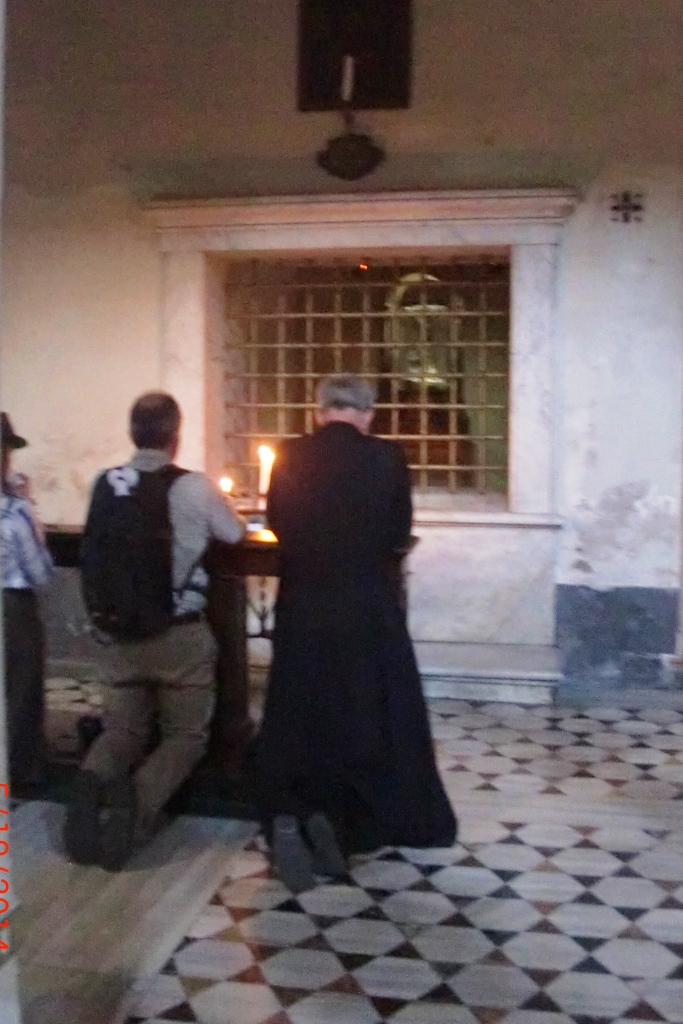
Praying before Christ's Column of Flagellation

Praying before Christ’s Column of Flagellation

Chiesa della Gesu

Chiesa della Gesu

Madonna della Strada, Chiesa del Gesu

Madonna della Strada, Chiesa del Gesu

Walking, Via Gesu

Walking, Via Gesu

S.Maria sopra Minerva

S.Maria sopra Minerva

Dominican, S.Maria sopra Minerva

Dominican, S.Maria sopra Minerva

Mosaic, S.Maria sopra Minerva

Mosaic, S.Maria sopra Minerva


On Mothers

It’s crystal clear, the skies windswept and bluer than blue, here in the Bay Area this Mother’s Day, the second Sunday in May, Mary’s month of May. The proximity of the two celebrations each year always touches me, for it is a time to consider the very center of human life, the miracle of birth.

Mothers, like our mother Mary, have strong ties to their children. In some sense, after the season in the womb, after the dramatic entrance into our world, after the great first gasp of air, the cord is never cut, but holds fast throughout life. Some cords are stronger than others, some ties are formed in spite of little desire or intention, some are never formed through tragic circumstances. Some mothers early on have the sword of love pierce their hearts; some know that piercing later. Mothers who adopt, God bless them, may not have given birth, but in their hearts they did, and they swaddle that baby close, cheek against breast, nearly one flesh. Love is like that. It weaves a strong cord, entwining, holding, feeding, eyeing, singing.

We know that our mother Mary, the new Eve, grinds her heal on the ancient serpent, Satan, destroying him. She gives birth to the Son of God, incarnate in her womb. She loves, she suffers, and she watches her son die a cruel and humiliating death. She is full of grace and blessed among women. She prays for us just as we ask her to. She has appeared to many of her children through the centuries, sending them fountains and wells of healing waters. She loves us so; she is our mother.

As a mother I for a time housed my child within me. My body was his home, his very life blood. It is easy to think that he was literally a part of me, so close were we, but that is the great mysterious miracle. For the child was separate, a genetically unique human being, unique in all past, present, and future time, fully known only by God. When labor is accomplished, and the unborn is born, mothers know they have been part of the greatest miracle on earth. Gather any group of mothers together and mention the birth of a baby, and each will remember what happened to her on that day. She will recall the hugely important part she played in this great drama, for it is seared in her memory. Mothers tell their stories to one another as though reciting heroic ballads upon which the world depends – all history, all humanity, all love. The hours and minutes of giving birth are alive, fresh and real, eager to be shared.

The anguish and the pain are forgotten in the joy of new life. Circumstances may not have been perfect – perhaps the mother was alone. Perhaps she didn’t want the child. Perhaps she thought her life would be ruined or simply changed. Perhaps she gave birth in a back room, or in a cave, or in a stable. But with the telling, each mother chooses the joyous bits to remember. The infant placed in her arms. “Hello,” she says. “What shall I name you?” Then, “I love you… don’t worry, it will be all right.” She vows to protect that child forever; to feed, clothe, and teach this son or daughter to become loving and responsible. Of course her life is changed. How could it not be? She will never be the same. But she has no regrets. She is a mother now. She has learned how to love.

But most of all mothers remember how close we were at that moment to the heart of life, the beating heart of God, in this stunning miracle, how in that place at that time in each of our lives we touched eternity.

Today, as we drove to church this morning, my thoughts returned to a moment nearly forty-two years ago in Grace Hospital in Vancouver, Canada. My son was born, big and strong and healthy and a little pinched around the head. He was bald. He squinted up at me as I held him in the crook of my arm, neatly wrapped in cotton flannel. Today he is bigger and stronger and still healthy, a father of two. He shall always be my little boy, even at six foot three, and I shall always love him, always worry about him, always want to shelter him from life’s sufferings such a part of love. That’s what mothers do.

So on this Third Sunday of Easter when the preacher spoke of Mother Church holding us in her womb, gathering us all together, protected by her seamless cloak woven from the golden threads of sacraments, I understood what he was saying perhaps better than he did. The Church is many things – an ark in the sea of life, the Bride of Christ, the Body of Christ, Mother to her faithful children. I thought of icons depicting the Madonna holding the Church within her cloak, for Mary was the first Christian tabernacle, her body the home of God’s Son, and today, the home of His Body, the Church, the Body of Christ.

The images danced in my mind, weaving, joining, coming together again. Words cannot fully explain what is unexplainable. Mysteries are mysterious. But image and symbol and story and art and song can connect the dots of God’s love for us so that we begin to see a shape, an outline, for we recognize reality when we see it. And the Church nourishes and protects us just as mothers nourish and protect their unborn. The Church teaches us and shows us the way, just as mothers do their born children. We need only say yes to her. 

And when we do say yes, when we listen to her and worship within her and remain faithful to her, suddenly we see. We are no longer squinting; our eyes are opened. The skies are bluer than blue, the air windswept and crystal clear.

On Life and Death and Life Again

I attended a funeral for a friend on Friday. Kathryn was a member of our parish family who joined about a year ago. We didn’t know she was dying of cancer.

She was bright, witty, with a big smile and an infectious joy in living. One Sunday, shortly before she died, as I was leaving the parish hall, I turned to her and waved goodbye. She grinned, waved back and shouted, “I love you.” I smiled back and shouted, “I love you too.” That was the last time I saw her.

She had orchestrated her dying. She found a church that would help with her year of preparation, but she didn’t want anyone to know (except our priest). When I learned she had gone into the hospital, then was dying at home, I felt as though I had been cheated of knowing her better. Others said the same thing to me. “We wished we had known…”

I understand her choice of silence. We would have treated her differently and she didn’t want that. She wanted to live life to the fullest up to the last minute in as ordinary a manner as possible. And what a life she had had: she had several advanced degrees; she was a classical violinist; she wrote and published a volume of “poetic letters”; she was a stewardess for World Airways, a librarian, a model for I Magnin’s. She had a house full of cats and stacks of books. As I gazed at the photos in the booklet given to us at her funeral, I saw she was beautiful, intelligent, and precocious at an early age.

Our priest said in his homily on Friday that she died a “good death.” She prepared the booklet ahead of time, chose the hymns and the pictures and the readings. And as I left the church, walking through the narthex on Friday morning, I paused before the open casket. I said to her, see you in Heaven, Kathryn, I love you.

A body no longer living is a body that no longer has God’s breath breathing through its lungs, no longer has blood beating through its heart. Kathryn was close to seventy-one, but her face was smooth, all life lines gone. I knew she wasn’t in that body anymore, but I also sensed she was with us for the moment, that she was out-of-body, smiling her big smile and laughing.

I thought of her on Saturday when I attended a joyous bridal shower for another friend in the parish. Twenty ladies gathered to sip champagne and iced tea, lunch on quiche and salads and cake, and open presents to the chorus of oohs and ahs and grandmotherly advice and sayings. Did you know that the number of times you cut the ribbon is the number of children you will have? We of course were hoping for many children… to add to our parish joy. (She seemed to cut the ribbon quite a few times.) Kathryn would have loved the moment, she was so full of life.

And I thought of her as I sat in church this morning on Good Shepherd Sunday, the Second Sunday after Easter. Kathryn was one of the sheep who had come into our little fold, had chosen us to be with, as she did her dying (what an honor). She knew the voice of Jesus the Good Shepherd, so that when he called her name she could follow. She trusted him to care for her, to protect her, in life and in death and in life again. She knew where she was going, she knew how to get there (unlike St. Thomas), and she knew she would recognize the gate to Heaven.

On Friday we read together the beloved Twenty-third Psalm:

The Lord is my shepherd; I shall not want. He maketh me to lie down in green pastures: he leadeth me beside the still waters.He restoreth my soul: he leadeth me in the paths of righteousness for his name’s sake. Yea, though I walk through the valley of the shadow of death, I will fear no evil: for thou art with me; thy rod and thy staff they comfort me. Thou preparest a table before me in the presence of mine enemies: thou anointest my head with oil; my cup runneth over.Surely goodness and mercy shall follow me all the days of my life: and I will dwell in the house of the Lord for ever.

Anglican, Episcopalian, Lutheran, and Catholic churches have shepherds – bishops. Bishop comes from the word episcopos, Greek for “overseer,” or “shepherd,” one who guards. Bishops are priests elected and consecrated to guard us, to protect us from that which is not true (heresy) and from those who proclaim that which is not true (heretics), i.e., from wolves in the sheepfold. We trust our bishops to lead us on the path to Heaven and keep us safe along the way. But bishops are human and frail just like us, so our trust is not always rewarded. Nevertheless, in the Church we repent and forgive one another as Christ teaches us to do.

This morning we sang Eastertide resurrection hymns, but we also sang, The King of love my shepherd is, whose goodness faileth never, I nothing lack if I am his and he is mine forever…   I was thankful that our Good Shepherd, who conquered death, who knows me as I know him, leads me through this world and into the next just as he led Kathryn.