
 Man is a curious combination of opposites, desiring both community and isolation. The distance we keep between one another is a function of many factors, but our relationships have always been complicated. Even that closest connection – mother and child – is fraught with distance varying in time, in place, beset by darkness, illumined by light.
What closes this distance between one another? Love. Selfless, sacrificial love. How do we know this? Christ came among us and showed us how. He bridged the distance between us and God, so that we could do the same between one other.
This morning in the Sunday School the sunflower seeds planted last week had sprouted in their bright pails. Tiny green leaves had pushed through the dark soil toward the light of the window. A new creature had been born from the loamy cocoon just as a child is born from the watery womb. New life had appeared from those simple seeds.
As we sang our song in our circle about the saints of God, the children had an attack of the giggles. I watched as the condition spread like contagious happiness from one child to the other. The joy grew and colored the air as they laughed at silly things, small exaggerations of hand movements as we sang. Finally as we collapsed in hysterics, I eyed my trusty ten-year-old assistant. She snapped her fingers and all slowly grew calm, the giggles subsiding to happy ripples of contentment. We returned to our song with added energy.
Now, as I remember that laughter and its contagion, I know the little distance, such as it was, between each of us, collapsed. We were close as close could be in the shared silliness of the moment. And in the shared hour to come we laced ourselves even closer. It was like tightening a shoe so that it wouldn’t come off, so that the canvas was one with the foot. Other Sunday morning hours had begun the lacing. And so we would continue in the weeks to come, weaving our lives into one another’s, into God’s heart, to produce his seamless cloak of love.
Our Lord and his saints bridge distances. We learned about St. Martin of Tours today, the fourth-century Roman soldier, baptized Christian, who came upon a poor man in rags, freezing in the cold of winter. Martin took out his sword and cut his own cloak in half and gave half to the man. That night Martin dreamed that Christ appeared to him wearing the half-cloak. What Martin had done for the beggar, he had done for Christ.
The story reminded me of a program my son is involved in in Boulder, Colorado called the Reverence Movement. Offering temporary shelter to homeless women and helping to provide meals to both men and women, volunteers offer their time to bridge the class distance, to show Christ’s love. The name Reverence struck me, for reverence is the child of respect. Once we become arrogant and proud toward one another, we cannot love, we cannot revere, we cannot respect. We increase the distances.
Peggy Noonan recently wrote about the increasing separation she has observed between the ruled and the rulers, between ordinary folk and the elites. The distance is enforced with ridicule, shaming, ostracism, and physical attacks against those who differ in opinion. The distance is found throughout the political spectrum. Such distance, such contempt, such pride, will destroy us.
Our country was founded on the basis of equal opportunity for all, free association, free speech, freedom of religion. It was founded on the Judeo-Christian idea of the dignity of the individual, for every man and woman is created and loved by God. It was a revolutionary idea, fraught with challenges as diverse races entered the population. Could these distances be bridged? Could slavery be abolished? Could opportunities be equal? Could the work place and the community reflect a rule of law determined by the majority with respect for the minority? Could each and every one of us be treated with reverence?
We are human beings and live in semi-darkness. Evil exists. Bad things happen and men turn away from the light. It has been a great challenge. And yet America has survived by bridging the distances between her citizens.
Our shared humanity means we share one another’s sufferings. We know we must admit our failings, clean out our hearts, if we are to respect others. We know we are equal in the eyes of a loving God. We know that the beggar in the cold is Christ.
This morning, having watered their sunflowers and colored a picture of St. Martin, the children trooped with balloons flying high downstairs to the parish hall for hot dogs and chips and cookies, their love lacing them together and sending them into the future, a future of hope and laughter, closing all distances in a gaggle of giggles.
 The children were eager this morning to be photographed with their pink and green pails under the window in our bright Sunday School room. Natalie, age six, stood on one side of the planting tray, her head tilted like an elfin faerie, and Luisa, age four, stood on the other, devoutly serious.
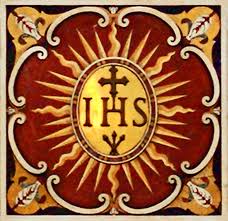 Today traditional Anglicans celebrate the Feast of the Holy Name of Jesus.
 We celebrate this Holy Name of Jesus on August 7, the day after the Feast of the Transfiguration. The closeness of the festivals is appropriate, for it is on Mount Tabor that Jesus reveals himself as God’s Son once again, reflecting his own Baptism:
 ething happens in the Mass.
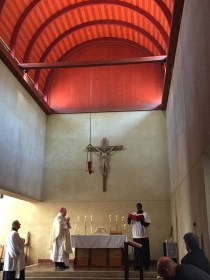 The organ is played on Sundays. It wasn’t played in the weekday Masses, but then we had melodious singing. The postulants, discerners, and clergy, robed in black, entered in silence, into the silence, and took places along benches lining the walls. Rug squares served as kneelers on the polished tiles. As the Mass danced its way through the Lessons, Creed, Absolution, Offering, Consecration, and Communion, the congregation sang responses, sang the Gloria and the Creed, sang hymns with one voice or in harmony. There were quiet “said” Masses too, spoken only, Masses mourning recent Christian martyrs, words full of reverence and love, and longing for a world at peace not war. And each Mass, celebrated by a different priest, was unique, reflecting the celebrant’s unique manner and character.
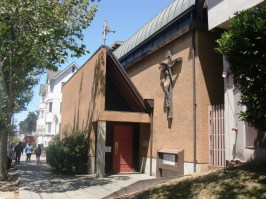
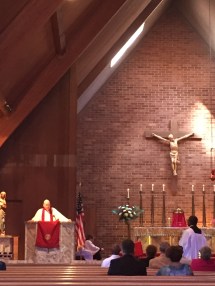 This last week I spent in seemingly alternating universes, attending daily Mass at our Anglican Seminary Summer Session at St. Joseph’s Chapel in Berkeley at mid-day, and then watching the GOP convention in the evening. The former was quiet, focused, purposeful, and passionate. The latter was lively, energetic, excited, and passionate. The convention was the body politic that exercises freedom of speech and assembly, a gathering of devoted delegates to nominate the next President. The Seminary Summer Session was the body ecclesia that exercises its freedom of religion and worship, a gathering of devoted clergy, postulants, and men discerning their vocation.
 Beware and be aware of the desire to be squeaky clean, to cleanse our culture of people we don’t like. Beware and be aware of the desire to cleanse history of facts, to rewrite the American story.
 I celebrated my sixty-ninth birthday yesterday, and so I was particularly happy that today I found myself singing with the children in Sunday School, “I sing a song of the saints of God…”
 My husband and I are usually early to Mass, early to everything for that matter. This morning was no exception as we entered the spacious nave of our local parish church.
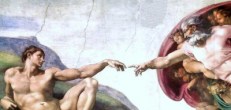 The heat wave in the Bay Area is browning and burning our California grasses. We hide from the cruel sun, the thirsty sun, the killing sun. Our fragile systems can only take so much heat, so much cold. We thrive in a narrow temperate zone, our human comfort zone.
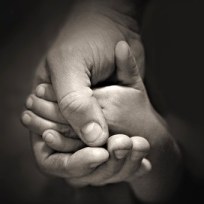 We live in a time of confusion and increasing chaos, as traditional gender roles come into question. And so on this day when we honor our fathers I wonder who and what they are, were, and should be.
 And so we honor stepfathers as well, and all those who have stepped into the silent absence with their presence and their love, and all of those uncles and cousins and friends who have acted as fathers to those children bereft, all priestly fathers, parish fathers, community fathers. I was once a single parent, and I am so grateful for the many fathers of our local church who were quietly present, strong in their faithful support.
 Christine Sunderland
