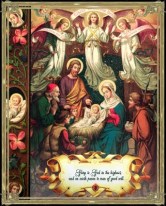
A Living Creche

The Nativity of Our LordIt was cold and windy when we arrived at church this morning for our Living Crèche Christmas Pageant. The Bay Area has had a little rain this weekend, and for this gift from the heavens we are grateful. Still, it was cold, bitingly cold, at least for us softies in California. 
I had placed extra gold garlands in a Sees shopping bag along with an angel costume made from a white sheet I found last night in a linen closet. My notes from last year’s Christmas Pageant warned me we had run out of costumes, so I made my own this year, freeing up the choir cottas for the littler angels. This morning, in the dark before dawn, I grabbed some pins for Mary’s headscarf and a pair of scissors and whatever safety pins that caught my eye in a drawer. 

I was all set.

Each year I look forward to wearing my wings, and I suppose this might be evidence of early senility at the age of sixty-eight, but I like to think I am flourishing a child-like spirit, an attitude, as I recall, our Lord Jesus commanded us to cultivate. So I am. 

My husband and I crossed the parking lot with our bags and found refuge in the warm church, where I soon greeted our young Mary, a sweet precocious nine-year-old. We found the Sunday School rooms and laid out the costumes and went to work costuming children and adults as they came in from the cold. 

Our “Living Crèche Christmas Pageant” is a multi-generational effort (lucky for me). Children watch and learn from working with adults, hopefully, as we support one another. The children know that they too are part of this Great Story of Christmas in the creation of a living crèche. We all sense this is far more than play-acting. In some solemn, holy, joyful way, we are creating, through lessons, carols, and tableau, not a performance but a prayer, a parish family prayer. This is no small thing. 

The Great Story of Christmas – the Incarnation, God becoming man, taking on human flesh to redeem us – is a cosmic prayer. But even more than a prayer, it is a prayer-dialog. It is part of a conversation begun with Adam and Eve, one that is never-ending. And that moment in Bethlehem when Christ was born, when God the Son became one of us, was an intimate crucial moment for us all, a turning point in human history. In that moment Almighty God kissed us. He held us in his embrace. 

The Great Story of Christmas is God’s love song to humanity. And since his coming among us over two thousand years ago, Christians have responded, have sent heavenward their own love songs to God, through art, music, pageantry, and liturgy. The conversation is never-ending, for these responsorial prayers will be sung in turn between Heaven and Earth until the end of time. 

One of the beauties of the Living Crèche is that the tableau – this still-life living scene – is created in layers as the congregation sings and the lessons are read (usually Luke 2 and part of Matthew). In our parish we begin with Adam and Eve and their Fall from grace. They remain “on stage” (in this case the chancel, above the steps) as the rest of the story is added: the Annunciation (the Virgin Mary and the Angel Gabriel), the Incarnation (the Virgin Mary, St. Joseph, Baby Jesus). Soon shepherds of Earth and angels of Heaven step solemnly up the aisle to honor this newborn king. When all have taken their places, after Scripture and carols, the tableau is complete and we have told with our lives the Great Story of Christmas. 

I thought of this as I put on my wings this morning in the Sunday School room. Another angel helped me and straightened my garland halo. Our heavenly host was ready to fly to the manger, set before the high altar in the sanctuary. We gathered in the narthex to await our moment of entry through the double doors, our stepping up the red-carpeted aisle to help create our living crèche. 

Our ages spanned eighteen months to sixty-eight. Some of the young adults in our cast had been part of the Living Crèche when they were toddlers, and now they brought their own children to create memories, to hearten hearts, so that they could share this experience with their children, to enliven lives with the love of God come among us, Emmanuel. 

We processed up the aisle and told the story with our living bodies. We became the sculpted art of God’s great love. We recessed out, having taken part in God’s love song by singing our own song in response to him. We knew as we left the warm church and re-entered the cold world we carried his love inside us. We could hear the melody, feel the beat of God’s heart within our own. 

And this is the gift of Christmas, Emmanuel, God with us, God in us.

A Still Small Voice

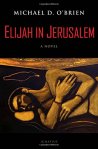
Elijah in JerusalemI’ve been rereading for review Michael O’Brien’s Elijah in Jerusalem released in August by Ignatius Press. The story has seamlessly woven into my Advent readings from Isaiah and Revelation which focus on similar themes about the End-Times. The tribulations are great, the plagues horrific, death rides the world. In the midst of these apocalyptic themes, we see the Prophet Elijah, returning as one of two last witnesses to warn the Anti-Christ. He is humble. He can hear the still small voice of God.
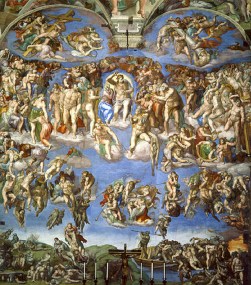
Today we recall the End-Times and Christ’s Second Coming as we prepare for the celebration of his First Coming at Christmas. In both preparations, we must face judgment. We must clean out our hearts to be worthy to receive him at Christmas and to kneel before him at the Judgment. In both senses, these Advent scrubbings are made easier when we consider Christ is not only judge but loving redeemer, the Way, Truth, and Light. We are moved by love not fear, by the desire to be more like him, more in him, more a part of him.

It is this dependency, this trust, this smallness that is at the heart of confession and absolution. It is in the not-knowing that we find rest, not in the knowing. 

I often wondered about the Tree of the Knowledge of Good and Evil. Why were Adam and Eve punished for desiring knowledge of Good and Evil? To be sure, they were disobedient which is reason enough to be sent out of Eden. But why that particular tree? Don’t we want that kind of discernment? 

Our Father Elijah in O’Brien’s novel wrestles with an aspect of this problem. He wants clear instructions. He wants to know. His heart is eager to do God’s will, he fasts, prays, goes without sleep. But there are times when God is silent. Our Father Elijah cannot hear the still small voice that the Prophet Elijah of Scripture had heard on the mountain and Elijah himself had heard earlier. Our Father Elijah becomes despondent. Why has the Spirit left him? What is he to do next? Did he misread his earlier instructions? Wasn’t he supposed to leave Ephesus and journey to Jerusalem to confront a man who many thought the messiah and others thought the Anti-Christ? Weren’t he and Enoch, his companion, to be the two witnesses mentioned in Scripture? Was he having grandiose ideas of their true mission? 

The doubts assail him. He doesn’t know what to do. He finally realizes that his demand for answers, his need for control, is in itself the obstacle. His need to know – to eat of that fruit – is preventing him from hearing God’s voice. Only in his humility, his trust, can he hear God’s voice and truly know, so that he can take the next step, do God’s will. 

Father Elijah is a Carmelite monk, an order founded on Mount Carmel, the traditional home of the Prophet Elijah. The Prophet Elijah of the Old Testament retreated to a mountain to pray:

And, behold, the Lord passed by, and a great and strong wind rent the mountains, and brake in pieces the rocks before the lord; but the Lord was not in the wind: and after the wind n earthquake; but the Lord was not in the earthquake: And after the earthquake a fire; but the Lord was not in the fire: and after the fire a still small voice.  (I Kings 19:11,12)

Our Father Elijah must learn to hear this still small voice as his namesake had done. He must seek a humility that opens his ears to hear. Being gifted with a keen intellect, the challenge is great to accept this cloud of unknowing, one embraced by Christian mystics going back to St. Augustine of Hippo. 

Unknowing. A difficult desire. I love the old hymn’s refrain: “Trust and obey, for there’s no other way, to be happy in Jesus, but to trust and obey.” I have often thought that the best cure for stress, anxiety, and depression is simply to trust in God. We still must plan, work, learn, organize, and arrange our lives. But at the end of the day, when we have done our perceived duty (the conscience of love), meeting the demands of family, faith, friends, vocation, we can release from prison any anxiety that remains.

We pray the Psalms and read the lessons for Morning and Evening Prayer. We pray an Our Father and a Glory Be. We invoke Our Lady with “Hail Mary, blessed art thou…”, we pray for others by name and intention, and for ourselves that we not lose the humility that will open our ears to God’s voice.  “Be still and know that I am God” (Psalm 46:10). We quiet our hearts and minds. We listen to the words of the Creed on our lips, the Te Deum, the Jubilate Deo, the Venite. We then take our rest in the heart of God, in the palm of his hand. All anxiety flees, banished by humility.

On this Third Sunday in Advent, Gaudete Sunday (Gow-day-tay Sunday), meaning Rejoice Sunday, we sing an introit of joy: 

Gaudete in Domino semper: iterum dico, gaudete… Rejoice in the Lord always; again I say, rejoice. Philippians 4:4–6; Psalm 85 (84):1 

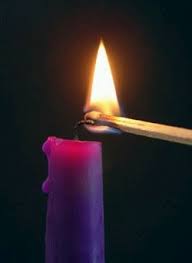
We light the rose candle amidst the purple penitential candles nesting in their Advent greens, and we consider Heaven, having faced Death and Judgment on Advent One and Two. We await Christ’s advent at Christmas, his advent in our hearts and bodies in the Eucharist, and his Second Coming in Judgment. The way to Heaven is narrow we are told, rather like the eye of a needle. We need to be small enough and humble enough to cling to Christ as he rises us up, to enter Heaven with him. 

 And so the Church cradles us through the year, teaching us how to grow toward Heaven, with its seasons of penitence and joy. We are of the world and not of the world, living fully within creation yet knowing we are destined for something even greater and more glorious: Heaven.

And so we do indeed rejoice.

Death, Judgment, Heaven, and Hell

476px-LastjudgementReflecting on these traditional Advent themes, I searched the Internet to learn more about them. I discovered that many Protestants and Catholics seem to avoid death, judgment, heaven, hell. They prefer the more feel-good themes: hope, peace, joy, love, or waiting themes such as expectation, fulfillment, prophecy, etc.
I finally found Father Longenecker’s blog at Patheos.com. Father Longenecker is an Evangelical turned Anglican priest turned Roman Catholic priest. Like many converts, he understands the temptation to dilute Christianity. Others who have made a similar journey and have taken a stand in the American public square include Father Richard John Neuhaus (Lutheran to Roman Catholicism) and Dr. Scott W. Hahn (Presbyterian to Roman Catholicism).

Father Longenecker reminds us of Holy Scripture and the purpose of Advent:

“Advent is… a time to face facts. Christ is on his way, but it may not be the happy party everyone would like to imagine. He is the Good Shepherd, but he is also the Righteous Judge… It does matter what religion you belong to. ‘No one comes to the Father but by me’ says the Righteous Judge… Universalism is false. Some people will not be saved. ‘Broad is the path that leads to destruction. Narrow is the way that leads to life and few there be that find it.’ So we had better snap to it says the prophet preaching to himself. I want to set out on that quest to follow the map, fight the pirates and find the buried treasure–which is eternal life.”

These are hard words for many of us to accept.

Some communities speak of living in a “bubble” of unreality, having cushioned the hard edges of life. Today, in 2015, Americans live in such a bubble of unreality, the nation having been at peace for over forty years. The last military draft ended in 1973. While we bemoan sending our sons and daughters to Iraq and Afghanistan and Syria, putting them in harms way, they go there by choice, not by conscription. We live in a bubble.

The two Paris attacks and the recent San Bernardino attack have brought death home to us. But death has always been with us, even inside the bubble, we just refuse to see it. War, terrorism, threats to peace whether domestic or abroad, force us to face death.

This, of course, is one of the fruits of Advent, rightly referred to as a “Little Lent.” We are reminded of the terror of our own mortality, that our days are numbered, our bodies decaying with each minute.

Christians believe our future is something to take seriously. Not only do we die, but we are given the chance to live again. Not only are we given the chance to live, but the chance to live forever in the glory of Heaven. It sounds good, but the catch is that Day of Judgment. Holy Scripture makes this clear in a way that cannot be sugarcoated as metaphorical. Again and again, we are told we will be asked to explain our lives, give an accounting. We will be judged. And the only person who can redeem that judgment call, be our advocate, is Christ Jesus.

As for me, I’d like to know where I stand in these eschatological indictments. I’d like to prepare if possible, as I would for a crucial exam.

And so on the first two Sundays of Advent (today is the Second) I’m glad that we are reminded of Death and Judgment. We take stock, we examine our hearts and our lives, we confess, and we repent. We are no longer afraid of facing death, knowing we have a friend in Jesus, an advocate in our last days, or The Last Days, whichever come first.

This is good news. This is incredibly, credibly good news, that we, like Christ, with Christ, will overcome death. But how does this happen?

It happens with the advent of Christmas. It happens with the coming of Our Lord, to live and die and rise again. As fully human and fully divine he takes us with him, bears us up. We become one with him to break the bonds of Hell, to rise to life eternal. His flesh and blood are the only way to the Father, to truth, and to life. Jesus Christ comes to us at Christmas as a baby in Bethlehem, incarnate, in the flesh, and he comes to us daily on the many altars of the world in the bread and the wine of the Eucharist.

This is good news. The attacks in Paris and San Bernardino remind us today of death and darkness, something Advent reminds us of every year. But Advent gives us the antidote to darkness and death, the living God-made-man, the Incarnation of Divine Love. Advent gives us the good news of Christmas.

As traditional Anglicans, we pray the Collect in our Book of Common Prayer not only on the First Sunday in Advent but each day until Christmas Day:

“ALMIGHTY God, give us grace that we may cast away the works of darkness, and put upon us the armour of light, now in the time of this mortal life, in which thy Son Jesus Christ came to visit us in great humility; that in the last day, when he shall come again in his glorious majesty to judge both the quick and the dead, we may rise to the life immortal, through him who liveth and reigneth with thee and the Holy Ghost, now and ever. Amen”

Good news indeed.

Heaven and Hell are the themes of Advent 3 and 4. Just in case we weren’t paying attention to the first two Sundays, we are offered the choice with a different emphasis. Do we want to live in eternity with Love or eternity with Unlove? With God or without him? It is a choice I can make today, this very minute, for Heaven and Hell begin in real time on this real earth. We make the choice continually, and with each choice between selfishness and selflessness we choose our direction and our destination, Heaven or Hell. Like a body of law, our choices build upon past choices, so the warnings in Advent are vitally real in present time, vitally present in real time. It is easier to set a straight course now than later. It is wrenchingly difficult to turn around and go a different way later, to re-pent.

So Advent reminds us how to travel to Heaven. It gives us a roadmap, so  that we may cast away the works of darkness and put on the armor of light.


Advent Editing

writingSince signing a contract with eLectio Publishing earlier this week for the publication of my novel, The Fire Trail, to be released May 10, I have been rereading the manuscript, polishing, fine-tuning. Words and phrases are deleted and replaced, sentences are shaved and reshaped, paragraphs and pages and chapters judged as honestly as possible.

It would seem an appropriate work to tackle during Advent, a season of penitence and preparation as we wait for the celebration of Christ’s advent at Christmas. For like the examination of my words, Advent is also a time to examine my heart, to see what should be deleted from my life and replaced, discouraged or encouraged, torn down or shored up, what should be shaved and reshaped, what should be confessed, judged, and absolved. It is a time when we ask that God’s law be written on our hearts.

For Advent is about change, about the editing of our lives.

When I edit a manuscript I measure it against certain standards. I’ve learned and hopefully continue to learn the craft of writing fiction, the structure of the novel, the way words, story, plot, and character weave together. I try to fill my ears and eyes and mind with good writing, to absorb vocabulary and symbols and images, to improve my own attempts to hold my manuscript up to a standard. I listen to language, the rhythm and syntax and flow of dialog and description, attending to the music of words and their dance, be it a minuet or a waltz.

Editing is about choice, choice based on a standard. And for mankind those standards were given to us when God wrote his law on tablets of stone, and Moses carried them down the mountain to God’s chosen ones. That law was fulfilled, filled with fullness, made perfect, when Jesus the Christ was born in a hillside cave outside Bethlehem. That law was fulfilled with his life, his death, and his resurrection from death into life, his shattering of the veil between man and God, his making them at-one, in his Atonement.

In the season of Advent we look to Christmas, to the celebration of the birth of Our Lord. We do this by editing our lives using his standards, his rule of law, his law of love. We want to be ready to receive him into the words and pages of our days, weeks, years, to welcome him to live in our chapters and breathe life into our own stories. To be ready we need to edit ourselves.

Some of us think we have nothing to delete or add to our lives. We are fine the way we are. The problem of sin is for others, not us. It is time then to begin with beginnings: the Ten Commandments. Curiously, they are difficult to keep in today’s culture of distraction. The first four are considered sins against God; the last six are sins against one another. Today we’ll look at the sins against God. These will be challenging enough to suggest a robust humility:

  1. God spake these words: I am the LORD thy God; Thou shalt have none other gods but me.
  1. Thou shalt not make to thyself any graven image, nor the likeness of any thing that is in heaven above, or in the earth beneath, or in the water under the earth; thou shalt not bow down to them, nor worship them; for I the LORD thy God am a jealous God, and visit the sins of the fathers upon the children, unto the third and fourth generation of them that hate me; and show mercy unto thousands in them that love me and keep my commandments.

Do I worship false gods? Do I spend too much time, talent, or treasure on anything that is not to God’s glory, not a part of his plan for me? Has my own selfishness hurt my children, and taught them how to be selfish too, to in turn hurt their children, my grandchildren?

  1. Thou shalt not take the Name of the LORD thy God in vain. 

The everyday use of “OMG” today is astounding. The commandment not to use God’s in vain would seem the easiest of all, and yet saying the name of God frivolously, without meaning or reverence, that is, in vain, is a common transgression. We say it. We hear it. We read it. Bestsellers and mainstream movies use this language liberally without thought to the power of words, whether spoken or written. I can edit my tongue, and edit my reading list, but it is more difficult to edit what I hear. A friend’s solution to this oral pollution was powerful: when someone says “God!” or “Christ!” my friend offers up her own prayer by adding “be praised!” The addition, I’ve found, invites holiness into the moment, making each word spoken precious.

  1. Remember that thou keep holy the Sabbath-day.

For Christians, Sunday is the Sabbath, celebrating Christ’s Resurrection. I must confess I don’t always feel like going to church on Sunday, but I’m always glad I went. I’ve found that regular worship edits my soul, fine-tuning it, regulating its rhythms and guiding its dance. What happens in that simple hour of song and Scripture and sacrament is mystifying, miraculous. I am changed. Words do not fully explain it but I’ll try a few: I enter disordered and leave re-ordered, I enter guilty and leave absolved, I enter sorrowful and leave joyful, I enter depressed and leave enlightened, I enter dying and leave reborn. Keeping Sunday holy by uniting with Christ’s Body is crucial to the editing of the soul.

And so the manuscripts of Me and You are works-in-progress, to be published in Heaven, on our personal release dates, our new birth-days. There is, for me, much to work on, many areas to refashion and rebuild. The editing is ongoing, with the help of sacrament and song and Scripture, with the advent of Christ in history in Bethlehem, the advent of Christ today in the Eucharist and his Spirit in daily prayer, and the advent of Christ at the end of time.

Lord, have mercy upon us, and write all these thy laws in our hearts, we beseech thee.

Thanksgiving for America

flagI’m pleased to announce that I have been offered a contract to publish my sixth novel, The Fire Trail. So I am particularly thankful to God as we approach this national day of Thanksgiving.

But I am also thankful for Thanksgiving itself. It is a time to be reminded to cultivate an attitude of gratitude in spite of a culture of pouting grievance. Once a year the nation recalls, with thanks, the exceptionalism of America. We look back to our history of religious liberty and the many streams of faith mapping our great land. We celebrate our history of free speech and the vitality of civil debate that built our great academic institutions. We are grateful for the remarkable centuries of relative peace ensured by the rule of law, its enforcement, and the courts that judge blindly without regard to race, gender, class, religion. No other nation can boast these things in this way.

But as we celebrate this Thanksgiving, it seems that our national and cultural firebreak, that border between civilization and the wilderness, has been breached as never before. The flames have jumped the path and are threatening our towns and very way of life.

Can we change course in time? I’m not sure. Can we put out the fires of intolerance and terror? Can we ensure those liberties we have enjoyed, for our children and our grandchildren and their children?

In many ways we have arrived at this point through our own success in creating a civilized world. Freedom carries within it its own seed of destruction. We have not worried about invasion and tyranny and submission to sharia law. In this sense we have succeeded beyond our wildest dreams, for America has created a culture of ease, believing the nation would live forever. So we have become frivolous in our worries: the use of fossil fuels or windmills, offense over a slur from an officer or a teacher, academic courses that challenge rather than validate our self-esteem. The delicacy of our concerns reminds me of T.S. Eliot’s The Love Song of J. Alfred Prufrock: “Do I dare to eat a peach? I shall wear white flannel trousers, and walk upon the beach.” We continue with our lives, walking on the beach, not paying attention to the tyrants who wish to conquer our shores.

Nine-eleven caused us to sit up and pay attention, as did other shootings and bombings since, and now we watch as Paris burns. We mourn, we light a candle. But Paris is far away and surely we will manage here as we always have. So we think.

Historian Niall Ferguson quoted Bryan Ward-Perkins in the London Times: “Romans before the fall were as certain as we are today that their world would continue for ever substantially unchanged. They were wrong. We would be wise not to repeat their complacency.” Mr. Ferguson concludes, “Poor poor Paris. Killed by complacency.”

Indeed. But we like complacency. We are not used to having to pay attention. We have others do that for us – our elected officials, our military, our great minds. After all, we don’t have to pay attention much to vote, do we? Or do we?

Eva Moskowitz, founder and chief executive officer of Success Academy Charter Schools, claims in the Journal that her astounding success in raising test scores in poor communities has been mainly due to a single principle: the students must pay attention. She gives educator Paul Fucaloro all the credit for inspiration and teacher training, explaining how “Every child had to sit up straight and show he was paying attention…students had to sit with hands clasped and look at whomever was speaking…” The teacher called on the students rather than asking for volunteers. If the student couldn’t focus, the teacher moved the student to the front of the class. “As Paul repeatedly preached to me,” Ms. Moskowitz writes, “it’s morally wrong to let a child choose whether to pay attention, because many will make the wrong choice and we can’t let them slip through the cracks…. it’s our job to teach them to focus.”

I recall my own public school years in the ‘fifties and ‘sixties. These expectations and procedures were firmly in place. We were expected to listen and be prepared to answer. We didn’t sit in circles but in rows so that some students were brought to the front for closer supervision. Our attitude was graded and was the first grade my parents looked at. I could get away with B’s and C’s in academic subjects, but if there was the slightest question as to my attitude, or my “citizenship,” there would be a serious discussion about the report card.

It appears today you must send your children to a charter or private school to ensure this kind of discipline, which means that the average public school graduate has not always learned to focus, to pay attention, to have a positive attitude toward learning, to become a good citizen. It may be that many of the teachers were products themselves of such schooling and find it harsh and lowering of self-esteem to establish such behavior boundaries.

So, like the bored student gazing out the classroom window or secretly playing a digital game on a cell phone, Americans gaze out the window into the clouds, wondering whether weather is too cold or too hot, too wet or too dry. We campaign for slow-food and decry genetically modified food. We chase Twitter trends and indulge in bestseller porn.

The Fire Trail pays attention to these themes and so I’m especially thankful this Thanksgiving. I’m thankful, for I love America. I want America to be around for my grandchildren and their children, a free America, a peaceful America, and a grateful America. I want an America that holds up the ideal of a civilized world. I want a world that pays attention to goodness, truth, beauty, and most of all, love.

The Fire Trail calls attention to these things, where these ideals came from, and how we can best preserve them. It calls on the students in the back row with the dazed bored look and moves them to the front row. It asks them questions and listens to the answers. It encourages civil debate.

I’m thankful to God most especially this Thanksgiving for the astounding joyous privilege of living in this country for another year. I give thanks for those brave men and women on the battlefields of culture or combat who have paid attention and continue to watch out for us. They rebuild our fire trail daily. They keep America safe.

Thomas Sowell recently quoted Winston Churchill, appointed prime minister during World War II: “All I hope is that it is not too late. I am very much afraid it is. We can only do our best.”

We can only do our best: Another ideal to be thankful for.


Crying for Paris

Paris MapThe horrific attacks in Paris this week brought home once again the precarious nature of our freedoms. 

And so we cry for France and the rest of Europe, so vulnerable with porous borders, weak military, costly social welfare, and alarming inclusivity. 

As the daughter of England, America looks to France, and all of Europe, with anguish and tears. America was birthed by the English, explored by the French, settled by the Spanish, and later enriched by Germans, Italians, Irish, East Indians, Africans, Asians and many others. America has gloried in inclusivity, insisting this great experiment in democracy will after all succeed. Yet, in the last fifty years it is showing signs of serious failure. 

Since her birth, America has welcomed all who escaped to her sanctuary of sacred space, of liberty and life and the peaceful pursuit of happiness. All who came desired safety and a chance to live a better life in which to raise their children. Some sought life itself. This stream of grateful immigrants continues, legal and illegal, crossing borders, running around and over borders, desperate to get in. 

As America grew in strength and wealth, she defended England and the countries of Europe, as any good son or daughter would defend their family from harm. She became a force for good, sometimes through might, sometimes through love of all humanity, usually well intentioned. 

But as Europe aged she grew complacent about defense, counting on America’s strength. Americans looked across the seas to Europe’s villages and history, her cobbled streets, her quaint ways, her saints, her cathedrals, her vineyards and her civilized way of life. We were wealthy and could afford a military that could defend the free world, protect our Western Civilization. Europe rested, relaxing borders. With American might, Europe could afford generous social welfare programs. She could house, feed, nurse, and school all who crossed into her lands, even those who broke her laws. Giving and giving, Europe self-righteously distributed her benevolence. Americans, those coarse fellows across the sea, could provide troops as necessary. 

But no longer. A little like Robin Hood, America robbed from her defense to protect her domestic welfare. She too wanted to feel self-righteous, to “care” as Europe cared. To pay for these programs, programs that buy votes, the CIA was cut and we were attacked on 9-11-01 in New York. To pay for these programs, the military budget was cut and policies of disengagement and “dialog” with our enemies were preferred over shows of strength. 

Islamic State took notice. And so, the barbarians are no longer at the gates. They are here. Living among us, networking their creeds of jihad. National boundaries no long keep the bad guys out. They keep them in. 

It has been predicted by many that Europe as we know or knew it is over. Demographics prophesy that France will be a Muslim state within the next decade, and a sharia state soon after. Put simply, free French are not having children; sharia French are. The same could be said for England. 

In America we are teaching our surviving children to hate our culture, its history, its freedoms. They will not be a generation interested in protecting us. 

In America we rob our children of religious faith and leave them to wander in a nihilistic desert. They will fill this void and find meaning in a Facebook network of suicide warriors. 

In America we slaughter our unborn and euthanize our aged, blinded in our selfishness, not seeing that we are assisting in America’s own suicide. 

But in spite of all the wars and rumors of wars, all the fear on city streets, all the anguish in the once glorious city of light, we hope and do not despair. Those who can see are seeing for others. Those who can teach our children the truth are teaching them the truth. Those who can pray are praying. 

We prayed for Paris this morning in our little chapel in Berkeley. And I prayed that the eyes of the West have been briefly opened, hopefully long enough to change course, to destroy this cancerous evil spreading through the free world. We need a strong America again, one clear-eyed and courageous, yet humble enough to sacrifice for others. We need to wave the flag and revive old-fashioned patriotism.

We need an America that will defend the streets of Paris, once again showing the world and its tyrants that we will ensure peace through strength.

Sacred Dignity

Michelangelo CreationThe belief in the dignity of every human being is based on the Genesis account of creation, that we are made in the image of God. The Judeo-Christian tradition celebrates this idea that there is a sacredness, a holiness, to all human life. Our system of laws and our identity as free nations in the Western tradition are founded on this idea.

And so it is vital that we do not disparage Western civilization. We must not equate our values to those of other cultures, as if there were no difference, but rather give place to the Western tradition as vitally superior, a way that respects human dignity.  There is a moral hierarchy, with judgment and approval, and we desire to preserve our own culture in a world that seeks to destroy it.

Being made in the image of God makes us different from other animals, for we are given the ability to reason. We seek truth and ferret out lies. We are blessed with minds that sift and sort facts in order to conclude. We recall the past to conserve its best for the present, so that we may effectively plan the future. And we do this to provide for our children, the next generation, stamped with this sacred dignity as we have been.

Our belief in human dignity is the foundation of our desire to do right and eschew wrong, to uphold truth and expose lies. And so it is troubling to see the public twisting of truth today – Ms. Clinton’s hiding of state emails and lying about them; the mainstream media’s near cover-up of her obstructions; her lying about the Benghazi attacks on September 11, 2012 when she claimed they were a reaction to a video. Lies about lies, covering-up cover-ups. It is deeply troubling that Ms. Clinton, who clearly sees herself as privileged and above the law, is running for the presidency of our nation, a country based on equality before the law.

Our belief in human dignity, the foundation of this equality, also raises concerns when government allows some racial groups to be above the law and others left unprotected. Where police presence is threatened by cellphone cameras, as it increasingly is, those same communities become victims of their own violence. Most black crime is caused by blacks, not police, and those rates are rising rapidly with the retreat of law enforcement in black neighborhoods. According to FBI Director James B. Comey, in a speech at the University of Chicago Law School, October 23:

“Something deeply disturbing is happening all across America…something has changed in 2015. Far more people are being killed in America’s cities this year than in many years…. far more people of color are being killed… And it’s not the cops doing the killing.. We need to figure out what’s happening and deal with it now.”

Without the rule of law and its enforcement, the truth of sacred dignity is forgotten. Chaos reigns, tribes war against one another, families feud for power, and a jungle culture becomes the new American way. Civilization crumbles, dignity disintegrates, spirits shatter.

The belief in the value of human life is an exceptional one, unique to the West and its children of many races around the globe. The twentieth century saw this belief erode when the false narrative of population explosion swept America, propelled by the mainstream media. Paul Ehrlich, a biologist with no credentials as a demographer, wrote The Population Bomb in 1968. This myth of overpopulation birthed the United Nations Population Fund and the Malthusian Club of Rome. Indira Gandhi’s government forcibly sterilized eleven million, among whom 1,750 died. China’s one-child policy, supported by UNICEF, was rigidly enforced, causing a surfeit of boys and a disappearing work force, not to mention the tragedy in human lives. As Bret Stephens writes in the Wall Street Journal: “It’s not surprising that someone like Mr. Ehrlich, trained as an entomologist, would be tempted to think of human beings as merely a larger type of insect.” The lie was lucrative, providing posh conferences and bestseller books, becoming self-propelling.

The truth is that the world’s population could fit comfortably into an area the size of Texas. But without belief in God and the sacred dignity of his people, interest groups seek power and wealth at the cost of truth.

The importance of Western values is seen in a story told by Jonah Goldberg in National Review about General Charles Napier, British commander-in-chief of colonial India. General Napier was asked by Hindu priests to be allowed to practice their venerable custom of sati, where widows throw themselves onto the funeral pyres of their husbands, sometimes forced to do so. The general replied,

“Be it so. This burning of widows is your custom; prepare the funeral pile. But my nation has also a custom. When men burn women alive we hang them, and confiscate all their property. My carpenters shall therefore erect gibbets on which to hang all concerned when the widow is consumed. Let us all act according to national customs.”

Not all cultures and customs are created equal; we must evaluate and judge according to our founding belief, the sacred dignity of every human life. We must follow the Napier Doctrine.

In another instance, Mr. Goldberg cites the New York Times’ report that American soldiers have been ordered to ignore child rape by Afghan soldiers, even on U.S. bases. Special Forces captain Dan Quinn retaliated against an Afghan commander who kept a boy as a sex slave. Quinn was removed from his command.

Mr. Goldberg suggests an etiquette manual for Afghan troops that would include: “Do not rape young boys when you are a guest of the Americans. If you wish to follow your own customs in this matter, take note: It is an American custom to beat the stuffing out of men who chain up and rape young boys.” Hooray for the Napier doctrine.

We honor Western civilization. We celebrate the dignity of persons of any age, any class, any race, any gender, any place. We judge other cultures based on this belief.

For we are made in the sacred image of God.

All Hallows

all saintsHallowe’en comes from the contraction of All Hallows Eve. To hallow is to make holy, and October 31 was (and is) the eve before All Hallows Day, or the All the Holy Ones Day, All Saints, honoring Christian saints. The celebration is followed by Allhallowstide, in which all of the Christian dead are remembered. This coming week churches all over world will remember their dead, their loved ones, calling out their names on All Souls Day and, in this ceremony of love, hallowing them. The evening before, Halloween, sees the last of the unfriendly spirits roaming the night, for they are vanquished by the light of Christ in the morning, and fear is vanquished by joy.

Sometimes fear is good. It is an intuitive instinct that signals danger. Gavin de Becker, an expert who evaluates potential threats to famous people, titled his invaluable book on safety, The Gift of Fear. And in this sense, fear is a gift, a survival signal, a warning that lights the dark.

Children are afraid of the dark. And we should be too. Novelist Jake Halpern writes in the Wall Street Journal about fear of the dark:

“Since the dawn of man, night has been a time when we were in danger, when we were vulnerable – to lions, club-toting men and giant chasms into which we could fall… it was evolutionarily advantageous for us to be afraid of the dark. Those of us who feared the night and cowered from its dangers, survived. Those who went for strolls in the dark ended up as snacks for lions.”

Today with electric light we laugh such fears away. Yet we are ambivalent about fear itself, sometimes denying it, sometimes welcoming it. We flirt with it, tease it, to see what happens when it draws near, for we have banished most survival fears from long ago such as hunger, shelter, wild animals. We are curious, enticed by darkness.

A friend of mine once claimed that she liked the feeling of fear, of being on the edge of danger, secondhand fear experienced in a book or movie. There are many words for this feeling of excitement. We shudder and shiver, chilled to the bone. A frisson gives us goosebumps. A ghost walks over our grave. We are on the edge of our seats, waiting to be safe again. What is the lure? Why flirt with the dark, with falling into the abyss? Are we rehearsing our future? Our death?

Halloween has in many ways become a rehearsal as well, as children (and adults) don costumes and pretend to be someone or something else and venture into the dark. For some the choice is innocent role playing, choosing to be princes and princesses, musicians or athletes. Still, others choose to be witches and goblins. Some choose the light and some the dark. Some choose life and some choose death: skeletons, ghosts, and grim reapers, desiring to scare.

Our nation too seems on the edge of darkness, in the dusk of its day, playing dangerous games with life and death, slaughtering generations of unborn innocents. We survivors look away, pass on the other side of the road, just as we do in the world theater of wars and rumors of wars, withdrawing and allowing the dark to swallow the light, whether in Moscow or Tehran or the borderlands of the West.

Light and darkness, life and death. The line between them is not often clear, sometimes smudged into dusk and dawn. And so it is in our hearts, where good sheds light and evil darkens.

And so I’m grateful that the dark of All Hallows’ Eve is banished by the light of All Hallows’ Day and the light of Sunday resurrection. This morning I gazed upon six thick white candles on the stone altar of St. Joseph’s Chapel near U.C. Berkeley. The candles flamed brightly, the fiery wicks drinking in the air above, flickering their tips toward heaven. A roughly carved crucifix rose above the tabernacle, beyond the suspended Sanctus light. We stood and turned toward the entry as five student acolytes processed in, carrying torches and crucifix, followed by the white-robed clergy. The organ bellowed through the vaulted domed space and echoed over the russet-tiled floor as we joined in songs of praise to God for his saints.

Halloween would not exist if it were not for All Saints, the holy-day that gives the costumed evening its name. After the night of darkness, a weak sun broke through this morning and bathed our world in light. We sang as one people, giving thanks for those men and women who chose the light and turned away from the dark. Martyred for their choice, and today still being martyred, we honor them. History has known a world without Christ, a world of impenetrable darkness, one rightly feared. We peer through the dusk of our days, keeping our candles lit, sharing the love of God, the light of Christ, looking to the morning of resurrection.

Licensed to Vote

voteSometimes I think one should be licensed to vote in national elections, perhaps take a test as one is tested for a driver’s license. Each of us wield a powerful tool, the vote, more deadly than any vehicle. We should be responsible with that tool, just as we should be responsible with our vehicles. We must know the rules of the road – the role of government, the history of our country, essentially, Civics 101.

The history of the West is largely the history of Jews and Christians and their systems of right and wrong, codified in time, ways of living together (not always successful) that honor the dignity of every person. We are taught shoulds and oughts. We feel shame and guilt when we should and ought to feel this way. We honor humility, and we dishonor pride. These are mechanisms of change within and without, ways to right our behavior, to become righteous, better people. We confess our sins and we make amendment. We repent, return to the right path. Can a society survive without these habits of living and thinking? Can a society that values self-esteem over self-sacrifice continue as a community? That is the challenge of today’s secular culture.

In many areas of society – government, church, family – I increasingly meet those who want to run away from serious debate, rational reasoning. We are like birds with our heads in the proverbial sand. It is more comfortable to avoid discomfort, to insulate oneself with rosy visions of reality. Who doesn’t want to love everyone and be loved by everyone? Sounds good.

But life is more complicated than that, indeed, survival as a nation is more complicated. One behavior slides toward another. In studying history, whether it be the history of an individual or a nation, we see these patterns and can better predict outcomes from those patterns. We apply that knowledge to current crises and so make better decisions.

In a democracy we citizens need to be educated on the issues. Without an educated electorate electing, choosing candidates and platforms who will determine our nation’s future, democracy becomes a sham and we the people, blindly teeter on the edge of a cliff.

It takes courage to face reality, whether it be the state of our own hearts or the state of the state. Many of us would rather not face facts, just to keep the peace. The price is high, however, as we veer unchecked toward the precipice.

In our nation, we look to educational institutions to educate us, to ensure each generation learns their country’s founding story, as unbiased as possible, through clear lenses rather than filtered through biases of gender or class, race or religion. We look to our schools and universities to foster honest debate, in fact, to teach us how to debate civilly, how to consider the opposite side of an argument. Most importantly, we want to be able to hear criticism and not deem it hate speech, to differ without fearing jail.

There has been a recent trend on university campuses for students to veto invitations to speakers with whom they disagree. So far, among many, Ayaan Hirsi Ali, George Will, and Charles Murray have been invited and disinvited because of the possibility of disagreement among students. For disagreement has become synonymous with hate. Here, on university campuses, where the exchange of free ideas should be encouraged, where the First Amendment right of free speech should be explained and exalted, tyranny of thought and language reigns.

McLaughlin & Associates conducted a survey of attitudes towards free speech on campus, and by wide margins, students desire codes regulating speech for students and faculty, requiring “trigger warnings” in class in case material might be uncomfortable. Might be uncomfortable? I would find the trigger warnings themselves uncomfortable; does that mean there should be triggers for the triggers?

Such absurdity nearly sidesteps the serious harm done to free speech and the dumbing down of an electorate who should be tough on all sides through reason. The gift of reason is unique to our species, one claimed divine and proof of God’s existence, that is, the existence of a reasoning Creator. We think things through, we legislate laws, we judge our fellows innocent and guilty. Courts and their legal systems, rights to defense and trial, separation of powers stemming from Magna Carta and earlier, all are rooted in the remarkable belief that we can reason through our differences, and only in this way can we maintain peace.

That we must train the next generation to do the same, to carry on this great tradition of Western civilization, seems obvious, at least to this writer, using her limited talents to reason.

Children who are surrounded by serious conversation around the dinner table are deemed to have a head start in life in contrast to those not exposed to such speech. They learn by example the steps taken to reach a point, and the charity required to listen to opposing views. Such beginnings are far more powerful than class or gender or race. There was a time it was thought that only the best educated could provide these beginnings for their children.

Not so any more, it appears, with the current trends. For academia favors a sweet diet of no opinion, sameness. We must agree (with the liberal viewpoint) or be arrested. Why does this brave new world remind me of a book by that name? Why does it remind me of Islamic State and its thought police who behead Christians and crucify those of differing beliefs, who sell their children into slavery, who watch and wait as America grows increasingly weak and wavering?

The natural desire to avoid conflict, to silence speech contrary to one’s own, and then silence one’s own speech to keep the peace, is especially harmful to a nation nearing national elections in 2016. But we must take courage, pull our heads out of the sand, and listen to the arguments pro and con. We must study our Western patrimony (Daniel Hannon’s Inventing Freedom is a good and readable start) and make intelligent, educated choices in the voter booth next year. We should listen to the candidates and judge their true character. Do they understand America’s true character? Are they unafraid to uphold the character and the history of the West? Or do they feed us a sweet diet of platitudes and promises to make us feel better?

If we don’t do our homework, then we should not be voting. If we do not license ourselves to vote, others will take our vote from us.

The Gift of Rosemary Kennedy

RosemarySuicides are on the rise, school shootings seem a regular event, insanity and violence not unexpected. Are we seeing the collapse of Western civilization? I often wonder. Then along comes a book like The Missing Kennedy, Rosemary Kennedy, by Elizabeth Koehler-Pentacoff (Bancroft Press, 2015).

This is an important and encouraging book. The author tells the story of Rosemary Kennedy (1918-2005) from a personal perspective. Elizabeth Koehler-Pentacoff’s aunt, a nun, cared for Rosemary at St. Coletta’s in Wisconsin, a Roman Catholic home for the mentally ill. The young Elizabeth visited Rosemary when she visited her aunt, Sister Paulus. In this remarkable account, the grace of God ripples through the pages.

Rosemary Kennedy, “Rosie,” was born a slow learner, and it is thought brain damage occurred during her birth, but she had no physical handicaps. The highest reading level she achieved was 3rd-4th grade. As she matured physically into a beautiful young woman, she became vulnerable and at times disruptive in her innocence, and her brothers did their best to protect her. Her father, Joseph Kennedy, learning of a method that might calm her and ease her life, allowed a lobotomy to be performed, a procedure that had been occasionally successful (at the time). But the operation made things far worse, partially paralyzing Rosie age twenty-three, and nearly destroying her ability to speak. She would need assistance in the basic functions of living for the rest of her life.

This was truly a tragedy for all concerned. Joseph Kennedy sent Rosie to St. Coletta’s. For twenty years she was isolated from her family, the doctor decreeing such visits would disturb her. Finally, in 1961, sister Eunice and mother Rose began regular visits. So did the author, Elizabeth Koehler-Pentacoff.

The author, a Roman Catholic, was clearly influenced by Rosie and Sister Paulus, and I could see the grace of God working through them all. Elizabeth’s dedicated aunt, full of love for the helpless, the abandoned, and the unwanted, touched the hearts of all in her circle through her example. I could see that the author was given a deeper sense of appreciation for the handicapped and what it means to love sacrificially as her aunt loved. The dignity of every living person shines through these pages.

As I read this book, Governor Brown signed the bill legalizing assisted dying in California; the U.K. was studying the option, avoiding the word euthanasia, preferring death with dignity. Earlier and ongoing, the investigation of Planned Parenthood’s selling of baby body parts littered the news, the horrendous videos a reminder of what our nation has become. And of course, for the last forty-two years the unborn who might be handicapped or unwanted have been “terminated” in the womb under the euphemism of choice. What do these word-shifts do to our language? What do these actions do to our hearts? Do we become desensitized, hardened, with these images, these verbal aberrations, and these stories?

And does a book like The Missing Kennedy do the opposite? Does the story of Sister Paulus and Rosie, of the Kennedy family, the author Elizabeth Koehler-Pentacoff, make us more sensitive, opening our hearts to loving as we are meant to love, without regard to handicap, without regard to degrees of perfection.

When the Kennedys finally reunited with Rosie, they were inspired to help the mentally ill, funding research programs, passing legislation, and founding Summer Camp Shriver which became the Special Olympics. All of these efforts were the result of Rosie and her tragedy. Rosie’s handicaps became blessings, making those around her better. She taught them how to love. She taught our culture how to care.

There seem to be two streams running through America, one of selfishness and one of selflessness. The great irony, the devil’s victory, is that the former leads to unhappiness, depression, and suicide. The self-centered life chases a greedy illusion of met needs and devours itself in its turning inward. The self-giving life, one seeking God’s path of sacrificial love, ends up discovering joy, meaning, and the actual fulfillment of the self.

We are tempted today to throw out the undesirable, the inconvenient, the unborn, the less than perfect, the aged. And if we give in to this temptation, which might at times seem deceptively attractive and even arguable, we shall be changed as a people. We shall become hardened and we shall shatter.

The Missing Kennedy is full of photos, many from the author’s private collection. The ones I particularly loved were the group photos. At first there is just Rosie and Sister Paulus, then others join, including the author, then more and more Kennedys gather around Rosie. She becomes, in the end, the center of the family. We are all better for her having lived, reminding us that the Rosies of our world have a place in the heart of our culture. We are better, too, for Ms. Koehler-Pentacoff’s heartwarming memoir of Rosemary Kennedy’s life.