Category Archives: Uncategorized

On Fathers

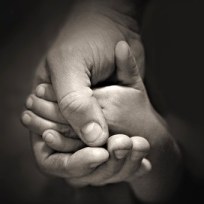
Father Son handsWe live in a time of confusion and increasing chaos, as traditional gender roles come into question. And so on this day when we honor our fathers I wonder who and what they are, were, and should be.

The animal kingdom has been busy this last spring, giving birth, and baby deer cross our front lawn. We humans share some of their generative biology – the male unites with the female to give life. Some animals form a kind of family, with a male taking on the protective role of father, at least for a time. Other animals don’t and the male moves on. Humans throughout history have formed families, having reasoned that society works better that way. Early families were often polygamous, the male having many wives to produce many children for the tribe. More people was good, not evil. More meant safety and better defense. More meant productivity and wealth. More meant a future for the community and nation. 

Judaism and its child Christianity define marriage as the union of one man and one woman, united sexually and by vows of love and commitment before God. Marriage is considered generative, meant to produce children. Throughout Holy Scripture this relationship is replayed, as God the Father creates his people, God the Son unites with his Bride the Church, and God the Holy Spirit weaves them together in Love. God creates us not because he is lonely, but because he is Love. That’s what Love does. 

And thus Love is sung to us throughout the centuries through the Church. It dances and weaves through her liturgies, reflecting light like a many-faceted jewel. Love calls us to love one another, the other, one who is not our self. The ultimate expression of love is marriage, where two different people love one another – different genders and different genes. They unite to generate life, to bring children into the world to love and be loved. 

There are times when fathers take on mothering roles. And there are times when mothers must act as fathers. But in the Christian family, our bodies, our genders, define our primary purpose under God, the role that nature has given us. When this purpose is denied, chaos results. 

Mothers are the inner home of love, for they carry in the womb the new life created. They then bear the child and create an outer home of love. Fathers beget this new life, determining it’s gender, and initiating its conception. And so two become one, generating a unique human being, one never repeated before or after. A mystery and a miracle.

This miracle of life is often taken for granted. And yet so sacred a union, so mysterious a bond, this bond between husband and wife, and between parents and children, that it is the foundation of our culture. As we see today the traditional family threatened and torn apart, we must work to protect and mend it, to heal its brokenness.

At the least fathers must be present, both in body and spirit. We don’t hear a great deal about St. Joseph in Scripture. He is a good man, we are told. He listens to God. He trusts God. He takes Mary as his wife. He shelters her and the Holy Child growing within her. He provides a living so the boy can become a man. St. Joseph is powerfully present. This is what fathers do, even stepfathers. 

FamilyAnd so we honor stepfathers as well, and all those who have stepped into the silent absence with their presence and their love, and all of those uncles and cousins and friends who have acted as fathers to those children bereft, all priestly fathers, parish fathers, community fathers. I was once a single parent, and I am so grateful for the many fathers of our local church who were quietly present, strong in their faithful support.

When the traditional family is threatened, fatherhood is threatened. When marriage is no longer valued, fathers abandon their children. When fathers abandon their children, families are wounded, and civilization collapses. 

I believe we are seeing signs of such collapse: children raised by one parent, usually the mother; children denied the bonding security of family love; children unable to create such bonds of family in the future, having no models.

Cult creates culture, and without Judeo-Christian institutions of temple and church, the traditional family will disintegrate. Fathers and mothers, united in matrimony, committed to love, are key to the institution of the traditional family. Today they are encouraged to abandon one another and their offspring to look out for themselves alone. 

And so I honor true fathers who do what needs doing, silently, lovingly, sometimes unsung and even unloved. You sacrifice, you shelter, you make it possible for mothers to mother and children to grow up. We need you, for our children, our grandchildren, and the very future of civilization.

Thank you.
Tracking Truth

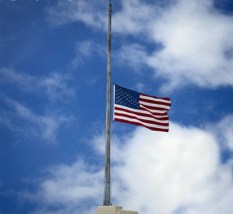
FLAG-AT-HALF-STAFFI returned home Sunday after a lovely time at the Presentation High Alumnae Luncheon in Berkeley to hear of another mass shooting, this time in Orlando, Florida. In the name of ISIS a gunman entered a gay bar and opened fire. 
It is odd that the liberal press isn’t more concerned about ISIS in our country, that they don’t seem to connect the dots, that Muslim extremists desire to destroy Jews, Christians, and gays, probably in that order. They desire to cleanse our world of what they consider blasphemy. Those of us who defend our right to exist, to speak, to worship, to live as we choose freely within the borders of law and order, are targets of radical Islam, be it homegrown or ordered by foreign terrorists. 

We freedom-loving Americans are in this together. We have a national election coming soon. Let us vote for the person who understands the threats to our country from within and from without. Let us vote for the candidate who will support our right to practice our religion and to speak freely, who values life from womb to grave. 

The Presentation luncheon was a reunion of ladies from many backgrounds. They were the lucky ones who attended an all girls’ school in the fifties, sixties, seventies, early eighties. I have long been impressed with the cross-section of society represented by Catholicism, a faith for all peoples everywhere in all times. I am not an alumna but wish I was. I went to public schools, co-ed, and often wondered what it would have been like to have the experience of an all-girls school and one that taught a code of ethics and hard work. 

The history of Berkeley, the Presentation Sisters, and Presentation High is considered in my newly released novel, The Fire Trail, and so the ladies had a unique interest in the story. But they were also appreciative of other themes, the fires of our culture jumping our borders of law and order, devouring liberty and silencing speech. It is a story that considers how we can keep barbarians on the other side of our borders, how we might define, encourage, and safeguard our precious and disappearing civilization. For even definitions seem to have been forgotten. The Fire Trail is a tale that takes a second look at church-state issues, issues of persecution (yes, in the twenty-first century), re-examining the value of religious schools that teach right and wrong and the dignity of every person, what it means to be civilized.

I was glad to chat with the lovely ladies of Presentation High Berkeley, over sandwiches and fruit, wine and sparking water, about their experiences in a Catholic high school. Some said they worried about today’s crime, the inability to walk the streets of San Francisco to get to the office without fear. Some said they didn’t understand what was happening to our culture. 

It made me think of a recent article that asked once again (how many times is this asked?) what was the appeal of Donald Trump? Joseph Epstein writes that folks feel they’ve lost their country they want it back. They don’t embrace the agenda that progressives have slipped into their world through a back door. The Trumpistas aren’t haters or bigots, but they would like to see the rule of law applied equally. They would like public safety. They would like their sons and daughters to be safe on campus and given better role models than pornographic novels and violent movies enshrine. They would like their grandchildren to survive the womb to breathe the air of freedom. 

Indeed. I would too. 

And as I pray for the victims of the Orlando massacre, I pray that we tell the truth about what is happening in America. I pray that the media correctly reports the words of our candidates so that I don’t have to verify every speech on YouTube. Mr. Trump said something quite different about the judge that is presiding over his trial than what was reported by the media. At least as far as I could tell by listening and watching his speech, with real words coming from his lips. His phrases were conflated by both the right and the left, inferences underlined, truth abandoned.

I am waiting to see the media accuse Mr. Trump of the Florida shootings. The culture of violence is not caused by Mr. Trump’s free speech or even his simple diction. It is caused by the silence of good men and women, and the rabble who are allowed to set fires in public forums. 

Each of us must do our homework and sort truth from lies. Each of us must vote for the candidate that will prevent the next massacre on American soil. The truth is there, under the media rubble, in the ashes left by the press, and hopefully in The Fire Trail, carried home by the lovely ladies from Presentation High.


EVENT coming up: I will be reading from THE FIRE TRAIL along with six other adventurous ladies tomorrow at 11 a.m. (Tuesday the 14th) at Curves Walnut Creek, 1848 Tice Valley Blvd. (near Rossmoor). There is a chapter set at a facility similar to Curves. For a $10 donation to Blue Star Moms receive a copy of THE FIRE TRAIL. Come on by!

Why Walls

HADRIAN'S WALL

Hadrian’s Wall

The heatwave in the Bay Area is a dangerous one, for much of the golden grass covering our rolling hills has not yet been plowed under. It doesn’t take much to set it ablaze, and so I’m glad for firebreaks, those borders that protect us from the fires, those walls that keep us safe.

Much has been said about borders and building walls, tall walls, long walls, fortified walls, cyber walls, customs walls, checkpoint walls. Why have walls? Americans like people. We are friendly folk. Why do we need walls?

It goes against our grain to build walls around our country, concrete walls scarring our land. In spite of the media’s assertions to the contrary (and if a lie is repeated it somehow becomes true), Americans are not racists. We found ourselves in the twenty-first century scarred by our shameful history of segregation but accepting, even lauding, integration and equal rights for all. If anything, an inflammatory press keeps the uncivil Civil War alive. And we welcome immigrants of all races, as long as they desire to be Americans and respect our rule of law. And so we build walls, borders, fire trails, to ensure this happens.

We have an iron fence around our property to keep out wild animals, for we live near a state park. Turkeys fly over the fence (it’s a sight to see, a turkey flying) and do their considerably large business on our patio. That is merely annoying, not dangerous. But young bobcats and coyotes squeeze through the iron bars. They would make short work of our cats. They are not friendly, even if cute. I was sad when we fenced our olive trees with green wire to protect them from the deer. Every fall, these bucks rid their adolescent antlers by rubbing them against the trunks, so their adult antlers will grow. The practice reminded me of children and their baby teeth falling out to make room for the permanent ones. And at some point we all must leave childhood behind if we are to become adults.

There are places for fences and walls and I hold, as does the poet Robert Frost’s disagreeable neighbor, that “Good fences make good neighbors.” The narrator in his poem, “Mending Fences,” questions the mending of fences, the building of walls, as not encouraging the true “mending of fences” between people. Many question today. We want to be friendly. We are big-hearted good Americans.

But we need to keep our fences mended, not to keep us in but to keep the coyotes out. President Reagan cried, “Tear down this wall,” for it was a wall that kept people in, imprisoning them, not a wall that kept people out. The why, the purpose, is important. Pope Francis, according to the fiery press, has decried those who build walls. That’s not quite what he meant, but he could have been more specific, more careful in his choice of words with a predatory press at his heels.

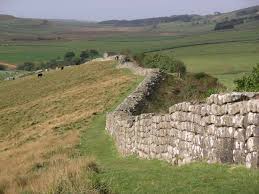
Historian Victor Davis Hanson of the Hoover Institution in his syndicated column this last week referred to Hadrian’s Wall that kept the Scots out of Roman Britain: “Rome worked when foreigners crossed through its borders to become Romans. It failed when newcomers fled into the empire and adhered to their own cultures.” Immigration is fine if assimilation is desired, but dangerous if assimilation is shunned. This latter case has been true, it appears to me, with many illegal immigrants crossing our southern border.

Assimilation has also been intentionally avoided by Muslim refugees transplanted by the United Nations, encouraged and supported by “humanitarian” foundations, both religious and secular. These refugees are flown over our borders, placed in rural communities throughout the U.S., towns unprepared for those who disapprove, hate, and fear American culture and freedom. Sharia law replaces American law. But we cannot have two sets of laws. We must be equal under the law. Lady Justice is blind.

Let’s rephrase Mr. Hanson’s excellent and succinct doctrine: “America works when foreigners cross its borders to become Americans. It fails when they cross its borders to adhere to their own culture.” We are a melting pot. We need to melt (at least to a degree).

This is a start, but I would add “when foreigners cross its borders legally.” We have much in common with our Catholic neighbors to the south in terms of faith and culture, for cult produces culture. I believe most Hispanics do assimilate into American life, stabilizing it. We welcome Western cultures who respect freedom. That there are so many immigrants here illegally, that children have been impacted by this national travesty, that there are sanctuary cities allowed, cities that encourage ongoing illegal activity, is a tragedy.

As we head for the California primary on Tuesday, it is gravely unfortunate how the press, both right and left, have misrepresented the desire, indeed the urgent need, to build a wall. They hype hyperbole and invite mob rule. They silence free speech.

We should not be afraid of walls. Walls define who we are. They are a tool. They protect us so that we can thrive, can love one another and live in peace. And America must thrive. She must be the light on the hill, the beacon of hope to a world of lawlessness. She must hold her lantern high, and welcome all who love her law.

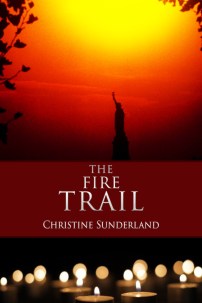
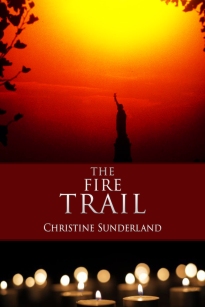
I’ve been promoting my new release, The Fire Trail (eLectio Publishing), which is about the border between civilization and barbarism. Lady Liberty commands the cover, but the sun is setting in a fiery sky. Hope is in the lit lantern she holds up to the world. Hope flames in the candles at her feet.

+++

The Fire Trail is now being carried by Orinda Books and Rakestraw Books as well as online retailers.

I will be doing a reading of The Fire Trail at Curves Walnut Creek (a chapter is based here), Tuesday, June 14, Flag Day at 11 a.m., 1848 Tice Valley Rd., near Rossmoor. Some of the ladies are taking parts and it should be fun. Open to the public. Copies available with a $10 donation to Blue Star Moms East Bay. Come on by!

Memorials to Remember

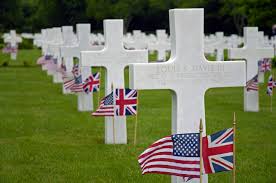
Memorial DayTomorrow is Memorial Day, the American holiday that honors all those who died while serving in the nation’s armed forces, defending our borders at home and abroad.
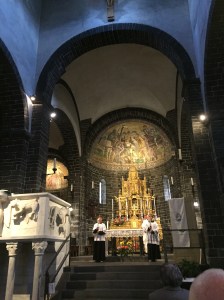
And yesterday was the first anniversary of the death of our Archbishop Morse, a man who died while serving in the Church’s armed forces, defending our borders of life and death, loving us to his last breath.

Today, this Sunday in Trinitytide, connects the two, and my memory remembers these borders of human life, of our nation, our great experiment in democracy, and of our Church, the Body of Christ on earth.

I am editing Bishop Morse’s sermons to be published by the American Church Union. One of the recurring themes is that religious belief begins when we accept our own death. This acknowledgement prompts us to consider the meaning of life, asks us to question who we truly are. What makes us human? Are we any more than a collection of molecules thrown together randomly?

Many have written intriguing answers to these questions. The Christian answer, of course, lies in what we call apologetics, the making a case for belief in a loving God who created each of us with and through love. In fact, as St. John (and my bishop) writes, God is Love. His breath breathed over the waters, created day and night, stars and sun and moon, breathed life into dust to create Adam, en-livening him with Himself. And so the Christian answer is that we are made in God’s image. We will not die, but through union with Christ, God in human form, we will enter eternal glory.

Another theme in Bishop Morse’s sermons is that if you don’t like being in love you won’t like being in Heaven. Falling in love with God is a magnificent journey that never ends.

I’ve been reading a book about this recently, The Romance of Religion, Fighting for Goodness, Truth, and Beautyby Fr. Dwight Longenecker, a Roman Catholic priest. Father Longenecker invites skeptics to view faith from new perspectives, to live dangerously with an open heart and mind. His blog at Patheos.com is called “Standing on My Head,” titled thus to encourage a new way of looking at Christianity, a more adventurous way, a romantic way.

I often feel guilty that many of my extended family, whom I love dearly, are missing out on life’s most beautiful, good, and true journey. They are, quite bluntly, being left behind. They are not living the great romance between man and God, the falling in love on both sides, the enjoyment and pleasure of knowing their Creator who so loves them.

As a writer I particularly appreciate Father Longenecker’s  apologia, for he explains the role of language and how words themselves link the physical world of matter with the spiritual realm of sharing ideas. He explains the historical roles of heroes and quests and storytelling, of fantasy and fiction and fairy tales. All of these core elements of our humanity, our history, define us as human, and for a reason. They tell us we are creatures greater than our material bodies, more than our lifespans. We are meant for something beyond, something glorious.

When we face our own death (the truth we know to be universally acknowledged, at least in the middle of the night), we become more interested in those spiritual realms, in man’s spirit, in that something beyond the present.

As an English Literature major at San Francisco State in the sixties, I was required to read the existential works of Sartre, Camus, and others. I wish I had been required to read more Dante and Shakespeare, but this was not the fashion. As I absorbed existentialism, the belief that all we have is the present and what we can see, I became keenly aware that I would one day die and that would be the end. The awareness threw me into a deep depression. But in 1967 pills to cure sadness weren’t as ubiquitous as they are today.

I asked the question that awaited in the dark corners of those pages: why bother to live if you were going to die? I considered suicide, for life had no meaning. What pulled me out of the depression was love, the love of a friend who encouraged me to read C.S. Lewis’ Mere Christianity, which provided a logical foundation for belief. Then I crossed the threshold of St. Matthew’s Episcopal Church in San Mateo where I found the tools needed to build upon that foundation: Scripture and sacraments, prayer and song, actions and words that defined the glorious worship of this loving God. I fell in love with Love, and with its cousins: beauty, truth, and goodness.

The borders of life are not birth and death but something far better. And like those brave men and women who lived and died defending our nation’s borders, our faithful clergy and laity live and die defending our spiritual borders. In America the two kinds of borders are vitally connected, for without freedom to worship and speak, believers will be silenced.

Memorial Day reminds us that borders preserve a way of life, indeed, preserve life itself. Our laws create borders, lines that we citizens must not cross over, lines drawn by all of us, together. As a culture we draw these lines between other behaviors as well, between the civil and the uncivil, between the mannerly and the unmannerly. Such borders are not legalized but they are protected by social sanctions – applauding and lauding, shunning and shaming. These are borders rooted in Judeo-Christian belief and practice, and should we cease to acknowledge America’s vital history, our borders (both national and social) will collapse.

My novel, The Fire Trail, speaks of these things, reminding us to remember who we are, to memorialize the many Memorial Days that honor our nation’s borders and those men and women who defend them throughout the year. For when we honor those who have died for our freedoms, we turn death into life.

Santissima Trinita in Bellagio

IMG_1533Bellagio, Lake Como, Italy 

We are staying a couple of days in Bellagio, a village perched on a peninsula reaching into the center of Lake Como. Ocher roofs nest against green, forested mountains, and you can see in three directions from our hotel’s gardens, south toward Como, across the lake to Menaggio and Tremezzo, and north to the snowcapped Alps. Most Italian villages have churches, and this basilica’s belltower chimes the time in the misty air.

Today being Santissima Trinita, Holy Trinity Sunday, I looked forward to visiting the basilica for Mass and seeing what our Heavenly Father would show me. The stone basilica (12th century, Romanesque) is nearly next door and we planned to attend the 11:30 Mass, following the Italian as best we could. I have found that the liturgy of the Divine Office, the Holy Eucharist, is the same everywhere – Scripture, Sermon, Offering, Consecration, and Communion with Our Lord and one another. As we stepped across the threshold I opened my heart and mind, waiting and watching, to see what I might see, to see what our Heavenly Father might show me. It was 11:15 and we were the first to arrive, but it was soon packed.

The church itself is a work of art. The tabernacle and high altar are golden and gleaming against the dark stone of the vaults and pillars. There is a large stone pulpit that the preacher used to full advantage, high above us, gesturing with bright-eyed enthusiasm. The pews are the expected hard wood and the kneelers even harder slats. Folks stood to pray more than they knelt. Kneeling was saved for the Consecration. The nave flooring was uneven, sloping down from the chancel to the entry, as though the church were indeed an ark parting the seas.

While I understand the structure of the Mass and many of the liturgical prayers, Italian being close to Latin, I usually struggle with the sermon in a foreign tongue. In this case the pastor had kindly provided an English translation in a leaflet. I scanned it as he spoke from his marbled loft.

The mystery of the Trinity is one that has long been debated and prayerfully considered. Analogies are given: St. Patrick’s three leaf shamrock is one and three; a tree has trunk, branches, and leaves, one and three; H2O can be solid, liquid, and gaseous, one and three. There has been an assumption that the Trinity is a difficult concept, those three Persons of God: God the Father, God the Son, God the Holy Spirit.

My late bishop often said the Holy Spirit was the love between God the Father and God the Son.

But today, it seemed clear, after reading the little leaflet in the Basilica of St. James (San Giacomo) in Bellagio. “All liturgical celebration, indeed all Christian prayer,” it read, “is Trinitarian: to the Father, through the Son, in the Holy Spirit.”

Growing up Presbyterian I was told to pray to the Son, to Jesus. Nothing wrong there, of course, except, I always wondered where the Father came in, and assumed He was watching from above, distant. As I grew in the Anglo-Catholic faith, I came to understand that prayer is addressed to God the Father, but in the name of Jesus Christ His Son, for we are told by Christ to pray in His name not to Him but to His Father. All prayers end with “in the name of…” and this is why. And all Anglican prayers (or most) address God the Father. For, I came to understand, Jesus is the Way to the Father. We pray through Jesus. They are both the same person, in this sense. Christ is the fleshly form of God on earth, and it is His humanity, this incarnation, that allows us to touch God. This is the only Way to God.

But what about the Holy Spirit. While I understood that the Spirit is the love between the Father and the Son, today a new dimension entered my soul. In prayer, the Spirit is where we are dwelling. We are in the Spirit, as we pray through the Son, to the Father. And so in prayer we enter another state, a cloud of knowing rather than unknowing as the mystics like to say, for we are on the way to God, being in God, and traveling through God.

St. Benedict said that life is a pilgrimage into God with God. Yes. A pilgrimage into God the Father, within God the Spirit, and through the name (and Eucharistic union) of God the Son.

And so I left the gilded stone sanctuary a different being than the one I was when I entered. I was given a gift today, this Trinity Sunday 2016 in this village on the shores of Lake Como. I have been given many gifts, over many years of Sunday Eucharists, but this one I will not forget. Now each time I pray I shall think of that golden tabernacle and the true nature of the Santissima Trinita. I shall realize that as I enter my prayer with those first words, “Our Father who art in Heaven…” I enter into the Holy Spirit of God. He prompts me, He leads me, and He gives me the words to say, the desires to express. I am in the Holy Spirit, in Heaven on earth already.  This the magnificent gift of the Santissima Trinita.

The Fire of Pentecost

pentecost-flame2Lake Como, Italy

The Fire Trail, my sixth novel, has now been released into the world to fly on its own, and so we have flown as well, to Lake Como for a time of rest and re-creation. Settling into our hotel, we are recovering from the 20-hour trip, flying San Francisco-Newark-Milan, and the challenge of today’s airports, especially for the frail and elderly.

This morning, from our balcony, I hear the buzz of a weed-cutter clearing the hillside. Swallows chirp in the garden next door where visitors wander neat paths and beyond our terrace steep green-forested mountains descend to the long blue lake. I know, but cannot see from here, snow-capped Alps anchor the northern tip of the finger of water like winter queens on their thrones. Now, in the peace of a northern May morning, I consider yesterday’s Festival of Pentecost, a wondrous holy-day, and all that it means.

The images of Pentecost are powerful, a great distance from the gentle Jesus of mainline Protestantism. As the disciples await their Lord’s Holy Spirit promised at His ascension, they must have been fearful, wondering, and even doubtful. Their human limitations, just like ours, must have shadowed them, as they waited in hiding in Jerusalem.

And then it happened:

And suddenly there came a sound from heaven as of a rushing mighty wind, and it filled all the house where they were sitting. And there appeared unto them cloven tongues like as of fire, and it sat upon each of them. And they were all filled with the Holy Ghost, and began to speak with other tongues, as the Spirit gave them utterance. (Acts 2)

They were transformed. No longer fearful, they left the safety of their Jerusalem room and entered the danger of the Jerusalem streets, no longer in hiding, speaking in other languages of the “wonderful works of God.” Soon they found they had other powers, powers to heal, to endure, to inspire, to give others the power of the Holy Spirit, in a long succession through years and centuries to this day, to this moment, our moment in time, through Baptism, Confirmation, and Ordination.

The Feast of Pentecost is the fiat (meaning let it be done) moment for us all, a time we as children of God, say “yes” to Him, let it be done as He wills. For Mary said “yes” and was filled with the Holy Ghost, to nurture and give birth to God’s Son. We too, can say “yes.” We too, can be filled with His fire.

Lately I have been editing the sermons of our dear Bishop Morse, and reflecting from time to time on my last year with him, his last words. When we talked about the turmoil of our world, our church, even our local parishes, I often waited for an answer to why, some explanation for it all, and most of the time he would say, “He (or she) said yes to God. He (or she) didn’t say yes to God. That’s why. They didn’t open the door.” He would raise his brows, shake his head in wonderment, and his eyes would search mine to see if I saw too, if I understood. I did, for when you say yes, you ask that His will become yours. Let it be done. Fiat.

I have often thought of those words and their simplicity, as truth often is, right in front of us, staring at us, waiting for our response.

It is not always easy to say yes, and we often forget once we have said it. The Baptized forget who they are. The Confirmed do not remember. The Ordained look away. But if we have said yes, God will not forsake us. Then swords shall pierce our hearts, and nails shall wound our flesh. We shall know the despair of darkness, rimmed by the hope of light. In those times of terrible twilight and deepest dawn we must remember to breathe “Jesus” in and out, refilling our souls. We must remember to pray the Our Father, holding onto the words that will pull us to shore, that will give us life, that will save us.

Pentecost. They gathered on this Jewish festival day to remember the giving of the law to Moses on Mt. Sinai and were given a different kind of knowledge, commandment, and power. The English Church in time came to call Pentecost “Whitsunday,” White Sunday, for it was a traditional day of Confirmation, when the Confirmands wore white. Confirmation, of course, is a renewal, a confirming, of our Baptismal vows (vows of our godparents for us or our own vows) and is another Holy Spirit descent upon us. In Baptism and Confirmation, we say yes to God. We open the door to His will becoming ours. Let it be done. Fiat.

The disciples said yes, and on that day in Jerusalem two thousand years ago they received the Holy Spirit. And so we call this the Birthday of the Church. The Church – the descendants of those disciples – has been saying yes ever since, or at least trying to.

Last night, the evening of Pentecost Sunday, we stood on our balcony overlooking Lake Como. As a half moon rose in a chilly dark sky, fireworks boomed from a barge on the lake. Brilliant light rose and shattered over the waters, drifting down and disappearing like falling stars. The bright diamonds flashed so near I thought I might take them in my hands. But of course it was an illusion, a dream, a longing desire.

But Pentecost fulfills that desire. The Holy Spirit does indeed descend upon us and we can truly open our palms, our hearts, and welcome Him. We can say yes. We can have that desire fulfilled.

Sometimes we say no, even after we said yes, and we must repent. We must turn around, recall our yearning and renew our yes. This chance, a repeated loving chance, is the glorious heart of the Gospel, the good news of Christ’s life, death, and resurrection.

My little novel, The Fire Trail, draws that crooked line that runs between saying yes and saying no, or even saying maybe. The way of yes is the way of love, of self-sacrifice for our brothers and sisters. The way of no is the way of unlove, of self-gratification. The way of yes is the way of civilization, be it Western, Eastern, Southern, Northern. The way of no is the way of the jungle, barbarism, darkness. Nihilism. Nothing.

I pray, as I watch the clouds gather over the snowy mountains, that I will keep saying yes and that God’s tongues of fire will continue to rebirth His Holy Church, to inflame us all with His will. Let it be done. Fiat.

The Miracle of Mothers

Cover Art v2 (Flattened)Today is Mother’s Day. In two days my new novel, The Fire Trail, will be born. I have mothered it as best I could, and it is time for it to breathe in the public square. 
It has been said that finishing and publishing a novel is like giving birth. It is true, for it is like another child in the family, this book of mine, but it is also like sending a young adult out into the world. I have found that once the novel is written, the year or so it takes to submit and be published is a time in which my characters bounce in my head, anxious to be out, quarrelsome and nagging like children on a rainy afternoon, and when the day nears they grow suddenly quiet, thoughtful in their anticipation. Today they are curiously quiet.

The Fire Trail will be released this Tuesday, May 10, by eLectio Publishing. Soon Jessica, Zachary, Anna, and Nate will join my many other characters from earlier novels that have found their place among readers, have found booklovers who took them into their hearts and homes. Just so, I shall soon release Jessica, Zachary, Anna, and Nate, letting their novel appear on bookseller sites such as eLectioPublishing.com, Amazon.com, BarnesandNoble.com. These four characters shall be invited to live in laptops and iPads and iPhones with the click of a mouse, the tap of an app. They shall be on view, on lists, and on review by reviewers, celebrated in signings and voiced in readings. They shall people the pages, safe within the fiery cover, napping in the chapters.

My first novels, comprising my Trilogy of Western Civilization – Pilgrimage (Italy), Offerings (France), and Inheritance (England) – as well as my more recent novel of apologetics, The Magdalene Mystery (2013), are more religious in theme and content. Hana-lani, my fourth novel set on Maui, claims secular concerns, albeit embracing traditional family values. The Fire Trail is appropriately my most passionate, born of a desire to give life to our culture. For the history of Christianity that I traced in the Trilogy, a history that formed and continues to form Western culture, is no longer bequeathed in liberal academia, no longer considered necessary to democracy. And without a strong and true foundation of liberty and law, freedom of speech and religion, our unique and revolutionary civilization will crumble. 

And so, ablaze with fearful passion, alight with desire to raise prophetic warnings, I wrote The Fire Trail. On these pages I give life to my concern through the words (and characters) of my characters. My concern appears to be shared by others, for it has been a fiery election year, one of spirited debate and manic maneuverings that have left some of us breathless. Words are fired between candidates and are quickly inflamed by media and gossip. We have left behind us a trail of also-rans who magnificently added their measure to the mix. God bless America.

And we can still those  Godly words. We can still speak and write and worship without fear of reprisal, although the grievance culture threatens to shut us down any day. Speakers are disinvited from college campuses. Eggs are thrown in public forums. Police are forced to force a peace. The Supreme Court legislates, curtailing freedom and legalizing murder in the womb. We are so very close to anarchy that I sometimes want to crawl under the bed with my cat.

But I don’t. I decide to practice an attitude of gratitude rather than of grating grievance, for I am not only a mother of novels, I am a mother of sons. And thus I am thankful for all mothers, those who have offered their wombs to nurture new life, those who have fed their unborn with their time, talent, and treasure, those who care for the children given them. There is no job, no profession, no vocation, more important than being a mother. It is Godly and God-filled.

Mother’s Day is the second Sunday in May, appropriately so since May is the month of Our Lady, Mary our Mother. And Mother’s Day lands this year on Ascension Sunday, the day we celebrate the pulling of Earth into Heaven, the bodily ascension of the resurrected Christ. For God the Father reaches through his Son to us, to Mother Earth, and pulls us up and into Heaven to be with him for all eternity. We ascend with the Son to the Father. And there is more, for soon, we know, the Holy Spirit will come like flames of fire to the disciples at Pentecost, empowering them to change the world.

The Fire Trail‘s release is thus bracketed by Ascension and Pentecost, when that fiery spirit descends upon each of us, transfiguring us so that we can transform our world through transcendence. It is this spirit, this burning love of God, that gives hope to humanity.

It is a rich season of light and of love, this season of May, this season of miraculous mothering.

Uncovering a Cover

Cover Art v2 (Flattened).jpgThis last week I received (and approved) the cover for my new novel, The Fire Trail, to be released by eLectio Publishing May 10. It always astonishes me when I open that email attachment. I am filled with anticipation, then wonder.
Covers cover things, in this case, the interior pages, the real book. I had signed off on the interior galley earlier, having changed a word here and there, having caught some inconsistencies. They say one never finishes writing a book; one merely abandons it. How true. I usually have a sinking feeling when I sign off on a book, for it is like sending one’s child into the great wide world. Twinges of regret will shadow my exuberance over the release, and I shall be nervous to open a copy once published. Like many authors, I am my most demanding critic and shall always see errors to be corrected and changes to be made.

And so as I gazed at the cover of The Fire Trail I asked myself if it was a good representation of the story and its themes, its characters and their arcs, the burning passion that I had seared onto the pages with my words and phrases. The cover shows the sun setting in the west beyond the Statue of Liberty, the orb of fire falling into a dark horizon, with votive candles flaming below.

I suppose it is a truth (possibly trite) universally acknowledged that humans have their own covers hiding their true selves. Does my outward manner reflect my soul or hide it? Is my book to be judged by its cover? Am I am open book, disingenuous, integrated, whole?

Our flesh, our clothing, and our behavior cover and protect us. We are born with bodies and live within them a lifetime. Body and soul are at once separate and united. And yet we have a yearning to reach out, to experience something other, transcendence beyond ourselves. Some of us make this journey with drugs. Some travel into prayer. Some are absorbed by the beauty and truth of music and art, some lost in work and some in play. In fact, being absorbed in anything, be it work, books, movies, or love of another, pulls us out of ourselves. The movement away from self is a relief, a rest, a relaxation. Self absorption is exhausting. This is why, I am told, that a good sleep is more about the rest of the mind than the body. We need a break from ourselves.

As I peer at these words through the windows of my eyes I know that I desire such escape from self. I am blessed to have found rest in God, in worship, in prayer and praise and sacrament. I’m also re-created through beauty, in music, and in nature when it is friendly not deadly. I have found rest too in books and movies that pull me into another world.

As I gaze at my new cover for The Fire Trail, I ask myself, do the images invite me inside? Just so, our outward demeanors sometimes belie rather than reflect our inward states. Sometimes they protect the inner person with layers of sophistication, sophistry, fads, political-correctness, the zeitgeist of today. Sometimes it is frightening to drop the mask, the public persona, to be open, honest, and loving.

The Fire Trail referenced in the title of my new novel is a firebreak in the Berkeley hills that many walkers and runners enjoy for the panoramic views of San Francisco, the bay and its bridges. It’s a path that safeguards civilization from the wilderness, that protects Berkeley and its university from the firestorms that rage through the dry brown grass of the East Bay hills in late summer.

The Fire Trail considers whether the sun is indeed setting over Western civilization, ushering in a new dark age. But the fire of the setting sun is also the fire of burning votives, those prayers that lighten the dark. And the fire of prayer is lit by the burning love of God.

And so today, this last Sunday in Eastertide, Rogation Sunday, we pray for our world. Rogation comes from the Latin rogare, to ask, and we petition God for peace in the world, and the freedom to pray. In prayer, we unite with God’s sacred heart of burning love.

One of the appearances of Christ after his resurrection was on the road to the town of Emmaus. The two disciples who walked with him did not recognize him as Jesus who was crucified and risen from the dead. It was only when Christ breaks bread (recalling the last supper and the Eucharistic body broken) and vanished from them that they knew who he was. They wondered at their own blindness, saying: “Did not our hearts burn within us, while he talked with us by the way, and while he opened to us the scriptures?”

It has been said that when we face the last judgment, we shall either burn with the love of God or be burned by it, for mankind cannot bear too much reality. He must cover himself with anything that will distance himself from real life, from truth and even beauty. C.S. Lewis in The Great Divorce, a story about the irreconcilable distance between Heaven and Hell, describes the blades of grass in Heaven that will cut our tender feet if we are not made more real in our earthly journey, more full of the love of God.

And so we uncover our hearts and minds and souls, open them wide to God’s love – in history and in the present – so that we may infuse our culture with his law and liberty, peace and transcendence. Such experience of truth and beauty will make us more real, faith warriors able to protect our culture from the barbaric and deadly, so that that fiery setting sun will rise again, revealing a new day.

The Tapestry of Memory

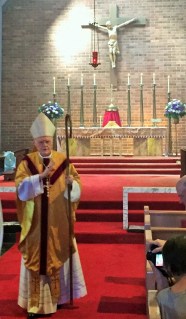
IMG_1326 (5)Perhaps it was the gold vestments against the crimson carpet at St. Peter’s Pro-Cathedral in Oakland that made the Mass of the Holy Ghost one of such deep beauty. Certainly the chanting from the choir loft behind us enhanced this sense of heaven and earth, the light angelic descants swirling over and around our mortal flesh in the weighty oak pews. It was both solemn and joyous, for we were thankful for our archbishop’s careful care over the last year and were happy to witness the installation of our new bishop. 

Saturday’s Mass was one of those moments in history that unites the political and the spiritual. Man has long organized his doings with one another, an activity we call politics, and in this national election year we are keenly aware of this process. We desire freedom and peace, and our national conversations as to how to achieve this in the most equitable manner with the most noble result, occur at set times. We hope and pray that the conversations – the debates, the reportings, and the elections themselves – lead to answers that most of us can live with, peacefully, in community with one another. 

Just so the Church, that Body of Christ on earth, must organize its “political” life within the Church in much the same way. We meet yearly to elect and legislate and found and order anew. But we also protect what has gone on before – those things we have found to be good. We conserve and preserve and build upon the old to create and re-create the new.  

Man is naturally conservative in this sense, that he must build upon his past for good or ill, and that is why change is often difficult, even painful. Instinctively he holds on to his biography, his ancestral beginnings. Intuitively he honors memory, the recording of history whether it be personal, public, or institutional. Today hundreds of years and thousands of photos and documents can be stored in a tiny chip of metal, retrieved with the flick of a finger, so that flexing the memory muscle is not as needed. Or is it? 

It has been observed that we are losing our ability to memorize, losing memory itself, for we have instant access to information. If this is true, then our rituals and storytelling grow even more vital to both nation, church, and temple. Those who have thrown out their past will find their future rootless, their lives or countries or churches built upon sand. 

And so as we convened together in meetings and gathered together for meals this last week, our diocese was charged to remember, to build upon our history as we step into the future. We did this through word and sacrament, prayer and praise. We acted out the great drama of our life together kneeling in pews and sitting on folding chairs. We told our stories, giving life to the memory of who we were and are and who we will be. It was rather like weaving a beautiful tapestry, with each one of us adding a thread to the design. Soon we could see the image we had woven – one of faith, hope, and charity. 

At St. Peter’s on Saturday the archbishop knocked on the narthex doors. The doors flung open, and thirty clergy processed up the red carpet to the altar, two by two, lead by the thurifer, the torchbearers, and the crucifer. The archbishop came last, shepherding his sheep, regal in gold and holding a shepherd’s crook. The gilded robes looked heavy, the miter pressing, and just so his duties must weigh upon his soul, for he must feed and protect his sheep. 

And so the Mass began, and we told our story of God’s great love. We sang our song of confession and absolution, of offering and receiving, of uniting with the eternal in the bread and the wine of the Eucharist. We told our story as we recited creed and read scripture, how God took on flesh to become one of us, to die for us, to live again for us and bring us with him. We told the story again and again, and especially on this Saturday morning in the slanting golden light that fell upon the red tabernacle and white altar, as our archbishop installed our newly elected bishop. We told the story as the bishop received the pectoral cross of our late Bishop Morse, a gesture reminding us to remember our journey to this moment. And we told the story as our bishop received his crozier, to remind him to remember that he must protect and feed his sheep. 

As Ruth R. Wisse writes in the Wall Street Journal, “All that has been earned and won cannot be maintained unless it is conserved and reinforced and transmitted and celebrated.” She is speaking of an “optimistic conservatism” seen in the observance of Passover, seen in the American rituals of Thanksgiving and the Fourth of July. As individuals, citizens, and believers, we can lose it all if we don’t remember, if we don’t celebrate our stories, if we don’t remember to remember.

Making America Great Again

voteI find it troubling how the media exaggerates and condemns discord stemming from political debate.

For discord is the bedrock of democracy. Silence is democracy’s opposite, and should be feared, for it means a drugged populace, whose speech has been taken from them.

As we watch both political parties engage in heated debate, I see the heat as healthy. We should be celebrating the candidates’ right to speak, their passion. To be sure, there are degrees of civility and incivility, lines we don’t like crossed, a continuum that can be slippery, but that is the rough-and-tumble nature of freedom. “Sticks and stones can break my bones but words can never hurt me.” Not entirely true, but true enough. We have laws governing the degree of hurt, of slander, of libel, and when dealing with public figures the laws stretch to accommodate the free speech necessary to the public square.

I celebrate the fierce rivalry displayed over the last year between our many candidates. But I also celebrate those who bemoan the incivility, the name calling, the “tricks” played with “rules” regarding delegate selection. Let those who bemoan continue to be the brave watchdogs that report the crossing of lines and the slipping down the slope of unmannerly dialogue.

All this is good for our country, healthy for America. And there are other kinds of dogs in our political arena – underdogs, those who have been surrounded and bullied by both the left and the right and the media. While it is difficult at times to view Mr. Trump as an underdog, he is clearly beset by his own party powers-that-be, as well as his opposing party and the media both left and right. It is difficult not to root for such a knight clanking clumsily about in his rusty armor, such a strange American hero disguised in rich man’s clothing. For our knights since the time of Arthur and Lancelot are supposed to be gallant and polite. Our heroes are supposed to be in rags. The riches are ordained to come later, after the conquest, like trophies. Mr. Trump is a curious hero appearing on the American scene. He is rich and he is unpolished. Upper classes call such persons “boors.” They are embarrassed by him.

America is not a monarchy and because her people are fighters in both word and deed, they have saved the disintegrating, nominal Western monarchies from foreign occupation. Essentially, America has fought their wars, rescued them. And so when I see the upper crust in Britain and France bemoan our gutter candidates, looking down at such American roughnecks, I wonder at their grasp of reality, their knowledge of history. Remember World War II? Remember the London bombing? Remember Dunkirk? Remember the Holocaust threatening Britain?

The world is affected by America’s national elections. We make a difference in the balance of power, and how we structure our elections matters immensely. While I’m not a fan of the electoral college, I understand its history and the place of state’s rights. As a conservative in California my vote has rarely counted in Presidential elections. I would like to see more enfranchisement and less disenfranchisement. I would like to see, as Mr. Trump would like to see, a complete overhaul of the electoral system.

I would like to see a more honest media, both left and right. I have read again and again allusions to Mr. Trump’s invective against Muslims, Mexicans, and women. The “invective” as I recall regarding Muslims, while poorly stated, called for a temporary ban on non-citizen Muslims entering our country until the borders were better secured against terrorists. Makes sense to me. The “invective” regarding Mexicans, again poorly stated, called for building a wall to keep the drug traffic out and to require all immigrants to enter legally and obey our laws once here. Makes sense to me. The “invective” regarding women, while again poorly stated, concerned a reaction to the slurs against his wife by the Cruz campaign. Makes sense to me.

Mr. Trump does not yet have my vote, such as it is. I am concerned, as many are, as to whom he will nominate to the Supreme Court. I am concerned about religious liberty and compromises he might make with Congress, in his deal making. But then, candidates promise all kinds of things and don’t deliver. This we know. At least he isn’t making specific false promises.

I believe that if America is made strong again, both militarily and economically, many problems will be solved or slowly dissolve. But without a strong military and a robust economy we will not be able to survive the many invasions across our borders that will destroy our culture, silencing our freedoms. Tyranny will reign, and those polished monarchies across the seas with their good manners will not send us aid, for they will have been silenced by sharia law.

It might be the time to elect a bumbling bear of a fighter, an unpolished knight in rusty armor. Perhaps he can improve his manners, polish his act. Perhaps he can be more “presidential” as his wife has urged him to be.

It might be the time to elect a strongman to protect the weak, a strongman who celebrates law, freedom, and the rule of the people. Ineffective leadership at this crossroads in our nation’s history will invite an even stronger regime from outside or from within. Americans want peace at home and abroad, but do they want marshal law, curfews, and a police state? History tells us, in the midst of anarchy, such an answer lurks in the shadows.

Let us celebrate and honor all of our candidates, for America truly has an embarrassment of riches, so many highly qualified men and women of varying ethnicities. The debate has been enriching, informing, and has awakened a sleeping giant, millions of voters paying attention. We are showing the world our greatest strength is our people. We are showing the world we are unafraid of confrontation, of free speech, and of searching for the truth. We may stumble and bumble and even be unmannerly but we will always fight to keep our Camelot democratic and free.