Category Archives: Uncategorized

The Holy Name of Jesus

Holy Name of JesusToday traditional Anglicans celebrate the Feast of the Holy Name of Jesus.

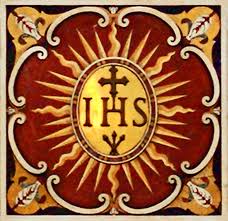
The Greek spelling of the Holy Name begins with the letters IHS: ΙΗΣΟΥΣ, IHSOUS in Latin. And so, like the Chi-Rho abbreviation for Christ, IHS has come to be the symbol for the Holy Name of Jesus.

I have long been fascinated by the power of the Name of Jesus. It is used often by those who do not believe, unthinking, even shortened to “Jeez.”  And yet in my own faith-pilgrimage, the name has grown precious to me. So I wince when I hear it sworn, used lightly, in vain, and I often add to their invocation, “be praised,” turning the curse into a blessing.

Even referring to Jesus casually seems flippant, harsh on the ear. Lord Jesus, or Our Lord, sounds better, sounds more appropriate when naming the Son of God, the Second Person of the Trinity, both imminent and eminent.

We name our children in Baptism, sometimes calling the service a “Christening.” For in Baptism the child is made a part of Christ’s Body, the Church, through the power of the Holy Spirit in the pouring of water. He or she is Christened, brought into Christ. Adult Baptisms do not include this naming, but nevertheless these men and women are Christened, brought into Christ’s Body.

What is in a name? Nothing and everything. I am identified by my name. I am called, chosen, loved, with this name. I sign my name, and my signature is my bond, my contract to be true and faithful – in marriage, in business, in law, even in giving birth. “Sign here.”

We capitalize our names to add emphasis. But we want to blend in as well, so we simplify spellings as we move between cultures. We change our names to reinvent ourselves, to avoid the law, to hide from the press.

And so, as the years go by I have wondered about the Holy Name of Jesus and its power. Even before Christ came to earth, we were commanded not to take the name of the Lord thy God in vain. When God the Son comes among us, New Testament testimony repeats again and again the power of the name of Jesus.

When Gabriel appears to Joseph in a dream, the angel announces, “you shall call his name Jesus, for he will save his people from their sins” (Luke 1:21).  St. Paul writes, “in the name of Jesus every knee should bow, of those that are in heaven, on earth, and under the earth” (Philippians 2:10). Those who “call on the name of the Lord” will be saved (Romans 10:3). 

St. John quotes Jesus: “If you ask the Father anything in my name he will give it you” (John 16:23). So we conclude our prayers with the phrase, “Through Our Lord Jesus Christ” or “In the name of Jesus.”

The Name of Jesus drives out demons, baptizes, performs miracles. The invocation of the Holy Name protects us from evil. We pray the name of Jesus, breathing in and breathing out as we move through our days, travel through our time given.

Tranfiguration2We celebrate this Holy Name of Jesus on August 7, the day after the Feast of the Transfiguration. The closeness of the festivals is appropriate, for it is on Mount Tabor that Jesus reveals himself as God’s Son once again, reflecting his own Baptism:
“And after six days Jesus taketh Peter, James, and John his brother, and bringeth them up into an high mountain apart, and was transfigured before them: and his face did shine as the sun, and his raiment was white as the light. And, behold, there appeared unto them Moses and Elias talking with him… behold, a bright cloud overshadowed them: and behold a voice out of the cloud, which said, This is my beloved Son, in whom I am well pleased; hear ye him.  And when the disciples heard it, they fell on their face, and were sore afraid. And Jesus came and touched them, and said, Arise, and be not afraid. And when they had lifted up their eyes, they saw no man, save Jesus only.” (Matthew 17)

On the mountaintop, Jesus, Son of God, bridges heaven and earth, the New Covenant with the Old Covenant. We climb His Body into Heaven, like the angels on Jacob’s ladder. His Holy Name is our cry, perhaps our hymn to Him. We are transfigured in Him, by Him, with Him, and so our faces shine as the sun, our clothing white as the light. He shares it all with us, freely. Because God – Father, Son, and Spirit – is Love, is community, is touching and arising, unafraid.

A beloved parishioner passed into that white light this last Tuesday. She was elderly and her journey here was long and faithful. She came to Church every Sunday, easing her ’66 Chevy gently into the parking lot. She dressed up to worship the Holy Name of Jesus. She wore color-coordinated skirt and jacket, hat, gloves, polished pumps kept in good condition through the decades. She kept her soul in good condition too, and she would pause to chat with the Sunday School teachers and laugh with the children. The place in her pew is bare now, empty. It will never again hold such a lover of Jesus. But then every lover of Jesus is unique, unrepeatable, unforgettable. But she glowed, transfigured. She is greatly missed already.

And so we celebrate the Holy Name of Jesus, and as we sing our songs, we partake in that name, transfigured too.

On Masses and Miracles

SomSt. Joseph's 002compething happens in the Mass.

It has been a long time since I attended daily Mass for two weeks. True, I missed one Monday, and both Saturdays, but my grand total for the period July 17-31 was 12. Not that I was counting.

I’ve often thought that the Mass changed a person, outside and inside, body and soul. We are taught in the Anglican tradition that the bread and wine are the mystical body and blood of Christ. We are told that Christ enters the body when we receive the Eucharist. And with his entering of all the communicants at the altar, we experience a family forming the Body of Christ, one that is both physically and spiritually real. Even so, after fifty years of Eucharists, in some ways I believe this more, and in some ways I take this miracle for granted.

Many churches have liberalized and diluted this belief, as though embarrassed, as though Christ’s words in John, Chapter 6, verses 53-58, don’t exist. But our own Anglican Province of Christ the King (traditional Episcopalian) believes those words:

53: Then Jesus said unto them, Verily, verily, I say unto you, Except ye eat the flesh of the Son of man, and drink his blood, ye have no life in you.
54: Whoso eateth my flesh, and drinketh my blood, hath eternal life; and I will raise him up at the last day.
55: For my flesh is meat indeed, and my blood is drink indeed.
56: He that eateth my flesh, and drinketh my blood, dwelleth in me, and I in him.
57: As the living Father hath sent me, and I live by the Father: so he that eateth me, even he shall live by me.
58: This is that bread which came down from heaven: not as your fathers did eat manna, and are dead: he that eateth of this bread shall live for ever.   (KJV)

Many left him then because of those words, and many leave him today. They are, to be sure, revolutionary, astonishing words. Hard words. But our Anglican Church believes them, believes he meant them to be true.

And so we teach our postulants for Holy Orders that this is true. We act out this belief with daily Eucharists offered in residential programs at St. Joseph of Arimathea Chapel in Berkeley, the most recent session having just ended. The Noon Mass was open to the public, so I went.

I didn’t always feel like going. I had to give up my time. But to be fair, my time isn’t mine. It’s a gift, a loan from God. I have no regrets that I attended daily. My only regret is that I missed one – for a good reason – but nevertheless I missed it.

Sometimes I look back on my sixty-nine years and wonder how much of it I wasted, not listening to God’s promptings, but plunging ahead with my own ideas, my own plans, my own use of my own time, my, my, my….

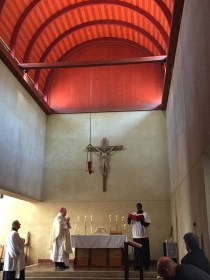
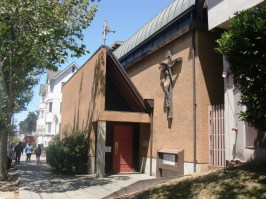
So each day I arrived early to this beautiful, haunting, intimate chapel, one block from UC Berkeley. I set out a sign announcing the special Mass that day. I lit candles before the Virgin Mary icon, so that bright flames led the eye upward, up to her comforting image, holding the Christ Child. I prayed an Ave Maria. Occasionally visitors peered in, exclaiming they didn’t know this stunning chapel was here, right on the corner of Durant and Bowditch. Some stayed for the Mass. Some lingered, then moved on. Would they recall the powerful peace in this sacred space of red tiles and barrel-vaults, the austere beauty of the chancel and the white-draped altar, the primitive wooden crucifix above, the massive pipe organ in the back?

IMG_2022The organ is played on Sundays. It wasn’t played in the weekday Masses, but then we had melodious singing. The postulants, discerners, and clergy, robed in black, entered in silence, into the silence, and took places along benches lining the walls. Rug squares served as kneelers on the polished tiles. As the Mass danced its way through the Lessons, Creed, Absolution, Offering, Consecration, and Communion, the congregation sang responses, sang the Gloria and the Creed, sang hymns with one voice or in harmony. There were quiet “said” Masses too, spoken only, Masses mourning recent Christian martyrs, words full of reverence and love, and longing for a world at peace not war. And each Mass, celebrated by a different priest, was unique, reflecting the celebrant’s unique manner and character.
Looking back at all those liturgies, I don’t believe I noticed a great change in myself, body or spirit, until the two weeks drew to a close. But toward the end of the second week, I found I slept more deeply, prayed more clearly, and best of all, was filled with a curious bright certainty. I had spent an hour each day outside myself, offering myself, more self-less, allowing God to heal me by living within me. It was and is as though there was a change in my body and soul, perhaps producing St. Paul’s immeasurable riches of God’s grace, bringing to mind the last line of the Te Deum Laudamus.

The Te Deum Laudamus, an ancient prayer praising God and part of our Order for Morning Prayer, is said to have been sung by St. Ambrose in the Milan Cathedral as he raised St. Augustine from the baptismal pool, Easter 387 AD. Augustine sang too. The last line reflects my heart: “O Lord, in thee have I trusted; let me never be confounded.”

I don’t like the feeling of being confounded. Nobody does I suppose. Confusion, disorder, and division are not the works of light, not the ways of God. They cause us to “groan and travail in pain” (again St. Paul). They cause insanity, war, and hate. But in the Mass, all is sane, orderly, and united in love. The beauty is seamless like the garment at the foot of the Cross. We enter the church’s sacred space confounded by the world and leave no longer confounded. We enter with divided hearts and souls, and leave as brothers and sisters. We enter as many and leave as one. We enter, propelled by duty and commanded by love, and leave trusting God once again. Why is that? Because we leave with him in us. We pray in the Mass, that “our sinful bodies may be made clean by his body, and our souls washed through his most precious blood, and that we may evermore dwell in him, and he in us.”

We are cleaned and washed, made ready for Christ’s indwelling presence.

A friend of mine is confined to a wheelchair. He arrived at the Noon Mass confounded by the works of the City of Berkeley who had removed the sidewalk in front of our chapel in preparation for repaving. He waited on the street, barred by the disturbing curb, and looked around. I stepped outside, keeping watch. Two workers eyed the wheelchair. I eyed them, then eyed a pile of plywood. “Could you make a ramp for him with the plywood?” I asked as nicely as possible. They looked slightly confused, but then jumped to it. Soon they had laid a bridge over the river of churned dirt. My friend drove his chair to the door, grinning. “I don’t give up easily,” he said. “I noticed,” I replied happily. I think we will call this the “Miracle of the Bridge over Troubled Sidewalk.”

With his broken body imprisoned in his chair, my friend is a walking, er, rolling, testimony to the power of faith. He rings the Sanctus bells in the Mass. He prays the Our Father, the Gloria, and the Nicene Creed as though he means it, distinctly, proudly, forthrightly and righteously a part of Christ’s Body. For Christ does indeed dwell in him, in me, in all of us who partake of the Eucharist.

Thinking back on these two remarkable, miraculous weeks, I give thanks that a bit of my self was offered, a bit of my time sacrificed, all now redeemed. And I shall continue to partake. I shall continue to not be confounded, for in him have I trusted. And it is a glorious way to be.

To view video clips and photos of the Noon Masses, visit St. Joseph’s Chapel Facebook page. 

A Dream for Our Children


IMG_2005This last week I spent in seemingly alternating universes, attending daily Mass at our Anglican Seminary Summer Session at St. Joseph’s Chapel in Berkeley at mid-day, and then watching the GOP convention in the evening.  The former was quiet, focused, purposeful, and passionate. The latter was lively, energetic, excited, and passionate. The convention was the body politic that exercises freedom of speech and assembly, a gathering of devoted delegates to nominate the next President. The Seminary Summer Session was the body ecclesia that exercises its freedom of religion and worship, a gathering of devoted clergy, postulants, and men discerning their vocation.

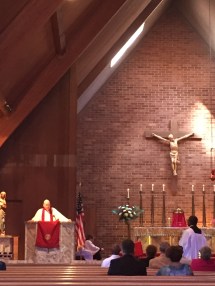
The week was crowned with an ordination in our parish church, St. Peter’s Anglican in Oakland. It was a glorious crowning, with soaring and thunderous organ and enthusiastic hymn-singing, with a majestic and humble bishop leading our flock, with a sermon that gathered past, present, and future and made sense of them. It was glorious as the sun streamed through skylights, illuminating the medieval crucifix and the red-draped tabernacle, red to signify the Holy Spirit weaving among us. In this sacrament of ordination, God the Holy Spirit enters the heart and soul of the ordinand when the bishop, in an apostolic line dating to the original apostles, lays his palms upon the ordinand’s head, continuing the line into the future.

I brought the Sunday School children in, to witness parts of the service, and they were sometimes bored, sometimes wondering, sometimes enthralled. They will one day bring their children in to witness sacramental ordinations and those children will bring theirs in to give witness to God’s working among us.

Now, looking back, all of the hours that made up the days and formed this third week in July of the year 2016 reflected this movement of history. The convention brought the past and present together and ordered the future. The seminary did the same. And today, all was distilled into an hour of music, light, and God with us, Emanuel

It is good to recall, as the second convention begins this week, and as we enter the second week of the Seminary classes, that the vision of America is a religious vision. It is the dream of pilgrims escaping religious tyranny. It is the dream of equal opportunity, human dignity, free speech, and freedom of religion. It is the dream of every American and rooted in Judeo-Christian ideals. To thrive, America must encourage church and temple to inform state and society. To thrive, America must engage Christian and Jewish voices in our national conversation.

And to thrive, we must recall simple good manners, simple civility, proper and improper conduct. These mores, going back to Moses and the Ten Commandments, and probably to Abraham, are the foundation of our culture. So I was gravely disappointed in Mr. Cruz’s speech at the convention. He had been graciously invited, in the hopes of unifying the party. But by not endorsing Mr. Trump, he tried to divide. At the celebratory moment of Mr. Trump’s triumphant acceptance speech Mr. Cruz chose to oppose him in the public spotlight. For three days the convention boisterously enjoyed the give and take of the nominating process, the roll calls, the yays and the boos, the pumping of signs into the air. But Mr. Cruz wanted to grab what wasn’t his and hurt the winner, a poor sport at best. He was dishonorable, mean spirited, and ill mannered. As Peggy Noonan writes in the Wall Street Journal today:

“If you can’t endorse, good for you and stay home. That isn’t politics, it’s basic human comportment. If someone you’re certain is awful invites you to a party, you politely decline. You don’t go, walk in to the room, and punch your host in the head.”

Basic human comportment. Mr. Cruz crossed the line that civility has drawn to protect civilization from barbarians. Mr. Cruz isn’t loud or grandiose. He is polished and articulate. But he doesn’t seem to have a sense of right and wrong. He scares me.

But Mr. Trump gives me hope. His family and fellow workers love him and testify to his character and his huge heart. Mr. Trump’s acceptance speech was grandiose and loud (he needs to modulate), not so polished, but pointed and powerful. He fleshed out plans for our country, giving us a vision that was both caring and bold. He speaks for those who feel they have no voice, are not represented, are not allowed to have an opinion without facing ridicule and riot.

It’s nice finally to have someone stand up for us, even if that person is sometimes awkward, bullish, and straightforward. I could get used to that kind of president, that kind of leader, someone who cares about the rest of us, someone who will allow us to worship as we choose, who will allow us to pass our great American culture of freedom on to the next generation.

And so, as I witnessed our devoted ordinand kneel before our wise bishop, the children intently watching, time stood still. The chapel Masses mingled in my memory with the cheers on the convention floor. Priests had spoken; politicians had orated. We continued the dream of America, on our lips and in our hearts, a dream for our children one day to dream too.

To see and hear video clips of the Seminary singing and the ordination processions, visit our Facebook pages for St. Joseph’s Chapel and St. Peter’s Anglican Church. Seminary noon Masses at St. Joseph’s this next week are open to the public; limited seating.

On Cultural Cleansing

voteBeware and be aware of the desire to be squeaky clean, to cleanse our culture of people we don’t like. Beware and be aware of the desire to cleanse history of facts, to rewrite the American story.

They say this election is the year that reflects the rebellion of the middle class against the elites of our country: Washington bureaucrats, Hollywood stars, New York publishers, and anyone who graduated from an Ivy League college.

Elites are self-perpetuating. They make sure their family and friends continue to be elites. They hide in clubs and behind secure gates and go to safe schools. They sometimes rig the game, but most of the time the game is theirs already. Elites make the rules, pass the laws, lobby their cause in Congress.

But there are and always will be (I hope) Horatio Alger heroes in our great nation, those men and women who build upon their lower and middle class backgrounds and climb the ladder into the upper class, rung by rung, hour by hour, breaking through a gender-neutral glassy, caste and class, ceiling. They work hard, they sacrifice, they sleep little, and they win the prize. They earn it the old fashioned way, inching from rags to riches.

And there are and always will be voters who have had enough of big anything, be it government, stars, companies, unions, egos. These voters say, I want my freedom back. I want the chance to be a Horatio Alger hero, the hero of my own story. I want peace in my neighborhood, police who fearlessly police to ensure that peace. They say, I want disturbing the peace to be a crime once again. I cannot move up the ladder if anarchy reigns and martial law follows suit. I cannot climb if I am crushed and enslaved by big government.

And so as we begin our national conversation, in the living rooms of our national conventions, Mr. Trump doesn’t look half bad. Mr. Trump gets it. We want peace and freedom and we want to be protected from violence and slavery. We want peace so that we can pursue happiness, worship as we wish, educate and raise our children as we choose.

Our culture seems to be one of escalating violence, a violence often caused by a creed of cleansing. The eugenics movement of the early twentieth century was attractive to those who desired to cleanse the population, to allow only “people like us,” Nordic Europeans. Built upon Darwinian thought, the movement led to Hitler, its high priest. It was embraced by the Left, claiming that blacks, eastern Europeans, and southern Europeans, were genetically inferior to northerners. As Thomas Sowell writes in the Wall Street Journal, “Progressives spearheaded the eugenics movement, dedicated to reducing the reproduction of supposedly ‘inferior’ individuals and races. The eugenics movement spawned Planned Parenthood… in academia there were 376 courses devoted to eugenics in 1920.” Southern whites were Democrat, southern blacks Republican. Republicans sponsored the Civil Rights Act of 1964. Somehow in the cleansing of history, these facts are seldom mentioned.

It has been said that if a culture treats life as disposable, violence will be commonplace. Having made killing the unborn legal, killing the elderly is next, both groups considered unwanted, messy burdens. With echoes of Hitler, the handicapped will be cleansed as well. The belief that all life is sacred will be whitewashed, as a religion of death supplants the Jewish and Christian religions of life.

We must recall the history of Western Civilization, how we got here, who we are, what we stand for, so we can choose the national road to take. The image of cleansing the populace is not new, but one repeated throughout history, in “purges.” The iconoclastic Protestants of the sixteenth-century Reformation were sickened to the point of rage when they saw religious images in the churches of France. They believed Catholics worshiped images and “polluted” Christianity with heresy and superstition. They entered the churches and destroyed images, whitewashing frescoes and toppling statuary. They saw themselves as cleansing their culture.

Radical Islam desires to cleanse the world of infidels and set up a caliphate of true believers, instituting sharia law, which will punish dissent and enslave women. In many communities in Europe and the U.S., such law is already observed.

Western culture is also obsessed with clean. The cleansers appear to come from upper classes, folks who own too much and have too much time. Guilty as charged, they desire to rein in their own materialism, to boast self-denial through simplicity, to re-order their unproductive lives. They are repenting and seek redemption, desiring not only people but ideas to be clean too. As Laura Freeman writes in the British Spectator, the desire to cleanse often leads students “to approve only one point of view and to [not allow] any speaker who dissents. Anyone not on message about trans issues, the migrant crisis or abortion will find themselves summarily [rejected] from the campus. What is a ‘safe space’ if not somewhere white, tidy, clean and antiseptic, with nothing on the walls to offend a delicate sensibility?” Sounds familiar.

Cleansers are also active cleansing the environment and demanding programs that hurt the poor, that raise the cost of living with large government programs, that use bad science to support “man-made” global warming.

Cleansers deny the global south genetically modified crops (GMO’s) needed to survive, crops that have nearly banished world hunger.  Folks in Uganda and Zimbabwe cannot afford to worry about genetic modifications, deemed safe by good science. Anti-GMO protesters have destroyed fields and hampered research. As Purdue University President Mitchell E. Daniels Jr. said in a speech quoted in the Wall Street Journal, “We are dealing… with the most blatant anti-science of the age. But it is worse than that. It is inhumane and it must be countered on that basis… this is an indulgence of the rich and it is not just scientifically indefensible, it is morally indefensible.”

A friend said recently that democracy is messy. She protested in the sixties so that the issues “would be on the table.” Certainly we are allowed to speak, to have a voice. But we must speak civilly as many in our history have done, as Martin Luther King did. We can tolerate messy as long as we respect one another. We can welcome diverse views. We don’t need to have everything clean and perfect and orderly. We don’t need to be Stepford citizens with lockstep opinions. But we need to follow the rule of law we have all agreed upon, not a rule imposed by self-perpetuating elites, be it the Supreme Court or the White House or Ivy Leaguers destroying third-world food supplies.

So beware and be aware of those who cleanse speech, those who cleanse history, those who cleanse the culture of the unwanted. As we begin our great national conversations in Cleveland and Philadelphia, let us listen carefully, listen to reasoned argument, listen to the bells of peace and freedom ringing across our great land once again.

Birthday Blessings

birthday candlesI celebrated my sixty-ninth birthday yesterday, and so I was particularly happy that today I found myself singing with the children in Sunday School, “I sing a song of the saints of God…”

We all love birthdays, ours or others, for they are celebrations of life. Birthdays are markers in time, signposts on our journey from birth to death. Birthdays proclaim birth-years, a twelve month unit man has created to organize his life on earth. When we are young birthdays mean cake and presents. In this way we are taught to celebrate them. As we age, birthdays say, hooray, I’m alive, I made it another year. Birthdays are one way man faces the reality of his existence, life’s transitory span, the fact that our bodies will, no matter what we do, one day turn to dust.

We are creatures bound in time, yet we yearn for eternity. And so we ignore, even deny, that our time is limited with a beginning and an end. We live as though we will live forever, and this denial of our mortality is not only a protection against facing our death, but evidence that eternity lives within us, our very Creator.

There was a time in Western Christendom when days were not divided into hours, and hours not divided into minutes. There were no clocks ticking, no watches with hands counting seconds. Days were observed by sunrise and sunset, and by the ringing of church bells at matins and vespers. In earlier times sundials prefigured clocks, the pointer casting a shadow, and the shadow revealing the movement of the day’s time by the movement of the sun. The longer the shadow, the lower the sun and the coming of darkness, its drawing near, nightfall and nighttime and all that that meant. Night falls, drops upon us with the setting of the sun, blanketing the earth in the sun’s giant and forbidding shadow.

We light the dark with fiery candles, so we can see. Just so eternity intersected time with the coming of Christ, a light in the darkness, gifting temporal creatures with God’s glorious present, Christ, who fills past and present and future with eternal presence, turning we mortals into immortals. But in our journey in this life we are still bound by time.

There are times when I forget time, when I am outside of time in a blessed way. They are moments of devotion, concentration, living outside myself, absorbed by others. Stories, songs, and children pull me out of time, pull me out of being aware of the minutes slip-sliding away, disappearing. Love does this too, with the touch of friendship, the eyes of the beloved. The mysterious bond of marriage that, with grace, time strengthens, is a bond forged in mutual selflessness and sacrifice birthed by vows blessed by God. The love of mothers and fathers for their children opens a door to the eternal. The mystery of love, moving away from self toward the other, pulls us to the shores of eternity so that we can dip our toes in its waters. These mysteries tell us eternity is now.

On the annual remembrance of the day of birth we light birthday candles. We sing to the honoree. We give gifts to bind us together with love. The ritual teaches our children that life is good, to be celebrated, that life shines light upon the world, and that we are thankful for life, every year, day, minute, second. We show our thanks by our love. We sing joyously, triumphantly, carrying a blazing cake into a darkened room. The birthday honoree makes a wish and blows out the candles. In the light we wish for our heart’s desire, and the wishing itself (and all those fairy tales about wishes) reflects our yearning for eternity, our longing for the flames on the cake to never go out. The child blows and the light is gone. We sigh, seeing our future.

The colored wax drips, drowned by the frosting. The cake is cut, and we break bread together. We take part in our common humanity in this celebration of another year of life.

Last night, I dipped my fork into the chocolate brownie cake, with its gooey frosting and melting ice cream alongside. I tasted the dark richness and briefly wondered whether chocolate itself might be a bit of eternity. Thinking back, I’m sure it is.

We are given so many tastes of eternity in life: through our senses, through scripture, sacrament, and song, through the glory of the earth, through our life with one another.

But we are also given tastes of no-eternity, darkness, that other state of being, often called Hell. The two streams, the river of Heaven and the river of Hell, flow through our own time in this world. One stream is love and the other unlove; one selfless, the other self-ish; one sacrifice, the other indulgence; one freedom, the other slavery; one life, the other death. We can choose which stream to follow.

My old bishop loved the hymn, “Shall we gather at the river”:

“Shall we gather at the river/Where bright angel feet have trod,/With its crystal tide forever/Flowing by the throne of God?”

And the refrain:

“Yes, we’ll gather at the river,/The beautiful, the beautiful river;/Gather with the saints at the river/That flows by the throne of God.”

And so my sixty-nine birthdays have flowed like a river through my time on this earth, and I now sail into my seventieth year. There will be swirling currents, still-waters, waterfalls, undertows, risings and floods. But through the Church, and with the grace of God, the stream will lead to the river that flows by his throne. I shall then celebrate a rebirth-day in a timeless time, marked by the singing of saints and angels.

The children this morning sang with gusto, twirling and pointing and folding their hands, showing and telling about the saints of God. It was a perfect birthday gift, a grace-filled birthday blessing and I grinned as we sang the last verse:

“They lived not only in ages past,/There are hundreds of thousands still./The world is bright with the joyous saints/Who love to do Jesus’ will./You can meet them in school, or in lanes, or at sea,/In church, or in trains, or in shops, or at tea;/For the saints of God are just folk like me,/And I mean to be one too.”

Let Freedom Ring

Declaration of IndependenceMy husband and I are usually early to Mass, early to everything for that matter. This morning was no exception as we entered the spacious nave of our local parish church.
I was glad to be early, for the organ soon sounded a lilting prelude. The time is a precious one, the fifteen minutes in this gentle quiet, a hushed time that settles my heart and mind. It is a quarter of an hour that bridges the rushing noise of the world outside with the sacred space of the church inside. It bridges chattering thoughts demanding attention with silence and melody. Time enters eternity in this brief segment of time and I wanted eternity to enter my soul.

Today, especially, this Third of July, I wanted to pray extra thanks for tomorrow, the Fourth of July. I opened our Book of Common Prayer and began reading the Psalms appointed for this day, kneeling on the cushioned kneeler and glancing up to the bright chancel before me.

A worn red carpet led to the chancel steps and on to the marble altar and white-draped tabernacle. Bouquets of red, white, and blue carnations shared the altar with gilded candlesticks and flaming tapers. The red brick apse caught some of the morning light shafting from the skylights, light that illuminated the medieval wooden crucifix. The red, white, and blue, the band of light descending, the American flag draped to the left all seemed to express truth, beauty, and goodness.

As my eyes rested on the flag, I recalled why I was giving thanks.

Every Eucharist (Greek for thanksgiving) is a prayer-song of thanks, an offering of praise and glory to God for his great gifts, including freedom, and today was one of many Sunday thanksgivings. But Independence Day, remembered in our Prayer Book, is when church and state unite, for our church would not be here without the protection of the state.

True, history tells us that we are celebrating our independence from Great Britain. But the essence of that departure is the freedom to worship as we please. And freedom of worship is the daughter of free speech, free expression within the law. As long as we keep the peace, our Founders reasoned, we could express ourselves freely. Self expression has come to mean many things, but originally America was colonized by those pilgrims fleeing religious persecution. And so we hold this truth to be self-evident, that man should be allowed to worship God as he chooses.         

No longer could the elite dictate to the rest of us, for we Americans declared in writing on July 4, 1776 that, 

“We hold these truths to be self-evident, that all men are created equal, that they are endowed by their Creator with certain unalienable Rights, that among these are Life, Liberty and the pursuit of Happiness… That to secure these rights, Governments are instituted among Men, deriving their just powers from the consent of the governed… “

We are created equal by our Creator. We have the right to Life, Liberty, and the pursuit of Happiness. We have the right to withdraw or grant our consent to government action. 

The Declaration of Independence led to revolution and the creation of a sovereign nation. In the next years a Constitution and Bill of Rights (first ten amendments) limited government’s powers to those consented by the governed (1789). And so the First Amendment reads: 

“Congress shall make no law respecting an establishment of religion, or prohibiting the free exercise thereof; or abridging the freedom of speech, or of the press; or the right of the people peaceably to assemble, and to petition the Government for a redress of grievances.” (Italics mine) 

And so I considered these things, these American things, as I knelt in the pew of our parish church, gazing at the stars and stripes of the flag. I knew such liberties were British too, going back to Magna Carta, but somehow they had been overruled in these American colonies. So, naturally, we expressed our dissent. 

The American flag stood appropriately between pulpit and altar, connecting these two threatened expressions of religion – word and sacrament. For we are men and women who express ourselves in many ways, with five senses, with bodies and minds, hearts and souls. Our Creator gave us imaginations enriching the human community with poetry and art, song and dance, love and longing. We are created whole persons by our Creator, known by him even in the womb, and are made holy by our Creator in Sunday worship. For he too expresses himself imaginatively (we were made in his image), creatively, for each one of us is unique. 

But perhaps the ultimate creative act of our Creator was to give us freedom. For in giving us the choice to love or not to love, he gave us the ability to define the outline of our souls, who we really are, who we desire to be. Free will, the greatest gift of love, opened a world of surprise, a Pandora’s box, allowing evil and suffering, disease and death into our world, so that in our last days, our last breaths, we see two doors, one to death and one to life. And even then we have the freedom to choose. 

I sat back in the polished oak pew and found the processional hymn #279. And as the crucifer and the torchbearers lead the clergy up the worn red carpet, I joined my brothers and sisters in song: “Praise to the Lord the Almighty the King of Creation….” The Mass began, the prayers were prayed, scripture and sermon were sounded, as the Holy Eucharist pulled us into eternity, into Love. 

It was good to be in church today, to celebrate our freedom of religion, to give thanks for our country’s founding. It was good to sing together, just before the sermon, Hymn 141: 

My country,’ tis of thee,  Sweet land of liberty,  Of thee I sing; 

Land where my fathers died,  Land of the pilgrims’ pride,  From every mountainside  Let freedom ring! 

My native country, thee,  Land of the noble free, Thy name I love; 

I love thy rocks and rills,  Thy woods and templed hills;  My heart with rapture thrills,  Like that above. 

Let music swell the breeze,  And ring from all the trees  Sweet freedom’s song; 

Let mortal tongues awake;  Let all that breathe partake;  Let rocks their silence break,  The sound prolong. 

Our fathers’ God, to thee,  Author of liberty, To thee we sing; 

Long may our land be bright With freedom’s holy light; 

Protect us by thy might,  Great God, our King. Amen.

 Samuel Francis Smith, 1832

 Indeed. Let freedom ring!

Walking on Water

Michelangelo CreationThe heat wave in the Bay Area is browning and burning our California grasses. We hide from the cruel sun, the thirsty sun, the killing sun. Our fragile systems can only take so much heat, so much cold. We thrive in a narrow temperate zone, our human comfort zone.  I’ve heard a lot lately about moving out of your comfort zone. And yet, too far out of that zone and we die. 
This week Christians worldwide celebrate the Feasts of Saints Peter and Paul, two giants in first-century Christianity. Peter is often portrayed as the heart, and Paul, the mind of Christianity. But both of them – the emotional, intuitive, forthright fisherman and the brilliant, poetic, focused theologian – knew the eternal nature of the soul, and the saving grace of Jesus of Nazareth. Both traveled outside their comfort zones. 

Saint Peter walked on the water. He stepped out of the safety of the fishing boat and toward Christ in the midst of a storm. Matthew records: 

24 But the ship was now in the midst of the sea, tossed with waves: for the wind was contrary. 25 And in the fourth watch of the night Jesus went unto them, walking on the sea. 26 And when the disciples saw him walking on the sea, they were troubled, saying, It is a spirit; and they cried out for fear. 27 But straightway Jesus spake unto them, saying, Be of good cheer; it is I; be not afraid. 28 And Peter answered him and said, Lord, if it be thou, bid me come unto thee on the water. 29 And he said, Come. And when Peter was come down out of the ship, he walked on the water, to go to Jesus. 30 But when he saw the wind boisterous, he was afraid; and beginning to sink, he cried, saying, Lord, save me.31 And immediately Jesus stretched forth his hand, and caught him… (Matthew 14, KJV)

When we begin to sink, whose hand do we reach for? Whose God? Whose truth? Or do we simply sink into our own depths, since in our pride, we consider ourselves all-sufficient. 

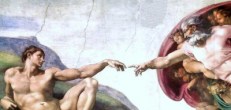
The image of Peter reaching for the hand of God reminds me of Michelangelo’s painting of Creation, God touching Adam and breathing life into him. And so in the Incarnation, God touches us. And we can touch him today through the Church, in the Eucharist. 

Peter is someone we identify with. He is fallible but bighearted. He believes but sometimes doubts. He is brave but sometimes terrified. Yet he is gifted with holy intuition, suddenly seeing the truth. It is Paul, formerly Saul of Tarsus, who explains what it all means with words and ideas in his letters to the to the newly formed churches. But Paul was blinded before he could see, as Luke records in Acts:

And Saul, yet breathing out threatenings and slaughter against the disciples of the Lord, went unto the high priest, and desired of him letters to Damascus to the synagogues, that if he found any of this way, whether they were men or women, he might bring them bound unto Jerusalem. And as he journeyed, he came near Damascus: and suddenly there shined round about him a light from heaven: and he fell to the earth, and heard a voice saying unto him, Saul, Saul, why persecutest thou me? And he said, Who art thou, Lord? And the Lord said, I am Jesus whom thou persecutest. And he trembling and astonished said, Lord, what wilt thou have me to do? And the Lord said unto him, Arise, and go into the city, and it shall be told thee what thou must do… And he was three days without sight, and neither did eat nor drink. (Acts 9, KJV)

Both Peter and Paul sought the truth. In our world where truth is ridiculed and slander lauded, where words are twisted and innuendos esteemed, where things are not as they appear, full of half-truths and half-lies, we grope like the blind trying to see a way forward as individuals, as a community, as a nation, as a world.

But truth be told, we need not fear stepping onto the storm-tossed sea. We need not fear if we reach for Christ when we begin to sink. We need not fear the light if it is God’s light. But we must never lose sight of who is calling us to walk on the water or to change our ways: the only one who claimed to be the Way, the Truth, and the Light.

On Fathers

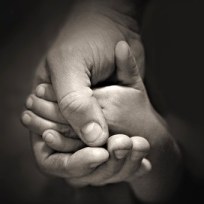
Father Son handsWe live in a time of confusion and increasing chaos, as traditional gender roles come into question. And so on this day when we honor our fathers I wonder who and what they are, were, and should be.

The animal kingdom has been busy this last spring, giving birth, and baby deer cross our front lawn. We humans share some of their generative biology – the male unites with the female to give life. Some animals form a kind of family, with a male taking on the protective role of father, at least for a time. Other animals don’t and the male moves on. Humans throughout history have formed families, having reasoned that society works better that way. Early families were often polygamous, the male having many wives to produce many children for the tribe. More people was good, not evil. More meant safety and better defense. More meant productivity and wealth. More meant a future for the community and nation. 

Judaism and its child Christianity define marriage as the union of one man and one woman, united sexually and by vows of love and commitment before God. Marriage is considered generative, meant to produce children. Throughout Holy Scripture this relationship is replayed, as God the Father creates his people, God the Son unites with his Bride the Church, and God the Holy Spirit weaves them together in Love. God creates us not because he is lonely, but because he is Love. That’s what Love does. 

And thus Love is sung to us throughout the centuries through the Church. It dances and weaves through her liturgies, reflecting light like a many-faceted jewel. Love calls us to love one another, the other, one who is not our self. The ultimate expression of love is marriage, where two different people love one another – different genders and different genes. They unite to generate life, to bring children into the world to love and be loved. 

There are times when fathers take on mothering roles. And there are times when mothers must act as fathers. But in the Christian family, our bodies, our genders, define our primary purpose under God, the role that nature has given us. When this purpose is denied, chaos results. 

Mothers are the inner home of love, for they carry in the womb the new life created. They then bear the child and create an outer home of love. Fathers beget this new life, determining it’s gender, and initiating its conception. And so two become one, generating a unique human being, one never repeated before or after. A mystery and a miracle.

This miracle of life is often taken for granted. And yet so sacred a union, so mysterious a bond, this bond between husband and wife, and between parents and children, that it is the foundation of our culture. As we see today the traditional family threatened and torn apart, we must work to protect and mend it, to heal its brokenness.

At the least fathers must be present, both in body and spirit. We don’t hear a great deal about St. Joseph in Scripture. He is a good man, we are told. He listens to God. He trusts God. He takes Mary as his wife. He shelters her and the Holy Child growing within her. He provides a living so the boy can become a man. St. Joseph is powerfully present. This is what fathers do, even stepfathers. 

FamilyAnd so we honor stepfathers as well, and all those who have stepped into the silent absence with their presence and their love, and all of those uncles and cousins and friends who have acted as fathers to those children bereft, all priestly fathers, parish fathers, community fathers. I was once a single parent, and I am so grateful for the many fathers of our local church who were quietly present, strong in their faithful support.
When the traditional family is threatened, fatherhood is threatened. When marriage is no longer valued, fathers abandon their children. When fathers abandon their children, families are wounded, and civilization collapses. 

I believe we are seeing signs of such collapse: children raised by one parent, usually the mother; children denied the bonding security of family love; children unable to create such bonds of family in the future, having no models.

Cult creates culture, and without Judeo-Christian institutions of temple and church, the traditional family will disintegrate. Fathers and mothers, united in matrimony, committed to love, are key to the institution of the traditional family. Today they are encouraged to abandon one another and their offspring to look out for themselves alone. 

And so I honor true fathers who do what needs doing, silently, lovingly, sometimes unsung and even unloved. You sacrifice, you shelter, you make it possible for mothers to mother and children to grow up. We need you, for our children, our grandchildren, and the very future of civilization.

Thank you.

Tracking Truth

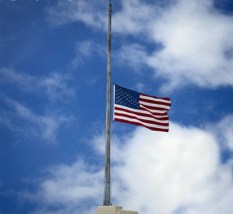
FLAG-AT-HALF-STAFFI returned home Sunday after a lovely time at the Presentation High Alumnae Luncheon in Berkeley to hear of another mass shooting, this time in Orlando, Florida. In the name of ISIS a gunman entered a gay bar and opened fire. 

It is odd that the liberal press isn’t more concerned about ISIS in our country, that they don’t seem to connect the dots, that Muslim extremists desire to destroy Jews, Christians, and gays, probably in that order. They desire to cleanse our world of what they consider blasphemy. Those of us who defend our right to exist, to speak, to worship, to live as we choose freely within the borders of law and order, are targets of radical Islam, be it homegrown or ordered by foreign terrorists. 

We freedom-loving Americans are in this together. We have a national election coming soon. Let us vote for the person who understands the threats to our country from within and from without. Let us vote for the candidate who will support our right to practice our religion and to speak freely, who values life from womb to grave. 

The Presentation luncheon was a reunion of ladies from many backgrounds. They were the lucky ones who attended an all girls’ school in the fifties, sixties, seventies, early eighties. I have long been impressed with the cross-section of society represented by Catholicism, a faith for all peoples everywhere in all times. I am not an alumna but wish I was. I went to public schools, co-ed, and often wondered what it would have been like to have the experience of an all-girls school and one that taught a code of ethics and hard work. 

The history of Berkeley, the Presentation Sisters, and Presentation High is considered in my newly released novel, The Fire Trail, and so the ladies had a unique interest in the story. But they were also appreciative of other themes, the fires of our culture jumping our borders of law and order, devouring liberty and silencing speech. It is a story that considers how we can keep barbarians on the other side of our borders, how we might define, encourage, and safeguard our precious and disappearing civilization. For even definitions seem to have been forgotten. The Fire Trail is a tale that takes a second look at church-state issues, issues of persecution (yes, in the twenty-first century), re-examining the value of religious schools that teach right and wrong and the dignity of every person, what it means to be civilized.

I was glad to chat with the lovely ladies of Presentation High Berkeley, over sandwiches and fruit, wine and sparking water, about their experiences in a Catholic high school. Some said they worried about today’s crime, the inability to walk the streets of San Francisco to get to the office without fear. Some said they didn’t understand what was happening to our culture. 

It made me think of a recent article that asked once again (how many times is this asked?) what was the appeal of Donald Trump? Joseph Epstein writes that folks feel they’ve lost their country they want it back. They don’t embrace the agenda that progressives have slipped into their world through a back door. The Trumpistas aren’t haters or bigots, but they would like to see the rule of law applied equally. They would like public safety. They would like their sons and daughters to be safe on campus and given better role models than pornographic novels and violent movies enshrine. They would like their grandchildren to survive the womb to breathe the air of freedom. 

Indeed. I would too. 

And as I pray for the victims of the Orlando massacre, I pray that we tell the truth about what is happening in America. I pray that the media correctly reports the words of our candidates so that I don’t have to verify every speech on YouTube. Mr. Trump said something quite different about the judge that is presiding over his trial than what was reported by the media. At least as far as I could tell by listening and watching his speech, with real words coming from his lips. His phrases were conflated by both the right and the left, inferences underlined, truth abandoned.

I am waiting to see the media accuse Mr. Trump of the Florida shootings. The culture of violence is not caused by Mr. Trump’s free speech or even his simple diction. It is caused by the silence of good men and women, and the rabble who are allowed to set fires in public forums. 

Each of us must do our homework and sort truth from lies. Each of us must vote for the candidate that will prevent the next massacre on American soil. The truth is there, under the media rubble, in the ashes left by the press, and hopefully in The Fire Trail, carried home by the lovely ladies from Presentation High.


EVENT coming up: I will be reading from THE FIRE TRAIL along with six other adventurous ladies tomorrow at 11 a.m. (Tuesday the 14th) at Curves Walnut Creek, 1848 Tice Valley Blvd. (near Rossmoor). There is a chapter set at a facility similar to Curves. For a $10 donation to Blue Star Moms receive a copy of THE FIRE TRAIL. Come on by!

Why Walls

HADRIAN'S WALL

Hadrian’s Wall

The heatwave in the Bay Area is a dangerous one, for much of the golden grass covering our rolling hills has not yet been plowed under. It doesn’t take much to set it ablaze, and so I’m glad for firebreaks, those borders that protect us from the fires, those walls that keep us safe.

Much has been said about borders and building walls, tall walls, long walls, fortified walls, cyber walls, customs walls, checkpoint walls. Why have walls? Americans like people. We are friendly folk. Why do we need walls?

It goes against our grain to build walls around our country, concrete walls scarring our land. In spite of the media’s assertions to the contrary (and if a lie is repeated it somehow becomes true), Americans are not racists. We found ourselves in the twenty-first century scarred by our shameful history of segregation but accepting, even lauding, integration and equal rights for all. If anything, an inflammatory press keeps the uncivil Civil War alive. And we welcome immigrants of all races, as long as they desire to be Americans and respect our rule of law. And so we build walls, borders, fire trails, to ensure this happens.

We have an iron fence around our property to keep out wild animals, for we live near a state park. Turkeys fly over the fence (it’s a sight to see, a turkey flying) and do their considerably large business on our patio. That is merely annoying, not dangerous. But young bobcats and coyotes squeeze through the iron bars. They would make short work of our cats. They are not friendly, even if cute. I was sad when we fenced our olive trees with green wire to protect them from the deer. Every fall, these bucks rid their adolescent antlers by rubbing them against the trunks, so their adult antlers will grow. The practice reminded me of children and their baby teeth falling out to make room for the permanent ones. And at some point we all must leave childhood behind if we are to become adults.

There are places for fences and walls and I hold, as does the poet Robert Frost’s disagreeable neighbor, that “Good fences make good neighbors.” The narrator in his poem, “Mending Fences,” questions the mending of fences, the building of walls, as not encouraging the true “mending of fences” between people. Many question today. We want to be friendly. We are big-hearted good Americans.

But we need to keep our fences mended, not to keep us in but to keep the coyotes out. President Reagan cried, “Tear down this wall,” for it was a wall that kept people in, imprisoning them, not a wall that kept people out. The why, the purpose, is important. Pope Francis, according to the fiery press, has decried those who build walls. That’s not quite what he meant, but he could have been more specific, more careful in his choice of words with a predatory press at his heels.

Historian Victor Davis Hanson of the Hoover Institution in his syndicated column this last week referred to Hadrian’s Wall that kept the Scots out of Roman Britain: “Rome worked when foreigners crossed through its borders to become Romans. It failed when newcomers fled into the empire and adhered to their own cultures.” Immigration is fine if assimilation is desired, but dangerous if assimilation is shunned. This latter case has been true, it appears to me, with many illegal immigrants crossing our southern border.

Assimilation has also been intentionally avoided by Muslim refugees transplanted by the United Nations, encouraged and supported by “humanitarian” foundations, both religious and secular. These refugees are flown over our borders, placed in rural communities throughout the U.S., towns unprepared for those who disapprove, hate, and fear American culture and freedom. Sharia law replaces American law. But we cannot have two sets of laws. We must be equal under the law. Lady Justice is blind.

Let’s rephrase Mr. Hanson’s excellent and succinct doctrine: “America works when foreigners cross its borders to become Americans. It fails when they cross its borders to adhere to their own culture.” We are a melting pot. We need to melt (at least to a degree).

This is a start, but I would add “when foreigners cross its borders legally.” We have much in common with our Catholic neighbors to the south in terms of faith and culture, for cult produces culture. I believe most Hispanics do assimilate into American life, stabilizing it. We welcome Western cultures who respect freedom. That there are so many immigrants here illegally, that children have been impacted by this national travesty, that there are sanctuary cities allowed, cities that encourage ongoing illegal activity, is a tragedy.

As we head for the California primary on Tuesday, it is gravely unfortunate how the press, both right and left, have misrepresented the desire, indeed the urgent need, to build a wall. They hype hyperbole and invite mob rule. They silence free speech.

We should not be afraid of walls. Walls define who we are. They are a tool. They protect us so that we can thrive, can love one another and live in peace. And America must thrive. She must be the light on the hill, the beacon of hope to a world of lawlessness. She must hold her lantern high, and welcome all who love her law.

I’ve been promoting my new release, The Fire Trail (eLectio Publishing), which is about the border between civilization and barbarism. Lady Liberty commands the cover, but the sun is setting in a fiery sky. Hope is in the lit lantern she holds up to the world. Hope flames in the candles at her feet.

+++

The Fire Trail is now being carried by Orinda Books and Rakestraw Books as well as online retailers.

I will be doing a reading of The Fire Trail at Curves Walnut Creek (a chapter is based here), Tuesday, June 14, Flag Day at 11 a.m., 1848 Tice Valley Rd., near Rossmoor. Some of the ladies are taking parts and it should be fun. Open to the public. Copies available with a $10 donation to Blue Star Moms East Bay. Come on by!