Category Archives: Uncategorized

Gates of Time

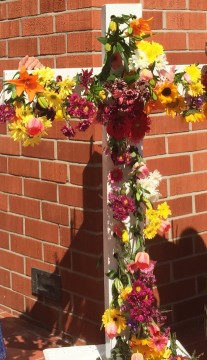
palm-sunday-globalAs creatures bound by time, we have long been fascinated by the idea of traveling back in time and changing history, be it public or private. Books and movies explore this phenomenon. What if… we ask plaintively. If only… we proclaim hopefully. Regrets can be mended, hurts healed, love renewed, if only. 

Christians are keenly aware of such regret, remorse that leads to penitence. We are schooled in self-examination and confession and repenting, to refuse the evil and choose the good. We look forward because we have looked backward and dealt with our past. In this sense we have traveled back in time, rooting out those weeds in our soul-gardens so that the healthy plants can flourish into the future. We are forgiven. The weeds are burnt to ash. The debt is paid. We start anew with a clean slate so that we can truly love as God loves. 

Today, Palm Sunday, we processed through Berkeley, waving our palm fronds. We re-enacted the drama of Christ riding a donkey through the gates of Jerusalem, the crowd waving their palm branches in joyous greeting. On Good Friday this crowd would shout condemnations not salutations, but today we recalled their happier cry, “Hosanna to the Son of David!” Their messiah had come to free them. 

And of course Jesus of Nazareth did come to free them, but free them from the slavery of sin rather than the emperor. Jesus would pay the price, atone, and with repentance, with re-turning to God, our pasts would be forgiven. Christ would act out God’s huge love for us, act in suffering and sacrifice, to heal our time past, present, and future.

So today, turning the corner of Bowditch and Durant, we followed the cross and the acolytes in their red robes and white cottas, and we followed the thurifer swinging his thurible of frankincense into Berkeley, waving our palms, recalling Christ’s approach to Jerusalem. And just so, we approached the entry to our chapel. As we entered our Jerusalem, St. Joseph’s Chapel, the organ thundered Hymn 62, “All glory, laud, and honor/To thee, Redeemer, King! To whom the lips of children/Made sweet hosannas ring,” and we joined in song, returning to our pews. Looking back, it seems we acted two parts, the apostles following Christ (the cross) into the city (the chapel), and the people who greeted their Messiah-King so joyously.

We moved from the public to the private, from the unprotected outside to the protected inside, a movement from wilderness to civilization. For cities are built to band men together for reasons of mutual safety and comfort. Today countries serve this purpose with guarded borders much as cities once had fortified walls.

Christ entered the city gates of Jerusalem, and he continues to enter our soul gates through the bread and wine of the Holy Eucharist and the indwelling of the Holy Spirit in prayer. For our hearts are gated, being homes of both the uncivil and the civil, the dangerous and the safe, the bad and the good. It is only when we repent, weed out selfishness and pride, that God can enter the gates of our hearts. When this happens we become a haven to the Heavens themselves. We allow God to live in us and through us. He becomes the true saving Messiah.

But we know too that just as the crowd changed their mood on Good Friday and the disciples denied and fled, so we will deny and flee. We will allow other people and other idols (time, treasure, talent) claim our allegiance and our love. We will take the easy way, the mistakenly safe way, forgetting that there is no safety outside the Heavenly gates. 

We cannot change these denials and these wrongs that form our yesterday, our history, but we can repent, turn around, be forgiven because of those Good Friday events two thousand years ago, because of the King who rode a donkey through the gates of our hearts. For he will always be waiting to re-enter those gates. He will always stand outside our doors, waiting, holding his lantern high. 

When he enters and redeems our past, be it yesterday’s past, last week’s or last year’s, he reconciles us to himself. We have changed time, rewritten our lives. Our histories are redeemed if we cry Alleluia on Easter morning. when all history, all time, paused to breathe, when death was conquered. 

But before Easter, and after Good Friday, Christ entered more gates, the gates of Hell. In his love he redeemed every one of us, every lost sheep,  BC and AD. 

For the King of Heaven loved and loves us so deeply that he suffered and died in order to vanquish death. He redeemed us, brought us home, so that we could live forever with him, so that we would no longer travel in time but live and love in all eternity.


Passionate Passiontide

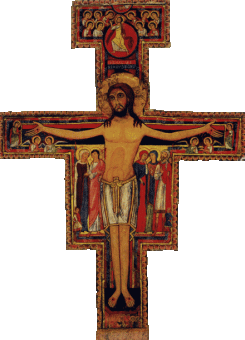
440px-Kruis_san_damianoWe are entering Passiontide, a time when we consider the great sacrificial love of God.

As I watched the passionate protesters at the huge Trump rally at the University of Illinois last week, I was struck by their hatred, not only of Mr. Trump and his supporters but far more importantly their dismissal of his right to free speech. Their own speech was all that mattered to them. They were all that mattered to them. No-one else could speak. Their world was small and dark, turned in upon itself, devouring itself, like cancer or gangrene. Such a world, such a place, Christians call Hell. 

For without God (and Hell is the absence of God), passion is uncontrolled and undirected. It becomes misplaced and dangerous. Whatever our passion might be, if it is not God directed and Christ-filled, it turns inward upon itself. It seeds destruction, including the source of the passion, the individual himself or herself. 

The word passion, as my bishop often said, is the union of the words love and suffering. For God became man to bring us close to him. By taking on our flesh and suffering with us, as we suffer, he redeemed and continues to redeem our suffering, our mortal flesh. We join him on the Cross and we join him in his Resurrection. This is called the atonement, the at-one-ment, for we are pulled into God by his becoming one of us. 

And so today on Passion Sunday the Church pauses and reflects on the Passion of Christ, the last two weeks of Lent – Christ’s painful path to Golgotha, the hill of the skull. All images of Christ in our parish church are hidden behind purple cloths, and we feel a visceral loss of love, to sense in some way what the world would be like without Christ. In the next weeks we will follow Christ on his path to Calvary as best we can, some of us better than others, depending on age and infirmity, time and desire, and most of all, depending on our love, our passion to follow him. 

I have come to believe, in my sixty-eight years, that we cannot experience goodly, Godly, passion without God. And we cannot experience God without the Church, his Body. We are not meant, as creatures created by a loving Father, to be alone, to meet our life’s challenges alone. We are meant to be loved and to love, and we can only do this through Christ and his great gift of himself.

The gift of Christ, the Son of God, was given to us two thousand years ago in Bethlehem and then on the Cross on a hill outside Jerusalem. In those moments, history breathed once again, as the fresh air of God’s love blew upon the world, changing it forever. Mankind turned up another path toward love, learning the meaning of true passion, God-filled love. Those who accept the gift never look back to the dark days of un-love. Those who accept the gift look forward to a lifetime and an eternity of glory and unearned love.

The gift of Christ, the God-Man, the incarnated Son of God, is, as they say, a gift that keeps on giving. With every Eucharist, God the Son is re-membered, made newly present in the Real Presence. With every Eucharist, God the Son mystically enters our bodies and re-members us. As Christ becomes one with our flesh, he dwells within, renewing, inspiring, with his love. His prayer becomes ours, and our prayer becomes his. Every day is an Epiphany, a day of manifestation and seeing. Every day is a day of becoming like the Wise Men at the manger, a day of understanding the manifold works of God. 

For as Christ became at-one with Man, he gave us a means – through his Body the Church – to become at one with him individually. Love is personal, tender, touching. God loves us, each and every one of us, each with our unique personalities. We are precious to him. He loves us personally, tenderly. He reaches out to us and touches us in every Eucharist. 

Only God can order our passions, whatever they may be, to be goodly, to be Godly. And with the ordering of loves, comes the ordering of our sufferings and sacrifices. Nothing is lost. All is offered up to the Cross, and all is returned a thousand fold. 

And so we enter Passiontide, a vigorous ride in and into our life with God. We ride confidently, knowing we are riding high and on to Easter’s resurrection.

Americans and Mr. Trump

voteIn considering the remarkable Trump phenomenon, I watch and I wonder, trying to understand his massive appeal. He seems trumpeted by those outside our nation’s elites – academia, media, politics, wealth.
Those folks outside these exclusive national clubs may not have succeeded as they hoped they would. The American Dream didn’t happen to them or they didn’t have the resources to make it happen. They didn’t make it (for whatever reason) to the top universities to sail into teaching or law or medicine. They couldn’t compete in the world of journalism and publishing and Hollywood, perhaps because of appearance or opinion or luck. They didn’t run for office because of quiet temperament or lack of desire, or the inability to pivot, preach, or promise with fingers crossed. And lastly they didn’t have the financial backing and courage to go into business and take risks, compete for their market share, broker deals so that others would lose and they would win. In the end, they perhaps weren’t competitive, and were happy to allow others do the competing, fight the fight, and provide products at competitive prices.

What does this group who trumpets Mr. Trump do for a living? I haven’t studied the stats but my guess is that they are proudly working class, sometimes working at several jobs, counting on their spouse to do the same. They watch their children bullied in school and on sidewalks and graduating unable to read and not knowing why America is great. All they want is public safety, good schools, and protection from tyrants at home and abroad. Freedom of speech and worship are taken for granted. They work hard, pay their taxes, and wonder why the schools are on lockdown and they can’t own a gun to protect their families and their pastor is going to jail for preaching from the Bible. 

They don’t have the time to study the issues. They aren’t schooled in the national debt and what it means for our future and our children’s future and even national defense. Many don’t understand that growing government means raising taxes or cutting programs. The nuances of numbers require a degree in accounting or economics or at least the time to study the current issues, none of which the working voter has. They are losing their faith in the media’s lockstep endorsements and explanations and they look to someone who says what they mean and mean what they say in words that make sense.

All the while we are seriously threatened by those who hate our freedom, outside our borders and within. We are not only threatened internationally but by homegrown terrorists in gun-free zones and by fellow citizens who would disallow people of faith to practice their beliefs. We are threatened by the dominant culture of self: selfishness, sloth, lust, envy, greed, gluttony, and arrogance, all vices that encourage self-pitying grievance and frivolous lawsuits crippling our courts. We are threatened by the strong who rob and kill the weak in dark alleys and bright abortion clinics.

Mr. Trump says, enough! And the disenfranchised hear him. They understand his message. And as I watch Mr. Trump in the debates what strikes me is his simplicity. A tad arrogant, to be sure, but clear and compelling.

I worked my way through college when college degrees meant something, and today have the rare opportunity, the time, to study issues and candidates, but I still feel incompetent to judge the complicated questions that will make or break our country. It makes sense that the Supreme Court shouldn’t be legislating new law,  but rather interpreting the Constitution. And it makes sense that our three branches of government serve to check and balance one another so that we the people are protected from tyranny. After all, we fought a revolution about that once, as I recall from fifth-grade Social Studies. The First Amendment is still a good idea, or I wouldn’t be allowed to write this or worship as I choose, at least as of this writing.

What I don’t like about Mr. Trump is his apparent arrogance, but perhaps he hasn’t been coached as well as the others on the art of image. He changes his opinions on the issues, but he says he’s learning as he goes. He often speaks in hyperbole, but the media (conservatives and liberals singing together) treats his simplifications as lies. They seem to enjoy misunderstanding his statements even as they reap huge ratings from them which means, of course, huge advertising dollars. When does exaggeration misrepresent one’s position? When Mr. Trump, for example, said he would like to see worse torture than waterboarding I assumed he meant within the law, that he would work to see the law changed. Many presidents work to see the law changed, some work legally and some don’t. Somehow I trust Mr. Trump to work legally, not like others we all know.

Mr. Trump is unpolished. His words are unpolished like many voters. He is a straight-shooter if it is safe to use a shooting analogy. But he listens and he learns and in spite of it all I trust him.

I’m not sure who I’m voting for. I’m undecided, although I will vote for the Republican nominee in the General Election. By the time the primaries get to California there won’t be too many candidates left standing. I long ago studied the two parties, trusting principles over people, and decided that the greatest good for the greatest number was represented by the Republicans. The greatest danger remains clear and present in the history of the last century when Hitler, Stalin, and Mao slaughtered close to 100 million in their totalitarian regimes. Big government stifles freedom and smothers the poor. It curtails creativity and hampers hope. It rewards those who promote bigger government, a self-perpetuating enterprise.

I will vote for the candidate that will work to keep America safe, ensuring our freedom and our future and our children’s future. I will vote for the candidate that will protect my right to worship, to speak, and to defend myself and my family. I will vote for the candidate that understands the need for an educated electorate, beginning with fifth-grade History, Economics, and Civics.

And I will vote for the candidate that sees America as exceptional, a beacon to the world, so that we can welcome more legal immigrants into our national family. They will, to be sure, add their own time and talent and treasure to our unique land of opportunity. Let’s build that border wall so that our laws can be enforced, so that no-one cuts in line. This is America, a land of liberty and justice for all, not just for some.

I have to thank Mr. Trump, for his energy, enthusiasm, and simple rhetoric, albeit sometimes harsh to the ear, has captured the national attention. Voters are listening. Voters are voting. They are taking their place in our exceptional history.

Sacred Sanity

Michelangelo CreationI have been typing and saving selections from our late Bishop Morse’s sermons and writings into Word files to be published soon by the American Church Union. As I type, I can see him saying the words, see his gestures, hear his tone and cadence, his deep and sonorous voice as he preached from the central aisle of churches and chapels.
There are several themes emerging from the lined yellow papers, all spinning around and within the Love of God, but the one that I have found especially true in my own life is the sanity of belief, the ordering of chaos, the means to a meaningful life. Sanity is rooted in the Latin sanitas, health. It has come to mean mental health, the ability to reason within the realm of reality. For the bishop, such sanity led to traces of sanctity.

It does strike me as odd and also tragic, as it did Bishop Morse, that so many don’t see what seems so obvious to many a Christian. It is heartbreaking to see hearts so broken and bleeding in our secular culture today. It is, I suppose, the cost of freedom and love and choice, all intrinsic to the whole cloth of Christian belief. But even so, as I journey into Christ I journey deeper into His tears, weeping for those I love, scattered like lost sheep in the deepening dusk at the end of the day.

There is much in the Gospels about seeing and hearing, watching and waiting, seeking and finding, asking and answering. Because these matters matter so much but are also tightly bound to the world of matter, they are often unseen and half-understood. Christ teaches in parables to help us understand how God has acted to redeem us from our selves, our selfishness. He is expressing the inexpressible, so that we can see and choose Him or not. Poets attempt this realm. I have found in the bishop’s sermons many quotes from Christian writers, from T.S. Eliot and St. Augustine, Boris Pasternak and Fyodor Dostoevsky, words that reflect the great themes of St. Paul who also tried to feed his flock in ways they would understand.

Many do not believe in Christ the Son of God because they think His life and death and resurrection unproven, and belief to be irrational and even insane. To me the Resurrection of Christ has been shown to be reasonably and historically true, certainly as true as the grass is green or the sky is blue. That’s enough for me. That’s enough to set me on my journey of faith and see where it leads. I have not been disappointed.

It leads of course to Christ’s Body on earth, the Church. For the Church, in spite of being composed of imperfect human beings, is the best ark we have. Within this sacred vessel bound for Heaven we feed on Scripture and sacrament, prayer and praise. We have mentors to guide us, brothers and sisters whom we love and who love us, each one finding his own unique God-given identity and purpose. Traveling this Way and with this Truth, I will fully know Life. I will learn love’s demands. With this Family of God, this Body of Christ, I will travel into the heart of God, and He into me. 

We are creatures designed to search for meaning. Without meaning we begin a journey into despair, for the path only stretches forward to life or backwards to death. Deep within we know this, and we search for meaning in little isms, so desperate are we to have a sane reason to continue living. Today there is an array of “meaningful” pursuits that don’t involve belief in God or His manifestation on earth among us. Unbelievers, casting about, create their own religions, whether they be of the earth or of man.

But Love demands freedom to choose. So God gives us choices, and some we make are insane and make no sense and some we make are sane and make complete sense. Some choices allow evil to fester and grow. Some choices distort and maim and kill.

As we try to choose sanely what or whom we believe and how we should order our lives, we should consider whether we desire our short spans to make a difference in this world or the next. Anyone can embrace good works without God (although such efforts are often short-lived and disingenuous), but to say yes to Christ, to ask our Creator to guide our choices, is to allow us to become our true selves, the persons we were made to be. So we ask ourselves, are we traveling in the right direction? Are we knowing joy? Can we say that we we are sane or are we living in a fantasy, phantasmal world of our own creation?

The word fantasy has roots in the Latin phantasia, imagination or appearance, and later phantom from phantazein, to make visible. Phantoms made the invisible visible. Today a fantasy is deemed untrue, imagined.

It is crucial to face what Bishop Morse calls “Reality,” to live a life of sanity and in the end, of sanctity. We are challenged to face the fact of the bodily resurrection of Jesus of Nazareth who called himself one with God the Father. We must look with eyes that see regardless of whether current correctness calls such facts fantasy. Have we not eyes and ears? Can we not see and hear? Have we not minds that can reason? And we must be humble enough to seek help from those who have made the journey before us. So much is at stake. We must ignore the phantasmal shapes, beware and be aware of the watering down of history to suit cultural mood and personal need, and steer away from phantasmal ghouls  wailing the sirens’ song.

We must face these truths and choose the path to Heaven. Then and only then can we know sacred sanity and genuine joy, even embrace traces of sanctity. We can, if we choose Love, sculpt our time on earth with magnificent meaning. Life is so short. We don’t want to miss one second on this reason-able pilgrimage into God.

Listening in the Stillness of Lent

prayerThere is a great rushing about these days and I, living in the world, rush too, doing and thinking and writing, packing my hours and days and weeks, overscheduling, overpromising. The younger generations twitter not only in tweets, but chitter and chatter like small birds, speaking at such a pace my untrained (elderly) ear cannot absorb the frenzy and I cannot interpret the bites of sound flung so furiously and I often ask for repeats but to no avail, for they too race ahead around another corner and beyond into the future.
When do we rest? When do we pause and reflect? When do we listen in quiet for the still small voice of God?

It has been said that the Christian’s growth is two-fold.  A Christian grows into Christ and at the same time Christ takes residence within the Christian. “He in us and we in Him” we pray in the Mass. We receive Christ in the Eucharist and with each communion we invite Him to take over more of our lives. As He grows within us in this sacramental action and as we pray the prayer he taught us to pray (Our Father…) He begins to pray within us, so that our prayer becomes His, our deepest desire. And so we journey through this passage of time on earth, preparing for eternity.

It is so very good that there are regular times in the Church Year in which we are pulled out of our busy lives. We are called, especially in Lent, to observe a different way of living. Essentially we are called to simplify, to remove habits of misspent time, habits of gluttony, and care-lessness, and dance to a simpler tune, a slower and quieter one, so that our slow steps will ease our hearts. So that we can rest. We are asked to take this gift of found time carved from Lenten discipline and use it to love, to love others in care-taking, to love God in prayer-making.

Sundays are days of rest throughout the year. Our Creator in his infinite wisdom decreed in the beginning that we should rest on the seventh day. For Christians this day moved to Sunday to honor the Resurrection. Sundays became sacred, set apart to worship God in repentance, renewal, and regeneration. They are weekly holy-days for the faithful, healthy-days for body and soul.

Studies have found that religious people in general live longer than others. I believe it must be true, at least for true believers, those who practice their faith, integrate their belief into their lives to become whole, holy. Christians live under a law of love that provides order, an ordering of importance, a prioritizing of concern. Having answers to crucial questions, having a map to follow, decreases our stress. We know that we will not always live up to this law of love. We may ignore the answers to the crucial questions. We may forget we even have a map. We err and we stray like lost sheep, we follow the desires and devices of our own hearts, and there is often no health in us. But we also know that we have a loving Father. We repent, we confess, and we return to His law of love. We recall the answers and we follow the route on the map that has been so clearly laid out for us.

The ability to release to a loving God all of this stress and worry, to let Him bear the burden on His holy wood, is a relief giving birth to joy. And in our joy we return to the cross to happily help Him carry it, walking with Him through Jerusalem and through our own lifetime.

Lent is a time of renewal through re-creation. We retreat and reflect, we repent and are reborn, we render unto God what is God’s. We move out of the fast lane and into the slower one. We prune, cut back, and feed. We watch for new growth, meeting Christ in Sunday worship, praying our Morning and Evening Prayers, calling on the housebound, giving to the poor in need and in spirit, embracing the forgotten and lonely who sit alone in the corner of the room, knowing we are embracing Christ.

All the while, in the silence of Lent, we listen for the still small voice of God. Soon, we know, in the killing and burial of our rushed time we will hear His voice. Soon, we know, we will join our voice with His, and His with ours, to rise once again in glory.

Crying for Camelot

FLAG-AT-HALF-STAFFHow does our culture move forward without a recognition of our Judeo-Christian roots,  to reclaim Camelot and that misty kingdom of knights and honor?
A generation born in the 1920’s that included many atheists and agnostics is dying. Whether they are surprised or not when greeted by Infinite Love, the God of the Ten Commandments, we believers are glad those unbelievers understood that Western Civilization depended upon the teachings of Christ, if not belief in him. The “greatest generation” recognized, quietly assumed, that Judeo-Christian roots were essential to the rule of law and respect for the individual.

One of those atheists was Sir John Mortimer (1923-2009). In a marvelous article in the January-February issue of Touchstone, Raymond J. Brown writes about the “New Rules of the Game” in “Farewell, Old Chessmate.” Many of us know Mortimer’s work through the BBC films of his books, Rumpole of the Bailey and others. Mr. Brown quotes Mortimer: “It is good to know that both the faithful and the faithless can still be playing from the same chessboard.”

Evidently, the satirical Mortimer was one of those unbelievers who felt comfortable living in the residue of Christian culture, even indebted to the source of the residue. He appreciated the great Christian contributions to the canon of English Literature and his own contemporary Christian writers:

“No one can deny that the Christian belief in the supreme importance of each individual soul was a great advance on the faith which thought of slaves as soulless. The King James Bible is of extraordinary power and beauty…. Much of the literature I’ve valued, the art I’ve most enjoyed, has been produced by unquestioning Christians. Whether I’m a believer or not, I’m a part of Christian civilization.”   (Where There’s a Will)

As Christianity’s influence has ebbed, Christians have seen the danger signs. Father Richard John Neuhaus (1936-2009) in The Naked Public Square (1984) called for Churches to re-enter the culture, to re-inform the debate in America and the West. With the retreat of Christians from this common conversation, Western culture would revert to pre-Christian chaos: slavery, discrimination, the strong bullying the weak, tyranny to keep the peace. Western freedoms and respect for the individual would be denied in the urgency of efficiency and sameness, soon to be forgotten in the mists of time.

I wonder if Mr. Mortimer considered how future generations would fare when his own generation no longer guarded the gates of Western culture.  As the nihilism of the liberal academic elite polices our public universities man’s natural religious impulse is redirected to saving the earth, saving the whales, saving the purple spotted badger. History of Western Civilization is not required so that an uneducated electorate votes by twittering soundbites and flickering images.

Generations of students have been raised with few Christian moral boundaries. If it feels good do it. Release your inner child or monster. Where Christianity defends the border between right and wrong by denouncing bad behavior, today’s creed encourages grievance tantrums, narcissistic self-pity, angry riots,  silencing free speech by demanding trigger-safe zones. Today’s creed divides and incites. Achievement is discouraged in order to assure equality and lack of offense. Excellence slips into mediocrity, boredom into depression. We reach for pills and cheap thrills in our books and movies.

With the death of Chief Justice Antonin Scalia, America has moved further along the road of indecent descent to a pre-Christian world. A brilliant scholar (and Catholic) who understood the need to preserve right and discourage wrong, Justice Scalia will be greatly mourned by those who see clearly the vital importance of the Judeo-Christian foundation to democracy. Perhaps his greatest contribution was his desire not to legislate but truly interpret the Constitution, empowering we the people to pass good law through elected representatives.

The faithless and the faithful must play from the same chessboard in order for democracy to be passed on to our children. As Mr. Brown concludes,

“The chessboard will likely not be playable, because the same rules, courtesies, limits, traditions, and possibilities will not be recognized by both players, much less understood. There will be no common ground between the believer and the unbeliever – not because militant atheists will have intentionally sabotaged the match, but because Western Christians will have allowed too much accommodation to the world, the flesh, and the devil.”

One is reminded of liberal Christianity, the dilution of belief in pulpit and pew, the subtle changing of the rules of the game to accommodate all comers. Confession is ridiculed, repentance a threat to self-esteem. Unborn babies are considered the property of their mothers, owned and enslaved. To speak against these things is to invite silencing and persecution.

Tyranny is near. As we move into the Lenten season, we must carry the Cross to Easter’s resurrection. We must pray for our nation, for the survival of Western civilization, for that misty land of Camelot that was only a dream but became a reality in Great Britain and her daughter, America.

We must pray that democracy and freedom will not be lost in the mist.

Journeying to Jerusalem

Ash WednesdayI’ve been thinking about the word passion. My bishop often said that passion was the union of love and suffering, love and sacrifice, and I often wondered about that. The root is passio, Latin for enduring, suffering. In the first century it came to refer to the suffering of Christ on the Cross. It appears that love became part of the word passion only after Christ’s sacrifice, when this particular suffering became united with the love of God.

The word passion is used in Holy Scripture in the Acts of the Apostles, where St. Luke writes in the first chapter: “to whom also he shewed himself alive after his passion by many infallible proofs, being seen of them forty days, and speaking of the things pertaining to the kingdom of God.”

Over time, passion came to mean extraordinary feeling, a super-human surge of life pulsing through the heart and soul. While for many years it meant emotional romantic love, it also came to mean a strong liking/loving anything – a passion for painting, for food, for music, etc. It is a word that has grown in power. What is your passion? Follow your passion! I admire your passion…

In fact, passion denotes today an enthusiasm that goes to the heart of who we are and who we are meant to be. It is the God-life within us that urges us to be our purest selves, to train our truest talents, to sculpt our souls and senses into the perfection that God intended when He formed us in the womb. We may have left behind the suffering, enduring, or sacrificial meaning of passion, or have we?

When we say someone is passionate about something there is a sense that that person would sacrifice, go to a great length, to work hard, to discipline and deny, to attain or achieve that something. There is an implied focus, the loss of pleasures or lesser passions, to arrive at the goal: long hard practice to kick that ball down the grass to its win; long hard practice to play Beethoven’s concerto; long hard practice to make the perfect soufflé. When we are passionate we desire to achieve the reward. We sacrifice. We suffer.

Love and suffering. Passion. 

It is no coincidence that the Epistle for today, the Sunday before Ash Wednesday and the beginning of our journey into Christ’s Passion, is St. Paul’s glorious thirteenth chapter of First Corinthians. Naturally, it is all about love (charity):

“Though I speak with the tongues of men and of angels, and have not charity, I am become as sounding brass, or a tinkling cymbal. And though I have the gift of prophecy, and understand all mysteries, and all knowledge; and though I have all faith, so that I could remove mountains, and have not charity, I am nothing. And though I bestow all my goods to feed the poor, and though I give my body to be burned, and have not charity, it profiteth me nothing.

Charity suffereth long, and is kind; charity envieth not; charity vaunteth not itself, is not puffed up, doth not behave itself unseemly, seeketh not her own, is not easily provoked, thinketh no evil; rejoiceth not in iniquity, but rejoiceth in the truth; beareth all things, believeth all things, hopeth all things, endureth all things. Charity never faileth: but whether there be prophecies, they shall fail; whether there be tongues, they shall cease; whether there be knowledge, it shall vanish away.

For we know in part, and we prophesy in part. But when that which is perfect is come, then that which is in part shall be done away. When I was a child, I spake as a child, I understood as a child, I thought as a child: but when I became a man, I put away childish things. For now we see through a glass, darkly; but then face to face: now I know in part; but then shall I know even as also I am known.

And now abideth faith, hope, charity, these three; but the greatest of these is charity.”   KJV

We know only in part what love is, what love demands, what love sacrifices and how it suffers. One day we will see fully. But until then we have Christ’s Passion – His death on the Cross. His resurrection attests to who He is and opens our eyes to the reality, yes, the passion of God’s love. Such love is beyond human understanding, unsearchable in its riches.

And yet we search for love’s riches in the Church, His Body, His Bride. We search and we find, opening the door to His knock, inviting Him in, He who waits on the threshold of our hearts. For He is passionate to be with us and within us, lighting our lives with His brilliance.

When we understand passion, that union of love and suffering, we begin to understand compassion, looking upon the suffering of others with-passion, with the desire to share the suffering, to alleviate it. We begin our own journey of love, into love and its demands, its joy as well as its sacrifice.

And so we approach Ash Wednesday, the beginning of our journey to Jerusalem, our pilgrimage into Lent, into the love of God, into the Passion of Christ, to arrive at Easter and our own resurrections.

Touching Love

Writing2I have been given the remarkable opportunity to look through boxes containing the sermons of the late Archbishop Morse, to possibly be published by the American Church Union. They were written on loose sheets on lined yellow legal pads. Some were jotted on hotel stationery. Some had their own colorful pocket folders, faded and spotted with time, water, and tea, and some were bunched with others by topic. Many were written in purple ink, his favorite, earlier ones in black ballpoint. There were even some typed from his seminary days, with notes in the margins from homiletics professors.

I hadn’t expected to find such treasures since he usually preached without notes.

I soon sorted them into seasons of the Church Year, but many sermons could have been preached anytime anywhere, and often were, as noted by his wife in the top corners in her neatly penciled script: date, feast date, parish. Some were added to, so that a sermon from 1961 lived on in 2006, having journeyed through half a dozen congregations, each time changed slightly according to hearers and season.

I began to type, words of hope, words of mystery and miracle, words of love. There was always a sense of happy wonder at the works of God among men and in his own heart and life.

At St. Thomas Anglican Church in San Francisco on February 18, 1990, Sexagesima Sunday (today’s Sunday in the Church calendar), he preached something like this: 

“We are in that wonderful three-week period of preparation for Lent, defined in the Prayer Book as the Pre-Lenten Season. These three Sundays are a period of reflection, and expectation for the severity of Ash Wednesday, the 40 days of Lent, Passiontide, and Holy Week. They are sort of hinges on the door that swings between the joyful mysteries of the Epiphany and the sorrow and suffering of Lent – the recalling of the passion and the death of Jesus Christ.”

Hinges on the door swinging between seasons. He was a poet. And, it occurs to me as I type his words, and now these words, that we are all poets searching for meaning, reaching for words to describe our human existence, to understand who we are. That is what poetry does, in the end, for it uses intense imagery to evoke sensory perceptions that will help us make sense of life. Christians have found such ways and such words in Sunday worship and so live poetic lives. We pray, and with prayer we use words to meet and touch the infinite, eternity, the source of all love, indeed, Love itself. We pour water in baptism to fill the reborn with God’s Spirit. We consecrate bread and wine to fill us with Christ in the Eucharist. We fill the finite – our own flesh – with the infinite. And we do this through the consecration of matter.

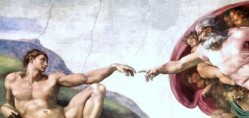
Sacramental Christians do not separate spirit and matter. The union of soul and body is the profound sacrament of Creation. In Michelangelo’s painting on the ceiling of the Sistine Chapel, the hand of God touches Adam, filling him with life, the life of His Word, God the Son, the Christ, the Logos. All creation reflects this sacramental action of love.

It is a beautiful day in the Bay Area today, this middle Sunday in Pre-Lent. This creation around us is windswept and cold, the air washed by last week’s rain. Puffy white clouds slip through pale blue skies, winter skies hoping for spring. The green hills reflect the glory of God, for they are indeed his creation, just as we are.

The Church Year reflects the natural year in many ways. The date of Easter follows the vernal (spring) equinox (nearly equal days and nights), for the Jewish Passover was celebrated on the first full moon following the vernal equinox, and it is recorded that the death and resurrection of Christ occurred following Passover. And so our days lengthen, become Lenten, moving toward that date of the Sunday after the first full moon following the vernal equinox, March 27, 2016, Easter, Resurrection Day.

The door of the season opens to preparation, penance, and hope. We scour our hearts and invite Almighty God in to dwell. We sing and we dance the liturgies of the Church to unite matter and spirit, time and eternity. Soon we hear the song, feel the rhythm, the poetry of words made flesh.

My calloused fingertips have been hard at work, carrying words and throwing them onto the keyboard, words that scurry across the screen and, I understand, rest in a memory chip or megabyte, to be invited one day to re-appear on screen and paper.

And so the bishop’s purple ink on the yellow papers, water marked and parched and smudged, moves from his fingers to mine, from his heart to yours. This seems right, for the recurring theme I have found so far in these joyful sermons is Love. That God is Love. That is why the Christian life is so love-ly, so full of love, so full of joy, of color, of music, of beauty, and of truth.

Christians, if they are faithful, touch Love itself.

Americans for Life

voteThey marched in freezing temperatures with a blizzard fast approaching. Washington D.C. was closed down – transportation systems crippled. There were fewer valiant witnesses to the Pro-Life plea than in previous years, yet their hearts burned with the love of life and of God. 

And it was perhaps the fire within them that I saw in the photos of the tens of thousands gathered in our nation’s capitol, to march to the steps of the Supreme Court. In the dark of winter they carried their flaming hearts, lighting the way, reminding the world to see what we have done and are doing to our nation. 

It is difficult to see in a storm, and a blizzard is blinding. But these valiant marchers represented the majority of Americans who do not believe abortion on demand should be the law of the land. They represented the forty-three million unborn children murdered, a massive genocide. Their crime, these little ones? Wanting to live. 

I am thankful these protesters gave witness. Abortion is like the elephant in the room, only it is an elephant in our nation, avoided, not spoken of in polite society. Those of us who can see the elephant can no longer turn away and pretend it’s not there. We cannot say that taking innocent human life is a choice, a right, in a civilized world. Recently it seems that our laws protect those who break them, yet do not protect the innocent, the least of us, the most vulnerable, the unborn. 

There will be a judgment one day, a day when each of us will stand before God in His brilliant all-seeing light. We shall answer for our lives. We will be judged, essentially, on how well we have loved one another, on whether we loved life more than death, loved others more than ourselves. God does win in the end, and he is a loving God, desiring us to love, commanding us to love. 

The annual March for Life is held on or near January 22, the day of the 1973 Supreme Court ruling, Roe v. Wade. It is a wintry time, when light is less. But the days are lengthening, and soon we will enter the Lenten Season to prepare our hearts for Easter. Lent means lengthening, a stretching of the light to shrink the dark. And so our nation, in the cold of winter, tries to see a way forward in today’s blizzard of choice. Our nation needs to lengthen the light and shrink the dark.

January 22 borders deep winter and early spring. In the Church we have been celebrating Epiphany, a starry season of light and seeing, of manifestations of God become man, when Eternity intersected Time. Epiphanytide is short this year, two Sundays, so that today we suddenly find ourselves in Pre-Lent, three Sundays before Ash Wednesday. We prepare our hearts for Easter, and in the discipline of fast, prayer, and sacrifice, we shed light on our own lives so that we can repent and move toward the light of God’s love once again, so that we can truly see the resurrected Christ and partake of his resurrection. During Lent we confess our unlove, the selfishness that hardens our own hearts, and that hardens the heart of America. 

Our nation, in this election year, is also called to choose light over darkness, life over death. Our country is called to repent, to change. As we cast our votes we become part of our culture, be it one of life or death, and we become responsible for its law. Each of us will one day account for the vote we cast, the part we played in creating those laws. As a conservative in California, my vote doesn’t seem to make a difference in the electoral system. But I know it does. God counts my vote, and it lessens my culpability in the ongoing genocide of our next generation, a genocide that averages a million babies a year, forty-three million lives in the last forty-three years. 

We hear that women want to “own” their bodies. They want to fulfill their dreams. Such ownership of another person is slavery. Dreams are not fulfilled through such ownership. Such dreams, built on such a lie, are nightmares. President Lincoln and Dr. King knew this. Such nightmares lead to suicide; such lies will kill America.

We must pray for our country, for this lie lives in our law. It is said the tide is turning, that eighty percent of Americans now favor restrictions on abortion; two-thirds of those are “pro-choice.” As we enter this time of choosing our leaders let us choose those who will work to redeem our culture, so that America can once again be a beacon of light to a darkening world. 

As we step into Lent, we must pray for light and life. We must fan the flames of love in order to see our way to Easter.

Wonderful Words

birdIt’s been a week of words, words, words, and more words. 

Some words were heated such as those between Mr. Trump and Mr. Cruz in the Republican debates. Some words were measured and thoughtful, such as those of Mr. Carson and earlier Ms. Fiorina in those same debates on Thursday. If words had trajectories, the former words were missiles launched; the latter words were birds circling and weaving.

I’ve been thinking about words and their power, particularly this last week of Epiphanytide when the Church celebrates the Word made incarnate in Bethlehem, Christ manifested to us, the world, the Word alight in the darkness. 

Words continue to light the dark, to beam bright epiphanies into despair and loss and confusion. Words comfort and heal and explain and judge. They forgive. They love.

The Bible is called the Word of God, and I’m glad the Gideons still supply hotels with free copies in nightstand drawers. The Gideons, a society of Christian businessman formed in 1899, has distributed over two billion copies of the Bible in two hundred countries in one hundred languages, today printing eighty million copies a year. Lately I’ve noticed the Bibles sitting alongside the Book of Mormon and sometimes the Teaching of Buddha. I wondered about the rarity of the Koran in these rooms but understand there is a concern about disrespect. One imam said that Muslims don’t need a copy of the Koran for they have memorized the first chapter, prayed five times a day.

It is good there are other faiths represented in these nightstands. Inclusivity protects the Bibles from the charge of exclusivity when guests complain of religion in their room. Americans are a freedom-loving people. We believe in freedom of religion, freedom of speech, freedom of thought and conscience. It is why we debate conscientious issues before choosing our president. It is why we fearlessly use heated words, or words launched like missiles across a stage toward our opponent, missiles targeting other words.

I enjoy the politically incorrect Republican debates. They show that America still has a pulse, her arteries are flowing, her heart beating, in her celebration of free expression. Some pundits have complained there are too many candidates in the field, but I laud the number. Let us encourage this multi-faceted discussion and be proud of the raucous, boisterous conversation. Let us appreciate the talented and articulate candidates who give of their time, talent, and treasure, of varying gender and generation, race and ethnicity. This is America at its best. This is how we elect our governors.

And we use words, words, words. Let them fly through the air, circle and weave, and come home to roost in our hearts and minds. Let the words win and lose, as they become forged in debate, fired by truth.

Lots of words. I’ve been sorting our late bishop’s words, his sermons, scrutinizing the yellow lined pages, the brown parched sheets, scraps from hotel stationery scrawled with words, handwritten, prescient ideas pressed onto paper, words written in the purple ink the bishop favored. Staples or  clips join some pages, linking sermons back to 1951, his year of ordination to the priesthood. I’ve come to see an order in the pages, and the words, how they fall naturally into Church Year seasons and feast days within those seasons. There are also speeches given at dedications, ordinations, baptisms, synods, pilgrimages, retreats, and funerals. Dates, places, and occasions are recorded in the pale pencil script of his loving wife. 

Hundreds, thousands, hundreds of thousands of words. “He was a mystic,” a friend said recently. But then, all sacramental Christians are mystical by definition, for we believe in the mystical and mysterious action of the Holy Spirit among us in this hard world of matter. We believe in the mystical change in the bread and wine as the Word once again becomes flesh and dwells not only among us but within us in the Eucharist. We believe in the Spirit mystically flowing through the waters of Baptism and the oils of Unction and the words of absolution given by a priest to a penitent in Confession. The Spirit mystically weaves into the vows of bride and groom as they say committing words before a priest who, in the name of the Body of Christ, blesses their marriage, and the Spirit works mystically through the hands of a bishop in Ordination and Confirmation. 

As I study our bishop’s words, his purple script on yellow paper, I pray that God will enter my mind and heart and speak to me just as he entered my bishop’s mind and heart and spoke to him, that I might share these words bridging heaven and earth, spirit and flesh. One day, God willing, the words will flow onto pages bound into a book to be held and read, words that will instill the greater Word.

This last week, before the political words and the sorting of the words on the yellow lined pages, I sent off my review of Michael D. O’Brien’s Elijah in Jerusalem to CatholicFiction.net. In this end-times novel, Bishop Elijah confronts the Antichrist in Jerusalem. Like his namesake, the Prophet Elijah, Bishop Elijah listens for the still small voice of God. I too am listening for it, hoping to hear those huge words spoken by the little voice, whispering in the stillness of heart and soul. I often observed my bishop listening, listening to all of us with our many words and opinions, hopes and fears, but also listening to something else, someone else, trying to catch the quiet voice that wove among us as well. 

With the many threats at home and abroad, threats to freedom and faith, to liberty and law, let us celebrate free and faithful words, expressions of who we are and who we are meant to be, as Americans, as believers in God who became the Word made flesh.