Category Archives: Uncategorized

The Fire Trail in Our Hearts

Yelp1

My good friend Bishop Morse often said, “God wins in the end.” As I age, my years and my tears tell me the same thing, for I see darkness exposed by light more and more often. 

Each of us has a border that runs though our hearts, dividing the dark and the light, the evil and the good. Only when we illuminate that dark side can we become whole as we are meant to be. It takes courage to shine light on the cancer growing in those corners, the red raw wounds of deeds and misdeeds, that done and that left undone. It takes God’s spirit to embolden us to confess our sins. 

And so as I write and rewrite The Fire Trail, a novel in many ways about that line running through each of us, between the uncivil and the civil, I am reminded that I am not immune to the dark encroaching on the light, to the barbaric crossing that border in my heart. None of us are. 

Our culture does not encourage us to be humble, since humility lowers self-esteem. But true humility allows God to wash our hearts clean, and even if the soap stings, only then can we begin to heal. C.S. Lewis said, “True humility is not thinking less of yourself; it is thinking of yourself less.” And what a relief it is to think of others and not oneself, to turn outward and not inward, to dwell on the miracle of each of us, of all creation, and not just the miracle of me. Such turning toward the light strengthens us, doesn’t weaken us, as our culture claims mistakenly. Turning toward the light, toward the commands of God and the demands of true sacrificial love, makes us larger and more real, pulls us toward certainty and sanity. 

And so when I repeat the forceful and almost-embarrassing words of the General Confession in our Book of Common Prayer each Sunday, I am encouraged to admit I have not loved enough this last week. I have withdrawn my heart when I should have opened it wide. I have forgotten my prayers, and particularly my intercessory prayers. I have squandered time, that precious gift on loan to each of us, the gift of life itself: 

“We acknowledge and bewail our manifold sins and wickedness, Which we, from time to time, most grievously have committed, By thought, word, and deed, Against thy Divine Majesty, Provoking most justly thy wrath and indignation against us. We do earnestly repent, And are heartily sorry for these our misdoings; The remembrance of them is grievous unto us; The burden of them is intolerable.”

Is the burden truly intolerable? Must I bewail my wickedness? The dark part of me says no, I didn’t really do anything wicked this week. The light part, on the other side of that fire trail through my heart, says that because I know God and have the benefit of scripture and sacraments and the Church I am held to a closer accounting, a higher mark. To whom much is given, much is required. God is, indeed, wrathful and indignant because I did not say my prayers, because I squandered my time and treasure, because I know better. They may be venial and not mortal sins (no murder involved), but even these “little” sins allow festering in the dark corners of my heart. And one sin leads to another, like cancer. 

A terrible crime is committed in my novel, The Fire Trail, near the Berkeley hills Fire Trail, the wide break that protects the town from wildfires. Other crimes cross the trail and hurt the townspeople, destroying the peace and setting fires in neighborhoods once safe. And we hear of worldwide breaches, of wars and rumors of wars, of beheadings and bombings and massacres, of eruptions of lava and ash spilling into our communities. 

Humanity will always carry that scar, that jagged line running through its heart; it will always need to tend the firebreak so that the wild will not devour the tame, so that the fires do not breach the lines, do not leap into our towns, countries, and world. 

I suppose my little novel is merely a reminder that this is true, that we must not fall asleep on this crucial watch. The guards in our towers must be awake and alert so that they can spot the first flames coming over the hill, before our people are engulfed. 

And so it is with the making of laws, good law that builds upon good law, laws that our children may in turn build upon. We in the present carry this great burden, responsibility, and honor, to watch – even demand – that this happens. We must weave the good and the true of the past into the present, so that our children may one day do the same with their inheritance. What we do, how we vote (each one of us), matters. History matters. Liberty matters. The Constitution, the rule of law, our three branches of government, all matter. Who we are as a free people in a world of unfree peoples matters. 

We will be answerable for our inheritance, whether we have squandered it, whether we have hidden it, or whether we have increased it with goodness and wisdom. 

One of my characters seeks goodness, beauty, truth, and transcendence. A reader of my manuscript, The Fire Trail, an Anglican priest, explained this week to me (forgive my paraphrasing, Father) that goodness (virtue) can only come from truth (veritas), truth being God, that without God goodness denies itself, for it becomes self-serving and proud, no longer good. It is union with God that allows the fruits of virtue to grow and flourish. St. Maximus the Confessor (580-662) wrote about this. 

This is the question of our time. Can we be good, virtuous, civilized, without God? Or if all of us cannot manage belief in God, can those who do not believe see the need to respect those who do, support those institutions that will bear virtuous fruit through the building of schools, hospitals, and other endeavors devoted to the common good? 

In the early 1980’s Father Richard John Neuhaus wrote a book called The Naked Public Square, pointing out this great need in our nation’s public conversation. Os Guinness has written The Global Public Square, pointing out the need for such conversation in the world, the need for the Judeo-Christian perspective on culture creation.

But it begins with and in our own hearts. It starts with that line dividing the dark and the light. It begins with Sunday worship and confession and union with God. Only then can we turn to our communities and countries and world and shine the light in the dark corners. 

And, as Bishop Morse reminded me, God wins in the end. We need merely be faith-ful.

Requiem

APCK-Logo-10-03-2008It was as if Archbishop Morse of our Anglican Province of Christ the King were present among us, and perhaps he was, the sense was so palpable. 

My husband and I arrived early Saturday morning for Bishop Morse’s Requiem Mass at St. Peter’s Anglican Church in Oakland, near Berkeley in the historic residential neighborhood of Rockridge. The clergy were vesting in the Sunday School rooms (the sacristy being too small for such numbers) and as I checked on the nursery – lights on, toys set out, our young attendant waiting for the first arrivals with her sweet smile – I was greeted with the awesome anticipation I usually sense when dozens of clergy meet for a single Mass, whatever the occasion. 

But Saturday’s occasion was a serious one, an especially joyous one. These men knew this was a historical event, a meaningful time in all of their lives, in the life of the Church, in the world itself. This funeral was for no ordinary man, not your average priest. Bishop Morse had welcomed these men into the fold of the Anglican Province of Christ the King over the past thirty-seven years with the vision to continue traditional Anglican Christianity. Each man who had known  this bishop had differing and yet similar stories to tell of his love for them. 

A good shepherd, Bishop Morse had found these young men at miraculous moments in the millions of moments in their lives – at crossroads moments – and revealed the love of God in a compelling way. Saturday morning, as they robed in the Sunday School of St. Peter’s, pulling cassocks and cottas and stoles over their heads, chatting and catching up with one another’s lives since the last gathering, they were thankful for this man who had changed them forever. 

I had checked on the nursery and had watched the tide of clergy ripple through the Sunday School rooms. I now entered the nave of the church and joined my husband in our pew. I said my prayers of thanksgiving and looked about. Four large candles stood at the head of the central aisle, before the chancel steps, waiting for the casket. To the side of the chancel an acolyte entered from the sacristy. He lit tall candles on the altar. A large medieval crucifix hung over a tented tabernacle and marble altar. I thought how the steepled wooden ceilings and red-brick apse formed the bow of our ark. Stained glass windows, glittering along the side aisles, told stories of St. Peter. Behind and high above us rose the choir loft with St. Ann Chapel’s wondrous singers. Beyond them more stained glass burned bright with Pentecost crimsons, flaming to the eaves. 

As we waited in our pews, the choir sang softly, and I recognized Shall we gather by the river. Then the choir was suddenly silent, and in the silence a procession stepped up the aisle. Torchbearers held flaming candles, the thurifer swung clouds of incense, the crucifer held high the crucifix. Four young men, the bishop’s grandsons, rolled a closed casket to rest between the standing torches at the head of the aisle. 

I gazed at the draped casket, knowing that the spirit of this man was no longer there. He was alive, but where was he? Sleeping? Purgatory? Heaven? The body had become, now separated from the spirit, a symbol or memory, something tangible, and as sacramental Christians we honor the material of creation. We believe God  created us and our world from his great love. He even entered  our created order himself to walk among us, to die among us.

So in our liturgies, matter matters. Matter is our means of expression; matter is our vocabulary, our dialog with God. Hence, candles burn, incense billows, bells ring. We use our bodies to kneel and genuflect and make the Sign of the Cross over our heads and hearts. We process with our feet, we anoint with oil, we baptize with water, we mark foreheads with ash. We act the story, we celebrate the glories as we re-create Maundy Thursday, Good Friday, and Easter Sunday in every Eucharist. We receive the Son of God, uniting his body and blood with our own, taking, eating, and drinking the consecrated bread and wine at every Mass.

Words are one means of expression, but only one (and I do love words). We desire to express the profound love of God through the dance of the liturgy, through our bodies, through our living lives. 

So I gazed at the coffin, now anchoring our ark of a parish church, sitting in the heart of its cross. It was as though our ship had paused in its sailing through the rough weather of our world, and in this time of standing still we on board in the pews wove prayer and song around and over the body of the man who had fought for us all these years. 

Robert Sherwood Morse took a strong stand against the riptides and undertows of the seventies, eighties, nineties, and the first fifteen years of this millennium. He told the truth, unafraid, always listening to the voice of God spoken through scripture, sacrament, and tradition. Especially in the last few years, a time in which I was given the grace to work with him, I could see him listening, looking, feeling his way through choices, sometimes hard choices. In essence, he protected us from heresy, ensuring the ancient creeds would continue to be recited and, more importantly, believed. So, like Noah, he built an ark and welcomed us in. And like Moses, he led us through the desert to the promised land. He walked straight and tall, holding fast his shepherd’s crook. He watched out for hungry wolves. He protected us. He guided us. He loved us. 

And in that love he taught us how God loves. In that love he taught us how Christ loves, how to love one another. “Christianity is caught, not taught,” he often said. His exuberant witness was indeed catching, and the fire of God’s love spread from soul to soul in his congregations as his many arks set sail through the years. And we always knew it was Christ who acted through him. He was a vehicle, a way, a disciple who pointed to Christ, waving his hands in gentle arcs as he preached from the central aisle.

He loved the Holy Eucharist: “The purpose of the Church is to give humanity the Eucharist. The Church must clear the roads so that this can happen.” 

And so, as I gazed upon the draped casket surrounded by flaming candles, as I joined in the prayer-dance of liturgy and song, and as I stepped to the altar to receive Christ, our good bishop was present, with us. He heard us, he smiled upon us. His love wove between us, pulling us into Christ. For our bishop knew, and knows at this moment as I write this, that he formed a cross with his body, linking earth to heaven, a cross pointing to the true Cross, the way to life, to God, today and in eternity. 

As we sang, Yes, we’ll gather at the river,/The beautiful, the beautiful river;/Gather with the saints at the river/That flows by the throne of God, I could hear him singing with us, gathering us together in his love this first Saturday in June 2015, gathering us together in our mortality, so that we could gather later in eternity by the river that flows by the throne of God. 

Biography of Archbishop Morse

Notes from Paris

IMG_0697 SMALLWe have settled into a historic Left Bank hotel not far from the Seine’s Pont Neuf, having traveled from London on the Eurostar train, via the Chunnel. 

As we sped underneath the waters of the English Channel (do they call it the French Channel on this side?) I marveled again at such technology and tried not to think of the seas above us. Security had been increased at the London St. Pancras Station, and as we edged step by step in line with too much luggage to drag and hoist onto the belt and the x-ray machines and then maneuver through passport control, I tried not to think of terrorism in crowded public places. 

Our modern world has paid a price for its modernity. Village or neighborhood risk has expanded to world-wide risk. We read of tornadoes and hurricanes and earthquakes far away and we mourn the victims. We follow wars and genocides and beheadings as though they were close by. The world has shrunk to our phone or laptop or TV. 

No wonder some are depressed, angered, and grieved. No wonder the suicide rates rise and euthanasia even considered. We feel for the planet, its peoples. Their sufferings are ours. While it seems at times too much for one person to bear, perhaps it is good to know these things happen and can happen; perhaps it is good that we are forced to look and see, to pull our heads out of the proverbial sand. But history attests that disaster is not new, whether natural or manmade; what is new is that we are aware of such horrors, we watch them unfold, sometimes on live media. 

IMG_0688 SMALLBut then, for Christians, we have our annual festival of Pentecost, the breath of the Holy Spirit breathing upon the disciples in Jerusalem. The disciples are given the wondrous power of language, to speak to those of differing tongues about the wonderful works of God. And such language, such speech, was repeated again and again in sermons and holy suppers that first century of the Church. These words, forming at first an oral tradition, were finally written down, first in St. Paul’s letters and St. Luke’s Acts of the Apostles, and then in the Gospels of Matthew, Mark, Luke, and John. Those codices, thought by many to have been the first use of the codex (leafed book) as opposed to scrolls, were again copied and recopied through the centuries down to the present day. 

So not only do we have the horizontal present-day knowledge of events worldwide, but we have vertical timeline knowledge, memory connecting the past to the present, coloring it. This timeline forms a historical highway leading to a crossroads where these two paths of knowledge meet. And of course, the road to the past also travels into the future, and we look ahead to the next minute, hour, day, week, year, and to our final passing into another, better world. We look back to our personal past and forward to our personal future; we look back to humanity’s past and forward to humanity’s future. And all the while we absorb the events of the world in the present day, surrounding us and demanding our constant attention. 

IMG_0685SMALLWe have in a sense eaten of the tree of knowledge, and we suffer for it. I am happy to have modern medicine and hygiene and the comforts of today, central heating and plumbing and running water. But science goes further than basic comforts; it allows us to design babies and kill those left over or unwanted. Such knowledge is godlike and without God’s help, we are lost in a sea of facts, data, with no good way to make sense of the jumble. The tree of knowledge, without God, produces poisonous fruit, deathly fruit. 

And so God gives us that help if we desire it. I love this Pentecost scene in Acts 2, when the disciples receive the power of the Holy Spirit. This breath of God comes upon them as a “rushing mighty wind, and it filled all the house… there appeared unto them cloven tongues like as of fire… upon each of them.” They are empowered by God; they have been given the means to express the profound events of the Incarnation and Resurrection that they have witnessed. Until this moment they had hid, timid, afraid, waiting for a promise made at the Ascension. After this moment they knew what to do; they knew what to say; they knew to whom to say it, where to say it, and above all how to say it. And of course, in time they confessed to what they had seen with their lives, as martyrs, with the exception of St. John. 

Pentecost is the union of God and man. It is the filling of man with God. And soon, as the disciples broke bread as Christ instructed them to do, consecrating the bread and wine to become his body and blood, taking and eating, and re-membering (re-forming) him, as they met together for these holy suppers of thanksgiving, eucharists, they became more and more filled with God, through his Spirit and his Son. 

God made sense of the marvelous works he had done on the Cross and in the empty tomb. He had made sense of it all and of all of us and our wars and our disasters. We too can enjoy this making-sense; we too can take and eat and re-member; we too can find answers to the disturbing tumult around us. We need only head for our local church. 

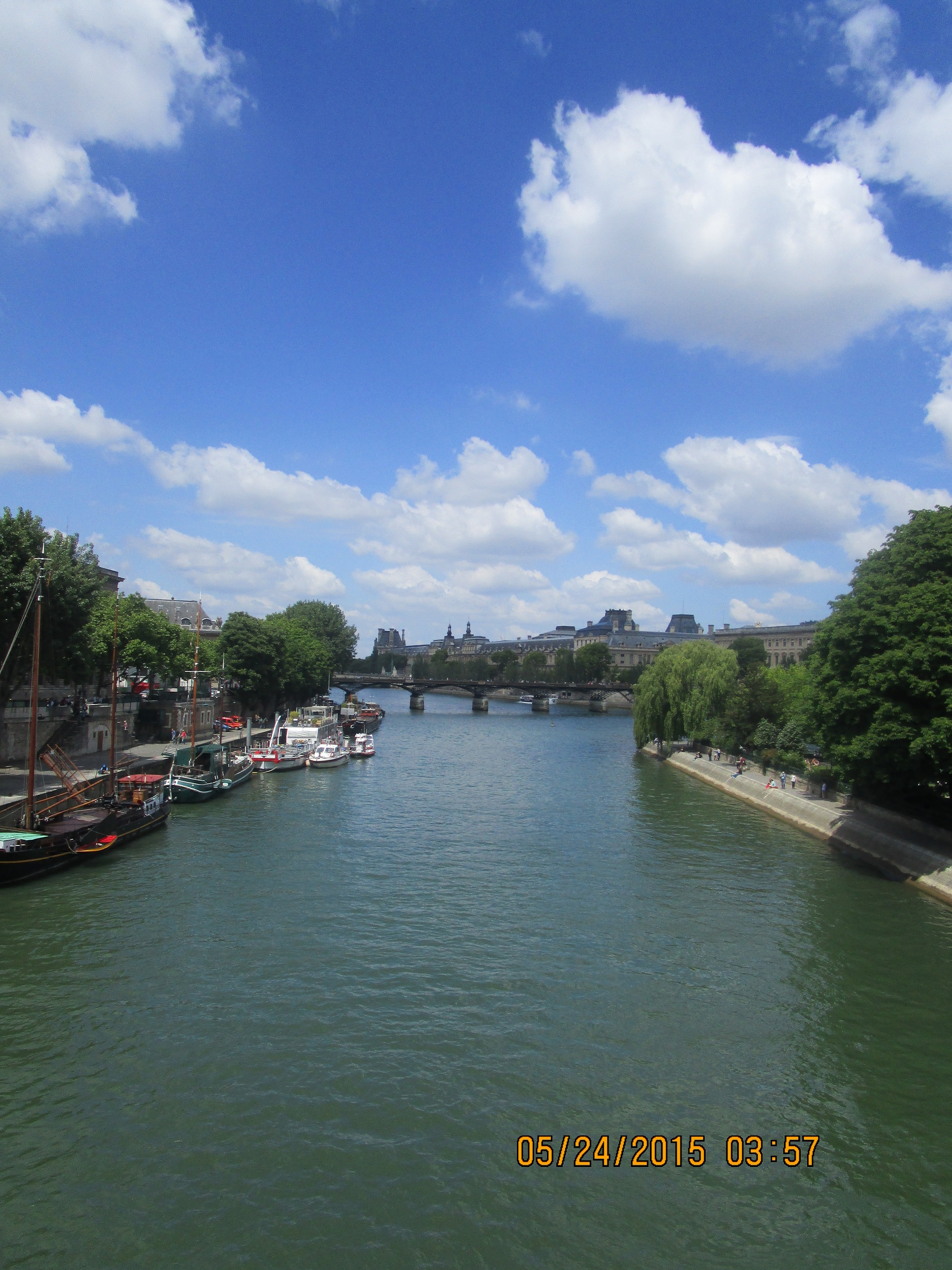
Paris is tumultuous and full of tourists this late in May. But on Sunday mornings it suddenly becomes quiet. The streets are silent, some empty. Families gather for brunch or bask in the parks. Lovers stroll. Cats scrounge for scraps in the open cafes. But the balmy weather is edged with sudden chill and brisk breezes and clouds scuttle over an ever-changing sky. The river rolls under the many bridges, and plane trees, lushly green, are happy with the end of winter. 

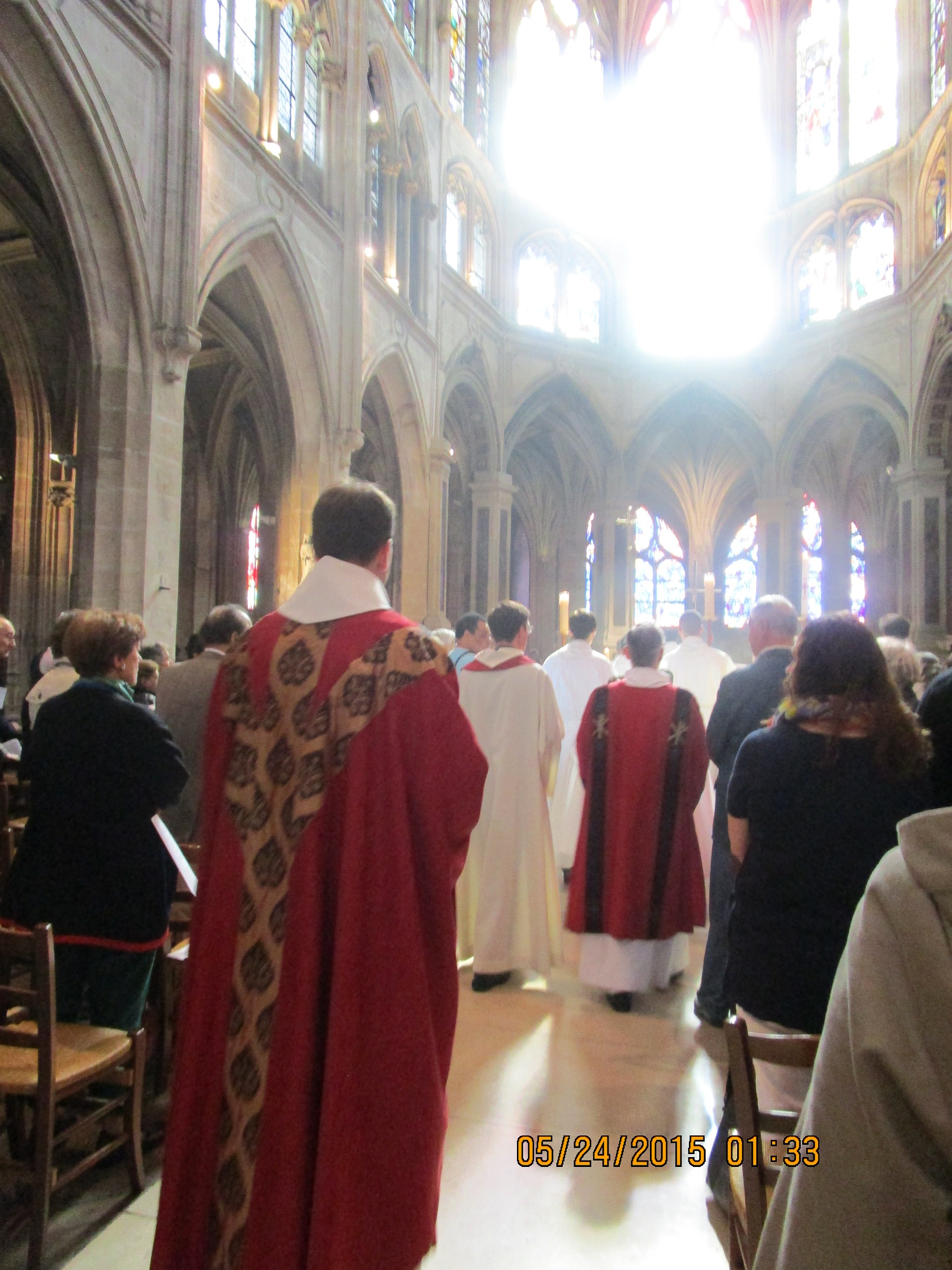
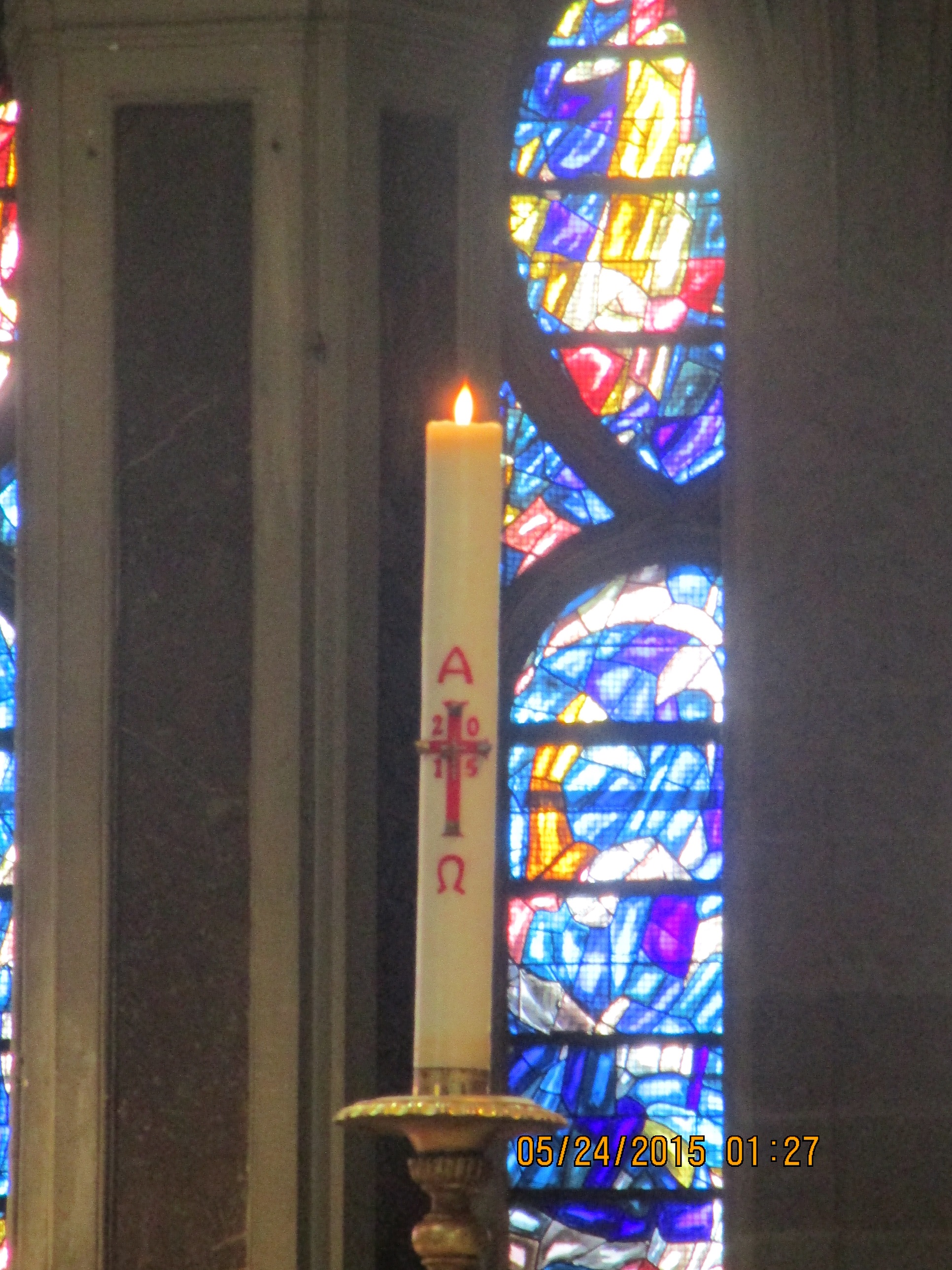
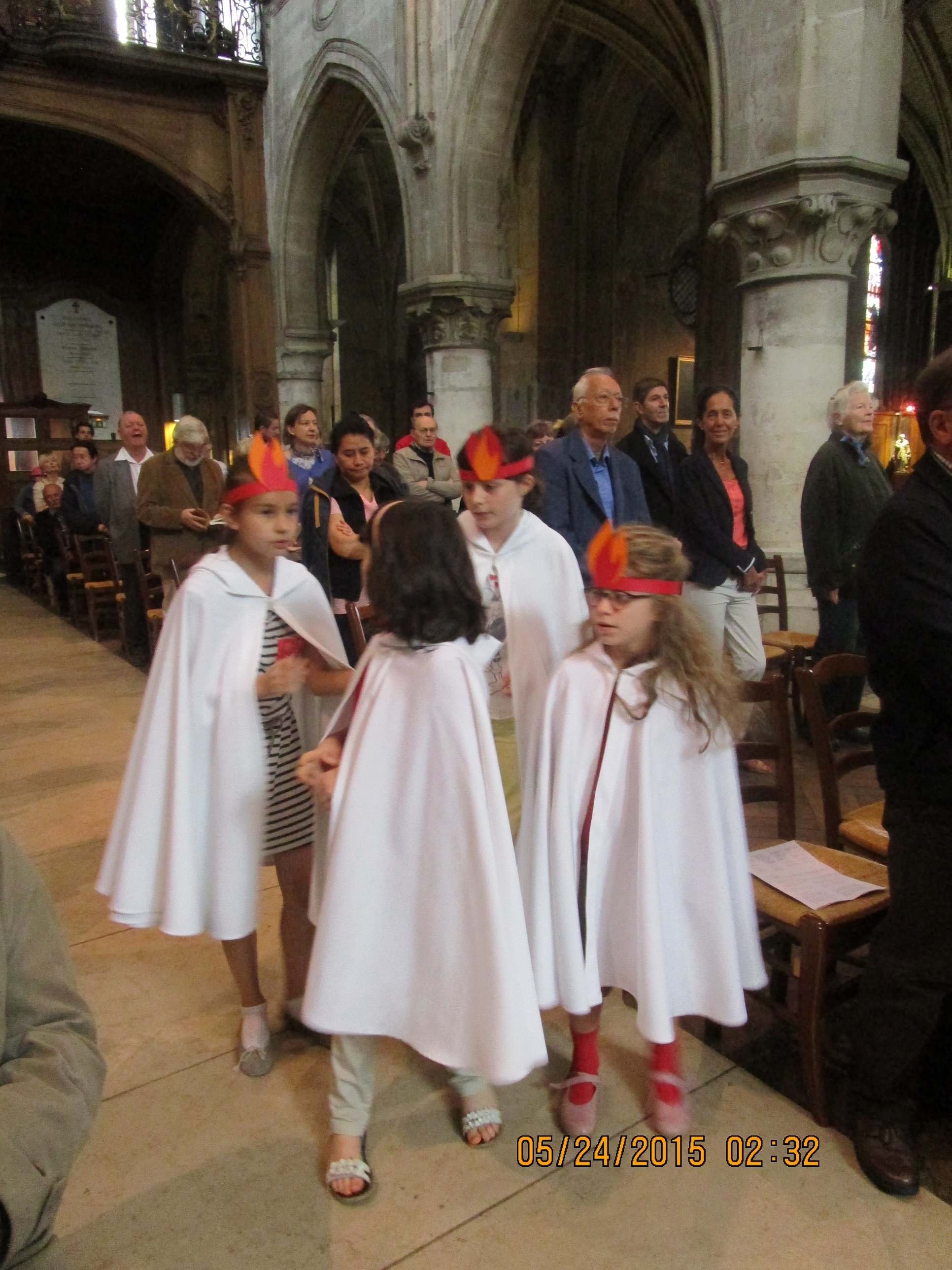
IMG_0691SMALLWe stepped through the quiet lanes this morning to say prayers with other faithful at the ancient church of St. Severen (13th C), and we followed the French Messe on the handout as best we could. The church was packed; candles flamed, stained glass glittered over high gothic double ambulatories; children in white capes and headbands with Holy Spirit paper flames, joined the procession. The songs and the singing echoed up and over us, swirling into the vaults. 

At peace with the city, with ourselves, and with God, we made our way to the Bateau-Mouches, the riverboats, to see Paris from the Seine. I thought how, at least for a time, everything made perfect sense, this Pentecote Sunday in Paris.

Gathering at the River

gathering at the riverMy good friend, wise counselor, and sacrificial priest, is dying of terminal cancer. He is ninety-one. He will be leaving us soon. 

I owe him my life, at least my reborn life, after returning from Canada to the Bay Area where I grew up. I was twenty-nine, wounded from a disintegrating marriage. On the third Sunday of January 1977, I climbed the broad steps of St. Peter’s Anglican Church, Oakland, holding firmly the hand of my towheaded, bouncing, four-year-old son. 

I was already an Anglo-Catholic, having come from Vancouver’s St. James, so I had high expectations as I entered the hushed nave, but my expectations were surpassed on that Sunday morning. The beauty of the liturgy with its fragrant incense, flaming candles, chanting responses, poetically profound hymns, pulled me into the heart of God. The sixteenth-century language – Shakespearean and Elizabethan words and phrasing – restored my soul and renewed my heart. I had come home to beauty, truth, and goodness, to the family of God, the Body of Christ. I had entered Love incarnate. 

The rector, a simple priest of large frame and thick hair, who preached earnestly about the love of God from the central aisle, welcomed us. The families of the parish adopted us. Over the years I traveled in the faith, learning its language, the necessary art and parts of prayer. I began to glimpse heaven, in the daily faithfulness of an Our Father and Glory Be, and in the increased faithfulness of Morning and Evening Prayer, in the joy of receiving the Eucharist into my body and soul, in the “parting of the veil” at the altar. 

I remarried at St. Peter’s, before that same altar. My son served as an acolyte and was confirmed before that altar. In the course of time, my priest and his wife traveled with me and my husband to Western Europe, to the Christian foundations of Western Civilization in Italy, France, and England. We visited monasteries, memorials, great basilicas and humble hermitages. We journeyed from abbeys to cathedrals to healing waters to shrines of the saints. My priest was a wise mentor, showing me how God worked in and through history. 

My first three novels were born of those travels. They explore our history through the journeys of Madeleine and Jack Seymour, a present-day couple who climb a ladder of Christian challenges – healing of body and soul, penitence and forgiveness, redemption and salvation, sacrificial love versus narcissistic lust. These stories comprise Pilgrimage, Offerings, and Inheritance, set in Italy, France, and England. My priest is the genius behind these stories; where they sing in key they do so because of him; where they sing off-key they do so because of me. They are given depth with his words, his beliefs, his ways of seeing and understanding that settled into my soul. 

The stories in turn gifted me with the joy of writing, and for this gift I must be ever in my friend’s debt. As he lay dying he turned to me with half closed eyes, my novel-in-progress on his mind. “The new book – don’t forget the changes,” he barely breathed. “I won’t,” I said. “They’ve already been made.” It was true, I had rewritten portions as he suggested after his reading an early draft, making The Fire Trail richer and more powerful in its consideration of barbarism and civilization. He won’t be able to read the new version until later, at the river. 

Christians never really say goodbye. They say God be with you (the origin of goodbye) or Till we meet again. My priest says he is leaving us, not that he is dying. He often said that we will “gather at the river.” I asked him one afternoon as he lay dying, “Which river? I need to know where we are gathering when we meet in heaven.” His eyes opened wide and locked on mine. “Why, the one that flows by the throne of God.” I laughed. “Of course,” I said. “Now I know where to gather.” I later looked up the lyrics, and sure enough, the refrain was just as he said: 

Yes, we’ll gather at the river,
The beautiful, the beautiful river;
Gather with the saints at the river
That flows by the throne of God.        (Robert Lowry, 1864)

When I left him that day, I kissed his forehead and said, “Till we meet again.” He barely nodded and smiled as he drifted off to sleep. 

We worked together on many projects, my saintly priest and I. I always considered it an honor to do what I could, as best I could, with the time given. I prayed about what to do next, listened to Holy Spirit nudges, trusting that the Holy Spirit, that Breath of God, would breathe me along the right path. When I made wrong turns, I prayed I would return to the crossroads and choose again. 

Sacramental Christianity, the faith taught me by my priest, is woven with these wonderful truths – the turning, the changing, the leading, the following the star. Life is a dance, a sacramental dance between heaven and earth, and through Christ, in Christ, the two – the invisible and the visible, God’s world and man’s world –  waltz with one another. Without the Incarnation, that first dance two thousand years ago, we would not be dancing with the angels. We would not know how. 

All this and much more I learned from my prayerful and penitential priest. I sing with gratitude for his life, so thankful that I could share a small part of it, and now, as he leaves us, he is teaching us how to make a “good death.” For one day I will follow him. I will leave; I will die. The best way, it seems to me, is to have made a “good life.” Then, leave that goodness in the hands of those you love and who love you. For love unites us all – the love of God, the love of Christ, the love of the Holy Spirit binding us together. And my priest loves each one of us, as we love him, binding us together in this God of infinite love.

In my freshman year in college in 1965 one of the final exam questions in my Western Civilization class was: “What is the good life?” It was of course a reference to the classical philosophers, but today I know the true answer. The good life is to know God, to be redeemed by Christ, and to live the life of a sacramental Christian. There is nothing better than that. Such goodness defines everything else.

And I owe the answer to my priest, who, in time, became bishop and then archbishop. At this writing, on Ascension Sunday 2015 celebrating the ascension of Christ to heaven, this earthly shepherd of souls lingers in his love for us, even after last rites. In my ongoing prayers for him, the river is never far from my thoughts, beckoning us, calling us to gather by the throne of God. And I realize now it is the river of life, eternal life and eternal love.

Deo Gratias…  Safe travels, dear friend.

Law and Order

If we can’t police ourselves, others will police us. History, that long forgotten study of cultural, social, and national memory, is a clear witness that this is so.

And so I weep when I see Baltimore burn with such division, so inflamed by looters who discredit and dishonor the peaceful protestors of their community. Then, to see the city government allow this to happen, as though sanctioning it. For when law is not ordered, enforced by the state, disorder is seen as lawful.

We live in a democracy, a glorious, messy mix of peoples of all races, classes, ages. We are an experiment, according to European observers, and I often think the experiment is on the brink of collapse at moments like Ferguson and Baltimore. We have grasped a delicate balance between state and individual, between no speech and free speech, between public and private spheres. We are a family of passionate beliefs and ideals, often opposing, thrown together in a whirlwind we call society.

How are we to we get along? How do we express our deeply held opinions and beliefs? How do we protect property and individual freedoms? Provide for our future as a free people? Ensure our defense and care for the poor and innocent, the least among us? We do all of these things through laws, good laws.

Without law, we become slaves, property owned by the strongest among us. Without law to protect us, we allow might to make right. We hide in fear waiting for the looters who will, in the end, rule us.

I am looking forward to reading Os Guinness’s book, The Global Public Square: Religious Freedom and the Making of a World Safe for Diversity. As Christianity is marginalized in our culture, so are the Judeo-Christian virtues of tolerance, self-restraint, and brotherly love, among many other values supporting democracy. To be sure, Christians and Jews do not always practice what they preach, but ideals must still be preached, they must still be heard and honored in the public square.

We can differ as Americans, but we can continue to converse. We can respect one another’s right to speak, to believe and live in peace, as long as we keep the peace. One group of color or creed need not dominate; but all must keep the peace.

And so as the looters set fire to their own community in Baltimore, and as others smashed car windows in our neighboring Oakland, I thought back to our inaugural lecture on Sunday night taking place at our new Center for Western Civilization, near UC Berkeley. It was well attended by young and old, from many racial backgrounds, and we were told by one speaker that each of us had lit a candle with our presence, adding to the light of freedom. There were also many words of encouragement at the reception afterwards: “So glad you are doing this,” they said again and again as I recalled the Center’s mission:

“Ignorance is the greatest threat to our civilization. Departments of Liberal Arts are shrinking in our major universities. Courses in the Western Tradition, history, literature, art, poetry, philosophy, and ethics are no longer required. Few students have enough understanding of the origins and principles of Western Civilization to maintain or advance our democratic institutions. The absence of this critical knowledge threatens the future of our personal freedoms. It is our responsibility to support every effort to keep the lights of freedom burning before we descend into darkness.”

The lights of freedom – our flaming candles – must help us see where we have come from in order to know where we are going. Fire is good when tamed and used constructively by man. It warms us when we are cold. It cooks our food and burns our garbage. In even turns our flesh to ash to be buried when we die. It lights the dark of the past, the present, the future. Each of us present on Sunday night on Bancroft in Berkeley was lighting a candle in and for our world; each of us was eager to keep the flame burning if only for another lifetime, another year, another day.

And in the end, each of us is only that, a single voice in a sea of voices and one soul in an ocean of souls. I carry, like my neighbor who sat next to me on the hard folding chair in that YWCA hall, a hope within me that my single voice matters, and that my neighbor’s voice matters too. The Baltimore looters matter, each one of them. All of us form America, and we can all carry a flame – our voice – into the public square of our nation, and of our world.

But the flame must not burn others; it must light their way. It must not destroy; it must give life. But how do we keep our candles lit in this darkness?

We keep them lit by respecting law and order; by enforcing peace in our communities. We keep them lit by understanding who we are – where we have been and where we are going.

Truth and Lies and Shades of Gray

ft5I recently arrowed send and, instantly it seemed, my novel-in-progress flew from my desk in California to an editor on the East Coast. Before I clicked send, however, The Fire Trail had been rewritten with the help of a West Coast editor and other readers. Characters were developed more fully, I hope, scenes added and expanded, plot points remapped, histories made true. 

I am enraptured by what is true, a true truth-junkie. In all of my novels I have tracked and tried to capture truth, turning this elusive and challenging quality into characters who live and breathe, people who people my pages. For it is the artist’s solemn obligation to attempt this invaluable and possibly foolhardy feat, this re-presenting what is true about you and I, our world, our very existence. It is a big and scary subject, and some of us do not want to hear about it, for as T.S. Eliot wrote in Four Quartets, “Humankind cannot bear very much reality.”

We call these realities “hard truths,” and they are ones which make some folks squirm: the definition of marriage and why the state should be interested in its definition, the sacredness of life from conception to grave, the need for freedom linked to responsibility, liberty linked to law, democracy linked to educated voters. Yet all of these truths are necessary for American culture to survive, indeed, for free peoples of the world to survive.

Approaching the election season, we voters must understand these issues in order to decide them. It is good and glorious that we have these months to debate truth, from all points of view. It is good and glorious that as citizens we can learn what is at stake, can recognize when truth is elasticized and remolded, is shape-shifting. In this learning process, we can pull truth back into its proper shape, return it to its true character.

And so in my little novel that flew through cyberspace last week I tried to pull these elastic truths back into their real shapes through my characters. The characters themselves, for that matter, are icons of many people I have known. They speak with voices I have heard. They have been molded with words as an icon is painted with prayer, so that they will one day turn around to face readers and say, “I am… so pleased to meet you.” Thus, the dance together begins, a waltz or a minuet, a conversation between character and reader, slowly, picking up pace and tempo, as the music of language is sounded.

Art is a medium of truth. It is a way of expressing the inexpressible, explaining the unexplainable, touching familiar notes deep within our common heart, as though we were an orchestra playing a symphony. The artist reaches into clay or image or symbol, tempo or melody or chord, and re-molds it to show something true about each of us. The medium is only that, a medium, material used to tell us about ourselves, who we truly are.

Unfortunately with the rise of advertising over the last century, truth has become malleable, slanted, slippery. And with advertising we recognize this, we are forewarned, and we hesitate before believing that snake oil will cure blindness.

But in the process, journalists, publishers, and politicians have been tempted to also twist and stretch truth, so that honest elections are held hostage to news media, be it print, video, or electronic. Shades of gray stretch as far as the eye can see. Colors and definitions disappear in a wasteland of relativity. What are we voters to do? We can only be aware, beware, and be wary of the lie that there is no truth, no right way forward.

And so as we listen and read, as we consider what direction our nation should take, who should lead us through the wilderness of our world, I am glad I created characters who live within the debates. I will refine them with honest fire, hammering and shaping their golds into revelations, beautiful and good and true.

For in the end, this is what we all desire, to know in truth where we have come from, where we are, and where we are going.

Easter Flowers

IMG_0485 (2).3The glories of Easter and Eastertide lift me into familiar joy, one that I expect each year. And yet this joy surprises me with its nuances, colors, and music: the lilies on the altar, the flaming candles, the removal of the purple coverings, the triumphant hymns and processions.

Easter often signals the arrival of spring, and the natural world reflects the supernatural with sunshine. This Easter in the Bay Area a long desired rain descended from the heavens, splattering our dry California soil. It was a too-short rain that came and went quickly, but it peaked Easter morning. Still we were dry inside the ark of the church.

After the Scripture lessons and Creed, and before the sermon, the children flowered the thick white Easter Cross placed at the foot of the altar steps. They shoved bright blossoms into the deep holes, and watched the wood of the cross come alive. Just so, I thought, Mary Magdalene came to the empty tomb and found the living Lord walking in the garden.

The Gospel appointed for Easter Day, the highest holiest day of the Christian Year, details Mary Magdalene’s visit to the empty tomb in a manner found in histories, not myths or legends. These specific details had been passed from one generation to another orally in the early Church, and were recorded decades after the event. So it is not surprising that the accounts vary a bit, but in the essence they are the same: Jesus, their Lord, had risen from the dead.  

The accounts agree on another key fact, that the women, not the men, made the discovery. Had these resurrection stories been invented, those who found the empty tomb would have been men not women. And yet, remarkably, the apostles did not find the tomb first; they didn’t even believe the women when they ran back to their hiding place and told them. It is Mary Magdalene who makes the discovery, and at first she doesn’t understand what has happened either, thinking the body has been stolen, a detail that could not have been invented. 

In John’s account, Peter and John return with her to the tomb and see the linen cloths lying to the side. John understands: he remembers the scripture foretelling his rising from the dead. Peter does not understand and they return home, leaving Mary Magdalene to encounter the “gardener.” 

Picture 089Unique to John’s account is this moving conversation between Jesus and Mary Magdalene: 

But Mary stood without at the sepulchre weeping: and as she wept, she stooped down, and looked into the sepulchre, and seeth two angels in white sitting, the one at the head, and the other at the feet, where the body of Jesus had lain.

         And they say unto her, “Woman, why weepest thou?”

She saith unto them, “Because they have taken away my Lord, and I know not where they have laid him.” And when she had thus said, she turned herself back, and saw Jesus standing, and knew not that it was Jesus.

         Jesus saith unto her, “Woman, why weepest thou? whom seekest thou?”

She, supposing him to be the gardener, saith unto him, “Sir, if thou have borne him hence, tell me where thou hast laid him, and I will take him away.”

Jesus saith unto her, “Mary.”

She turned herself, and saith unto him, “Rabboni.” (Master)

Jesus saith unto her, “Touch me not; for I am not yet ascended to my Father: but go to my brethren, and say unto them, I ascend unto my Father, and your Father; and to my God, and your God.”

Mary Magdalene came and told the disciples that she had seen the Lord, and that he had spoken these things unto her.        (John 11-18, KJV)

The risen Christ makes numerous appearances on earth before his ascension to Heaven, but even with these accounts, many today do not believe in the resurrection of the Son of God. Some of us need help, it seems. I was one of those. 

I was converted by reason, arguments I read when I was twenty, made by C.S. Lewis in Mere Christianity. I made that first step of faith (I didn’t feel I was leaping) and found an Anglican church (Lewis was Anglican) to find out more. Experiencing my first Anglican liturgy in the spring of 1967, I was entranced, overwhelmed by beauty. I began the dance of a lifetime, weaving Heaven into my earthy world. 

I am still dancing, learning new movements and new steps, and enjoying the many other dancers in the Body of Christ, the Church, who dance with me and alongside me, helping and teaching me. 

And so, each Easter as the dead wood of the white cross comes alive with reds and blues, greens and yellows, pinks and purples, flowered by the children of our parish, I am thankful. I am thankful for Mary Magdalene and her faith and her witness to the glorious Resurrection of Christ; I am thankful that I could tell her story in my novel, The Magdalene Mystery, and in the telling understand how truly historical those resurrection accounts really are, deepening the belief I found forty-seven years ago, strengthening Lewis’s reasonable reasoning.

But most of all I am thankful for the Son of God among us, having risen on Easter morning, having walked the earth to appear to many, and with us today in the Eucharistic gifts of bread and wine. I rejoice in God’s great love: to be born among us, to live, die, and rise again, to take us with him into eternity in this world and the next.

Waving Our Palms

palmsundayWe sat in the front pew, the children and the teachers, waiting and watching. The purple-draped altar, the purple-draped candlesticks, the purple-draped medieval crucifix all stood solid and royal and richly beautiful.

We have been waiting throughout Lent, waiting for this momentous week, considering our hearts and our lives and our habits of love or un-love. Yet Palm Sunday is the day we end our waiting and begin our acting. As Christ entered the gates of Jerusalem on Palm Sunday, so we enter Jerusalem too, as we take part in the stupendous drama of the Son of God’s last week before his crucifixion, the week that Christians, all over the world, call Holy Week. 

Holy Week marks the days leading to Easter. The last three days, the Tridium, begin with Maundy (commandment) Thursday when we remember the Last Supper and Christ’s commandment to “love one another” as he gave himself to us in the Holy Eucharist. That same evening we strip the altar and turn out the lights, reflecting Christ’s arrest and abandonment in the Garden of Gethsemane. We even create a garden of flaming candles to honor the reserved Sacrament that has been removed, and some of us will “keep the watch” all Thursday night, undoing that desertion in Gethsemane.

On Good Friday, remembering God’s good death that saves us from ourselves, we watch as eternity intersects time and the earth quakes. The Son of God is crucified; the tree of Eden becomes the tree of Calvary, reversing Eden.

Some of us keep the Holy Saturday vigil, entering a darkened church and lighting it with flaming candles as the new day of Easter approaches. Some of us, like Mary Magdalene, will rise on Easter morning to find the tomb empty and to celebrate the risen Christ – and our own resurrections – with colorful flowers on a white cross and lots of happy singing.

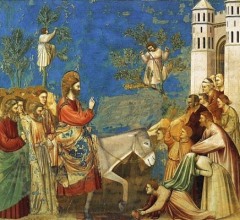
But today, Palm Sunday, we waited and we watched in our pew, for soon, soon, we knew we would be given our blessed palms. As the Gospel was read, describing what we were soon going to act out, I entered into the liturgy, this moment of meaning created by time and tradition and creedal belief over two thousand years. I entered the story and walked alongside that colt carrying Our Lord through the gates of Jerusalem. 

So this morning, the children and the teachers stepped to the altar rail and received their palms, then stepped back to their pew. Soon all those in the rows behind us received theirs too. “We’ll follow the cross,” I whispered to the children, and we waited for the clergy and acolytes to step into the nave and begin the procession. The choir sang joyfully the resonant hymn, “All Glory Laud and Honor…” and we followed the cross, leading the congregation, waving our palms and singing too. 

Ritual is an art-form, and art is mankind’s way of expressing the great truths of his existence. Liturgy uses many art-forms: poetry and prose, music and drama, songs and prayers, symbols and settings richly textured with meaning. Ritual is a deeply satisfying way to express who we are, why we are here, where we have been and where we are going. It expresses what God, in his immense love for his creation, has done for us, and continues to do for us. 

The dramas of Holy Week and Easter are part of the greater drama of the entire Church Year found in Roman Catholic, Anglican, Lutheran, and Orthodox traditions, and to a lesser degree in other Christian bodies. But Easter is the culmination of that year. Since Advent and our waiting for Christmas, we have been preparing for Easter’s Resurrection. Christmas means nothing without Easter, for it is the Resurrection that marks Christ as the Son of God. It is Easter that makes us sit up and take notice and ask, “If he did rise from the dead, then who did he claim to be, and what did he command? What does he command today? Who exactly is he? Does he really love us that much to die for us?” 

As someone once said, Christianity is all about the Resurrection. If you believe in the resurrection of Christ from the dead – and there is ample historical evidence to support such belief – then the rest follows easily. And the rest is, oh my, a glorious journey, full of color, meaning, certainty, and the love of God singing to you at night. 

But I am ahead of the story and the week opening before us – we are still at the gates of Jerusalem. The children and the teachers followed the cross around the church, and the congregation followed us. Today being a fine sunny morning, we followed the cross outside into the neighborhood and around the front and back to the narthex doors. Our priest pounded on these gates: Jerusalem, oh Jerusalem! The doors opened and we entered the heart of the ark of the church, stepping up the red carpet toward our front pew. 

And so now we step into Holy Week, prayerfully, awe-fully, watching, waiting, and acting out this grand drama of the love of God, as once again, eternity intersects time.

Time Turning and Returning

PassiontideThe altar was draped this morning in purple – purple covered everything, it seemed – the tabernacle, the giant candlesticks, the huge medieval crucifix, the Lady Altar, the lecterns. We were drowning in purple. And so I considered my purple, penitent past, one which I revisited recently. 

I returned to a place I had not visited in thirty years, a city in which I had lived in the 1970’s, for the funeral of an old friend gone to Heaven. He was a devout Christian; he knew where he was going and he knew the way. He was eight-two, my son’s godfather. We had been in touch by phone and through Christmas cards, but not much else. 

So my son (42) and I (67) flew north to Vancouver, Canada. And as we flew above the clouds, I traveled back in time to a younger version of myself. The younger version, a girl in her twenties, peered over my shoulder that day of the funeral as though watching and taking stock of who she would become one day. 

I considered from time to time, as we prayed the prayers over the ashes in the Anglican Church, sitting with old friends in the pews, the unique journeys we each had made to this place and this day in this year 2015. I learned more about journeys, those stories, later over coffee and sandwiches. My friends had suffered death, illness, and loss. But we were joyful in spite of it. Children had grown to be parents, just like my son, and I marveled at these children now in their forties who once played together and flew kites on the green lawns of Stanley Park. Our children had grown up. And of course I noticed other graduations: retirement, gray hair, silvery beards. 

IMG_0437 (2)My son’s godfather, Frits Jacobsen, whose ashes we placed reverently in the square space in the cemetery grass, was a rare creature, a Christian bohemian. Born in 1933, he emigrated from Holland to Toronto with his young family after the war. Many years later he resettled in Vancouver and made a humble living as a book illustrator. He devoted countless hours to his church, his community, and the poor. He was self-supporting with his pen-and-ink drawings. He might have been confused with the hippies, a generation later, but he was far nobler. He lived in a garret in Shanghai Alley, Chinatown, in old Vancouver. Today the building is adjacent to the newly redeveloped Olympics and World’s Fair district, but back in the 1970’s it was a poor, albeit quaint, neighborhood, with soup kitchens and lines of homeless. 

IMG_0425My son, with the help of his miraculous IPhone, found the address. I recognized the door, with the 522 painted over it. We took photos from all angles. It was when we headed back to the car, time telling us it was time to leave for the funeral, that a lovely young lady came through 522. We asked what floor she lived on. The top, she said, curious. Could we come up? we asked. My son explained our connection with the former inhabitant (Frits had moved with the area’s redevelopment). When she learned that an artist had lived there, she was delighted to invite us in. And once again, as I climbed the familiar stairs to Frits’ studio and smelled the same musty stairway smells, that other girl I was, so many years ago, smiled from behind my shoulder. I pinched myself as I watched my grown son climb the stairs ahead of me, for I could see the four-year-old blond towhead clambering up behind him to visit his Uncle Frits. 

Frits, opining in his heavy Dutch accent, with his beret and his trim beard, was both gregariously joyful and astutely serious. He brooked no compromise with his Christian beliefs and would follow those who pledged the same. He was sure the Apocalypse was imminent. He judged his culture and he judged rightly, I believe, although he was a bit too harsh, to my way of thinking, on other denominations within the Body of Christ. Frits had his opinions and wasn’t shy about voicing them. And we loved him for it. He was a breath of fresh air. 

After the graveside service last week we gathered again to recall Frits and how he would love our gathering. We looked at his artwork, shared plates of fruit and salad. We laughed a good deal, and we knew Frits would have liked that. We remembered how we had found one another at church, our glorious Anglo-Catholic St. James, and how we had formed friendships including singles, couples, and young families. We didn’t have much, but we liked to talk about faith, about Lewis and Tolkien, about books, about theology, and we would gather together over wine and cheese and pineapple upside-down-cake. We picnicked at Stanley Park and dreamed where our lives would take us. For we were young then, and our future spread before us. We were fearless, undaunted. We embraced living. 

And so as I revisited my earlier life, more battle weary but also more wise, I guessed my friends felt the same. We looked different and yet the same, and we wove together the years we were apart in our conversations, asking, remembering, wondering why this and how that and where was so and so and what happened then. Each of us carried a universe within us; we had lived most of the universe already, and the stories, like planets, revolved around one another once again. 

I realize now as I write this, how rich we all are to have lived so long, to have so many stories texturing us and coloring our lives. Some are painful tales to be sure, but some are joyful. The threads of the weaving are both dark and light, drab and colorful. 

And also, as I now think back on this morning, Passion Sunday, when we enter the heart of Christ’s story – who he was, who he is, how he saved us from death to be with him – I understand a bit more than I did last year at this time. For my own passio – my story of moving through time, suffering the wounds of life and celebrating the healings – is fuller than it was even then, one year ago. For each of us, as Christians, are not only a part of God’s great creative project for his creation, but are also part of God’s great creative project for each of us individually, if we say yes, if we say, “be it unto me according to thy word.”

And so as we enter Passiontide, we look to Palm Sunday and Holy Week. We consider what it all means, our lives and the lives of those we love, weaving them together in our prayers and offering our new coat of many colors to God. We look to Palm Sunday and Our Lord’s entrance through the gates of Jerusalem. As the children waved the palms, just so we wave our lives woven by each minute, hour, day. We lay down this fabric of our lives before the Son of God who rides on a donkey through the holy gates. We lay them down alongside the children’s palms.

And we look forward to the glories of Easter.

The Light of Lent

Advent St. JWe are deep into Lent, entering the heart of understanding of who we are, who we are meant to be. We have traveled beyond the ashen cross on our foreheads that marked us as Christ’s own. We have moved into disciplines of reading, prayer, abstinence, and charity. Now, having celebrated the Third Sunday in Lent, we pause and take stock. We judge our hearts and our lives. We re-commend, re-commit, re-create ourselves to travel even deeper into the heart of God.

Being marked with the cross helps us follow the path to Easter and resurrection. We do indeed need this sacramental help. We need to immerse ourselves in the daily office, in the appointed psalms and epistles and gospels read for over two thousand years. We join Christians around the world as they too follow this Lenten path, they too read, mark, and inwardly digest the Word of God as they write it upon their hearts.

We sacrifice our time (our precious hours allotted, our numbered days) to keep our rules as best we can, which is to say, at least for me, not very well. But God knows our hearts, both the good and the bad, the beautiful and the ugly. He knows, and like a good father, leads us along, taking our hand in his, tenderly aware of our frailty.

The Gospel appointed for the Third Sunday in Lent is about Jesus casting out a demon, one that made the man dumb, unable to speak. We too live with this demon inside us, devouring our thoughts (making us truly dumb) and silencing our voices. We see our culture move away from God, yet we do not change our ways. We are mute, we want peace, we want to include everyone, and never offend.

St. Mark in Sunday’s Gospel records Christ saying, “He that is not with me is against me: and he that gathereth not with me scattereth.” How true today as it was then, for demons scatter, confuse, and derange. Our culture is scattered, confused, and in many places deranged.

St. Paul in Sunday’s Epistle gathers and lists precepts to form a way of living, defining a moral code as he lists temptations of body and soul. “For ye were sometimes darkness, but now are ye light in the Lord: walk as children of light: for the fruit of the Spirit is in all goodness and righteousness and truth; proving what is acceptable to the Lord.” Yes, the path is clear, it is one that gathers righteousness and, in the gathering up, must choose.

All choice requires judgment, but our choices and judgments are inevitably influenced by the culture we breathe. God in Christ steps into that culture, in history and today, offering his own sculpting of our souls. He was, after all, the modeler of the clay that formed us, giving us life as he breathed upon us so long ago in Eden. He loves us, his own creation, his treasured created beings who were modeled in his image to reason and create just as he did and does. He wants us to come back to him, to come home. So in his time on earth in that eastern Roman province he showed us our way home, how to choose, how to judge amid the myriad of choices. He showed us what is good and what is bad, what fruits we should eat and what fruits we should not eat, if we want to become who we are meant to be in all eternity.

All creation is about judgment, including and excluding. When I write a sentence I am actively choosing, including, excluding, judging words and tone and sound and syntax, even beauty. Some might disagree with my choices. This is their choice. I might not make the choices that others make, but I must allow them to choose, to create their own lives and grow their own souls. It is this allowance, this respect for others’ choices that the revolutionary and unique Judeo-Christian tradition upholds. This is the freedom God has revealed to each one of us; this is love.

The creation of a poem or painting or symphony have been, in the Judeo-Christian tradition, a reflection of the beauty, truth, and goodness of God revealed to us. As belief in our God of Abraham receded in the last century, so too has the beauty, truth, and goodness of our culture faded. As Anglican philosopher Roger Scruton writes, today’s culture is one of “repudiation.” The atonality of music repudiates tonality, creating noisy chaos; deconstructionism in literature repudiates literary forms; artist-signed urinals and soup cans displayed as art repudiate the classic requirements of sculpture; paint thrown on a canvas repudiates the learned skills of figure drawing and observation of nature. Indeed, all these modern forms repudiate the boundaries of the disciplined art form, and in this sense join the cultural repudiation of all authority seen in other areas of society.

In Culture Counts Mr. Scruton writes, “the new curriculum in the humanities, which is relativist in favor of transgression and absolutist against authority… presents an obstacle to cultural renewal… there is such a thing as the critical study of works of art and literature… that transits a legacy of moral knowledge.”

We must judge where we want to go, as individuals, as a nation, as a world. We cannot be all inclusive, for total inclusivity means chaos and anarchy, inviting totalitarian rulers. We must follow the path that has made the Anglosphere great and free. We must applaud those who have made this choice in arts and letters, and not those who choose repudiation and chaos. Particularly those in power, those with influence, and those with talent and intelligence in academia – the elites of our culture – have a grave responsibility to protect us all by supporting that which supports freedom.

In this way we will imbue our culture with Lenten discipline. We will mark an ashen cross upon every work and every endeavor, whether belief is there or not. We will support the ideals of love that Christ and his Church gives us year after year as we wave our palms at the gates of Jerusalem on Palm Sunday, partake of the first Eucharist in the upper room on Maundy Thursday, watch and wait at the foot of the cross on Good Friday, and rise with him on Easter morning. These are choices we must make, we want to make, we choose to make to ensure a world that is good, beautiful, and true.