
Tag Archives: Christian

The Light of Lent

Advent St. JWe are deep into Lent, entering the heart of understanding of who we are, who we are meant to be. We have traveled beyond the ashen cross on our foreheads that marked us as Christ’s own. We have moved into disciplines of reading, prayer, abstinence, and charity. Now, having celebrated the Third Sunday in Lent, we pause and take stock. We judge our hearts and our lives. We re-commend, re-commit, re-create ourselves to travel even deeper into the heart of God.

Being marked with the cross helps us follow the path to Easter and resurrection. We do indeed need this sacramental help. We need to immerse ourselves in the daily office, in the appointed psalms and epistles and gospels read for over two thousand years. We join Christians around the world as they too follow this Lenten path, they too read, mark, and inwardly digest the Word of God as they write it upon their hearts.

We sacrifice our time (our precious hours allotted, our numbered days) to keep our rules as best we can, which is to say, at least for me, not very well. But God knows our hearts, both the good and the bad, the beautiful and the ugly. He knows, and like a good father, leads us along, taking our hand in his, tenderly aware of our frailty.

The Gospel appointed for the Third Sunday in Lent is about Jesus casting out a demon, one that made the man dumb, unable to speak. We too live with this demon inside us, devouring our thoughts (making us truly dumb) and silencing our voices. We see our culture move away from God, yet we do not change our ways. We are mute, we want peace, we want to include everyone, and never offend.

St. Mark in Sunday’s Gospel records Christ saying, “He that is not with me is against me: and he that gathereth not with me scattereth.” How true today as it was then, for demons scatter, confuse, and derange. Our culture is scattered, confused, and in many places deranged.

St. Paul in Sunday’s Epistle gathers and lists precepts to form a way of living, defining a moral code as he lists temptations of body and soul. “For ye were sometimes darkness, but now are ye light in the Lord: walk as children of light: for the fruit of the Spirit is in all goodness and righteousness and truth; proving what is acceptable to the Lord.” Yes, the path is clear, it is one that gathers righteousness and, in the gathering up, must choose.

All choice requires judgment, but our choices and judgments are inevitably influenced by the culture we breathe. God in Christ steps into that culture, in history and today, offering his own sculpting of our souls. He was, after all, the modeler of the clay that formed us, giving us life as he breathed upon us so long ago in Eden. He loves us, his own creation, his treasured created beings who were modeled in his image to reason and create just as he did and does. He wants us to come back to him, to come home. So in his time on earth in that eastern Roman province he showed us our way home, how to choose, how to judge amid the myriad of choices. He showed us what is good and what is bad, what fruits we should eat and what fruits we should not eat, if we want to become who we are meant to be in all eternity.

All creation is about judgment, including and excluding. When I write a sentence I am actively choosing, including, excluding, judging words and tone and sound and syntax, even beauty. Some might disagree with my choices. This is their choice. I might not make the choices that others make, but I must allow them to choose, to create their own lives and grow their own souls. It is this allowance, this respect for others’ choices that the revolutionary and unique Judeo-Christian tradition upholds. This is the freedom God has revealed to each one of us; this is love.

The creation of a poem or painting or symphony have been, in the Judeo-Christian tradition, a reflection of the beauty, truth, and goodness of God revealed to us. As belief in our God of Abraham receded in the last century, so too has the beauty, truth, and goodness of our culture faded. As Anglican philosopher Roger Scruton writes, today’s culture is one of “repudiation.” The atonality of music repudiates tonality, creating noisy chaos; deconstructionism in literature repudiates literary forms; artist-signed urinals and soup cans displayed as art repudiate the classic requirements of sculpture; paint thrown on a canvas repudiates the learned skills of figure drawing and observation of nature. Indeed, all these modern forms repudiate the boundaries of the disciplined art form, and in this sense join the cultural repudiation of all authority seen in other areas of society.

In Culture Counts Mr. Scruton writes, “the new curriculum in the humanities, which is relativist in favor of transgression and absolutist against authority… presents an obstacle to cultural renewal… there is such a thing as the critical study of works of art and literature… that transits a legacy of moral knowledge.”

We must judge where we want to go, as individuals, as a nation, as a world. We cannot be all inclusive, for total inclusivity means chaos and anarchy, inviting totalitarian rulers. We must follow the path that has made the Anglosphere great and free. We must applaud those who have made this choice in arts and letters, and not those who choose repudiation and chaos. Particularly those in power, those with influence, and those with talent and intelligence in academia – the elites of our culture – have a grave responsibility to protect us all by supporting that which supports freedom.

In this way we will imbue our culture with Lenten discipline. We will mark an ashen cross upon every work and every endeavor, whether belief is there or not. We will support the ideals of love that Christ and his Church gives us year after year as we wave our palms at the gates of Jerusalem on Palm Sunday, partake of the first Eucharist in the upper room on Maundy Thursday, watch and wait at the foot of the cross on Good Friday, and rise with him on Easter morning. These are choices we must make, we want to make, we choose to make to ensure a world that is good, beautiful, and true.
Singing with Saints

SAINTS2I’m afraid I don’t appreciate falling back an hour so that we can spring forward later in order to move an hour of light from evening to morning. It confuses the body’s natural clock, and I’ve yet to find a good reason to practice daylight saving time today. I’m told it has to do with farmers needing earlier morning light, but the advantage only lasts a few weeks.

And yet, just as when I travel across time zones, the change brings to mind the strangeness of time itself, its movement, its speed usually governed by my own attention. Time speeds up when I am thinking; it slows down when I am not focused. But we all know this is an illusion, a fact that makes the whole process even more strange.

Aging speeds time too. We live a certain life-time, a set span as though we inhabit parentheses or brackets or quotation marks. Perhaps birth is a capital letter and death the period; we are the sentence and we hope we have many clauses and interesting verbs and fascinating, colorful nouns. One way or another we travel a road through time from birth to death, like flipping pages in a book, and the traveling seems to speed up as we move along. Those childhood years stretched out, especially those summer months with no school (at least in my childhood) and those long lazy days of reading and riding bikes into dusk and darkness and someone called you in.

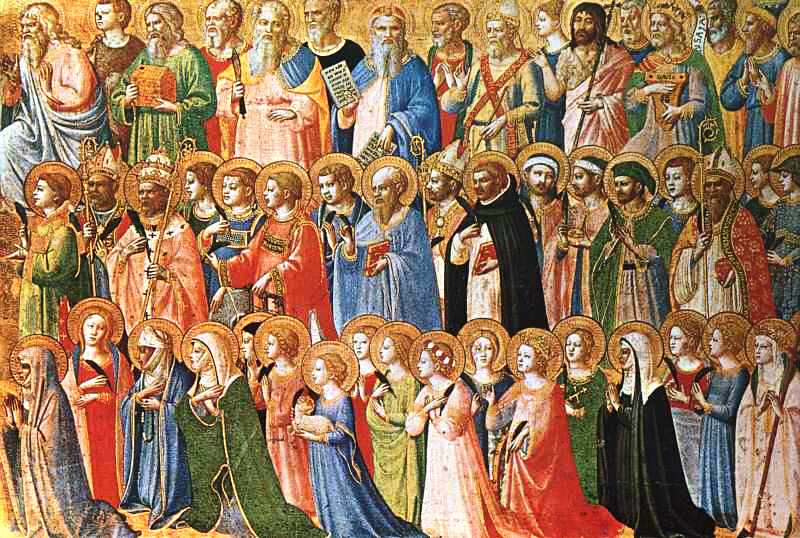
And so it seemed appropriate that the Festival of All Saints landed this weekend, All Saints on Saturday with its extra hour (a sweet gift to be taken back later) and All Souls moved to tomorrow, Monday. All Saints and All Souls is a festival of time, I’ve often thought, celebrating the mystery of human life, and God within each of those human lives. We talk about the Communion of Saints, linking those from the past with those in the present with those to come, all in communion with us when we receive our Communion, communing together on a Sunday morning.

As our preacher explained, when we worship God we take part in the glory and worship of those in Heaven – the souls, saints, and angels, as described in the Revelation of St. John, the Epistle for All Saints Day:

I beheld… a great multitude, which no man could number, of all nations and kindreds, and peoples, and tongues, stood before the throne, and before the Lamb, clothed with white robes, and palms in their hands, and cried with a loud voice, saying, Salvation to our God with sitteth upon the throne, and unto the Lamb. And all the angels stood around about the throne, and about the elders and the four living creatures, and fell before the throne on their faces, and worshipped God, saying, Amen: Blessing, and glory, and wisdom, and thanksgiving, and honour, and power, and might, be unto our God for ever and ever. Amen. (Rev. 7:2+)

In our earthly hour of liturgical worship, ritual choreographed like a dance incorporating all the earthly senses (hearing, seeing, touching, tasting, smelling), we worship outside of time with those before, those now, those to come. We also worship deep inside time, in its very heart, the kernel of created life, deep within God himself as he enters deep within us. It is a pinpoint moment all pulled together as the Host is placed on the tongue and we sip from the chalice.

Time is telescoped on a Sunday morning in a simple church, so that when we leave the sacred and re-enter the worldly rushing world around us, where time devours seconds on a dial or falls into the abyss of a digital screen, gone – when we re-enter our ordinary comings and goings – we bring that timeless telescopic moment with us. We carry that jeweled moment, and all the jeweled moments of worship, collected in each of us, recreating us to be who we truly are. We become further sculpted and more defined. We have been fed and enriched and changed each time we join this host of witnesses, each time we sing our songs of worship as one voice:

For all the saints, who from their labors rest,
Who thee…..  by faith before the world confessed,
Thy Name, O Jesus, be for ev – er blest,
Al – le – lu – ia,  al – le – lu – ia!
                (#126, 1940 Episcopal Hymnal)
 

Our preacher spoke of the tortures of the early saints, their long, drawn-out martyrdoms as they confessed the lordship of Jesus of Nazareth. We look around our world today and see similar Christian martyrdoms, but we feel safe on our own soil. So far. Would we deny our faith? We wonder on days like today, when we recall Tertullian’s “the blood of the martyrs is the seed of the Church.” We are thankful for these saints, for where would we be today without them?

Time would be a dull thing, scattered and meaningless, with no end in sight and too many ends in sight. We would be devoured by the noise and rush of the world or simply our own silent pride. We would be blind to beauty, truth, goodness. We would not see God, and so we would not appreciate the life he has given us; life would be cheap.

And so, in a way, All Saints is a prelude to Thanksgiving for, while every Eucharist is a festival of thanksgiving, today is a day in which we give special thanks for that emerald moment of worship promised, that moment we join with the heavenly host in the worship of God with the great Communion of Saints.

Crossing the Courtyard

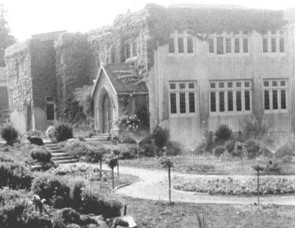
St. Peter's, 1913

St. Peter’s, 1913

Our parish church, St. Peter’s Anglican in Oakland, is building a new courtyard. Over the summer we have entered the church through side doors and back doors. We have peered over broken-down walls and into churned-up soil and rock. Along the way we unearthed our original cornerstone, laid in 1913. Somehow it was buried when a new church was built alongside the old in 1957. 

There has been much discussion, weighing in, rethinking this and deciding on that, in the process of executing the architect’s vision for our courtyard. Are the colors compatible with the existing buildings? Should there be a lych-gate or just a gate? How high will the brick walls be exactly? Did we really have to remove the palm tree? When will it be finished? In time for our organ concert? When will the elevators for the handicapped be done?

There has been much sighing and wringing of hands and raising of brows, then chuckling and open palms and leaving it all to God. Somehow we have weathered the great questions and agreed upon sensible answers. God has been good.

Today, finally, we could see how it all might turn out. Planting beds are marked. The brick wall (not too high) is finished, an inviting border. Soon the patio will be laid. Soon the front doors will be opened, their chains broken, and soon we will once again cross the threshold of our church, leave the secular behind and enter the sacred.

The sun came out this morning as we peered over the low brick wall. The heavy fog that settles upon the Bay Area this time of year had burned away. The earth, its gravity holding our church fast on its rim, was turning slowly, away from summer into autumn in this part of the world, away from winter into spring in other parts. For us here, on this part of the planet, daylight shrinks as the dark of night expands.

I’m glad to have a sacred space hugging the edge of the earth so firmly, and I’m glad to have a courtyard that links the secular with the sacred, that points to the light in the darkness.  Crossing such a space is a preparation, a time to quiet the mind and heart before kneeling in a pew to worship God. It is a time to bridge two worlds – that of God and that of man.

In the end, that is what Christians do, or are called to do. Each of us is a kind of courtyard, a linking and a joining of the secular and the sacred, of earth and heaven. We have experienced the transcendent, God become man, God giving himself to man in the Eucharist, God living within man through Eucharist and Spirit. But we are all only partly finished courtyards, I fear, for each of us has a long way to go for our gardens to flower, for our patios to be solid enough to bear much weight.

But we open our gates, and we invite those outside to come inside, to leave the noise and enter the quiet. We say, come, look and see what we have seen! Come, know the peace of God. Come, be healed. We witness to transcendence, here in our earthy world, an increasingly dangerous and barbaric world.

The Gospel for today was the healing of the man who cannot hear and cannot speak. He was deaf and dumb. Christ charges him and the witnesses to tell no one, but they do anyway, “beyond measure astonished, saying, ‘He hath done all things well: he maketh both the deaf to hear, and the dumb to speak.’ ” I too am beyond measure astonished when I enter our holy space and gaze at the altar and its tented tabernacle resting in its garden of fiery tapers. I too want to tell about it, for my ears have been opened and my tongue loosed. I too have been healed of apathy, despair, depression, heartbreak, fear… to name just a few demons. I too have been forgiven my sins. Once, long ago, I was invited to enter through a gate by someone, like me today, grinning and beckoning from a courtyard, calling me to cross the threshold and enter the church. And once I entered, I knew, from the beauty that engulfed me, that I had left the secular and stepped into the sacred. And I was beyond measure astonished.

Soon our courtyard will be finished. Soon it will invite the halt, the lame, and the blind to enter this holy home of God and be healed. Soon it will witness to the world the incarnation of God, to Emmanuel, God with us. For the 1913 church and the 1957 church are now joined by the 2014 garden court, the child of a century of worship, a century of incense, candles, and song, a century of transcendent beauty.

http://www.saintpetersoakland.com

Holy Spirit Joy

A friend of mine died this last week. She stepped into the next life, for she was and is a Christian. She knew the way to Heaven for she had spent a lifetime inside the warm ark of the Church. Through joy and sorrow, through health and sickness, she was surrounded by the guidance and love of the Body of Christ.

We were not close friends, but we were longtime friends. Somehow the years (thirty-seven) sharing a pew in our parish church, kneeling and praying and singing together, created a mysterious, miraculous bond. Our sons served together as acolytes, and oddly enough both boys ended up in Colorado a few hours away from one another, with their own families. When my friend began working in the small publishing office where I work too, it gave me great joy to see her more often. We compared our Rocky Mountain sons and counted the days until our next visits to see the grandchildren. We compared photos and shared Facebook postings. Now, as I write this, I see her smile and I hear her laughter.

Now she is gone, or rather, she has gone ahead of me.

It was not a surprise, for she had been dying slowly of cancer and the treatments were no longer working. Yet it was a surprise, a shock, and I still can’t really believe she is not on this earth, that she has moved on, to be with Our Lord in Heaven and sing with the angels and saints. There will be an emptiness in the office now.

I’m so glad we have the Holy Comforter, the one who strengthens us in times like this, the Holy Spirit of God given us at Pentecost. And in the many churches we visited in Italy last month, this strengthening sense of God was present. Italy is full of haunting, beautiful, intoxicating churches alive with God’s Spirit, sometimes dating to the fourth century and earlier. They teach me about Heaven and earth as I enter and cross the threshold into the sacred. I gaze up the central aisle, focusing on the high altar with its potent tabernacle. Everything in the church points to the Blessed Sacrament reserved in that tabernacle, the Holy of Holies, even the domes dance above, linking Heaven to earth through this church rooted in the ground, whether the church be small or large, humble or grandiose.

I find history fascinating, at least history that explains my present, helps me with the riddle of me, so the history of the Western world in particular is the underpinning, the foundation for our American life today. It is useful history, events and people that formed us as a culture molded our thought patterns, directed our assumptions. It explains, solves the mystery of life.

The Magdalene MysteryAnd so it is even more so with the history of Christianity, particularly visible in Italy’s churches. It was this fascination that led to my novel, The Magdalene Mystery, for the mystery of Mary Magdalene is the mystery of history, how we know what we know, or do we know anything? Is life meaningless, are we dumb beasts, and is all of life merely chaos spinning into a void? What did the Magdalene see that Easter morning two thousand years ago? Was it just the gardener after all? Were the early accounts of the resurrection of Christ true?

I cross the threshold of a church and I know I can know. I know I can find the answers if I want to. All of the imagery explains what happened and what it means to me today on my own journey. All of the faithful who have gone before have added to the great wealth of knowledge we have concerning exactly what happened in those first decades of the first millennium.

The churches speak to me, again and again. They speak of God’s love, what our lives mean, who we are meant to be, where we are going. Through the churches, God speaks to all of us. We need only listen.

Today is Pentecost Sunday, the festival of the Holy Spirit descending upon the disciples and baptizing them with fire. Thus today is the Birthday of the Church. It is a day to watch and listen, for as our preacher said, God’s Spirit weaves through us in spectacular ways. We simply need to pay attention.

I agree. In Rome, as I chatted with other Christians on fire with God I sensed the Holy Spirit weaving among us. Sister Emanuela at St. John Lateran was alight with God’s love as she recounted her experiences sharing the Christian art of Rome with English visitors (you might recognize her joy in The Magdalene Mystery). Father Paolo of La Maddalena, an exquisite golden Baroque church, included us in the celebration of the birthday of San Camillo, the founder of his Order of the Ministers to the Sick, the Camillians. We met Camilliani pilgrims from Great Britain, from the Philippines, from northern Italy, each alight with God’s love, each dedicating their lives to easing suffering and giving hope to the dying. Father Paolo blessed their hands, for their hands are healing hands.

Christians the world over carry the Holy Spirit within them, for they say yes, they are open to God working in them, weaving them together into a beautiful tapestry. The Holy Spirit bonding is greater than kinship, greater than friendship. It is a quiet bond, for we are linked by the still small voice of God. But it is strong and it is faithful, and it is intoxicating.

And one day, I shall join my friend and we shall share our stories and our lives. We shall sing alleluia with the angels and the saints, praising God for all he has done for us.

A Chapel in Berkeley

On this Second Sunday in Lent, my husband and I worshiped at St. Joseph of Arimathea Chapel in Berkeley, a block from the University of California campus.

It was not our first visit to the chapel, for our publishing group, the American Church Union, is headquartered in the adjoining building (where I spend considerable time…) along with our Anglican Seminary, St. Joseph of Arimathea Theological College. It is also the seat of our dear Archbishop Robert Morse.

It was the first time, however, that we arrived on a bicycle race day. After finding on-street parking, still free on Sundays (!), we stepped around the roadblocks, watching the cyclists fly around the corner of Durant and Bowditch. This particular corner was our destination as well and, as we approached St. Joseph’s Chapel, working our way through the gathering race-watchers, we heard the happy thunder of the pipe organ.

It was a traditional English hymn that poured out the open doors and onto Durant Avenue. Many race-watchers on the sidewalk paused, wondering about the music. “An Anglican church,” I heard someone say, approaching the sign near the front door. “Hmmm, interesting,” he murmured, and moved on to the corner’s edge and the flying cyclists.

The day was bright, a glorious spring day. The hills in my East Bay neighborhood have turned a velvet green. Balmy weather has returned as though last week’s welcome rain was a distant memory. Berkeley buzzed with the energy of youth enjoying a sunny Sunday morning.

We left the bright energy of the flying cyclists and their watchers and followed the music. We entered the chapel’s softly lit space and paused in a small foyer. A Madonna and Child opposite the doorway caught the light, glowing. Turning, we stepped into the barrel-vaulted church, a “collegial” church, meaning one with a choir and sanctuary but no large nave. The space, twenty by fifty, thirty feet high, reminded me of chapels we have seen in Europe, medieval parish churches dating to the seventh and eighth centuries. But I knew St. Joseph’s was built in the mid-twentieth century, designed by William Dutcher, who clearly had a good sense of history and acoustics as well as holiness. In this chapel, the eye is drawn first to the altar – the simplicity points there – then above to the sixteenth-century crucifix, and higher to the vaulted ceiling.

We were early, the first to arrive, and I appreciated the time to gather my heart and mind into prayer. Sitting on wooden benches, we listened to the organ. The music spilled onto the red-tiled floor, winging to the altar, the crucifix, soaring beyond. A hanging sanctuary lamp glowed before a rustic altar, and soon a gentleman entered from the side of the sanctuary and lit six candles on either side of a purple-draped tabernacle. The white stucco walls, unadorned, added to the simplicity, and I recalled a Cistercian abbey (much larger) we visited in Provence: Senanque, where the empty space channels vision, and thus heart, mind, and soul to the altar and its tabernacle.

The organ is on loan from the university in a happy collaboration with St. Joseph’s. It is, according to the website (www.anglicanpck.org/seminary) a “twelve-stop, two manual and pedal, mechanical-action instrument,” built by Herr Jurgen Ahrend of Loga-Leer, Germany, renowned for his work in Europe and America. The organ is especially tuned for liturgical music of the medieval and early modern periods, so that we enter history as we sing.

I’m not a professional musician but I am drawn into beauty, and especially beautiful music, and if I am allowed to sing hymns I know and love in an intimate space like this, I think I am in heaven and not Berkeley at all. If an organ such as this one leads me through the music of beauty, a mere fifteen feet away from my ears, I am sure I am flying with the angels, and my feet couldn’t possibly be planted on terra firma.

The Anglican liturgy, with prayers dating to the seventh century, with words translated from the Latin to Elizabethan sixteenth-century prose, is especially beautiful and stunningly poetic. Over the years the words have become part of me, as the beauty has soaked into my five senses. I hear the song, see the procession of acolytes and flaming candles, smell the burning wax and the billowing incense, feel the host upon my tongue, and taste the eternal as I receive Christ into my body.

But the liturgy in this small soaring space, the organ thundering its notes upon our ears, is intimate. It is the intimate experience of God among us, touching us, loving us. Outside, the watchers shouted and bicycles buzzed. Inside, we flew as well, soaring into the chapel vaults, winging with the music, the chants, the prayers.

It was a good morning, this Second Sunday in Lent. As I saw the Cal Crew process in as acolytes (one of their duties as residents in the chapel’s neighboring house), I smiled. The young men carried their flaming candles, stepping seriously, holding the crucifix with care. As the liturgy of the Eucharist began, we all stepped into time, past, present, and future, with ancient prayers and future glory.

And we left the chapel with a holier sense of the present, and our place in time, this Second Sunday of Lent 2014.

On Life and Death and Flowery Graves

My husband and I picked out our grave plots this last week. 

We have not been diagnosed with terminal illness, nor do we expect to die suddenly. Either of course might happen, but so far God has blessed us with many years of life on this earth and our ailments are part of natural aging, my sixty-six years, and my husband’s seventy-eight. 

But I wanted to know where my body would be lying. I did not want cremation, although many do and I respect their choice. It’s cheaper, to be sure. But I wanted “full body burial” as the Family Service Counselor described it at Queen of Heaven Cemetery in Lafayette, California. I wanted to give witness, after I was gone, to the sanctity of life, even my little life; I wanted to join the many other believers who lay under this flowery field in the East Bay hills. Their graves lay neatly in rows, some with flat headstones, some with upright blocks of granite or marble that caught the light from the morning sun. 

It is curious how long I have put off this trip to the cemetery. It was always something I could do another day, another week, another year. But I didn’t want to leave these decisions to my sons and daughters; I wanted to personalize my sacred journey from earthly life to heavenly life. The word “cemetery” comes from the Greek, “sleeping place,” and I would give witness to eternal life and the immense love of God as I lay sleeping, awaiting the final resurrection. 

We followed our counselor, a young, endearing, and informative guide, across the broad lawns that were browning slightly from California’s drought and the wintry air, up the paths that parted the graves. As I stepped carefully, meditatively, I was reminded of other graves I have visited, in particular that of Raymond Raynes in the Mirfield Monastery in northern England. The monks’ graves in the garden of the Community of the Resurrection had been marked with simple wooden crosses bearing first names. We found Father Raynes’ grave and said a prayer of thanksgiving for his saintly life. Now, walking through the Queen of Heaven garden, I recalled other cemetery gardens: one beloved collection of graves on a hilltop on the Island of Lanai, where Cook pines rustled in the breeze high above, the sea far below; English headstones in the yard of St. Mary Magdalene, Oxford, untended, with high grass obscuring the stone slabs; the many churches we visited in Europe surrounded by their living dead, who waited for that last resurrection.

Here, today, in this country, it seems that churches do not sit amidst their dead, sheltered and sheltering their own past, but send the bodies to be buried elsewhere. There is a fear of morbidity, of corruption, of dying. Gravestones identify our birth-day and our death-day, with our lifetime equaling a long dash. We must admit, in a cemetery, that we are mortal. We must admit that the young and the good die and leave us far too soon. We must admit that cancer ravages and war maims and we mistreat one another. We must admit that we do not love enough. These are hard admissions in a world that values self-esteem, self-obsession. 

Queen of Heaven Cemetery sits in a gentle valley. I looked up to the low January sun and to the hills holding us so sweetly in the cool breeze. We needed to choose our gravesites, and I prayed for guidance even in this simple choice. We had seen the gravesites available and had weighed this and that – the sun, the hills, the trees, accessibility to the path. Should we face north, south, east, west? Do we want a bench? I gazed over the flowery field, the reds and pinks and yellows dotting the grass, the headstones seeming a comfortable and welcoming congregation of hosts.

Where should we be? Which plots? My eye rested finally on a statue with raised arms commanding the heavens and blessing the flowery graves. It was the Risen Christ. I bounded across the grass and stood before it, looking up to the powerful face that looked further up to the blue skies. Yes, I thought. I want to be under the arms of the Risen Christ. If anyone should visit my grave, they would see the Risen Christ alongside and over me and raising me to heaven with him.

And so it was that we found two plots a few feet from Christ’s right arm. And when visitors, if any should come, sit on the bench nearby they will see the Christ silhouetted against the blue sky and the golden hills.

I’m glad I didn’t put this cemetery visit off any longer. A curious peace and delight has settled over me since we drove away, having made the arrangements. For me, my own death makes my life even more meaningful, for the numbered days are just that – numbered. It is tempting to live as though this will never happen and many of us do this, acting as if today will last forever. But this is not reality. This is not the true way of things for humankind. So I am glad to have bracketed my days with this visit to Queen of Heaven so that each moment given me between now and my final visit is not wasted, so that each moment counts, just as it is counted. 

The field of flowers and their stones, winter’s grass waiting for spring’s greening, and finally the Risen Christ, his arms at once embracing heaven and earth, has entered my mind, unbidden, from time to time since then. The scene is a reassuring visitor, a happy moment that colors my days. It is a sudden, surprising burst of grace. For because I am a believing Christian, trying to be faithful, those arms, as they embrace heaven and earth, also embrace little me, yesterday, today, and tomorrow, forever.

Passages

It has been a season of passages for my ever-widening circle of friends, and since we love one another, I have walked alongside them, mourning and celebrating with them. 

The deaths – those passages from this world to the next – mark time and remind us of time. We don’t have steeple bells in our neighborhoods anymore, but the tolling is heard just the same. And in the Church, these passages are not just mourned, but are framed by births, Baptisms, Confirmations, and weddings. The dry grass of our elders is replaced by new growth, greening the soil of our parish. New life replaces the old; bells ring for the new just as they toll for the old. 

As Christians, we believe that death is a temporary parting. Something greater awaits us, something glorious, and one day we shall see those we love and who love us. Yet we remain here, rooted in time and earth, housed in flesh not yet transformed to glory. 

In this time we have been given, we have one another to cherish, and as I gazed upon the newlyweds in our church undercroft this morning, I shared in their joy. Their eyes were full of one another, as though each had sunk into the other’s heart and desired nothing more. Earlier we had worshiped together as a family. We had sung together, prayed together, and with one voice boldly proclaimed our beliefs together. We had taken part in the Eucharistic supper of the Lamb.

Baptism, our preacher explained, was our invitation to this holy supper, this wedding feast of the Christ and his bride, the Church. We are baptized near the entrance, for this is the beginning of our path. We enter the Church through Baptism and are invited to journey in time to the altar table. We reply to this invitation in Holy Confirmation. We say yes, and now we don our wedding garment – our spirit of penitence and worship – to take a seat at the festival table, to take part in the great celebration, the Eucharistic feast. 

So the Bride of Christ becomes the Family of God, as God enters each of us, and we are linked with one another in a deeply satisfying and sacramental way. We cherish one another and we partake, take part, in one another’s joys and sorrows. The newlyweds I congratulated this morning hopefully will be blessed with children, the incarnation of their love. So too, our Family of God shall share this blessing with them; we shall welcome each child through the open doors of our parish church. We shall baptize them and through water and spirit shall invite them on the journey to the altar, to their Confirmation, to their taking part in the wedding feast of the Lamb at the Eucharistic table.

We live in a dark and nihilistic age. And so, it seems to me, that the light within the Church shines even brighter, in contrast. But each of us must accept the invitation to enter the light, so that we may truly love one another, so that we may fully see the path ahead, the choices we will  need to make along the way. We must don the wedding garments of Baptism and Confirmation. We must wear the robe of penitence and sing the songs of praise, as we mourn and we celebrate our sisters and our brothers.

We have been invited to love, to share incarnation on earth, to journey with one another, to ring the chimes and toll the bells as we pass through these remarkable and holy passages of life.

Friends

I am often struck by how unique each of one of us is, and the miracle of this truth occurring again and again and again…. into infinity. 

It is like the prism of color we find in light, the colors that aren’t actually colors, but merging into those on either side. Where is green? Where is red? Where is blue? And yet every shade is there, to an infinite degree. It is like the perfect note soaring into a blend with other perfect notes in a string quartet, notes creating melody creating song, a song that echoes in your minutes and hours and days. It is like beauty, this unique person in a unique body. 

And so when I gaze at my friends, ordinary folks chatting around tables and milling in our undercroft after church I am often stunned by the glory of God’s creative power. I heard in a sermon once that each person is like a universe with its own planets and suns and moons revolving around one another. And yet the universes come together at times to form society, to gather in gatherings, to befriend in friendship. 

Friendship, our preacher said today, is something one works on. It is also a key and valued component of a good marriage. In friendship we look after one another, we sacrifice for one another, we celebrate and mourn with one another. We are not alone when we have friends, and to have friends one must be a friend, one must be-friend.

In our Gospel reading today Christ heals the man with palsy, who is dropped through the roof on a pallet into the crowd. His friends organized this operation, having faith that the Galilean prophet would heal their sick friend. Somehow, they open up the roof of the house and lower him in. They have faith. 

They have faith that the Prophet will respect their friend’s presence, lying on the pallet. They know that Christ will see this man as beloved and unique. They know that Christ will, in effect, see him. They are right.

Christ does see him. He sees inside of him, all of him, every shadowy corner. He says, Your sins are forgiven. He sees the man fully for who he is, good and bad. He loves him. He redeems him.

I have a number of friends who are crippled, or palsied, or maimed in some way. For that matter, everyone I know is maimed in some way, be it spiritual or physical, including myself. Yet the love of God sees us and holds us close, each of us. For we are created in his image, unique and miraculous beings placed in our moment in time. And we are given the power to love as he loves, respecting and cherishing all human life, from the womb to the grave.

I have been watching the video, War and Remembrance, a TV drama which reenacts the horrible holocaust of World War II. Here we see individuals who did not respect human life, who did not cherish each and every person created by God. It is a chilling reminder of a slippery slope.

To say we are part of the human race is not enough. We are much more than that. We are brothers and sisters, befriended and cherished by God Almighty, and we go through our time on earth breathing his breath, the power of his Holy Spirit.

My sister, the poet Barbara Budrovich, sent me one of her delightful poems, which, while this one is about punctuation, it is also about friendship, for our language reflects our deepest desires:

Who Am I?
Barbara Budrovich
 
I’m Comma’s identical twin.
 
With s by my side
I make others multiply.
 
Like our Ellipses
I stand for the missing.
 
I dwell in the sky
And bring–to the lonely–companions
Worth holding.

Patient and Brave and True

My husband and I drove from one micro-climate to another this morning as we headed to our local church, from valley sun to coastal fog. I entered the Sunday School rooms, switched on the lights, and leaned the welcome sign against the front door.

I inflated balloons – red, blue, yellow, green – and tied them to white ribbon, making a Sunday School bouquet, and hung them next to the sign outside. The sign read, “Summer Sunday School, Saints of God, All Welcome.” I left the door ajar in spite of a cold breeze that had found its way through the July fog and into our church.

All was ready – the Attendance Chart with its stickers, the circular rug for Circle Time, the organ accompaniment downloaded into my smart phone for “I Sing a Song of the Saints of God.” Small pails, pink and blue, waited for seeds and soil, the beginnings of new life, one of our summer projects.

I Sing a Song of the Saints of GodThe teachers arrived, followed by the children. We sat around the circle and read the story about the Saints of God (based on the hymn).  I tapped my phone and the organ accompaniment began. We stood, singing and illustrating the words with hand movements and twirls. As we sang (and twirled) I pondered the words of this classic hymn (243):

I sing a song of the saints of God,
Patient and brave and true,
Who toiled and fought and lived and died
For the Lord they loved and knew.
 
And one was a doctor, and one was a queen,
And one was a shepherdess on the green:
They were all of them saints of God – and I mean,
God helping, to be one too.
 
They loved their Lord so dear, so dear,
And his love made them strong;
And they followed the right, for Jesus’ sake,
The whole of their good lives long.
 
And one was a soldier, and one was a priest,
And one was slain by a fierce wild beast:
And there’s not any reason – no, not the least –
Why I shouldn’t be one too.
 
They lived not only in ages past,
There are hundreds of thousands still,
The world is bright with the joyous saints
Who love to do Jesus’ will.
 
You can meet them in school, or in lanes, or at sea,
In church, or in trains, or in shops, or at tea,
For the saints of God are just folk like me,
And I mean to be one too. (Lesbia Scott)
 

I love this hymn for it defines a saint as practicing ordinary virtues. Saints are patient, brave, and true. Saints simply love God and because they love him, they try to do his will. They are “just folk like me.” They may not always succeed (saints are not perfect) but they try.

Patience and bravery are clear enough. But true? The saints were true to the truth. They believed God became man and died for us, rising again. And they were martyred, rather than deny this vital truth. They were martyred for witnessing to it, for telling folks the good news.

Mary MagdaleneMy recent novel, The Magdalene Mystery, is about truth and its telling in the media, in academia, and in the Church. It is about the truth of Saint Mary Magdalene, who she was and who she wasn’t. It is about how we know what we know about the stunning events of that first century, events that changed our world, indeed, saved our world.

Tomorrow, July 22, is the Magdalene’s feast day, and we celebrate this woman who knew Christ Jesus, was the first to see the risen Christ, and preached his resurrection in Provence. With Bishop Maximin, she traveled the roads east of Marseilles, sharing the good news with this Greco-Roman culture. Some years later, she died and was buried in the area of Aix-en-Provence. Today, some of her relics rest in the cathedral in St. Maximin and some in the Grotto of La Sainte-Baume nearby, where legend says she lived her last years. Other relics are venerated in the Vézelay cathedral and some relics rest in her Paris basilica, La Madeleine. 

A group of American pilgrims are traveling to La Sainte-Baume for the annual Dominican pilgrimage from the town to the cave (Dominicans care for the grotto). They will pray for blessings, for patience, for bravery, for truth, and continue praying a novena, a nine-day prayer cycle. And, according to many, Mary Magdalene is a powerful saint and will hear these prayers. Paula Lawlor, a mother of seven from San Diego whose intercessory petition was answered some years ago, is leading the pilgrimage. She believes Mary Magdalene saved the life of her son, pulling him from an abyss. She believes this was a true miracle, and is now committed to witnessing for this saint. It is clear that Mary Magdalene changed Paula’s life.

Our Gospel today told of Christ’s warning against false prophets, “Ye shall know them by their fruits…”. We know the saints by their good fruits, by the lives they led, and lead among us today. As I sang with the children this morning, I knew Mary Magdalene would have done the same, teaching the next generation the truth about God and his mighty acts among men. She would have shared her love of God. She would have encouraged them to be saints too, to bring forth good fruit. Mary Magdalene was the first witness to the resurrection, and she witnessed throughout her life, just as we do today.

This morning at church, after coffee and conversation, my husband and I stepped outside. The fog was gone, the sun shone brightly, radiantly burning away the mist, allowing us to see the leafy greens and the blues of the sky. A dim curtain had been parted, lifted, burned away, just as it was parted two thousand years ago in that Easter tomb-garden when Mary Magdalene saw her risen Lord.

(To follow Paula’s pilgrimage, visit http://magdalenepublishing.org/blog/.)


On Freedom

It is with a reflective pause that I approach this Fourth of July, 2013, for it seems to me we have never before faced so many threats to our freedoms as Christians and to our freedoms as Americans, as part of a culture steeped in a Judeo-Christian ethos.

The encroachments have been small and sliding, one here, one there, hard to trap, painful to face, difficult to define, control, and challenge. The most recent – the Supreme Court’s definition of marriage – has, I believe, harmed the traditional family and thus has harmed the Church, two pillars of our society. The answer perhaps is to change the naming, the wording, and call marriage “traditional marriage” and not simply marriage to separate it from other forms, for polygamy and incest will soon follow (there is no legal argument against either now). Either way, the government has decided to no longer support the traditional family as a vital institution in American society, one to be encouraged for the sake of the country.

Of course the family has been assaulted for many years, at least since the 1960s. The birth control pill divorced sex from procreation, and redefined marriage. We wanted our sexual freedom without responsibility. We wanted to marry and not necessarily have children. These desires naturally led to the right to kill those children in the womb. When we fell out of love, when the bliss settled into everyday reality, we embraced the chance to deny our marriage vows.

I have been divorced, and I know the heartache and trials that preclude, include, and result in divorce. I do not defend easy divorce – we must take stock seriously any act that threatens the family.

Yes, I pause each year and count our freedom-losses as we approach Independence Day. The Founders knew the importance not only of faith and family, but of free speech, and the harnessing of free speech is part of that  freedom-loss count. For language has been vandalized, truth has been put on trial, and in many cases Christians have been muzzled, afraid of offending.

If we deny our Judaic-Christian ethos, what have we as a nation? What rights, what freedoms are left to protect?

I read recently an article by Mary Eberstad, a fellow at Stanford’s Hoover Institution, that was most encouraging. She believes that when we hit rock bottom and realize that the government cannot possibly afford all it promises, that it cannot replace the family as a social institution of caregivers and educators, passing on the values of our society, that the government will wake up and support the institution of family once again. We pray this will happen sooner than later, at least the realization, and that there will be an America still to protect and an institution of family still to revive.

So this year, I celebrate the freedoms we have left, which are many. Conservatives and Christians – Christian conservatives and conservative Christians – can still speak out. We can still meet in the public square. Our voice can be still be heard, even if faint, often muzzled and, more effectively, ridiculed. There is time, but the clouds gather. The pulpit is threatened, print is threatened, public education is threatened.

As a Christian, I believe what the Church says is true: God wins in the end. But I love my country, I love my culture, I love the freedom and creative energy of Americans. I love that someone like my husband, a “poor boy from East Oakland,” as he has often called himself, could rise in a major corporation through sacrifice and hard work.

But the values of sacrifice and hard work are part of this body of traditional values that is dying. Without marriage and the family this treasure will not be passed on to the next generation. Many of our public schools no longer teach those values or where they came from. They no longer teach American History, World History, the History of Western Civilization, the past that shows us what makes civilization civil. And what does make civilization civil? The Judeo-Christian heritage upon which our Founders founded our nation.

Many have fought for these values, many continue to fight around the world. Martyrs die daily for their faith. Soldiers lay down their lives.

We celebrate these men and women, and our Founders and our freedoms. We raise the flag on the Fourth of July. But we also kneel in prayer as never before.

Here’s to thee, America the Beautiful!