Author Archives: Christine Sunderland

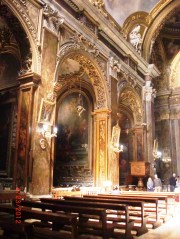
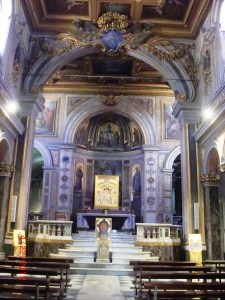
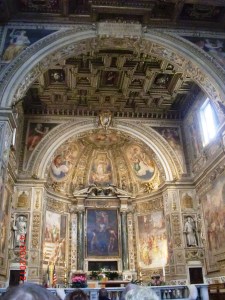
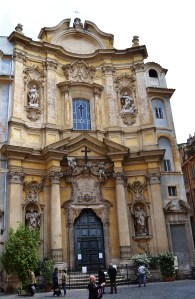
Santa Maria del Popolo, San Silvestro in Capite, Santa Maria in Via, Roma

Santa Maria del Popolo

Santa Maria del Popolo

I have fallen into a ritual of visiting Our Lady on this trip. Rome has so many stunning Madonnas, some brought in from the street corners where they once blessed a neighborhood, some from private homes where prayers were answered miraculously. Each one is different, each pulls me with a pathos and a joy, and I sense the Holy Spirit still working through these images.

So it was natural, on our last day in Rome to revisit Santa Maria della Popolo, Saint Mary of the People, which guards one of the main gates to Rome, where the Via Flaminia ends, bringing pilgrims from the north. I recalled a striking Madonna and Child over the high altar.

The church has interesting origins. Nero’s grave, said to have been on this site, terrified the locals who saw crows in the form of demons in one of the trees.  In 1099 Pope Paschal II cut down the tree, threw Nero’s remains into the Tiber, and built a chapel. In 1472 Sixtus IV built the Renaissance church we see today, which was soon layered with Baroque, and dedicated it to St. Mary of the People. Martin Luther once stayed in the Augustinian monastery next door. We crossed the broad piazza leading to the church and entered as a Mass was ending.

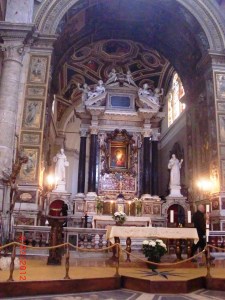
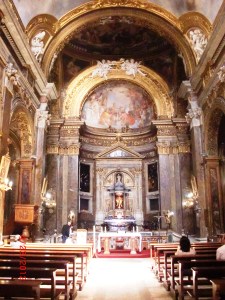
Chapels run along the side aisles, lining the nave leading to the high altar. Above the altar is the stunning Madonna. I paused and genuflected before the tabernacle – the red candle was aflame – and prayed my thanksgivings for the witness here in this church. I said my Ave Maria and she smiled upon me. We turned to the north transept chapel to see the famous Caravaggios, which appeared to have been completely restored, for the colors were unusually vibrant.

One is the famous painting of Saint Paul’s conversion. He lies on the ground, struck blind by the vision, with his horse nearby. The thrust of the light is tangible, and I am reminded of the angels appearing to the shepherds, saying, “Be not afraid.” I also recalled our priest at home mentioning in a sermon that Paul’s vision was permanently damaged, for while he regained his sight, he writes in his letters that he cannot see well. This I can appreciate, as, with age, my own sight is dimming. The second Caravaggio is the crucifixion of Saint Peter, the cross upside down to be different from his Lord’s crucifixion. The soldiers are fixing him to the cross, and I can hear Our Lord’s words to Peter earlier, that he would go where he did not want to go. Both paintings speak to us, for the figures are fully human and we are placed in the center of the drama, the suffering of these saints. And yet also, there is the drama of hope, that in these moments we are given a great legacy. So too, grace redeems our own suffering.

We next visited Santa Maria dei Miracoli, one of the twin churches on the other side of the piazza, at the head of the busy Corso. Here too a miraculous Madonna watches over the high altar, and I believe the story involved the flooding of the Tiber, as many stories do in Rome. We continued along the Corso, visiting several other Baroque churches – each unique with its own divine character stamped upon it through time.

San Silvestro in Capite

San Silvestro in Capite

We passed shops and shoppers, tourists, and crossed intersections with great care as cars and scooters whizzed by, and buses took over the road. We soon found the familiar San Silvestro in Capite, the British church in Rome. The name in capite refers to the famous relic housed in the northern side chapel off the narthex, the head of John the Baptist. The Irish Pallottini Fathers are in residence. and when we had visited a few years back, Father Fitzpatrick, the Rector, was in the process of ordering a new reliquary for the valuable relic.

Built over Emperor Aurelian’s temple to the sun, Popes Stephen III and Paul I built the first church in the 8th century to house bones brought from the catacombs (a list of the saints  who were entombed frames the front door), and it was rebuilt in the 12th and 16th centuries. The relics of Popes Silvester, Stephen I, and Dionysus rest under the high altar. Beyond the altar the grill remains where Poor Clares, who cared for the church until 1876, could take part in services.

We entered the ancient courtyard where columns and plaques witness to the earlier church, then stepped into the gold and marble interior. Another Baroque jewel of Rome, this church has the sense of holiness that we all yearn for. When I enter these churches – La Maddalena, Santa Sabina, Santa Susanna, San Silvestro – I am called to pause and pray. There is a hush that seems naturally prescient, nearly tangible, urging me. Light a candle, the hush is saying. Pray for a loved one. Pray for the suffering. Pray for your will to be God’s will. Pray, pray, pray. As for myself, I often don’t have the words to pray, to say what is in my heart.  So I use words given to me by the Church – the Our Father, the Hail Mary, the Te Deum, the simple Glory Be, and I am grateful for those prayers given.

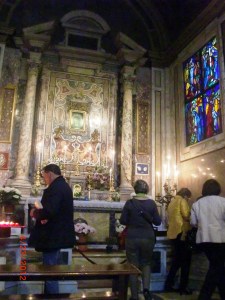
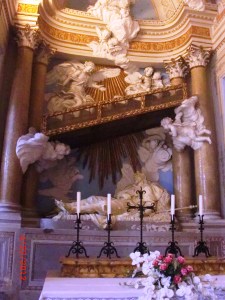
North Aisle, S.SilvestroThis day, Wednesday, the sun shafted upon the wooden pews and through the gilded arches of the side aisles, and I sighed and smiled with a sudden joy. We knelt and said a prayer, and padded silently back down the central aisle towards the front doors. We entered the side chapel to the right to visit John the Baptist’s relic, which now was indeed housed in an ornate and intricate gilded reliquary, as was fitting. Prepare ye the way of the Lord, he cried, and now we have the way, through the Church known through churches like this one.
We then crossed the narthex to a small office to say hello to Father Fitzpatrick, who was fortuitously in his office. He looked up and recalled me from our earlier visit and smiled a big welcoming smile. I told him about my new novel coming out, The Magdalene Mystery, and he nodded his appreciation (he already had Pilgrimage). He seemed very busy, and I fear we interrupted him, but the few minutes he gave us were ours totally. His eyes rested on mine, full of a liveliness that only God knows. It was good to see him again.

Santa Maria del Pozzo

Santa Maria del Pozzo

We left San Silvestro to enter the new piazza formed from the former muni-bus lot, a welcome transformation, then found Santa Maria in Via on one of the busiest arteries in Rome, the Via del Tritone. Santa Maria in Via refers to the ninth-century chapel “on the way” to the Via Flaminia, that main route in and out of Rome. It seems that in the thirteenth century there was a well on the chapel property that overflowed. A picture of Mary floated on the top of the waters. She became the Madonna of the Well, Santa Maria del Pozzo, deemed miraculous. Today she blesses a southern side chapel off the narthex, a place of respite in the frenetic Corso to pause and drink from the waters and say a prayer to Our Lady, for her encouragement and direction.

It was time for lunch, time to reflect on our time in this miraculous, eternal city, and to pray that one day we would return to revisit her saints and shrines, her churches and chapels.

The Aventino, Isola Tiberina, Roma

Santa Sabina, Roma

Santa Sabina, Roma

It’s been chilly with intermittent rain but Tuesday morning the sun seemed promising, appearing suddenly from behind cumulus clouds that floated through the skies. We headed for the Aventino, a leafy district of Imperial Rome that looks over the river from its hilltop, today home to ancient house churches, basilicas, monasteries, and quiet cypress-lined lanes.

First we visited fifth-century Santa Sabina, built over a house church, the mansion belonging to the matron Sabina in the fourth century. The church retains its ancient basilica style, open and long, with the choir enclosed at the head of the nave. Often when we have visited in the past chairs filled the space, but this morning the nave was empty. We stepped slowly over the marble floors to the enclosed choir, then along the side aisles lined with giant fluted columns. Time seems to collapse here, where the high clerestory windows allow angled and limited light, and draw the eye upwards. Earlier, outside, we had heard children playing in a school yard, their shouts mingling to form an exuberant and raucous chorus across the street, but inside now all was silent. The quiet padding of my shoes was the only sound that broke the silence. I recalled fondly the scenes set here in my first novel, Pilgrimage, and visiting Santa Sabina was like visiting an old friend. The Dominicans are in residence here, and it was here that St. Dominic met St. Francis. They have an excellent gift shop in the adjacent building with icons and medals and candles for sale.

We continued to neighboring fifth-century San Alessio and peered at the image of

San Alessio, Roma

San Alessio

Alessio under the stairs, in the north aisle near the entrance. Tradition says that Alessio was the son of a wealthy family in the Aventino. He left his home to become a humble beggar, traveling as far as Edessa, Turkey. When he returned, no one recognized him, and he lived under an outside staircase. When he died, his parents found his story on a paper clasped in his hand. The story touches me, for it is about exile, humility, family, and with today’s broken families, broken by geography as well as belief, it was a familiar one.

We walked up the side aisle. The back garden was open, and from its terrace you can see St. Peter’s across the river, far beyond the red roofs of Rome. The crypt was open as well, and we descended irregular steps to the dim tenth-century sanctuary, haunting with frescoed figures on the walls peering at us intruders. Relics of Saint Thomas Becket sanctify the altar, aligned under the high altar above. Returning to the nave, I prayed an Angelus before the beautiful Madonna of Edessa, her icon blessing the north aisle.

We walked on to San Anselmo, a Benedictine monastery (they sing Gregorian chant 9 a.m. Sundays), but only had a moment to look into the spotless and shiny marbled interior, then bought some Trappist chocolate in the adjacent shop. The shop is also well stocked with icons, honey, olive oil, and other products made by the Trappists in Rome.

We were watching the time, for most churches close at noon for a few hours, and it was getting close to noon. We headed back to the path adjacent to Santa Sabina’s orange garden (the garden has wonderful views of Rome as well) and followed the cobblestones down to the river. We crossed the busy intersection (the Boca della Veritas is nearby), and walked along the river up toward Isola Tiberina and San Bartolomeo.

Isola Tiberina from the river path

Isola Tiberina from the river path

It’s a lovely walk when the sun is out, the light filtering through the arcade of poplars that line the river path. The river was high this year – they’ve had lots of rain – and peering over the embankment, the greenish waters were rising over the lower walkway. Soon we came to the old footbridge that led to this charming island in the center of the Tiber.

Isola Tiberina houses a hospital, a restaurant, perhaps a hotel (?), and the ancient church of San Bartolomeo, now cared for by the Community of San Egidio, a new evangelical Catholic group dedicated to the poor.

We arrived in time (now after noon), for the church was still open. We entered

San Bartolomeo, Interior

San Bartolomeo, Interior

and paused at the foot of the central aisle. A dark ark, a boat-like reliquary, houses the relics of Saint Bartholomew, the Apostle, thought to be the same as Nathaniel. The ark has been turned into an altar, and it sits in its humble earthiness in the chancel, with several icons surrounding it. We stepped up the the altar and genuflected, then turned to the right to the south transept chapel to visit a stunning Madonna and Child. I said another Angelus, thinking a host of Madonnas were now praying for me. I find it so touching that there are so many different Madonnas in Catholicism, so that she may reach many nations and many individuals with unique desires and sufferings.

As we crossed the Pont Fabriccio back to the mainland, and as we stepped along the dappled path bordering the river, we thought it was just about time for lunch. It had been a good morning, a morning of sun and old stone and pondering the past made present by these amazing churches.

Santa Susanna, Roma

Santa Susanna, Roma

Santa Susanna, Roma

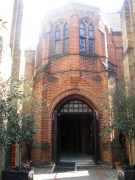
We arrived early to the 10:30 Sunday Mass at Santa Susanna and climbed the steps to the parish library.

My protagonists Kelly and Daniel in The Magdalene Mystery, begin their quest here in the library of Santa Susanna. It is here that they learn what must be achieved to receive a great legacy, here they receive the first clue. The rooms lined with books in English were as I recalled from earlier visits, and we searched for my trilogy of novels in the books – Pilgrimage, Offerings, and Inheritance – and sure enough, there they were in the Fiction section. I didn’t see Hana-lani – perhaps it was checked out.

Sister Nancy sat behind the desk and greeted us. I told her about The Magdalene Mystery soon to be available, partially set at Santa Susanna, and she and two other women (also sisters, I believe) were enthusiastic. I explained I wanted to correct the lies in Dan Brown’s stories, particularly about Mary Magdalene, and they nodded with vociferous agreement. As members of the American Catholic church in Rome, located across the street from a setting of Angels and Demons, the folks of Santa Susanna knew all about Brown’s mistakes, about his lack of respect for Christianity.

We excused ourselves for Mass downstairs. As we entered I thought how on this site stood the home of the saint and her place of martyrdom. Here she was beheaded by Emperor Diocletian’s soldiers in 293 for refusing to renounce her beliefs and for refusing to marry Diocletian’s general. Her family was Christian, her father a priest, and her uncle Caius was Bishop of Rome (280-296). Other members of her family were martyred; Bishop Caius escaped, to live another three  years.

As we found seats I gazed at the stories covering the walls, the stories of both the Roman Susanna and the Old Testament Susanna. The pinks and peach tones, the soft wash of light and color in such balanced and welcoming space gives a tranquil cast to the interior. When I enter this church, like many in Rome, I feel as though I have left the noise and fumes and secularism of the busy city outside and stepped inside to heaven.

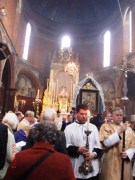
Looking about me at the glorious interior of art and color, I did indeed fall into another world. The choir, sitting in the south transept was practicing, and their voices echoed through the vaults. The raised chancel was flowered with Easter lilies, and the white Eucharistic table waited, in the modern manner, creating a more central altar, pulled away from the apsidal wall. A grated window could be seen in that wall, where once nuns could be silently present at the Mass. The Paschal candle burned brightly. The nave soon filled with faithful Americans in Rome, and clergy followed acolytes bearing crucifix and flaming candles, processing up the central aisle. We helped them with our singing, Love divine, all loves excelling…. and I noticed that the regular clergy of Santa Susanna were not among them this day, but rather Paulists were here on pilgrimage, some in the procession, some in the congregation. Father Paul Robichaud, former Rector of Santa Susanna and currently Postulator for the Cause of Father Isaac Thomas Hecker, celebrated and preached. He preached on the Good Shepherd, how Jesus is the only way to heaven. He knows us and we know him. He said that in order to understand the importance of this we must admit that life is hard, that suffering exists, and I would add, that death exists. Only when we admit we live in a fallen world, that we ourselves are fallen creatures, can we see why we need God. This admission is largely not made today, and God is not sought after. But the truth is that we are indeed broken and desire mending. Simple and profound, I thought. And so true.

We left Santa Susanna, full of God, his glory, his presence, his weaving through history and his people. Through song, prayer, sacrament, and word, we continued the great Incarnation into today, re-membering, thankful.

(www.santasusanna.org)

Santa Maddalena and the Camillians, Roma

La Maddalena, Roma

La Maddalena, Roma

My husband and I have returned to Rome for a few days to explore her many mysteries once again, and I wondered what I would discover on this trip, where I would be led, what adventure would unfold.

My novel, The Magdalene Mystery, to be released in May through OakTara Publishers, is set in Rome and Provence. Five of Rome’s extraordinary churches provide settings for the first half of the novel, and I wanted to see these churches again before signing off on the final proofs of the manuscript.

We found Santa Maria Maddalena on Saturday, using the route my protagonists take (to verify accuracy). We climbed the few steps to the simple doors set in the creamy Baroque façade and entered. As always when I enter La Maddalena, I took a sharp breath, for the beauty is tangible, the golds and marbles in such a small space filling my senses. I walked slowly up the central aisle, and halfway up, paused before the sweet icon of Our Lady of Health in the south aisle. I slipped a coin in to an iron box, reached for a votive candle and lit the wick with one already aflame, then set it carefully on the blackened tray. I said the Angelus, prayed for Our Lady’s prayers for my little novel set in this charming church. I then returned to the aisle and resumed my way to the high altar where a red candle burned. I genuflected, turned and saw the southern transept chapel was roped off. This was the Crucifix Chapel, where the scenes in this church are set. I looked around and saw a worker in a blue smock who was cleaning in the north aisle. We followed him into the ornate sacristy.

I asked the young man if he spoke English. Yes, he did, a little. I asked if he could give me the name of the priest-in-charge, so that I could send him a copy of my novel once available. Could he give me a name and address?

Ah, he said smiling, you would like a book about the church?

No, I said, I have written a book with the church in it. I want to give the church a book. As a thank you. (A huge thank you, I thought.)

He looked confused (which seems reasonable now on reflection) but raised his finger and moved toward the phone desk, where the resident clergy were listed on a laminated sheet. He picked up the phone, we waited, and after a minute, he hung up. Ah, he said, no one is home.

I was ready to give up the idea, but he raised his finger again and said, wait here. I go and find him. I think I hear him coming now.

We waited, wondering, and spent our time looking at the fantastic woodwork and paintings in this historic sacristy. Soon a slim dapper man in sweater and slacks approached us and shook our hands with ingenuous warmth. He was Father Paolo, and he was a Camillian, a brother of the Order of St. Camillus. The Camillians, Servants of the Sick, had been in charge of the church since it was built in the seventeenth century, shortly after Saint Camillus died in 1614, and before that in charge of the little oratory on the site. Father Paul didn’t wear the black cassock with the recognizable red cross on the front that identifies the Camillian Servants of the Sick, a red cross that was a forerunner of the Red Cross organization we all know today.

Father Paul spoke excellent English. He soon understood that my novel was set right here in his church.

He smiled. I will give you a tour, he said. You should have a privato tour. It is a big year for the Camillians. We will be celebrating our 400th anniversary! We are building a museum upstairs. It is not finished, but you can see.

Thus began a remarkable hour with Father Paolo who was incredibly gracious with his time and attention. He told us the story of their saint – the dissolute young Camillus de Lellis, converted after being wounded in war, after suffering for many years in Rome hospitals bleeding wounds that would not heal. He studied to become a priest, to help the sick throughout Rome, to comfort the dying, to nurse those with the plague. He gathered others around him who dedicated themselves to God to serve as he did, and the Pope gave them the small oratory near the Tiber dedicated to Mary Magdalene.

Ah, I said, yes, Mary Magdalene.

He nodded. Do you know the story of how the chapel came to be? No, I said. The Tiber flooded, he said, and the people found a wooden statue of the saint on the banks. It survived the flood, you see. They knew it was an image of Mary Magdalene because of the ointment jar she held. It is downstairs in the chapel.

I grinned. So that is how it got there, I thought. Another piece of the mysterious puzzle of Rome.

We were given a tour of the museum in progress – we passed workers upstairs with scaffolds and peered into the saint’s rooms. We saw relics and read histories, even how the wax mask was made of the face. And we returned downstairs where Father Paul led us in to the Chapel of the Crucifix.

I gazed upon the corpus on the cross. Like the crucifix in San Damiano that spoke to St. Francis outside of Assisi, Christ spoke to Camillus de Lellis when he was gathering his first helpers. At the time Camillus was discouraged. Was this really the work that he was supposed to be doing for God? Then he heard Christ say to him, “Keep going, for I will be with you and will help you. This is my work and not yours!”

I loved those words. They spoke to me as well. And as I gazed into the eyes of this joyful brother of St. Camillus, I knew they spoke to him. And I was grateful for this moment of friendship and communion.

So my little novel will be released in May, shortly before the great 400th year celebration of the Camillians, which as I understand, begins in July 2013 and lasts through July 2014, commemorating Camillus’s death July 14, 1614. I have not had a chance to read the thick glossy book our host gave us that is a part of the new celebration, but on glancing through it I can see that today the Camillian family of brothers and lay orders are worldwide, serving the sick and the suffering. They comfort and heal, build, and nurture.

They are bringing the love of Christ to the world’s people, and the people to Christ.

I was glad it was a good year for my novel to be born. As I said goodbye to the simple carving of Santa Maria Maddalena in the Crucifix Chapel and to the Madonna of Health glimmering in the south aisle, I was grateful. We said goodbye to Father Paolo. He gave us his blessing, and we stepped slowly down the aisle to the simple entrance, glancing up to the gilded choir loft with its golden cherubs and saints.

Our first day in Rome was indeed full of mystery and miracle.

Thanks be to God.

A Grotto of Light

This week I received the cover copy for my new novel, The Magdalene Mystery. This is an awe-inspiring moment in the process of publishing, for this is the image that my potential readers will see first. This cover will draw them in, or perhaps turn them away.

This part of the process is a simple one for me. I submit possible images to the OakTara’s design team, usually my own photos, and the designers then work their magic. With each book, I wonder, what will the cover look like?

This cover stunned me. Minute images of Mary Magdalene’s  grotto in the Provencal mountains – barely seen in my photo – were pulled out and enlarged, and with nuanced lighting, an aura of deep mystery was created. It was a remarkable transformation, and I for one, was drawn in by the effect.

How we see our world, how we know truth, is a major theme of the novel. The mystery of the grotto and the mystery of the saint herself have haunted both scholars and ordinary folks for centuries. What really happened two thousand years ago on the hill of the skull outside the great city of Jerusalem? In the burial garden was the stone miraculously rolled away? Did Mary Magdalene see the risen Christ? How can we know?

We peer into history just as we peer into this novel cover, where darkness meets light, and the light shines in the darkness. We look at the author’s name and evaluate her reliability as a chronicler of truth. Can we trust her? Can we believe her stories or the truths that lie beneath the stories?

I am currently reading a very good novel about (among other things) the nature of art, titled The Third Grace, by Deb Elkink, that I shall be reviewing soon. The author states at one point that, just as you are what you eat, you are what you read. I believe this to be profoundly true, and something not taken seriously enough today. There is a subtle working on the mind that occurs in reading anything, but even more so in reading a work that has layers of meaning, complex characters, and human relationships that exhibit truths about our world, about ourselves, about our humanity, like any work of art. We enter the author’s created universe and are largely in his or her hands to be molded into something else. We must trust the author.

Today’s world is one of little moral restraint or judgment, and this is true also of novel-writing. There are many authors who write to titillate the senses, not elevate them, to appeal to the reader’s dark places and not their better parts. Gratuitous sex and violence, often paired, are expected, and since addictive, often demanded. Slimly veiled pornography becomes the latest bestseller. So we must trust the author (and the reviewer) and perhaps not put too much trust in the media rankings.

As human beings we are constantly changing. There is no pausing for us, no halting. We either move forward or backward; we either grow or shrink. As we read lines on a page, we feed our souls and minds and hearts with a kind of food. Is it fatty? Is it tasty? Is it addictive? Does it enlighten or darken our sensibilities? Is it good for us or is it candy-coated poison refashioning our thought processes, our desires, our view of the world? Is it pure propaganda?

There is a just and proper place for showing the darkness of man, for revealing evil. But is the darkness, in the end, redeemed by the light?

Today was Good Shepherd Sunday, and I never tire of hearing the assigned Gospel, John 10:11+, where Christ says he is the good shepherd who gives his life for his sheep. The sheep know his voice; they belong to him. He knows them; they know him. In another passage he says he is the only way, the only door, to heaven. How do we, his sheep, know him? How do we know this door, know the path to take, know his voice? We learn to know him through Scripture, sacrament, and prayer. It is a lifelong growing process, this learning to know the shepherd of our souls.

As I gaze upon Mary Magdalene’s grotto deep in the center of my book cover, I realize that the darkness that enshrouds the cavern chapel in those Provencal mountains may be encroaching, but is not final. The grotto is lit with light, a light shining in the darkness. Just so, I pray that my own little story inside that cover will enlighten a few hearts, minds, souls, that it will feed a few sheep with the truth of the good shepherd, that it will lead us all closer along the path to his door, and he will know us just as we can indeed know him.

Lilies of Life

Life is so very fragile.

The week after Easter, it seems to me, is a time of sighing. It is like the denouement after a great event, the quiet reflection after giving birth, the aftermath after a celebration. The week before Easter we walk the Way of the Cross, to the Cross, crucifixion, death, burial. Then, on Easter Sunday, we are resurrected.

We are resurrected to who we are and who we are meant to be. The spidery webs of confused versions of who we are not – spun around us by our culture – are wiped clean and we see clearly we are God’s children, loved and cherished by him. We sing praises on Easter Day, we flower the white Easter cross, we inhale the pungent lilies adorning the altar. We are happy, because we know who we are and who we are meant to be. We are loved.

Then, we ease back to a quieter time of rejoicing, and as the week after Easter passes, the lilies on the altar grow more intense in their fragrance, so that by today, the Sunday after Easter, the power of their aroma owns the nave.  It is good that the the lilies are still there, still reminding us that we are resurrected, reminding us who we are, that we are resurrected children of God.

For this last week we have re-entered the outside world of confusion and whim, danger and lawlessness. A friend’s granddaughter, seventeen, survived a car crash, but remains in the hospital mending many broken bones, with her spleen now removed. She is young, they say, and will recover. She was lucky, they say. But, I thought as I gazed into her grandmother’s grief-stricken eyes, one moment she was driving to school, looking forward to graduation, and the next she was seriously hit in an intersection. How horrible. How fragile we are.

The following day I noticed my wallet was missing. I retraced my steps. Had it really been four days since I had seen it? With Easter preparations and church, it had been four days, indeed. We cancelled the credit cards, and I stood in line at the DMV to replace my license. I cursed the person that grabbed my wallet from the counter or the cart or wherever I had left it in a moment of distraction. Suddenly my identity was lost, owned by another. The plastic cards that defined who I was were gone – so where was I? A deep sense of loss settled in with my initial outrage.

Life is so fragile. I turn out my light at night with the certainty that I will awake in the morning. Will I? I make plans, but will I live to see them fulfilled? What will happen tomorrow, the next day, the day after?

So this morning when I was reminded that I am a child of God, a beloved person with a unique identity, cherished by my creator and heading home one day to eternal life with him, I was grateful, I was steadied. Certainty returned.

The lilies in my house fill the rooms with their aroma. I have nipped a few of the white trumpeting blossoms that were beginning to droop, and the closed ones have opened in turn. I add a little water each day to their loamy beds, to the dark soil behind the pink crinkly wrap, and they drink it, thirsty. Life rises through the roots, through the thick green stalks, through the green fronds that arc like dancers arms, up to the white flowers that seem to shout hope out loud.

So I treasure the aroma of the lilies and hold onto God’s promises of resurrection. I hold on to his commandments too, and try to be faithful each Sunday in church. For who knows what the next day, hour, minute might bring. Mary Magdalene reached to touch the risen Christ in that garden of burial. Just so, we reach for him too, like those white trumpet blossoms. We reach to touch him with song, sacrament, and scripture. The Church gives us a way to do that, and this makes me happy and ever-thankful.

Life may be fragile, but God has given us a way to touch him, to be filled with his strength, and to know who we are and who we are meant to be.

Flowering the Cross

We had risen early, while it was still dark. The morning was wet, a light rain having washed our world here in Northern California, but as the the night became day, the sun burned through in fleeting patches. Gray cumulus clouds waited nearby, as though offstage.  I had cut flowers and put them in a glass of water, and this morning I gathered them into a bunch, wrapped the stems in wet paper toweling and inserted this moist bundle into a plastic bag, slipped a rubber band around it to hold it securely, and set the colorful bouquet of red and pink and blue and yellow and green into a wicker basket.

We headed for church, to be early, to be ready.

As always on these high holy days I was expectant. No two Easters are ever alike. I wondered what this morning would bring, what drama would unfold. Who would come to worship, who would fill the pews, what miraculous words would our preacher preach from the central aisle, his eyes on fire with God? I wondered expectantly about the simple and extraordinary communion of bread and wine, each time unique but the same. Would this Easter be different from other times that I had knelt in the pew watching the angels dance about the altar? And then, when I was filled with God, would I know joy or peace or both? And last, I wondered, as we drove into the parking lot, which children would be there to help me place the flowers into the deep holes in the white Easter cross? Which children would have other family obligations in another church, another community and not make it to ours?

And so, as the morning passed, and the children bounced into the Sunday School with their Easter dresses and jackets and ties, I marveled, watching from some sweet place in my heart the drama unfold. There were visiting children, children from the past who we had not seen recently, and then we had our regulars as well. The children formed their own bouquet of color as they joined the teachers to place their flowers in baskets to carry up the aisle.

I waited with the children in the narthex for the right moment, our baskets clutched in our fingers. After the people proclaimed the Creed, we opened wide the doors into the nave. The acolytes had brought the barren cross to the head of the red-carpeted aisle where the steps to the altar began, and as the organ played the first notes of Hymn 94, Come ye faithful raise the strain of triumphant gladness… and the congregation began the first verse, the children, the teachers, and a few moms with babies processed to the cross. The deep holes were slowly filled, the young ones lifted up, the older ones choosing carefully where and how, absorbed in the task. Soon splotches of red, pink, yellow, and green covered the white wood, Our Lord’s wood. He had said, let them come to me, and we did. We let them come.

Later, after Scripture, Song, and Sacrament, we gathered in the courtyard. The cross, many-colored like an Impressionist painting or a stained glass window or even Joseph’s coat, was carried outside to the porch, and the sun suddenly appeared, burning in a blaze of glory. Our king was among us indeed, weaving among his people as they greeted one another, “Christ is risen,” and “He is risen indeed!”

I recalled all of these wondrous happenings this afternoon from my kitchen sink as I cut up fruit for the fruit salad, set out the ham, and prepared the salmon steaks for baking in their bed of pearl onions. We had spruced up the house a bit – new doormats, new doorbell (hadn’t been ringing in years), fresh pots of flowers in the back yard. I had set the table on Saturday with its white damask cloth, silver, and goblets. White roses in a small vase were placed in the center. My santon of Mary Magdalene stood next to a lamb and two sheep amid some greenery. Four white tapers waited to be lit by the youngest grandchild coming that day, eleven going on sixteen.

Mary Magdalene was in the back of my mind today as I wondered expectantly through the minutes and hours, for she was the one who came to the tomb while it was still dark that first Easter, that Sunday two thousand years ago. She was the one who first saw the risen Lord in the garden. She was the one who was open, expectant. “They have taken my Lord and I do not know what they have done with him.” Those words wring my heart year after year. And then, his response, “Mary,” opens it.

She was on my mind as well because my novel, The Magdalene Mystery, fortuitously is on its way to publication this Eastertide. So I had much to be thankful for during this Easter Eucharist, the chief thanksgiving sacrament of the Church. On Maundy Thursday we had celebrated this thanksgiving sacrament, recalling Christ’s last supper with the apostles, the future bishops of his Church, His Body. This, we remembered, was the night in which he was betrayed, and this was the night he took bread and wine, saying, this is my body and this is my blood. This was the night he did not drink of the fourth ritual Seder cup, for he himself would be that cup on Good Friday. He would complete the exodus from Egypt to the Promised Land. He would become our exodus from this world to eternal life, the paradise promised us.

So this afternoon when the doorbell didn’t ring, but instead I heard happy greetings outside, I rushed to see. My husband had gone out to meet our guests, and was already ushering them in through the open front door. The younger grandchildren stepped inside, so serious, so mature now at eleven and fourteen, followed by an older granddaughter with a serious suitor, then our son and daughter-in-law and her parents. They carried pies and promising gifts of chocolate.

We gathered these flowers of our family and arranged them around the white damask table now bright with burning candles. I watched and listened to the giddy chatter and the sober discussions weaving among us. I toasted family, friends, resurrection.

The sky had grown dark, and night was falling upon us. A silent, gentle rain was watering the earth. I recalled the bright flowered cross standing on the church porch in the blazing sun, the clouds parting. I was thankful that my cross, where my heart lived, was a flowery one, full of new life.

Palm Sunday

This week I completed the first draft of a reprint of  The Life of Raymond Raynes by Nicholas Mosley. I have been immersed in Father Raynes’s love and Father Raynes’s suffering, as he allowed God to work through his life to feed others with God himself, to help others know God.

He lived this life until he died a painful death at the age of fifty-five and entered the gates of his new life, his Jerusalem.

Raymond Raynes was a tall thin man, increasingly gaunt in his last years, a monk who ate little and slept little, but who loved a great deal, loved through his prayers and his time spent caring for others. He changed lives in the countryside of England and in the slums of South Africa, and he changed lives in Denver, Dallas, and San Francisco when he came to speak on his American missions. He wanted to stir up the Church, to wake up the Body of Christ. Why? So that they could see and know God.

Today, Palm Sunday, we re-member Jesus’ entry into Jerusalem. He rides a lowly donkey, yet the people greet him as a king. Hosanna, they cry. Hosanna to the Son of David. Jesus will be their new king, they think. They learn differently in the following week. We tell this story, act it out even as we process, holding our palm fronds, around the nave and sing, All glory laud and honor… By telling the story we draw closer so that we may know God better.

It is a dramatic moment when the Lord of All Creation so humbly enters this city of man. Born in a stable to humble parents, Jesus of Nazareth lived among a persecuted people, a poor people. After his time in the desert, after his baptism by John, he gathered his followers and spoke the truth to the crowds. Often the truth was too harsh and they fled, and often the truth today is too harsh, and we flee. But, as our preacher said this morning, those who knew him stayed, and those who know him today, stay too. When he said that we must eat his body and drink his blood, many left. Just so, many leave today. But those who knew him recognized him as the Messiah, the long awaited one, the Lord of All Creation. Those who know him today, those who worship faithfully with sacrament and scripture week after week – those folks understand who he is, the long promised savior.

I have an icon on my wall that shows this scene at the gates of Jerusalem. The colors are vivid – golds and greens and reds. We re-member and re-fashion, re-creating the true glory of this humble scene, this moment in history. Our preacher today spoke of those palm branches. He said that in this arid land only the rich would have palm trees. The palm branch, with its green fronds, meant water was near. So it is particularly poignant and meaningful that children waved their branches of life-giving water and royal privilege, before this humble man riding on a donkey.

In church, as I gazed upon the purple-draped chancel – so much purple! – the giant green palm branches that rose twenty plus feet on either side of the altar filled me with joy, the hope of Easter. They arced gently, nearly reaching the purple cloths over the crucifix. They said, soon, soon, it will be finished. Soon, soon, all will be renewed, reborn. Soon, soon, we shall be resurrected.

How do I know this? Because I have tried to be faithful in Sacrament and Scripture. I have worshiped regularly, have received the Body and Blood into my own body. I have listened to the sermons and the lessons that help me know God. I have listened for God’s voice in prayer. There is no magic involved in any of this. No luck. Maybe some grace and a little blessing and some angels urging me along the way. But through simple faithfulness we can know him. There is no other way. There are no shortcuts.

My novel, The Magdalene Mystery, is to be released in mid-May. It is the story of a quest to find the real Mary Magdalene, the woman who was the first to see the resurrected Christ. She came to the tomb out of faithfulness, doing what needed to be done. She didn’t expect to find the stone rolled away or the the man she thought was the gardener speak to her. But when he called her name, Mary, she knew him. Because she was faithful.

Father Raynes was faithful, and he taught us how to be faithful, how to know God. Like Christ Jesus, he tells the truth and not everyone wants to hear it. Some of his demands are difficult, some are inconvenient. But truth is the only way to life. As part of the Body of Christ, the Church, I shall be ever grateful for his stirring up, for his call to be faithful.  For in being faithful, we know God, and in knowing God, we live.

Pope Francis

They said the Holy Spirit would decide the election outcome of the new Pope. I wanted to believe this, but if truth be told I fully believed the Cardinals in conclave would decide. I did pray that the Holy Spirit nudge those Cardinals in the right direction.

Now, having heard and seen Pope Francis on television, I believe the choice was a good one. The Holy Spirit did indeed nudge those Cardinals and have the final say. This Pope is a saintly man, a humble suffering man, with a clear vision of rebuilding stone by stone the Church of Saint Peter. Young Francis Bernadone of Assisi heard God speak through the crucifix in the rundown chapel of San Damiano: “Rebuild my church which is falling to ruin.” And so seven hundred years later, a new Francis will answer the call again, will begin the rebuilding, the reforming.

I was deeply touched by the drama of Francis’s first twenty-four hours, particularly his sense of symbolic public act even at this early stage. He stands to meet the Cardinals in the Sistine Chapel, rather than sitting on the papal throne. He leaves them before finishing these ritual greetings to step out on the balcony to see his people, who must not be kept waiting any longer. He dons a simple white cassock. He stands on the balcony, his hands at his side, reminding me of Christ before Pilate. Here I am, take me, his body seemed to say. Then there were his first words to his flock. Good evening, brothers and sisters. He asks the packed square to pray for Benedict XVI, Pope Emeritus, and the entire throng say together with one voice their beloved Our Father, the Hail Mary, the Glory Be. Finally, he asks his people to pray for him. The square becomes silent in the damp night as they pray for their new Pope.

He is a man of the poor, pastoring the slums of Buenos Aires. He rode the bus, gave away the mansion, rented rooms where he cooked for himself and turned off the heat. He will rebuild his Church with the stones of poverty and humility, of obedience and discipline. He will expect those alongside him to do the same, as they gather such stones for a stronger foundation.

He is also a man of intellect, understanding. He knows what is true and what is not. He knows God, and he knows God’s Son. He is filled with the Holy Spirit. He is filled because he has emptied his self. He has a big job ahead of him, and with God’s help he can do it.

I wonder if Catholics fully recognize what has happened this week in the Church. I wonder if Christendom fully appreciates the man that will steer the course for the largest body of Christians in the world. This man will make a difference for all of us. He will carry on the work of those before him, but he will do it in a powerful way, a different way. He will straighten the paths with his humility and map the future with his discipline.

Today is Passion Sunday, marking the beginning of Passiontide, the way of love and suffering of Our Lord. These two weeks before Easter are a time of deep Lent, when we draw closer and closer to the Way of the Cross, the path to Golgotha, the hill of the skull. We act out the drama of Incarnation, Crucifixion, and Resurrection. We consider what it all means.

I am always startled on Passion Sunday, taken aback as I enter the nave. Everything in the sanctuary is draped in purple – the six tall candlesticks, the tabernacle and altar, the crucifix, the sculpture of the Madonna and Child to the left. All that purple, all that draping of the physical and dear expressions of our faith, stun me each year, again and again. These shrouds of mourning remind me of a world without Christ, a world where we cannot know God, a world without God.

For it is only through Christ that we can know God, who he is, what he is like: just but merciful, a God of love. Because of the living, breathing, temples of God – we Christians, the Body of Christ – his Holy Spirit weaves through this world, through them, through us. Each one of us is a tabernacle holding Christ, depending on the space we have emptied for him. He lives in each of us. He in us; we in him.

As I look at Pope Francis, and recall his namesake, I see a man whose bodily tabernacle has been emptied of pride, of self, emptied so that God can fill him. And I see hope for all of Christendom in this man, in this temple of the Holy Spirit. I see hope for each of us.

And I know, although deeply and profoundly saddened by those purple drapings, that Easter is soon to come. For the Holy Spirit is moving among us.

On Truth and Lies

I am nearly finished typing up The Life of Raymond Raynes, copying with minor changes the original work by Nicholas Mosley (thank you, Lord Ravensdale, for your blessings on this project). Those fortunate enough to have read Father Raynes retreat addresses, given in Denver in 1957, The Faith, will have a sense of what dipping into his biography would be like. Much of the three hundred pages comprises direct quotes from letters and speeches, so the text is largely Father Raynes’s words.

I am so honored to type these words. It is as though as I type the words enter my heart and mind in sacramental fashion. So I have spent a lot of time of late with Father Raynes, with him in South Africa, with him when he was Superior of the Community of the Resurrection in Mirfield, England, with him as he chatted about the faith in some of the great homes in rural England. (“House parties,” one retreatant called them, “all gin and confession…. they were wonderful…”)_

Our small publishing group hopes to produce more of these out-of-print books that tell of our Anglican way of Christianity. The more I live and experience Anglo-Catholicism, the more I am fulfilled by its rituals, sacraments, theology, and the more I appreciate our place in history and the telling of the Gospel.

Which brings me to interpretations, and ways of expressing the Incarnation and what it means. It brings me to the Gospel – what is it, what does it mean for me, for my family, for my community, my nation, the world. There are numerous answers to these questions, numerous interpretations.

Just as there are many interpretations of sacred texts. There are, our preacher reminded us today and I had to smile at its appropriateness for me at this time, interpretations of interpretations.

And this all leads to the question of truth. Can we know it, does it exist, are we merely beings of impulses and instincts. Is science so very incompatible with religion. I think not. They support one another.

My fifth novel, I hope and believe, will be released in May. The Magdalene Mystery asks these questions of interpretation, of truth. Can we know Mary Magdalene? Can we know who she really was? This question leads to the next, can we know what happened in that first century of the Early Church? Which of course leads us to Holy Scriptures and the challenge posed by many doubters in the last fifty years, can we know that a man named Jesus of Nazareth rose from the dead? Indeed, can we even know that Jesus of Nazareth ever lived and walked the earth?

I suppose much of this quest for truth is personal for me, since my father left his Christian faith and his pastorate in the sixties’ upheaval of doubt. He believed what he read, what so-called New Testament scholars were writing. The Jesus Seminar soon “validated” his new creed of unbelief. American culture, drunk with freedom from moral restraints, and celebrating the birth control pill, launched into a party that is still going on (the devastation caused by the sexual revolution is a topic for another day). My parents read themselves out and away from their living faith and into something sterile and self-serving.

So today I type quickly, my fingers tapping the keys. Father Raynes’s telling of the truth will be one more expression that will feed a culture starving for the real thing. Of course each of us must read, evaluate, and judge. That’s what free will is all about. But this biography that seems to be emerging through my fingertips, like The Faith, encourages each of us to decide on our own and not be swayed by media and false testimony. Father Raynes’s words point to true authorities, not bestselling journalists and sensational novelists and fads. His words inspire us to embrace the traditional morality of the Gospel, to see that right and wrong do exist, that selfishness is not an admirable trait. His words encourage us to have backbone, to stand up and be counted in our world today. His words encourage us to meet God and enjoy him forever.

And my little novel, soon to be in print, hopefully will do the same thing in a different way, with a love story set in Rome and Provence, and a mysterious quest with clues in breathtaking basilicas. A predator stalks, and folks spread lies like spiders spinning webs.

So I must get back to my typing and back to the joy of telling, retelling, and telling once again, making all these words come alive on the page.